
Nemetacum, what did the Gallo-Roman city of Arras look like?
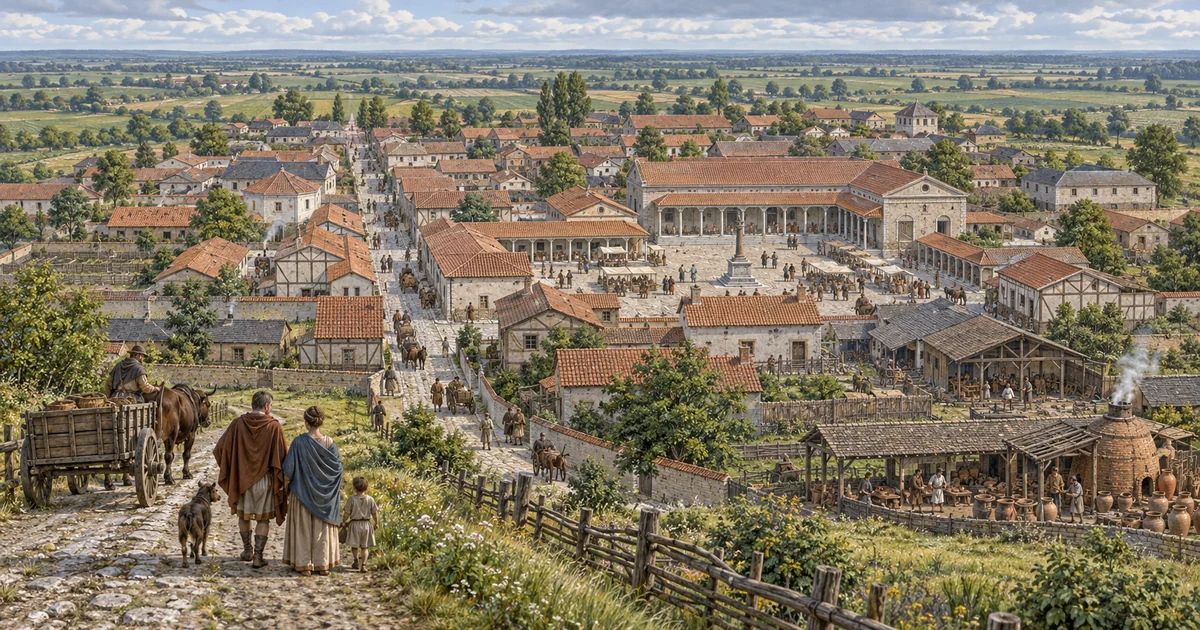
Before Arras, there was Nemetacum, the Gallo-Roman town of the Atrebates. Long overlooked by the general public, this ancient city was nonetheless, for several centuries, a prosperous urban centre of northern Gaul, with regular streets, public monuments and a textile craft exported across the empire. Its history, reconstructed from ancient texts, including Caesar's Gallic War, and above all from archaeological digs, sheds light on the Roman origins of Arras. It tells how a defeated Celtic people turned into a city integrated with Rome, before the crises of late Antiquity swept this first town away. To understand Nemetacum is to go back to the ancient matrix of a two-thousand-year-old city.
From a defeated people to a Roman city
The birth of Nemetacum is a child of conquest. After the submission of the Atrebates, the region entered Rome's orbit, and imperial power fostered the development of a town on the Mediterranean model. For the origins and context of this shift, one may usefully turn to the history of Arras from prehistory to Gaul, which traces the long path of the first inhabitants to the ancient city. Under the Roman peace, the Gallo-Roman town was organised on the hill of Baudimont, a slightly raised site overlooking the surrounding watercourses. The choice was no accident: it met needs of health, defence and control of the roads. Nemetacum then became the capital of the civitas of the Atrebates, that is, the administrative centre of a vast territory. This status gave it a political and fiscal role, but also a symbolic one, that of a local capital displaying the power of Rome. Within a few generations, the warrior people of the banks of the Sabis had thus become an urban community, adopting Roman town planning, techniques and part of the Roman way of life, while keeping a Celtic background.
The name Nemetacum, a sacred clue
The very name of the town yields a precious clue. Nemetacum, like the form Nemetocenna used by Caesar, derives from the Celtic word nemeton, which means a sanctuary, a sacred space, often a grove consecrated to the gods. This place name suggests that a place of worship preceded the Roman town, or at least that the site had a religious dimension for the Atrebates. This is common: many ancient cities grew around a sanctuary or a revered crossroads. Specialists of ancient Gaul nonetheless recall that interpreting place names calls for caution, since old forms are sometimes altered by the transmission of texts. To keep this sacred origin is therefore not to assert an absolute certainty, but to note a serious lead consistent with what is known of Celtic religion. Above all it recalls that, beneath the Roman town, lies an older layer, that of a people for whom certain places held spiritual value. This symbolic depth gives Nemetacum a substance that goes beyond a mere Roman administrative creation.
A town laid out on the hill of Baudimont
The digs carried out on the Baudimont site have revealed the features of a genuine Roman town. Nemetacum spread over some thirty hectares, a respectable area for a civitas capital of northern Gaul. Traces have been found of a regular urban plan, organised in blocks, with paved streets, water supply and drainage networks, and houses sometimes adorned with painted plaster and careful floors. The town had the facilities expected of a Roman centre, public monuments, spaces for trade and craft, attesting to an urban standard of living comparable to that of other Gaulish cities. This built setting reflects the adoption of Roman norms by local elites keen to display their integration into the empire. One should not, however, imagine a replica of Rome: Nemetacum remained a provincial town, on the scale of its territory, where native traditions mixed with Mediterranean contributions. Archaeology, by revealing these buried remains, allows the physiognomy of a vanished city to be gradually reconstructed, of which nothing survives above ground, but whose memory the Arras subsoil keeps. Each excavation adds its piece to this patiently reassembled puzzle.
| Marker | Detail |
|---|---|
| Site | The hill of Baudimont, in Arras |
| Status | Capital of the civitas of the Atrebates |
| Extent | About thirty hectares |
| Speciality | Textile craft exported across the empire |
Nemetacum, a crossroads of Roman roads
The prosperity of Nemetacum also owed much to its position as a crossroads. The city was linked by Roman roads to the great centres of northern Gaul, from the metropolis of Bagacum, today's Bavay, to neighbouring towns such as Cambrai, Amiens and Tournai. This road network, one of the densest in the empire, moved goods, troops, officials and ideas. For a town devoted to the textile trade, this insertion into the Roman roads was vital: it opened distant markets and tied the city to the imperial economy. The ancient roads left a lasting imprint on the regional landscape, some modern routes still inheriting from them. To place Nemetacum on this web of roads is to understand that it was not an isolated point but a link in a vast system of exchange that structured all of northern Gaul.
Daily life in the city
What do we know of daily life in Nemetacum? The digs yield above all fragments: pottery, coins, ornaments, remains of dwellings. They sketch an urban society where artisans, merchants, notables and common folk lived side by side, in houses of very different sizes. Life was paced by work, the market and religion, as in other Gallo-Roman towns. The inhabitants gradually adopted Roman customs, from tableware to fashions, without wholly renouncing their Gaulish background. This mixed culture, called Gallo-Roman, is one of the great original features of the period: neither quite Rome nor quite Celtic Gaul, but a fertile blend. Reconstructing this daily life calls for the archaeologist's caution, for objects speak less loudly than texts, but they say one sure thing: a numerous and active population lived here, part of its age.
Cults and beliefs at Nemetacum
The religious dimension, written even into the town's name, never vanished. Under the empire, the inhabitants practised a syncretic cult, mixing Roman deities with old Celtic beliefs, often paired under double names. Sanctuaries, altars and votive objects attest to this spiritual life, where the Roman pantheon overlaid native cults without erasing them. The necropolises, set as was customary on the town's edges, also shed light on funerary beliefs and the care given to the dead. At the end of Antiquity, a new religious horizon appeared with the spread of Christianity, which prepared the medieval world. The sources remain patchy and call for caution, but they confirm that Nemetacum was, from the original Celtic sanctuary to the first Christian communities, a place where the sacred held a constant role. This religious continuity already foreshadows the spiritual vocation that Saint-Vaast Abbey would later give the reborn town.
Textiles, the wealth of Nemetacum
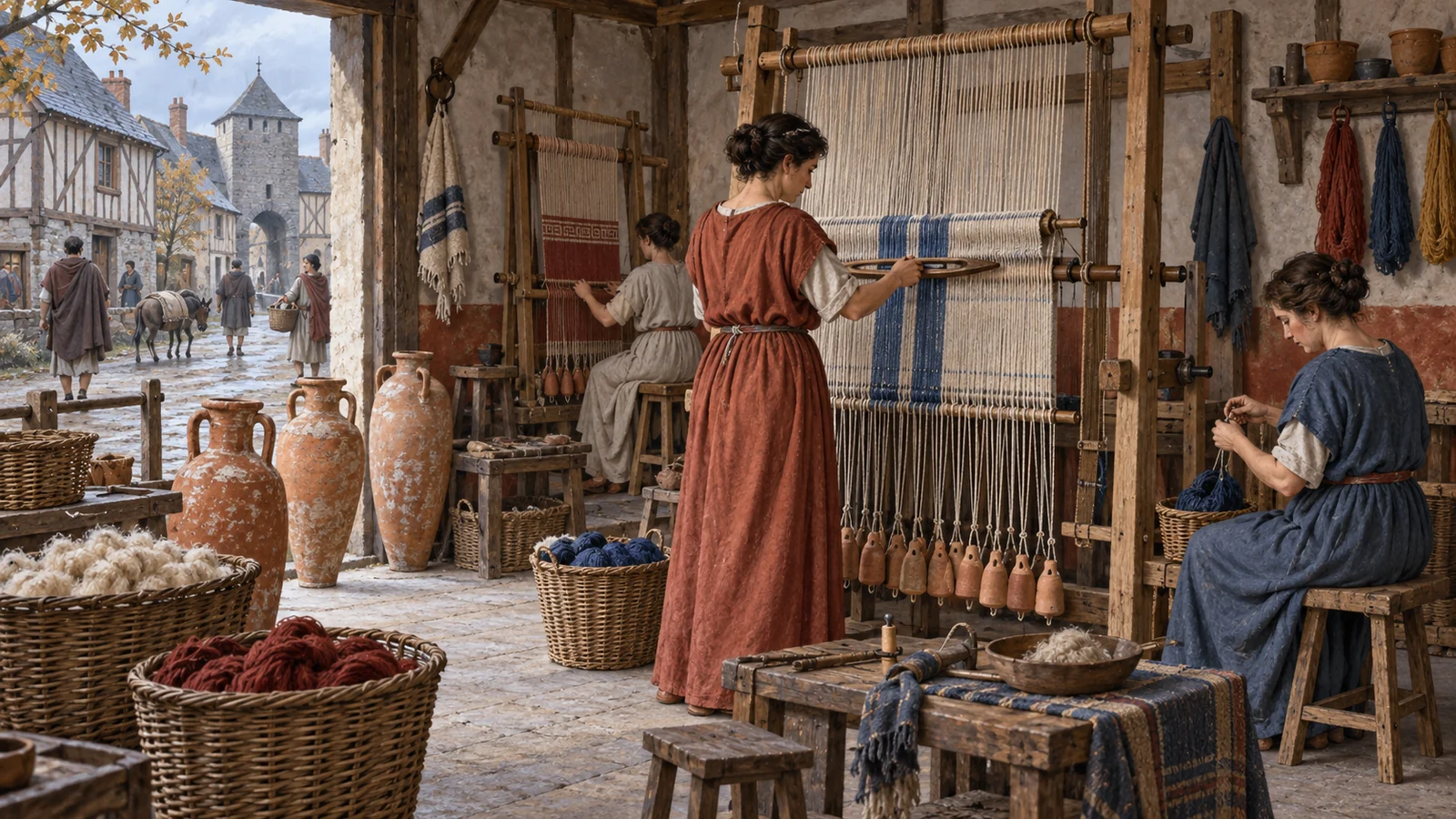
If Nemetacum prospered, it was largely thanks to an activity that would later make the medieval fortune of Arras: textile work. From Roman times, the region was renowned for its wool and cloth, prized well beyond the city and spread across the empire by roads and trade. This textile vocation, attested by ancient sources, draws a striking continuity with the following centuries, when the drapery and tapestries of Arras would shine across Europe. There is here a thread, literally, linking the Gallo-Roman city to the medieval merchant town. This economic specialisation also explains the prosperity of Nemetacum and the comfort of some of its inhabitants, whose dwellings and furnishings reveal a certain ease. It attests, finally, to the city's insertion into the great exchange networks of the empire, where goods travelled over long distances. Far from being an isolated market town, Nemetacum took part in an ancient world-economy, exporting its know-how and importing in return the products and fashions of the Mediterranean. This commercial openness is one of the keys to its success.
Fortifications, crises and decline
The prosperity of Nemetacum did not last forever. From the 3rd century, the Roman empire went through severe crises, and northern Gaul suffered the first Germanic incursions. Like other towns, Nemetacum then acquired fortifications, drawing back onto a more defensible core, a sign of troubled times. This shrinking of the town, observed by archaeology, reflects a shift: the open, confident city of the High Empire gave way to an anxious stronghold turned toward its protection. Difficulties piled up through late Antiquity, between insecurity, the weakening of Roman power and deep changes in society. The town seems to have kept a role, notably religious, but its brilliance faded. Historians urge us not to dramatise this decline too much, often gradual and uneven rather than a sudden collapse. It remains that the great urban centre of the early centuries was, by the end of Antiquity, only a shadow of itself. This trajectory, from rise to contraction, is that of many Gallo-Roman towns facing the end of a world.
From Nemetacum to Arras: a buried memory
The end of Nemetacum was not the end of the story. After the destruction and upheavals of the early 5th century, life did not entirely vanish from the site, and it was a little later, around a Saint-Vaast Abbey founded by the Crinchon, that the medieval town of Arras would be reborn, shifted from the ancient city. Nemetacum then became a buried memory, its name changing over the centuries and its remains sleeping under the soil of the present town. It is archaeology that, in modern and contemporary times, has unearthed this first Arras, giving flesh back to a forgotten city. Each discovery, from the street plan to everyday objects, helps us better understand what life was like here two thousand years ago. To make Nemetacum known is to recall that Arras was not born in the Middle Ages, but that it sinks its roots into Antiquity, on a hill where a Celtic people turned Roman built a prosperous town. This historical depth is a heritage treasure as much as a source of pride for today's city.