
Arras: between metropolises and European borders
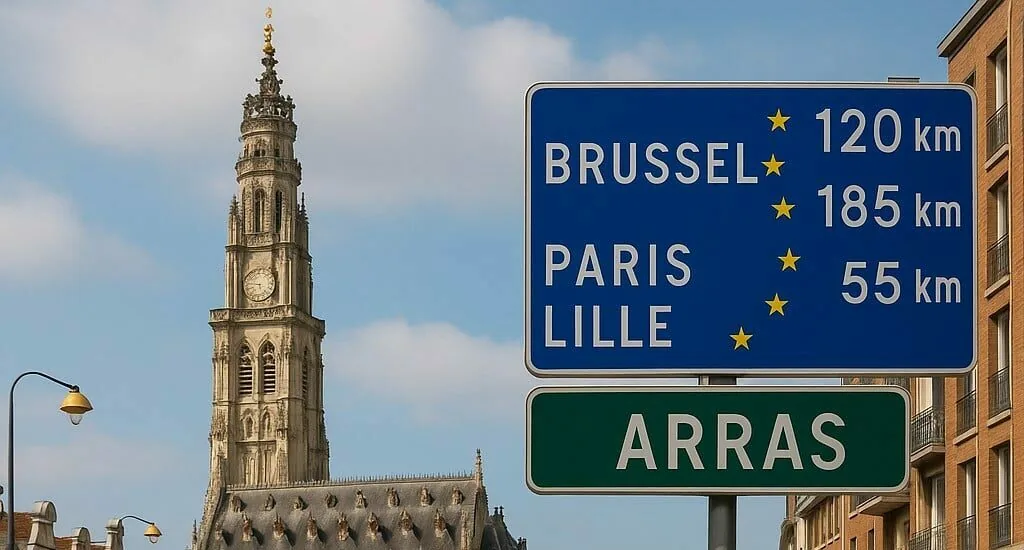
A glance at a map is enough to understand one of the town's great assets: Arras occupies a strategic position, between the great metropolises of northern Europe and a short distance from several borders. Neither entirely in the shadow of Lille, nor cut off from Paris, the prefecture of the Pas-de-Calais stands at a crossroads, at the meeting of the axes that link France, Belgium and beyond. This geographical situation, inherited from a long history, still shapes today the identity, the economy and the daily life of the people of Arras. It explains why the town, on a human scale, remains connected to the great centres, and why it attracts residents and businesses seeking a balance between accessibility and quality of life. This overview details what it means, concretely, to live and work in a town placed between metropolises and European borders.
A strategic position at the heart of the Hauts-de-France
Arras lies at the centre of a region, the Hauts-de-France, which is itself one of the most populous and strategic in France, turned toward northern Europe. This central position is no trifle: the town is a point of balance between the Lille metropolis to the north, the Paris basin to the south, and the Channel coast to the west. This positioning makes Arras a place of passage and encounter, at the junction of several territorial dynamics. Historically, the town owes much to this geography: a coveted stronghold, a commercial crossroads, it has always drawn on its situation. Today, this centrality translates into remarkable accessibility and into the role of an active chief town, concentrating administrations, services and activities. For a business as for an individual, being based in Arras means benefiting from this position without suffering the drawbacks of the very large conurbations. It is one of the springs of the appeal of Arras, which attracts those seeking proximity to the great centres without giving up a calmer setting. To understand the geography of Arras is thus to grasp an essential key to its dynamism: the town is not an isolated point, but a link in a dense network of towns and exchanges, at the heart of a region fully inscribed in the European space.
At the gates of the great metropolises
What is striking, when one looks at the distances, is the proximity of the great metropolises. Lille, the regional capital and great metropolis of the North, is only some fifty kilometres away, a few dozen minutes' journey. Paris itself is reached in a little over an hour thanks to high-speed rail, which places the capital within a day's reach for work, business or leisure. Brussels, capital of Belgium and seat of the European institutions, is about two hours away, while the coast and its ports are not far either. This situation makes Arras a town from which several capitals and major metropolises can be reached within the day, a rare advantage for a city of its size. Concretely, a resident of Arras can work in Lille, go to Paris for a meeting or spend a weekend in Brussels without major logistical difficulty. This accessibility multiplies professional, cultural and personal possibilities, while allowing one to live in a quieter and often more affordable town than the great centres. It is a precious balance, which explains the growing interest in Arras from those who work in the neighbouring metropolises but wish to escape them in the evening. The town thus offers the best of both worlds: connection to the great hubs and the gentleness of a city on a human scale.
A connected town: motorways and high-speed rail
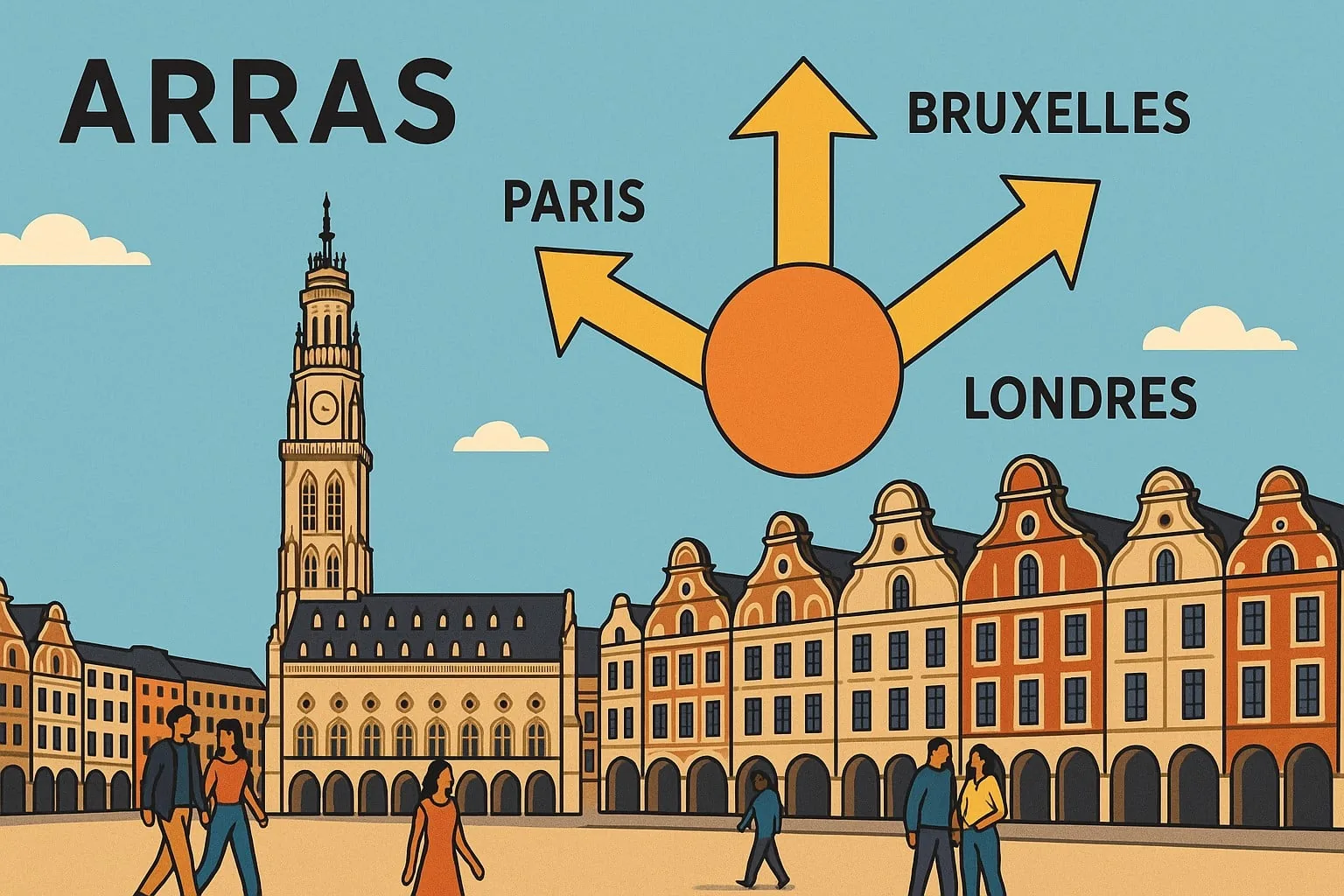
This proximity would be nothing without the transport infrastructures that make it real. Arras is an important road and motorway hub, served by several motorways that quickly link it to Lille, Paris, Belgium and the coast. This motorway network places the town at the crossroads of the great axes of northern France. The train plays an equally decisive role: from Arras railway station, high-speed connections put Paris a little over an hour away and Lille a few minutes away, while the regional network finely serves the territory. This double service, road and rail, is a major asset for daily journeys as for economic exchange. It allows residents to combine living in Arras with activity in the neighbouring metropolises, and businesses to send and receive goods and visitors with ease. The quality of these connections is moreover often cited among the first arguments in favour of settling in the town. Where other medium-sized cities suffer from a relative isolation, Arras enjoys an accessibility worthy of a metropolis, while keeping the advantages of a medium-sized town. This connectivity, patiently built over the decades, is today one of the pillars of its development, and it continues to weigh heavily in the location choices of households and businesses drawn to the region.
| Destination | Rough distance from Arras |
|---|---|
| Lille | Some fifty kilometres, a few dozen minutes |
| Paris | About an hour by high-speed train |
| Brussels | Around two hours depending on the mode of transport |
| Channel coast | Less than an hour to the coast and its ports |
A cross-border crossroads toward northern Europe
Beyond the French metropolises, Arras stands out by its proximity to the borders and to northern Europe. Belgium is only a short distance away, and beyond open the Netherlands, Luxembourg and Germany, a whole space of intense exchange. This cross-border position inscribes the town in a European dynamic, that of a region, the Hauts-de-France, which shares with its Belgian neighbours a long common history and many economic and cultural ties. The border, here, is not a barrier but a porous line, crossed daily for work, trade or leisure. Arras thus benefits from a position within a vast cross-border living area, where people, goods and ideas circulate. This openness onto northern Europe is a deep characteristic of the territory, which distinguishes the Hauts-de-France from regions more turned toward the interior of the country. For businesses, this proximity to the Belgian and northern European markets is a significant commercial asset. For residents, it broadens the horizon of possibilities, in matters of employment, study or discovery. Arras is therefore not only a French town well connected to its metropolises: it is also a gateway to northern Europe, a point of contact between France and its neighbours, heir to a vocation of exchange that geography assigned to it centuries ago and that modern infrastructure has only reinforced.
An economic and residential asset
This privileged geography is not just a matter of maps: it has very concrete economic and residential consequences. For businesses, the position of Arras, connected to the metropolises and close to the borders, eases logistics, access to markets and recruitment in a wide employment area. The town and its conurbation thus host varied activities, which benefit from this centrality and the availability of land at costs often lower than those of the great metropolises. For households, the equation is just as appealing: living in Arras means benefiting from proximity to the great centres while enjoying more affordable property prices and a valued setting. This argument weighs heavily for those considering settling, whether to buy a house in Arras or to rent a home there, combining comfort and accessibility. The town thus attracts workers employed in Lille or Paris, families in search of space, and businesses drawn by its positioning. This double attractiveness, economic and residential, flows directly from its geographical situation, transformed into a competitive advantage. Here again, geography becomes destiny: because it is well placed and well connected, Arras offers a setting where it is possible to reconcile a dynamic professional life and quality of life, which, in the age of new ways of working, is an increasingly sought-after and decisive asset in location choices.
Living in Arras, working in the metropolis
The geography of Arras has given rise to a particular way of life, that of living in a peaceful town while working, when one wishes, in a great neighbouring metropolis. Many residents of Arras make the daily journey to Lille, or occasionally to Paris, taking advantage of the fast connections to reconcile a career in a great economic hub with family life in a calmer setting. The rise of remote work has further reinforced this trend: being able to work from a distance a few days a week makes the distance to the metropolises less constraining, and all the more enhances well-connected medium-sized towns. Arras ticks all the boxes of this new way of life: accessibility, controlled prices, complete services and quality of life. This model attracts a population of workers who refuse to have to choose between professional opportunities and daily comfort. It also benefits the town itself, which welcomes these new residents and sees its economic and social life energised. Of course, this way of life has its demands, notably in terms of organisation and travel time, and it does not suit everyone. But it perfectly illustrates what the situation of Arras allows: a balance, a possibility to choose, rather than an imposed constraint. At a time when the question of where to live is being reconsidered by many, this ability to combine the advantages of the metropolis and those of the medium-sized town is one of the most current and decisive assets of the city.
A vocation as a crossroads inherited from history
If Arras is today a crossroads, it has always been one, and its vocation of exchange sinks its roots into a distant past. From Antiquity, the town was a point of passage on the roads that crossed northern Gaul, and its medieval rise owes much to its position on the trade routes, between the fairs and the great drapery cities. A stronghold disputed between France, Flanders, Burgundy then Spain, Arras long lived on the border of several powers, which shaped its character and its architecture. This history of a hinge-town, by turns coveted and prosperous, partly explains what it has become: a city accustomed to exchange, to crossed influences, to comings and goings. The geography that today makes its economic attractiveness is the same that, yesterday, made it a strategic stake and a merchant crossroads. There is thus a fine continuity between historical Arras and contemporary Arras, both defined by their position. To understand this thread is to measure that the openness of the town is not a recent phenomenon, but a constant of its destiny. The modernity of motorways and high-speed rail only prolongs, with new means, a vocation as a crossroads two thousand years old, inscribed in the soil and in the memory of a town that has always looked beyond its walls.
A territory turned toward Europe
One must, to conclude, place Arras back in the great European whole to which its geography attaches it. The town belongs to a border region, open to its neighbours, which has made its position an element of its identity. This European vocation can be read in the cross-border cooperations, in the daily flows of workers and goods, in the cultural ties woven with Belgium and northern Europe. Arras is not a town folded in on itself, but a point of a continental network, taking part, at its scale, in the dynamics that animate this part of Europe. This openness is all the more natural since the history of the town, long linked to the county of Flanders then to the Burgundian and Spanish possessions, has always placed it at the hinge of several worlds. Geography and history meet here to make Arras a border city in the noble sense, a place of contact and exchange rather than withdrawal. To understand this European dimension helps to grasp what Arras really is today: a French town of character, proud of its heritage, but also deeply inserted into a cross-border and metropolitan space. It is this combination, this ability to be at once locally anchored and broadly open, that makes the singularity and the strength of its positioning between metropolises and European borders, and that draws, for the future, real prospects of development.