
5th History and Genealogy Fair of Bruay-La-Buissière: the lecture programme of 3 and 4 October 2026
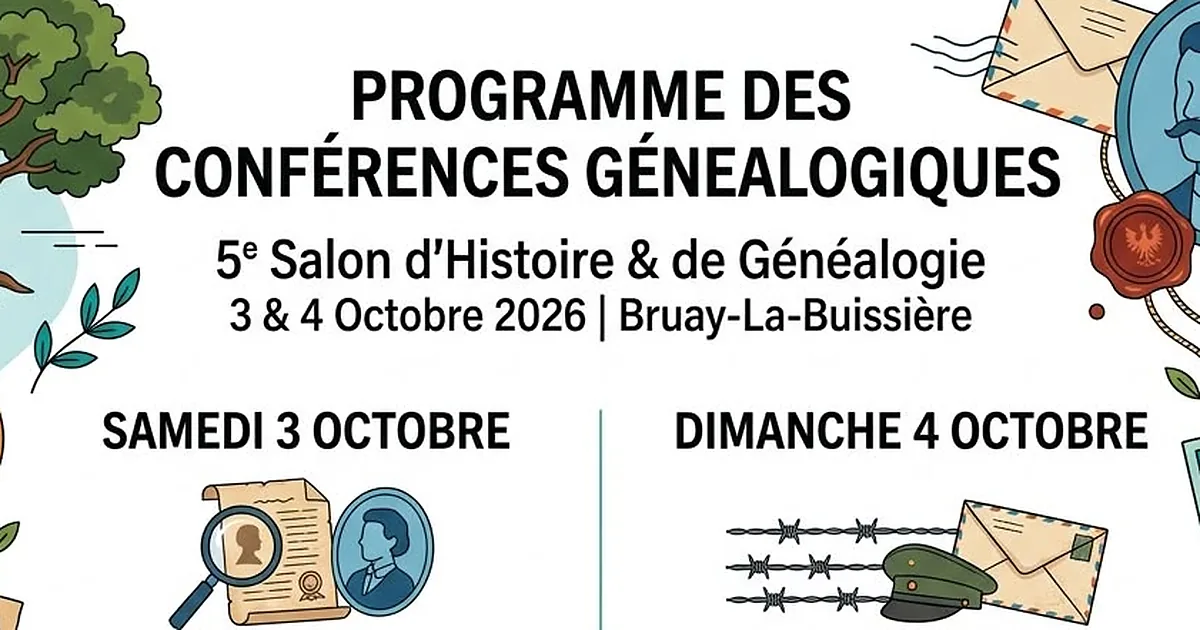
On 3 and 4 October 2026, the Marmottan community hall in Bruay-La-Buissière hosts the 5th edition of the History and Genealogy Fair, a rendezvous that has become unmissable for all those who, in the Artois and the mining basin, seek to trace the thread of their family history. Free entry, stands of associations and specialists, and above all a programme of four lectures exploring original avenues: genealogy through the senses, the search for ancestors in Poland, the journey of prisoners of war in Germany and the biography of an ancestor reconstructed thanks to augmented genealogy. Here are the details of this programme, what to expect from it and how to prepare your visit.
The 5th History and Genealogy Fair of Bruay-La-Buissière
The Bruay-La-Buissière fair returns for a 5th edition, two years after a 2024 edition that had already gathered enthusiasts, associations and the curious around local and family history. The principle remains the same and makes the success of the event: to bring together in one place, over a weekend, everything that allows one to start or deepen a genealogical search, from circles and associations of genealogists to specialists of a country or a period, by way of publishers, archives and digital tools. For those discovering the event, the regional genealogy fair of Bruay-La-Buissière was already presented on this site on the occasion of the previous edition, which detailed its spirit and its organisation. The Marmottan hall, in the heart of the town, offers a practical and accessible setting, and the free entry opens the fair to all, from the novice who has never consulted a civil-status record to the seasoned researcher stuck on a difficult branch. The 2026 edition stands out with a particularly structured lecture programme, with four talks spread over the two days, each devoted to a precise method or field of research. This upgrade in content, beyond the stands, makes the fair a veritable training moment, where one comes as much to listen as to exchange. In a region where the history of families is intimately linked to that of the mine, migrations and the two world wars, this rendezvous meets a strong demand: to understand where one comes from, with reliable tools and advice. The fair thus addresses a very wide public, from the inhabitants of the Artois and the Béthune area to visitors come from further afield, united by the same curiosity for their roots.
A lecture programme in four highlights
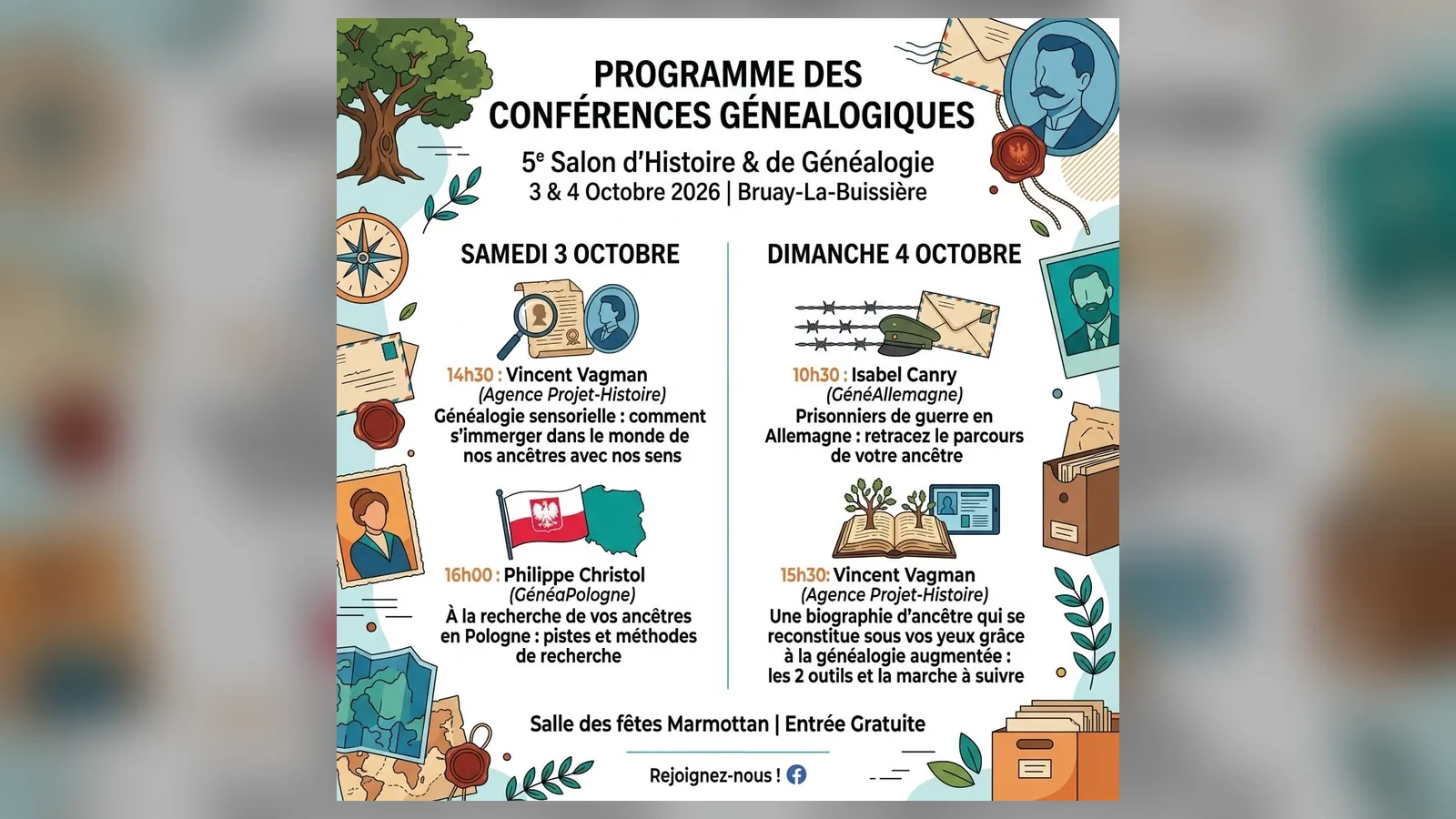
The heart of this 5th edition lies in its lecture programme, four rendezvous spread over Saturday and Sunday, designed to cover complementary approaches to genealogical research. Saturday 3 October opens at 2.30 pm with Vincent Vagman, of the Agence Projet-Histoire, on sensory genealogy, a way to immerse oneself in the world of our ancestors through the senses, before Philippe Christol, of GénéaPologne, takes over at 4 pm to explain how to find one's ancestors in Poland, with concrete leads and research methods. Sunday 4 October begins at 10.30 am with Isabel Canry, of GénéAllemagne, who will show how to retrace the journey of an ancestor who was a prisoner of war in Germany, then concludes at 3.30 pm with a second rendezvous with Vincent Vagman, devoted this time to an ancestor's biography reconstructed before the public's eyes thanks to augmented genealogy, with the two tools to know and the steps to follow. This programming has the merit of coherence: it starts from the sensory and the imaginary, passes through two fields of research very present in the families of the region, Poland and captivity in Germany, and ends with the digital tools that today transform the way of writing a family history. Each lecture lasts the time of an in-depth talk followed by exchanges, which allows one to ask precise questions of the speakers, all specialists in their field. It is possible to attend a single lecture or to follow all four over the weekend, while enjoying the stands of the fair in between. The table below summarises the times, speakers and themes to organise your visit.
| Day and time | Speaker | Lecture theme |
|---|---|---|
| Saturday 3 October, 2.30 pm | Vincent Vagman (Agence Projet-Histoire) | Sensory genealogy: immersing yourself in the world of our ancestors with your senses |
| Saturday 3 October, 4 pm | Philippe Christol (GénéaPologne) | Searching for your ancestors in Poland: leads and research methods |
| Sunday 4 October, 10.30 am | Isabel Canry (GénéAllemagne) | Prisoners of war in Germany: retrace your ancestor's journey |
| Sunday 4 October, 3.30 pm | Vincent Vagman (Agence Projet-Histoire) | An ancestor's biography reconstructed thanks to augmented genealogy: the two tools and the steps to follow |
Saturday 2.30 pm: sensory genealogy with Vincent Vagman
The first lecture of the fair approaches genealogy from an unexpected angle: that of the senses. Vincent Vagman, of the Agence Projet-Histoire, proposes to immerse oneself in the world of our ancestors no longer only through records and dates, but through what they saw, heard, smelled and tasted every day. The idea is simple and fruitful: once the family tree is established, the research gains by becoming an experience, by reconstructing the sensory environment of an era and a place. What was the smell of a mining town in the early morning, the noise of a village street or a workshop, the texture of bread and the taste of the dishes our great-grandparents prepared, the light of a house without electricity? By relying on the sources that describe material life, from post-mortem inventories to old postcards, from family recipes to testimonies, this approach allows one to give flesh to the ancestors and to go beyond the dryness of the registers. It joins a deep trend of contemporary genealogy, which no longer contents itself with accumulating names but seeks to tell lives, to understand contexts and to pass on a living memory to the following generations. For the amateur genealogist, sensory genealogy also offers a method to relaunch a search that is getting bogged down: by changing one's outlook and taking an interest in the living environment, one often discovers new sources and new questions. This opening lecture thus sets the tone of the fair, between documentary rigour and the pleasure of immersion, and addresses all those who want to make their tree something other than a list of surnames.
Saturday 4 pm: searching for your ancestors in Poland
The second Saturday lecture touches a particularly sensitive chord in the region: the search for ancestors in Poland. Philippe Christol, of GénéaPologne, will present the leads and methods to find the trace of families come from the other side of Europe, a subject that concerns tens of thousands of families in the Nord and the Pas-de-Calais. From the 1920s, the mining basin indeed welcomed a massive Polish immigration, called upon to work in the pits after the First World War, and Bruay-La-Buissière like the neighbouring communes still bear its mark, in the surnames, the churches, the associations and the traditions. To understand this context, the Lewarde mine, a historical mining centre, brings back to life the work at the bottom and the life of the towns where these families settled. Finding a Polish ancestor nevertheless supposes overcoming specific obstacles: the language barrier, the changes of borders and administrations over the course of Polish history, the diversity of Catholic parish registers, the sometimes fanciful transcription of names in French documents, or the location of the village of origin from approximate indications. The lecture intends precisely to give concrete methods to cross these steps, by identifying the available sources, the digitised archives and the possible remote procedures, so that everyone can reconstruct the journey of their family from the Polish village to the miners' row. For many descendants of miners, this rendezvous could well unblock a search left in suspense for years.
Sunday 3.30 pm: an ancestor's biography reconstructed live
On Sunday afternoon, Vincent Vagman returns for a second talk turned towards today's tools: an ancestor's biography that is reconstructed before the public's eyes thanks to augmented genealogy. The exercise is concrete and educational: starting from the elements one has on an ancestor, the records, the places, the trades, the historical events lived through, and showing how, with two precise tools and a procedure to follow, one goes from scattered data to a constructed and documented life story. Augmented genealogy designates this set of digital means that allow one to enrich, cross-reference and shape genealogical information, from online databases to writing-assistance tools, by way of mapping and historical contextualisation. The interest of the live demonstration is to unveil the method step by step, with its reflexes, its checks and its limits, rather than presenting a finished result without knowing how it was obtained. The lecture promises to indicate the two tools chosen and the sequence of steps, which will allow everyone to reproduce the approach at home on their own ancestors. This approach joins the concern of many genealogists who, once their tree is constituted, wish to pass on something readable and living to their relatives, a family book or a biography rather than a table of dates. It also closes the fair's programme in echo of the opening lecture: where sensory genealogy calls on imagination and the senses, augmented genealogy mobilises digital tools, and the two complement each other to write the story of a life.
Sunday 10.30 am: prisoners of war in Germany
The Sunday morning lecture, presented by Isabel Canry, of GénéAllemagne, focuses on a painful but omnipresent chapter in French families: the journey of prisoners of war in Germany. Hundreds of thousands of French soldiers were captured during the 1940 campaign and spent years in German camps, the Stalags for the rank and file and the Oflags for officers, not to mention the prisoners of the First World War. In the Artois, a land of fighting in 1914-1918 and then the theatre of the German breakthrough of May 1940, almost every family has an ancestor who went through captivity: to situate this context, Arras during the Great War retraces what the town and its inhabitants went through in 1914-1918, the first great wave of captivity for many families of the region. Retracing the journey of a prisoner supposes knowing where to look: military index cards and files, camp lists, the archives of the organisations that followed the captives, correspondence and parcels, or the administrative documents linked to repatriation and the rights of former prisoners. The lecture proposes to guide the researcher through this maze, by explaining which sources exist, how to consult them and how to reconstruct, camp after camp, a man's route from his capture to his return. Beyond the method, this rendezvous touches on the transmission of a memory often kept quiet in families, former prisoners having frequently remained silent about those years. To find their journey again is to give them back a place in the family history and to understand what they went through.
Preparing your visit to the fair well
To make the most of these two days, a few practical tips are in order. The fair is held at the Marmottan community hall in Bruay-La-Buissière, and entry is free, which allows one to come without commitment, for an hour or the whole day. It is useful to arrive with one's basic documents, a tree even a summary one, names, dates and places, or even copies of records or photographs: the associations present on the stands will thus be able to give precise advice, and the speakers to answer concrete questions after their lecture. Visitors interested in Poland or in captivity in Germany have every interest in preparing the information they have on the ancestor concerned, the supposed village of origin, the regiment, the date of capture or the name of the camp, in order to make the most of the exchanges with the specialists. It is also recommended to note the lecture times to organise one's day, those of Saturday following one another at the beginning and end of the afternoon, those of Sunday framing the midday break. Between two talks, the stands of the associations, archives and publishers allow one to discover local resources, to be introduced to online tools and sometimes to unearth books unobtainable elsewhere. Finally, the fair is also a meeting place: coming with a notebook to note contacts and the leads mentioned, and not hesitating to strike up a conversation, often makes the difference between a pleasant visit and a visit that truly relaunches a search.
Following the event and joining the community
Like the previous editions, this 5th History and Genealogy Fair is part of an associative and local dynamic, where exchange counts as much as the lectures themselves. The organisers announce the latest information, possible programme adjustments and the highlights of the weekend on social networks, and invite visitors to join them to prolong the exchanges after the fair. To know the practical details, ask a question or announce your visit, the Facebook page of the event centralises the news of this 2026 edition and allows one to stay informed until the day itself. This community of enthusiasts, which meets in Bruay-La-Buissière every two years, constitutes a precious resource for the genealogist, often confronted with solitary research: one finds there mutual help, readings of difficult records, advice on archives and sometimes unsuspected cousins. The October 2026 fair, with its programme tightened around four quality lectures, offers a fine opportunity to join it. Whether one comes for the senses, for Poland, for captivity or for digital tools, everyone will leave with methods, leads and contacts to advance their family history. See you on 3 and 4 October at the Marmottan hall; entry is free and curiosity is the only condition of access. The community hall is located on Place Marmottan, right in the town centre of Bruay-La-Buissière, a few steps from the town hall, as shown on the map below.