
Arras under the shells: how was the town destroyed during the Great War?
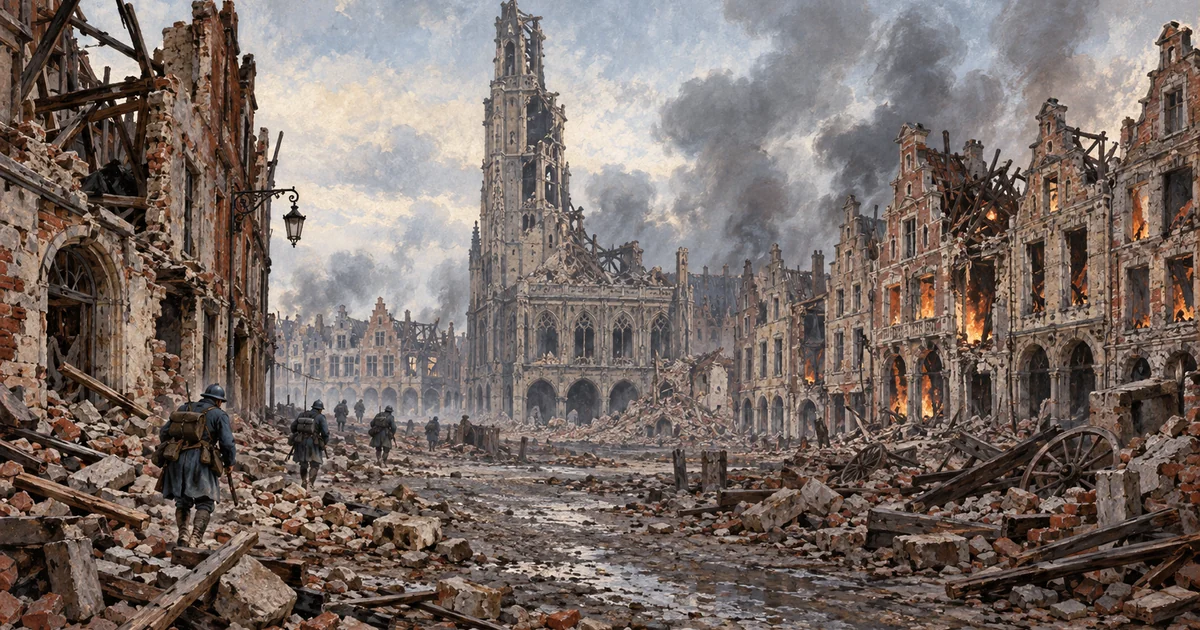
During the First World War, Arras knew one of the most tragic pages of its history: its destruction. Situated in the front line during almost the whole duration of the conflict, the town was subjected to incessant bombardments that ravaged it. From the fall of the belfry in 1914 to the ruins of 1918, Arras became a martyr city, whose heritage and houses were largely annihilated. A look back at these terrible years, when the town lived under the shells, and at the scale of the destructions it suffered during the Great War.
A front-line town
The position of Arras during the First World War sealed its destiny. In the autumn of 1914, the front stabilised in the immediate vicinity of the town, which found itself in the front line, only a few kilometres from the enemy positions. This situation, which was to last for a large part of the conflict, exposed Arras to bombardments and combats in a quasi-continuous manner. A front town, it suffered the direct consequences of its proximity to the battle lines. The defence of the town, to which the name of General Barbot remains attached, had prevented its fall in 1914, but Arras nonetheless remained in a perilous situation, at the outposts of the front. This front-line position made the town a constant target for enemy artillery. The shells fell on Arras for years, causing considerable destructions and making life impossible for a large part of the population. The town, caught in the vice of the front, suffered one of the longest and most terrible ordeals of its history. This dramatic situation distinguished Arras from towns situated in the rear, spared from direct combats. Here, the war was omnipresent, daily, in the din of the shells and the permanent threat. To understand the front-line position of Arras allows one to grasp the scale of what it endured. A front town during almost the whole war, it was exposed to the incessant bombardments that gradually ravaged it. This proximity to the front, which could have been avoided if the town had fallen or if the front had moved away, determined the fate of Arras during the conflict. It is from this situation that the destruction of the town followed, a martyr of its position in the front line, at the closest to the combats of the Great War.
The beginning of the bombardments
From the autumn of 1914, with the stabilisation of the front, Arras began to suffer the bombardments that were to ravage it. The enemy artillery, positioned a few kilometres away, took the town as a target, unleashing a shelling that continued, intermittently, for a large part of the war. The first bombardments caused immediate destructions and marked the beginning of a long ordeal for the town. The shells fell on the houses, the monuments and the streets, sowing death and desolation. This situation forced a large part of the population to flee, life under the bombardments becoming unbearable. Those who remained had to adapt to this permanent threat, taking shelter as soon as possible. The bombardments, which touched the whole town, spared neither the dwellings nor the heritage. Little by little, Arras covered itself with ruins, as the shelling continued. This beginning of the bombardments marked the entry of the town into the tragedy of destruction. What was at first only shots was to transform, over the months and years, into a quasi-total destruction. The town, taken as a target repeatedly, suffered a shelling whose cumulative scale was to end up ravaging it. To understand the beginning of the bombardments allows one to grasp the commencement of the destruction of Arras. From 1914, the town entered a period of bombardments which, continuing for years, was to cause considerable destructions. It was the beginning of a long martyrdom, that of a town subjected to the fire of the artillery, which gradually transformed it into a field of ruins, over the course of a war that never ceased to ravage the city.
The fall of the belfry
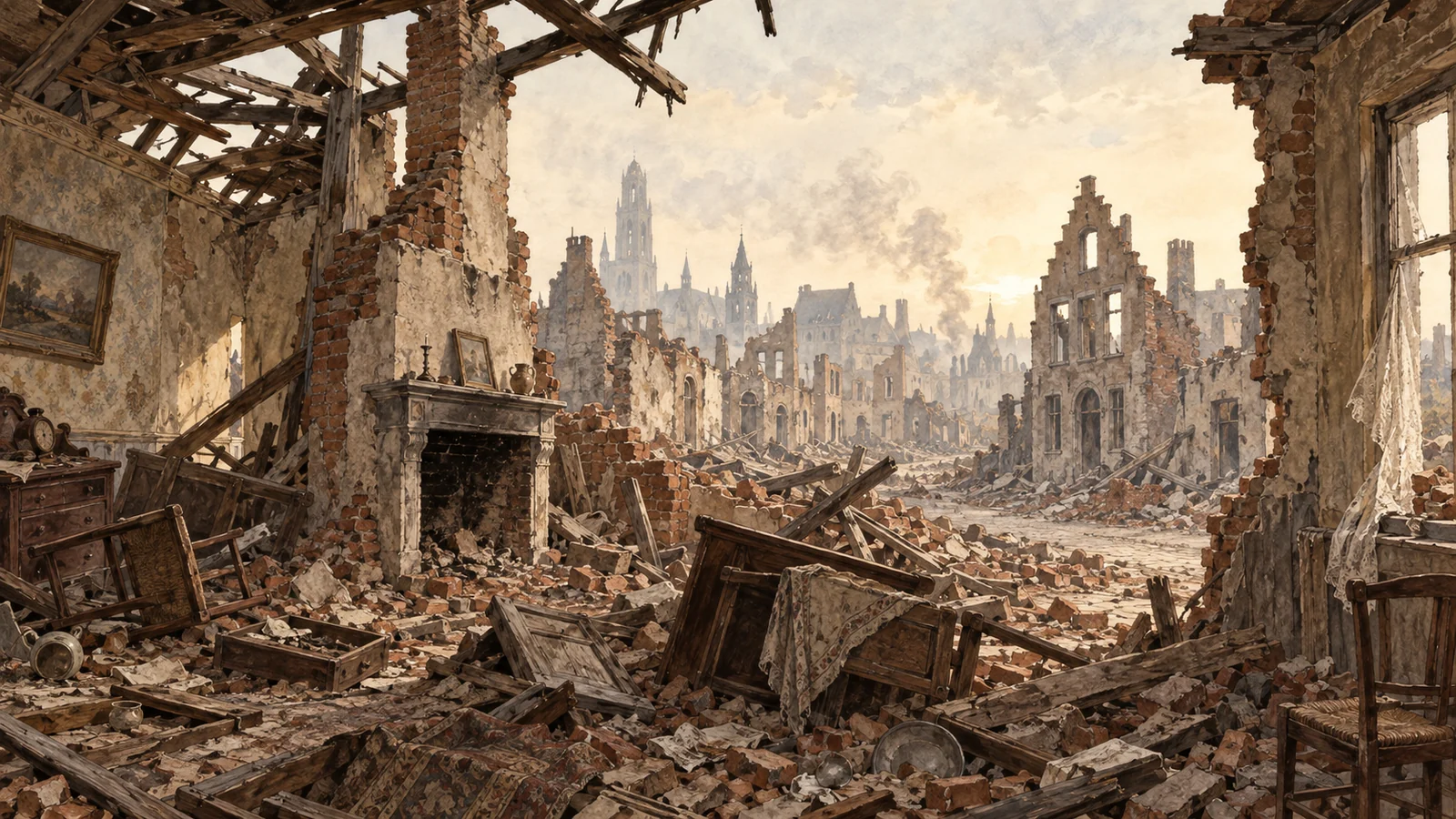
Among the destructions that struck Arras, the fall of the belfry remains one of the most symbolic events. From 1914, under the effect of the bombardments, the famous belfry of the town, symbol of communal liberties and jewel of the Arras heritage, collapsed. This destruction of an emblematic monument struck minds deeply, illustrating the scale of the disaster that was falling upon the town. The belfry, which had dominated the city for centuries, now lay in ruins, a victim of the shells. This fall had a considerable symbolic significance: it meant the destruction not only of a building, but of a symbol of the identity and history of Arras. The belfry was not an ordinary monument: it embodied the town, its communal past and its pride. Its destruction was therefore felt as an attack on the very heart of the identity of Arras. This event illustrates the dramatic character of the destruction of Arras, which did not spare the most prestigious monuments. The belfry, like the town hall and so many other buildings, was a victim of the bombardments. Its fall symbolises by itself the martyrdom of the town, the destruction of its heritage and its symbols. Fortunately, the belfry and the town hall would be rebuilt after the war, as one can see today by visiting the belfry and the town hall, reborn from their ruins. But during the war, the fall of the belfry struck minds as the symbol of the destruction of Arras. To understand the significance of this event allows one to grasp the symbolic dimension of the destruction of the town. The fall of the belfry, an emblematic monument, sums up by itself the drama of Arras under the shells, the destruction of a heritage and of symbols dear to the town.
A martyr city
Over the years of war, Arras became a veritable martyr city. The incessant bombardments, continuing for a large part of the conflict, caused considerable destructions. The quasi-totality of the town was touched, the houses, the monuments and the streets suffering the effects of the shelling. Little by little, the prosperous city of the Belle Époque transformed itself into a field of ruins. The famous squares, the architectural heritage, the dwellings: nothing was spared by the shells. Arras thus joined the sad rank of the martyr cities of the Great War, those cities ravaged by combats and bombardments. The scale of the destructions was such that the town, at the end of the war, was no more than the shadow of itself, a landscape of ruins. This massive destruction made Arras one of the symbols of the ravages of the war on towns. The fate of the city illustrated the violence of the conflict and its consequences on heritage and populations. A martyr city, Arras paid a heavy tribute to the war, suffering destructions among the most important that a town knew during the conflict. This ordeal deeply marked the history of the city and left lasting traces. The destruction of Arras was not a punctual episode, but a long process, which continued throughout the war, gradually ravaging the town. To understand what Arras endured as a martyr city allows one to grasp the scale of the drama. Ravaged by the bombardments for years, the town was largely destroyed, paying the price of its position in the front line. This martyrdom, one of the most terrible that a French town knew during the war, is an integral part of the history of Arras and its memory.
Life under the shells
To live in Arras during the war was to live under the permanent threat of the shells. For the population that had not fled, daily life was made of danger, fear and privations. The bombardments, which could strike at any moment, forced the inhabitants to take shelter, notably in the cellars and underground passages. Normal life was impossible in a town subjected to the fire of the artillery. A large part of the population had left the town, fleeing the bombardments, but some remained, adapting as best they could to this extreme situation. The military presence was also important, the front town accommodating soldiers. This cohabitation of civilians and military, in a bombarded town, characterised life in Arras during the war. Living conditions were extremely difficult, marked by danger, destructions and privations. To move about the town, to obtain supplies, to protect oneself: everything was complicated by the war and the bombardments. Life under the shells demanded a constant adaptation and a great resilience. This experience, lived by those who remained in the town, testifies to the harshness of daily life in a front zone. It recalls that the war struck not only the soldiers, but also the civilian populations, exposed to the bombardments and the destructions. To understand life under the shells allows one to grasp the human dimension of the destruction of Arras. Behind the ruins and the statistics, there were men and women who lived the ordeal of the bombardments, in extreme conditions. This life under the constant threat, made of danger and privations, was the lot of those who remained in the martyr city, witnesses and victims of the destruction of Arras during the Great War.
| Marker | Detail |
|---|---|
| Position | Front-line town near the front |
| 1914 | Beginning of the bombardments, fall of the belfry |
| Life | Under the shells, sheltered in the underground passages |
| 1918 | A town largely destroyed |
The boves, underground refuge
Faced with the bombardments, the inhabitants and soldiers found refuge underground, notably in the boves, those underground galleries that had existed for a long time beneath the town. Dug over the centuries, these quarries and cellars formed an underground network that offered protection against the shells. During the war, these underground passages were used as shelters, allowing protection from the bombardments. This underground network played an important role in the survival of those who remained in the town, offering a refuge against the shelling. The boves also served, during the conflict, to shelter soldiers and to prepare military operations, notably in the sector of Arras. This underground world, sheltered from the shells, constituted a space of protection in a town exposed to fire. The use of the underground passages during the war illustrates the adaptation of the inhabitants and the military to the threat of the bombardments. Faced with the destruction on the surface, the subsoil offered a refuge, a space where one could escape, at least temporarily, from danger. This underground dimension of life during the war is an important aspect of the history of Arras during the conflict. The boves, a refuge against the shells, testify to the way in which the town and its inhabitants faced the ordeal of the bombardments. To understand the role of the underground passages allows one to grasp how life could be maintained, despite the destructions, in a front town. The underground world of Arras, with its boves, was an essential refuge during the war, a space of protection in a city subjected to the fire of the artillery. This underground heritage, which goes back to the ancient history of the town, took on during the Great War a new importance, offering a shelter to those who lived under the constant threat of the bombardments.
The toll of the destructions
At the end of the war, the toll of the destructions of Arras was overwhelming. The town, subjected to the bombardments for years, was largely destroyed. The quasi-totality of the buildings had suffered, and a very large number of houses and monuments were in ruins. The architectural heritage, including the famous arcaded squares, had been gravely damaged, even annihilated. The prosperous and animated city of the Belle Époque was no more than a field of ruins, a testimony of the violence of the conflict. This toll made Arras one of the most destroyed towns of the Great War, a symbol of the ravages caused by the bombardments on the front cities. The scale of the destructions posed a considerable challenge for the future: a largely annihilated town would have to be rebuilt. The human toll, for its part, was also heavy, the war having caused losses and upheaved the life of the population. Arras emerged from the war drained and ruined, having paid an immense tribute to the conflict. This toll of the destructions illustrates the scale of the drama lived by the town during the war. The destruction of Arras was not partial, but massive, touching the quasi-totality of the city. This disaster called for a large-scale reconstruction, which was to mobilise the energies in the years following the war. To understand the toll of the destructions allows one to measure the scale of the ordeal suffered by Arras. A martyr city, largely destroyed, it had to rebuild everything, from the ruins left by the war. This overwhelming toll, that of a ravaged town, marks the culmination of the martyrdom of Arras during the Great War, and the starting point of the great worksite of the reconstruction, which was to allow the town to be reborn from its ruins.
Towards reconstruction
At the end of the war, Arras, largely destroyed, found itself facing an immense challenge: reconstruction. A ravaged town had to be raised again, rebuilding the houses, monuments and infrastructures annihilated by the bombardments. This considerable worksite was to mobilise the energies and extend over years. The reconstruction of Arras posed fundamental questions: should one rebuild identically, recovering the pre-war face, or modernise the town? The choice that was made, that of a reconstruction largely faithful to the pre-war heritage, was to allow Arras to recover its face and its identity. The famous squares, the belfry and the town hall were rebuilt, making the town reborn from its ruins. This reconstruction, one of the great worksites of the post-war, gave back to Arras its heritage and its character, which one can admire today, notably around the Grand-Place of Arras, reborn. The prospect of reconstruction, at the end of the war, opened a new page of the history of the town, that of its rebirth after the destruction. This worksite, the fruit of a will to make the city reborn, was to allow Arras to recover its face and to turn the page of the martyrdom. To understand the prospect of reconstruction allows one to grasp the stake of the post-war for the town. After the martyrdom of the bombardments and the destruction, Arras had to be reborn, to rebuild its heritage and its life. This reconstruction, which was to give back to the town its face and its identity, constitutes the natural sequel of the history of the destruction of Arras, that of a town which, ravaged by the war, knew how to be reborn from its ruins to recover its splendour and its character.