
The communal charter of 1163: how did Arras win its autonomy?
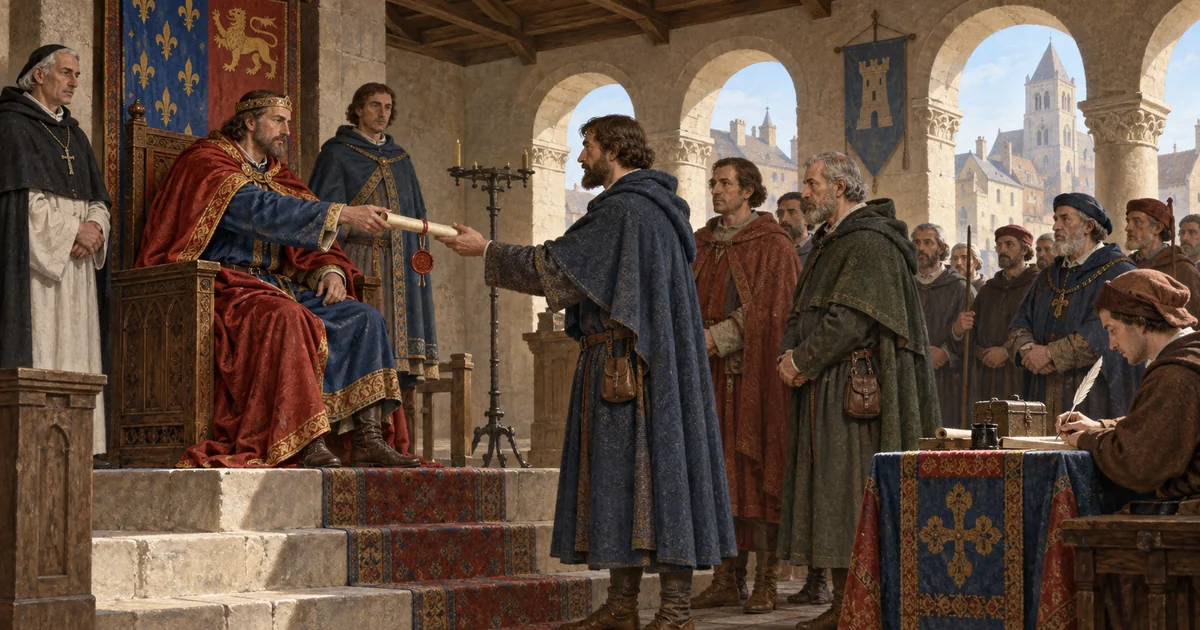
In the 12th century, as Arras grew rich from trade and cloth-making, its burghers obtained a decisive privilege that would shape the town for centuries: a communal charter, generally dated to the year 1163. This document, which recognised liberties and a form of autonomy for the town, marks the entry of Arras into the great communal movement then shaking northern Europe. Behind the sealed parchment a profound transformation played out: a merchant town ceased to be a mere seigneurial dependency to become an organised community, endowed with its magistrates, its rules and its symbols. To understand this charter is to understand how the medieval town in the full sense is born, with its aldermen, its belfry and its civic pride. It is also to grasp the legal foundations on which the golden age of Arras would rest, that of the tapestries, the fairs and the great bourgeois fortunes.
The communal movement in Flanders
The charter of Arras cannot be understood in isolation: it belongs to a vast phenomenon transforming the towns of northern Europe in the 11th and 12th centuries. Under the authority of the counts of Flanders, the merchant cities of the principality, Ghent, Bruges, Ypres, Saint-Omer, Lille, wrested or negotiated charters of franchises, often called keures in the Flemish world. This communal movement reflects the rise of a new social class, the bourgeoisie of merchants and craftsmen, whose wealth and numbers imposed new rules of the game. Historians of medieval towns, in the wake of Jacques Le Goff and Georges Duby, have shown how this urban rise upset the traditional feudal order, founded on land and the bond of vassalage. The counts of Flanders, skilful princes, often understood the interest of accompanying this rise rather than fighting it: prosperous, well-administered towns were a source of revenue and a political support. To grant franchises was to secure the loyalty of the burghers while framing their liberties. Arras, one of the richest cities of the principality, could not stay apart from this movement. Its communal charter thus belongs to a regional dynamic, in which the great cloth-making towns negotiated their place step by step in a world in full transformation.
What is a communal charter?
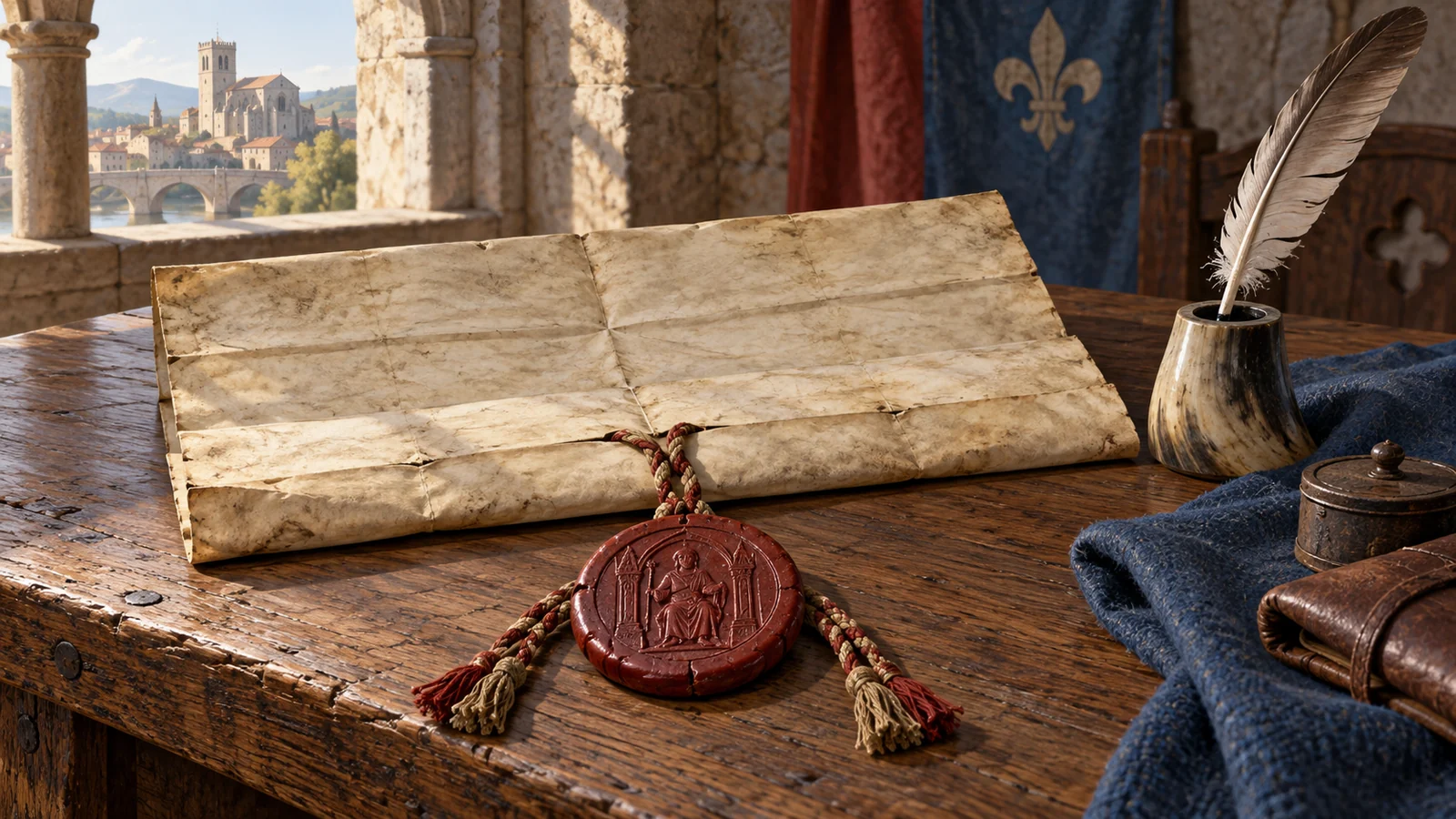
The word charter designates a written and sealed act by which an authority, here the count of Flanders, recognises rights and liberties for a community. A communal charter is not a declaration of independence: the town remains subject to its lord, to whom it owes loyalty, dues and sometimes military service. But it obtains in exchange precious guarantees: the security of persons and goods, known rules of justice, the limitation of seigneurial arbitrariness, the right to administer itself in part. Concretely, the charter often fixed the status of the inhabitants, the ways of justice, the taxes and obligations, as well as the organisation of the urban government. It transformed an aggregate of inhabitants into a legal person, the commune, able to act collectively, to own property, to seal deeds. This discreet revolution, purely legal in appearance, had considerable consequences: it gave the burghers partial mastery of their destiny. Historians of law stress the diversity of these charters, each of which reflects a particular local balance of power, between the ambitions of the town and the prince's will to keep his authority. The charter of Arras belongs to this family of founding texts which, across Europe, drew the legal face of medieval towns and laid the bases of their autonomy.
| Marker | Detail |
|---|---|
| Date | Around 1163, charter of franchises for Arras |
| Authority | The count of Flanders, lord of the town |
| Government | The aldermen, magistrates of the commune |
| Symbol | The belfry, sign of the urban liberties |
The aldermen, government of the town
The most visible consequence of the charter was the establishment of a true urban government, embodied by the aldermen. These magistrates, chosen among the notables and the great merchant families, formed the aldermanry, the body charged with administering the town, dispensing justice, managing finances and representing the commune. Municipal power was thus concentrated in the hands of an elite, the high bourgeoisie, whose wealth rested on trade, cloth-making and soon banking. This government of the aldermen was in no way democratic in the modern sense: it was the work of a small group of powerful families, often related, who passed the offices among themselves and looked to their interests. But it represented a considerable novelty in a world dominated by nobility and clergy: for the first time, enriched merchants and craftsmen governed a town. The aldermen held their assemblies, issued regulations, controlled the trades and the market, maintained the fortifications. They became the true masters of daily life in Arras, under the distant sovereignty of the count. This organisation, studied by historians of the medieval bourgeoisie such as Jean Lestocquoy for the case of Arras, reveals a complex and hierarchical urban society, where power was measured by fortune and credit, and where the commune was the affair of an oligarchy more than of the whole people.
The belfry, symbol of urban liberties
No monument says better the communal pride than the high tower raised in the heart of the town. The belfry and town hall of Arras, as in all the cities of the North, physically embody the urban liberties won by the charter. The belfry was not only a watchtower: it housed the communal bell, which paced the life of the city, called the burghers to assembly, sounded the alarm or the feast, and proclaimed the very existence of the commune. There too were kept the charters and archives, those precious parchments that founded the rights of the town, guarded like a treasure. Facing the church steeple and the lord's keep, the belfry asserted a third power, that of the burghers. Its height, its magnificence, spoke the power and ambition of the merchant city. In Arras, the tradition of the belfry crossed the centuries, and the present monument, rebuilt after the destructions, remains the proud heir of this medieval liberty. To understand the charter of 1163 is thus also to understand why the towns of the North built these superb towers: they were the stone signature of a hard-won autonomy, the visible symbol of a community that henceforth governed itself in part and meant to make it known to the face of the world.
A rich and ambitious bourgeoisie
If Arras could obtain such a charter, it was because its bourgeoisie had acquired considerable economic strength. The town was then one of the great centres of cloth-making, that woollen-cloth industry that made the wealth of the Flemish cities, and its trade radiated across all Europe. From this prosperity were born powerful merchant fortunes, but also a flourishing financial activity: the burghers of Arras became renowned lenders and bankers, to the point that the town's name was sometimes associated with usury and credit in medieval literature. This wealth could be read in stone, through fine dwellings such as those still testified to by the Hotel de Guines, or in the luxury of the tapestries that would soon make the glory of the city. It was this wealthy elite that governed the commune, financed its fortifications and monuments, and negotiated with the count. The charter of 1163 was at once the fruit and the instrument of this bourgeois power: it gave a legal frame to an already established economic domination. Historians stress moreover that urban autonomy benefited first this merchant oligarchy, which knew how to make the communal institutions the extension of its interests. The Arras of the aldermen was indeed the town of the great burghers, masters of money and power.
The charter and the birth of the golden age
The granting of the communal charter opens the most brilliant period of the medieval history of Arras. Strong in its liberties and autonomy, framed by a stable government, the town could give its full measure in the 13th and 14th centuries. Legal security and civil peace favoured trade, craft and creation. It was in this communal and prosperous Arras that the great cloth-making, the renowned fairs, but also an exceptional cultural life flourished, with its trouveres and its confraternities of jongleurs. The frame laid by the charter, by organising the town and guaranteeing its rights, was the seedbed of this rise. One must certainly not idealise this autonomy: it remained framed by the count, sometimes contested, reserved for an elite. But it durably changed the nature of the town, making Arras a true urban power, able to weigh in the affairs of Flanders and the kingdom. The charter of 1163 thus appears as a founding act, less spectacular than a battle or a reign, but whose effects were immense and lasting. It recalls that the history of towns is also played out in the silence of chancelleries, on sealed parchments which, by recognising rights, gave a community the means to build its future.
Sources, dating and the historian's caution
It is fitting, to conclude, to bring the nuances that historical honesty demands. The communal charter of Arras and its dating to 1163 must be handled with caution, for medieval sources are complex and sometimes patchy. Urban liberties were not always granted all at once by a single document: they often resulted from a long process, made of successive concessions, confirmations and negotiations between the town and its lords. A charter could ratify rights already exercised in fact, or confirm others granted earlier. Historians thus discuss the exact scope and precise chronology of these acts, without always being able to decide. This caution takes nothing from the importance of the phenomenon: whether it dates precisely from 1163 or belongs to a series of stages, the recognition of the commune of Arras is a major fact of its history. The essential, to understand the town, is to grasp the overall movement by which a merchant city acceded to autonomy, more than to fix a single date. This measured approach, attentive to the sources and the debates, is the one that suits the history of medieval institutions, a field where certainties are rare and where patient work on the archives still holds many discoveries.