
The counts of Flanders: how did Arras become a Flemish castellany?
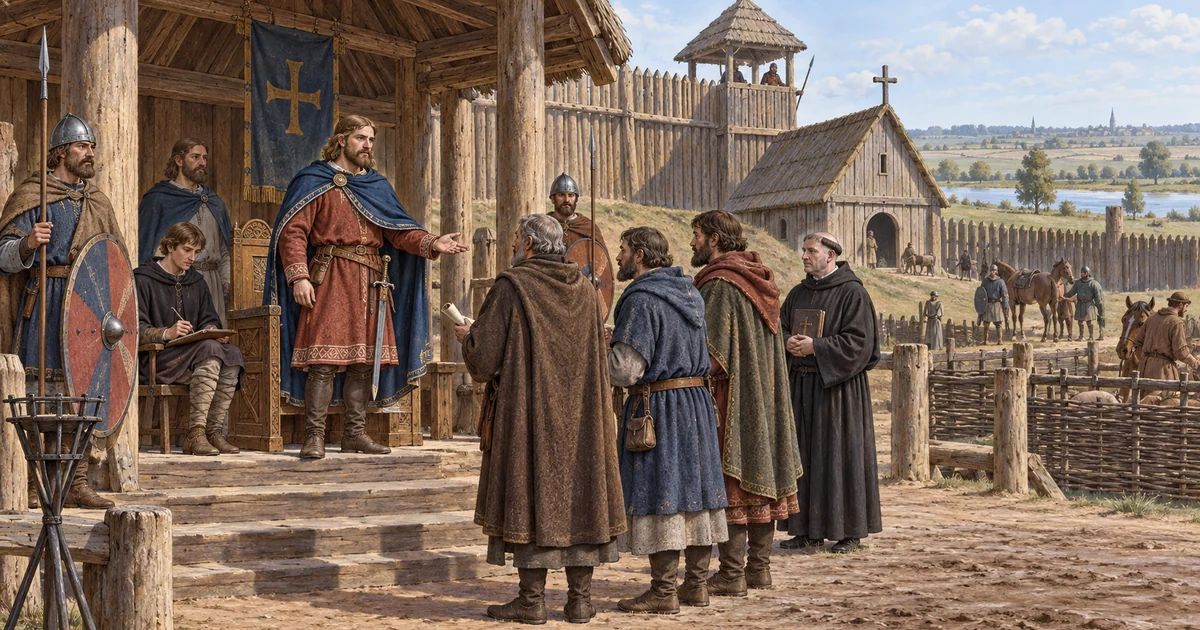
Between the ruin of the ancient city and the rise of the merchant town, Arras passed through a little-known but decisive period: the one in which it became a stronghold of the counts of Flanders and a castellany of their principality. From the partition of the Carolingian empire to the great Norse invasions, the region tipped into a new, feudal world, where power fragmented and fortified itself. Arras gained a distant master, the count of Flanders, and a local master, the castellan, charged with holding the town in his name. It was also during these obscure centuries that the town's lasting shape took form, divided between its episcopal quarter and the borough born around the abbey. This page of history, made of rare texts and archaeology, deserves attention: it explains why Arras was, for more than three centuries, a Flemish town before becoming a French one.
After Nemetacum: Arras in Carolingian Europe
To grasp how Arras entered the Flemish orbit, one must go back to the dismemberment of Charlemagne's empire. After the invasions that had ruined Nemetacum, the city had withdrawn and reorganised around its religious institutions, under the protection of the Frankish kings. The Treaty of Verdun of 843 placed the Artois in West Francia, the future kingdom of France, under the authority of Charles the Bald. Arras was then only the chief town of a pagus, the pagus Atrebatensis, an administrative territory inherited from Antiquity and entrusted to a count appointed by the king. This Carolingian framework, still marked by the idea of a state and a public office, would unravel over the 9th century under the pressure of succession disputes and raids from the north. As royal power weakened, local counts gradually turned their temporary charge into a hereditary domination. From this slow mutation, common to all northern Gaul, the great territorial principalities of the Middle Ages would be born, of which Flanders was one of the most powerful. Arras stood precisely on the southern edge of this forming whole, at the hinge between the Flemish world and the domain of the kings.
Baldwin Iron Arm and the birth of Flanders
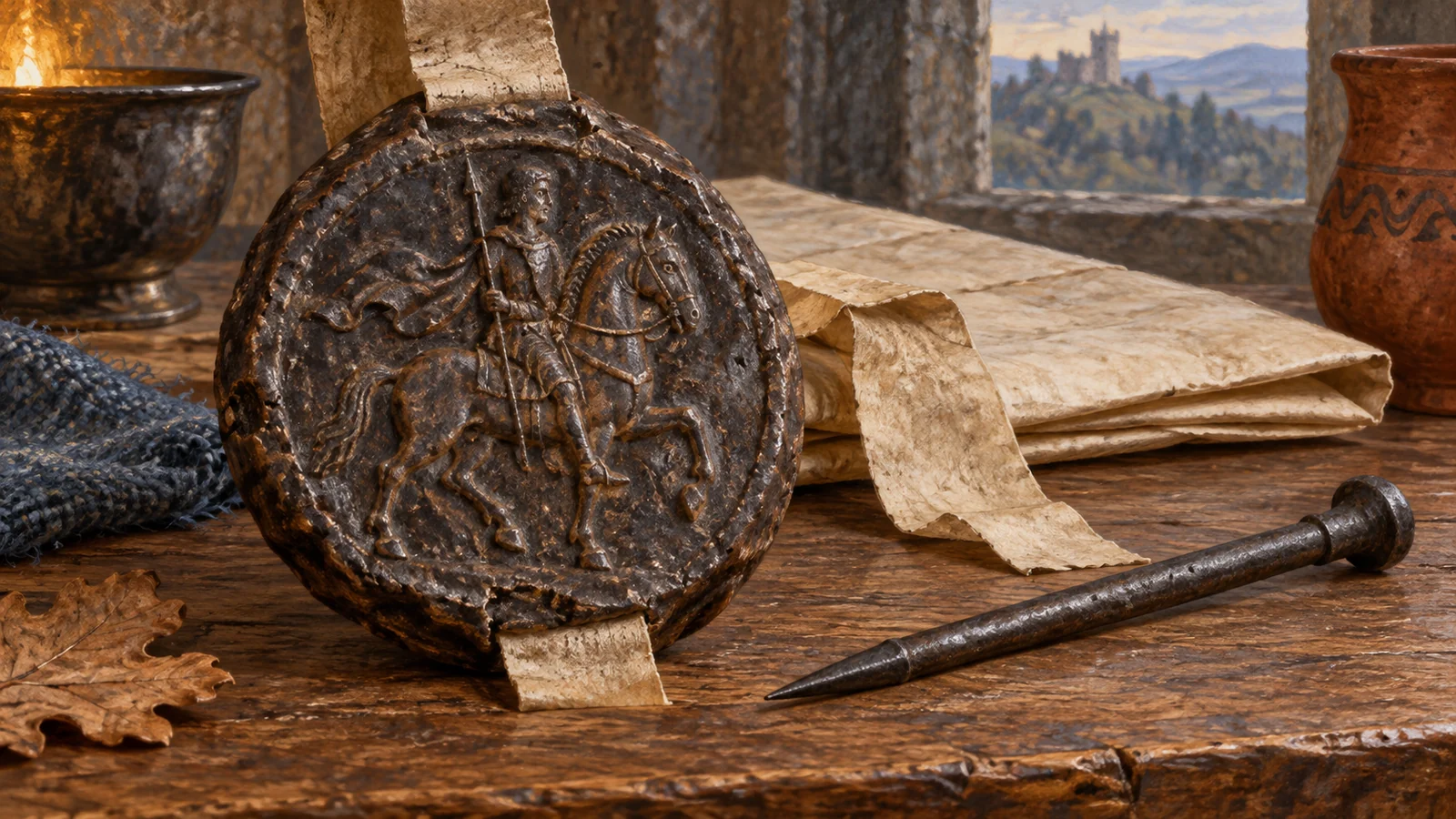
The Flemish principality has a founder with a novelistic destiny: Baldwin I, known as Iron Arm. Around 862, this powerful lord abducted Judith, daughter of Charles the Bald, before obtaining, not without conflict, the king's recognition of his marriage. In exchange, he received the office of count and the mission of defending the maritime frontier against Scandinavian raiders. From this initial nucleus, around Bruges and coastal Flanders, his successors would extend their authority southward, until it embraced the Artois and Arras. This expansion was not a single act but a process, carried out over several generations, mixing inheritances, marriages, shows of force and loyalties negotiated with the king. Historians of medieval Flanders stress how skilful this construction was, turning a military defensive charge into a genuine territorial dynasty. For Arras, the stakes were high: the town and its region passed under the sway of an ambitious prince, whose court, interests and networks looked northward, toward Ghent, Bruges and Ypres, rather than toward Paris. This shift of orientation, discreet in the texts, had deep and lasting consequences for the identity of the Arras city, which was long inscribed in the Flemish economic and political space.
The Norse invasions and the fear of the Vikings
The 9th century was, for all of northern Gaul, a time of dread. The raids of the Norsemen, those navigators from Scandinavia whom the texts also call pagans or Danes, sailed up the rivers and struck monasteries and open towns without warning. The Scarpe and the rivers of the Artois offered routes of penetration, and the Arras region did not escape the threat. The chronicles of the time, often kept by monks, describe plundered sanctuaries, relics carried far away to shield them from danger, populations fleeing before armed bands. This chronic insecurity upended the organisation of space: people took refuge behind ramparts, fortified high points and great religious establishments, learned to live under threat. The historian must, however, beware of exaggerating, in the wake of sources sometimes given to catastrophism, the scale of the destruction: not all towns were razed, and life continued between two alarms. Still, these decades of raids accelerated the militarisation of society and reinforced the role of the counts, alone capable of organising an effective defence. The fear of the Vikings was thus, paradoxically, one of the engines of the building of the principalities, and therefore of the anchoring of Arras in nascent Flanders.
| Marker | Detail |
|---|---|
| 843 | Treaty of Verdun: the Artois in West Francia |
| c. 862-864 | Baldwin Iron Arm, first count of Flanders |
| 9th century | Norse raids, fortification of the towns |
| 10th-11th c. | Arras, castellany of the counts of Flanders |
| 1191 | The Artois enters the royal domain |
Saint-Vaast Abbey, refuge and stronghold
In this turmoil, one place concentrated the life and defence of Arras: the great monastery built around the tomb of the patron saint. Faced with the raids, Saint-Vaast Abbey was gradually transformed into a veritable castle and fortified refuge, protecting its monks, its treasures and the surrounding population. Around it grew a borough, the nucleus of the future merchant town, distinct from the episcopal quarter gathered farther off around the cathedral. This duality, a religious City and an abbatial Town, born of the defensive necessities of the early Middle Ages, would durably mark the topography of Arras and even its political organisation. The abbey was not only a sanctuary: it was a considerable landed power, owning lands, villages and rights over a vast territory, and weighing heavily in the affairs of the region. The counts of Flanders, like the kings before them, sought to attach its abbots and control its wealth, so much was the establishment a pillar of local power. The economic rebirth of Arras in the central Middle Ages, that of cloth-making and fairs, would take root in this fortified abbatial borough, where men, capital and trade were concentrated. One measures thus how far the religious history and the urban history of Arras are, from the outset, inseparable.
What is a castellany?
The word deserves a pause, for it structures the whole government of the town at this period. A castellany was at once a territory and a function: the district around a castle, administered in the prince's name by an officer called a castellan, sometimes viscount. In the feudal system taking shape in the 10th and 11th centuries, the count of Flanders could not be everywhere: he therefore delegated the concrete exercise of power, the keeping of the fortress, justice, the levying of men and taxes, to local lords who represented him. The castellan of Arras was one of these relays, holding the town and its region on the count's behalf, wielding military and judicial authority, and enjoying considerable prestige. Historians of the feudal world, in the wake of Georges Duby, have shown how this interlocking of personal loyalties, lands and offices formed the backbone of medieval society, in the absence of a centralised state. The office of castellan, at first revocable, likewise tended to become hereditary, creating true lineages attached to the town. To understand the castellany of Arras is thus to understand how a city could be governed in a world without modern administration, through a play of men bound to one another by oath and service, from the count to the simple sergeant-at-arms.
Arras, a Flemish town before a French one
It bears insisting, for it is often forgotten: for more than three centuries, Arras was not a French town but a town of the county of Flanders. This belonging was in no way theoretical. It oriented trade toward the great cloth-making centres of the north, shaped the alliances of the local elites, inscribed the city in a space where Flemish and Romance rubbed shoulders. The Artois, of which Arras was the main town, formed the southern and largely Romance part of the Flemish principality, a land of the langue d'oïl turned toward a prince whose domain's heart often spoke Dutch. This frontier situation, between two linguistic and political worlds, makes all the originality of the history of Arras. It also explains the covetousness of which the town was the object: rich, well placed, it interested the counts of Flanders as much as the kings of France, who never ceased to extend their domain northward. The shift toward France would come only at the end of the 12th century, when the Artois left the Flemish orbit to enter the royal patrimony. Until then, to say one was of Arras was to belong to Flanders, and this long Flemish period left in the town, its law, its institutions and its culture, an imprint that the following centuries never quite erased.
The City and the Town: two poles, one destiny
The geography of power in Arras in the early Middle Ages can still be read today in names and places. On one side, the episcopal City, gathered around the cathedral and the bishop, heir to the ancient nucleus and centre of diocesan religious power. On the other, the Town, born of the merchant borough that prospered under the shelter of Saint-Vaast Abbey, seat of economic activity and soon of communal autonomy. These two ensembles, long distinct, with their own ramparts, authorities and interests, would only merge administratively in the modern era. This duality, singular among the towns of the North, is a direct legacy of the feudal centuries, when each power, the bishop, the abbot, the count through his castellan, sought to fasten its grip on a piece of the urban space. It was a source of rivalries but also of wealth, each pole drawing men and buildings. The historian who walks through Arras today finds this imprint in the layout of the squares, in the ancient separation between the cathedral quarter and that of the former abbey. To understand the counts of Flanders and their castellany is thus also to understand why Arras was long a double town, whose unity came about only slowly, at the end of a long companionship between the abbot's crosier, the bishop's mitre and the castellan's sword.
Rare sources, archaeology and caution
Writing the history of Arras between the 9th and the 11th century is a difficult exercise, and it must be said to the reader. The written sources are rare, scattered, often later than the events: charters, monastic annals, incidental mentions in texts drawn up elsewhere. Many were lost through the wars and fires that struck the town. Archaeology completes this patchy picture by revealing traces of occupation, fortification and craft, but its results must be interpreted with caution. Faced with these uncertainties, the serious historian refrains from asserting more than the documents allow: he proposes hypotheses, signals the debates over datings, distinguishes what is established from what is probable or conjectural. The great synthesis directed by Pierre Bougard, Yves-Marie Hilaire and Alain Nolibos, like the works of Jean Lestocquoy on medieval Arras, offer precious guides here, weighing each testimony. This rigour takes nothing from the interest of the period: on the contrary it invites reading it for what it is, a moment of formation, in which a town slowly reinvents itself after the fall of Antiquity. Far from easy certainties, the history of early medieval Arras is an open worksite, where each excavation and each rereading of the texts can still bring their stone.
A legacy reaching to the communal town
What the counts of Flanders and their castellans bequeathed to Arras goes far beyond the political frame. By protecting the town, organising its defence and its administration, they allowed the city to cross the obscure centuries and be reborn. It was under their authority, and often by dealing with them, that the Arras bourgeoisie grew rich, that cloth-making prospered and that the town ended by claiming its liberties. The great figure of Saint Vaast, first bishop of Arras, had given the town its religious soul; the counts of Flanders gave it its feudal frame, within which the medieval commune would hatch. The two urban poles, the castellany, the fortifications, the weight of the abbey: all these elements inherited from the early Middle Ages conditioned the town's later history, that of its textile and literary golden age. To look at this period is to grasp the invisible foundations on which the brilliant Arras of the 13th and 14th centuries would be built. Before the tapestries and the trouvères, before the fairs and the bankers, there were these centuries of patience and reconstruction, in which a small Flemish town learned, under the guard of its counts, to become great.