
Saint Vaast, first bishop of Arras: what does the bear legend say?

After the fall of the Roman city, it was a religious figure who would reopen the history of Arras: Saint Vaast, first bishop of Arras. Sent to re-evangelise a region partly returned to paganism and covered in ruins, he embodies the passage from the ancient world to the Christian world of the early Middle Ages. Around his memory a persistent legend was woven, that of the bear he is said to have driven off, which became his emblem. His story reaches us mainly through hagiographic accounts written long after his death, to be read with the historian's critical eye. It remains foundational nonetheless: from Saint Vaast, his tomb and the abbey that would spring from it, the medieval town of Arras would be reborn. A look back at a figure at the hinge of two worlds.
A saint at the origins of Christian Arras
To understand Saint Vaast, one must recall the state of the region in his time. After the invasions that ruined the ancient city, the land of Arras was largely devastated, its population thinned and Christian life, poorly established, in retreat. It is in this landscape of ruins and spiritual reconquest that Vaast intervenes, around the year 500. His mission was not to found a new religion on a blank slate, but to revive a faltering faith and reorganise a barely born local Church. The context is that of the nascent Frankish kingdom, where the conversion of kings and peoples opened the way to a deep Christianisation. Arras, a fallen former Roman city, had to regain a place in this new spiritual order. The role ascribed to Saint Vaast is thus that of a refounder: he not only rebuilt churches, he reinscribed the town in the Christian history of Gaul. On this account he is regarded as the father of Christian Arras, at the origin of a religious continuity that would run through the whole Middle Ages.
From Clovis to the bishopric of Arras
Tradition attaches the name of Vaast to a major episode of French history: the conversion of Clovis. According to the accounts, it was Vaast who was charged with instructing the Frankish king in the Christian faith before his baptism, on the road that led Clovis toward Reims. This episode, even if partly a hagiographic construction, places Vaast from the outset among the great, at the heart of the kingdom's Christianisation. Soon after, he was established bishop of the region, his charge covering Arras and, in tradition, the Cambrai area. To become a bishop, at that time, was to receive an authority both spiritual and social, in a world where the Church was taking over from collapsed Roman structures. The bishop was a pastor, but also an organiser, a protector of the people and an interlocutor of power. By linking Vaast to Clovis and then to the bishopric of Arras, tradition places the town within the great narrative of the Christian origins of France. One must, however, bear in mind that these accounts, written later, also aimed to magnify the saint and his episcopal see.
A ruined city to re-evangelise
The picture the sources paint of the Arras Vaast finds is a bleak one. The town, heir to the Roman city, was but a shadow, its buildings in ruins, its inhabitants returned to pagan practices or indifferent to religion. The re-evangelisation ascribed to him thus consisted of raising both stones and souls: restoring places of worship, preaching, baptising, re-establishing an organised Christian community. This work of spiritual reconstruction is typical of the action of early medieval bishops, architects of a Gaul deeply Christianised after the upheavals of the 5th century. One must beware of exaggerating, in the wake of the hagiographers, the extent of the paganism Vaast supposedly faced: these accounts often overstate to better exalt the saint's work. But they convey a deep reality, that of a region to be rebuilt, where the Church played a driving role. Through the figure of Vaast, a whole historical moment can be read, the one when Christianity establishes itself as the cement of a new society, on the rubble of the ancient world.
| Marker | Detail |
|---|---|
| Period | Around the year 500, at the dawn of the Frankish kingdom |
| Role | First bishop of Arras, re-evangeliser |
| Legend | The driven-off bear, become his emblem |
| Legacy | Saint-Vaast Abbey and the first name Gaston |
The legend of the bear
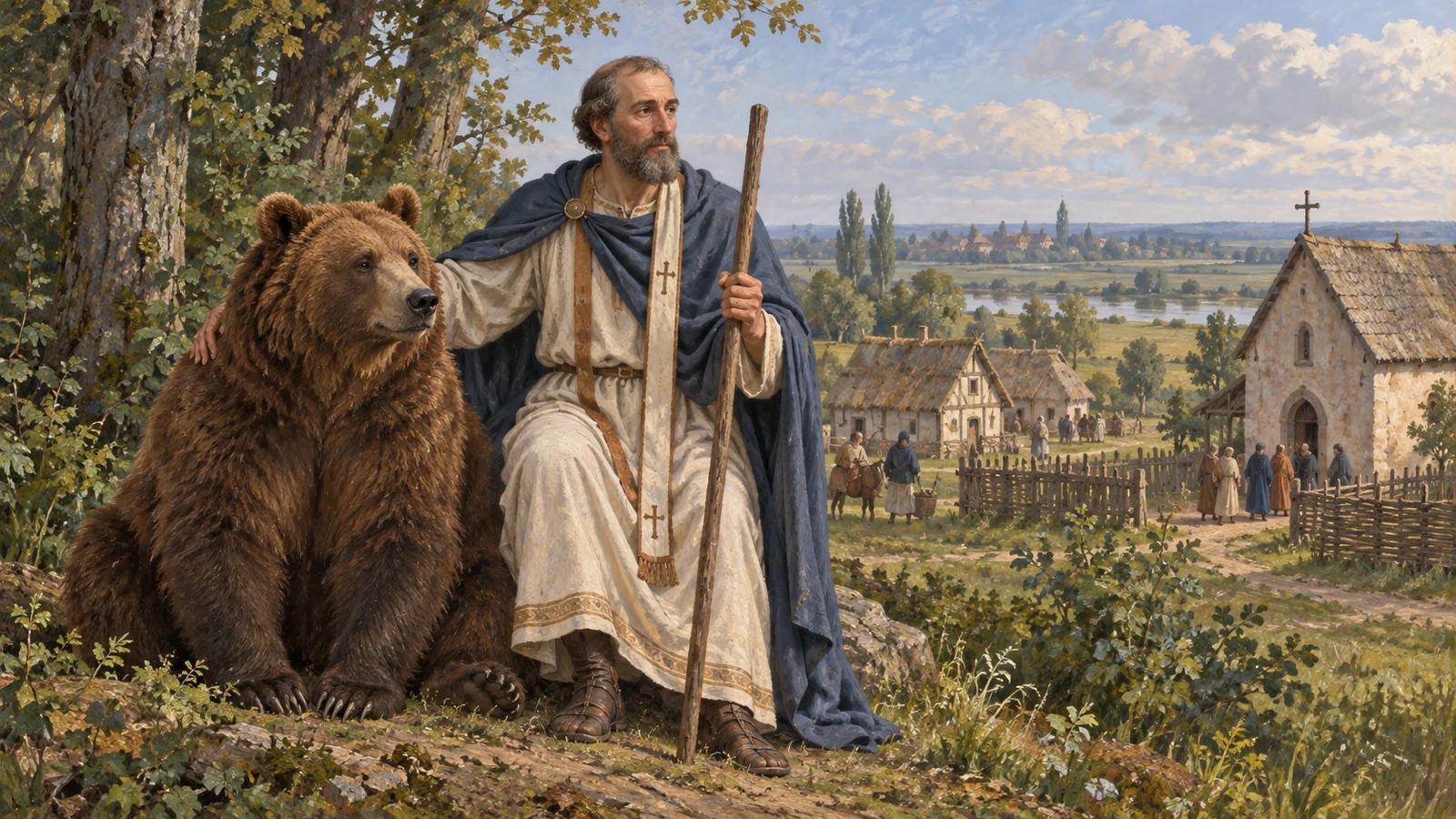
No account of Saint Vaast would be complete without the famous legend of the bear. Tradition holds that, arriving in the ruined church of Arras, Vaast came face to face with a bear that had made its den in the abandoned place. With a word, the saint is said to have commanded the beast to leave and never return, and the bear, docile, moved away forever. This wondrous episode, like so many hagiographic tales, has no value as historical fact: it belongs to the symbolic language proper to lives of saints. The bear there figures the wildness, paganism or disorder that the saint pushes back by the force of faith; its flight illustrates the triumph of Christian civilisation over a world returned to savagery. This is why the bear became Saint Vaast's attribute, often depicted at his side in religious art. To understand this legend is not to take it literally, but to read in it a message: that of a saint reputed to have tamed a country gone wild again. The historian treats it as a source on representations and devotion, not as the account of a real event.
Hagiography and history: what do we really know?
Caution is called for as soon as one speaks of early medieval saints. What we know of Vaast comes essentially from hagiographic accounts, those lives of saints written for the edification of the faithful, often long after the events. The oldest life of Vaast was written by a monk, then taken up and enriched in Carolingian times. These texts obey precise codes: they celebrate the saint's virtues and miracles more than they report an exact biography, and they readily borrow motifs common to other lives. The historian must therefore distinguish the plausible core, the existence of a bishop named Vaast working for the Christianisation of Arras around the year 500, from the legendary additions such as the bear or certain miracles. The dates themselves remain uncertain and vary from one source to another. This critical approach, far from impoverishing the figure, makes it more interesting: it shows how the memory of a saint is made and how a community gives itself a founder. Saint Vaast is thus at once a historical figure, of probable existence, and a memorial construction, shaped over the centuries by devotion and the needs of the Church of Arras.
The death and cult of Saint Vaast
After a long life devoted to his Church, Vaast died, according to tradition, in the middle of the 6th century. His tomb at once became a place of devotion, and his cult never ceased to grow. It was around his relics that the religious future of the town crystallised: much later, bishop Aubert had his body transferred and founded a monastery that would become the powerful Saint-Vaast Abbey, one of the most important in northern France. The saint's tomb drew pilgrims, gifts and protections, making his cult a driver of urban rebirth. In a medieval world where relics were at the heart of religious and even economic life, holding the body of a founding saint was a major asset. The cult of Vaast quickly overflowed the borders of Arras, carried by the influence of the abbey. Thus the saint's death does not close his story: on the contrary it opens it onto a long posterity, in which his memory structures the town and gives it a patron. This is one of the most striking traits of the early Middle Ages, where holy dead counted as much as the living.
Vedastus, Vaast, Gaston: a name that took root
The trace of Saint Vaast can be read even in language. His Latin name, Vedastus, gave in French the forms Vaast and Gaston, the latter first name coming directly from the saint. It also spread into a multitude of place names, the many Saint-Vaast of northern France, witnesses to the diffusion of his cult. This onomastic imprint is not incidental: it measures, in its way, the importance of a saint in a region's memory. Where the cult was strong, children and parishes were named after him, so that geography and civil registers still keep the memory of Vedastus today. For the historian, these names are precious clues to a saint's area of influence and the vitality of his devotion. That the first name Gaston, still borne today, descends in a straight line from the first bishop of Arras is surprising and delightful. This small fact of language recalls how much the distant past irrigates, often unknown to us, our most everyday present, and how lastingly Saint Vaast marked the north of the country.
From Saint Vaast to the medieval town
The legacy of Saint Vaast goes far beyond his person. By giving Arras back a Church and a patron, he laid the foundations of the medieval town that would flourish around the abbey and, later, its Gothic cathedral. The city reborn in the Middle Ages is a Christian town, structured by its religious institutions, its parishes and its places of pilgrimage, of which Saint Vaast is the first source. To make this figure known is to understand why Arras developed where it did, and why religion held such a central place there. From the bishop of the ruins to the great patron saint, the trajectory of Vaast follows that of the town: a rebirth after chaos, a patient reconstruction, a faithfulness to a memory. As one visits the former Saint-Vaast Abbey, now museum and cathedral, it is worth recalling the man who, fifteen centuries earlier, is said to have driven a bear from a ruined church. Behind the legend, it is the first Christian chapter of Arras that is written, and one of the most enduring of its history.