
Attila and the invasions: how did Nemetacum, ancient Arras, end?
Every city has its golden ages and its collapses. For Arras, the end of Antiquity was a time of great invasions and ruin, which swept away the prosperous Gallo-Roman city of Nemetacum. In the 5th century, waves of peoples from the east, then the dreaded passage of Attila and his Huns, plunged northern Gaul into chaos. This dark episode, known through ancient chronicles, hagiographic accounts and archaeology, marks the transition from the Roman world to the Frankish one. It must be told with caution, for the sources mix facts, exaggerations and legends, but it lights up a decisive moment: the one when the ancient city vanishes, before another, medieval and Christian, is reborn a little later on these lands.
The end of a world: an empire in crisis
The fall of Nemetacum was no thunderclap in a clear sky, but the outcome of a long decline. From the 3rd century, the Roman empire had gone through severe crises, and northern Gaul, exposed at the frontiers, had become militarised and fortified. The prosperous town described in the history of the Gallo-Roman city of Nemetacum had gradually drawn back, turned toward its defence. Imperial power, weakened by internal struggles and pressure at the frontiers, struggled to protect its northern provinces. At the turn of the 5th century, this fragility became a gaping breach. The Roman army, once all-powerful, no longer sufficed to hold back the peoples pressing at the gates of the empire. To understand the end of Nemetacum thus means placing it in this general context of gradual collapse, where an urban, refined civilisation gives ground, year after year, to insecurity. It is not an isolated town that sinks, but a whole world, that of Roman Gaul, which wavers and is about to tip into another age.
The great invasions of 406-407
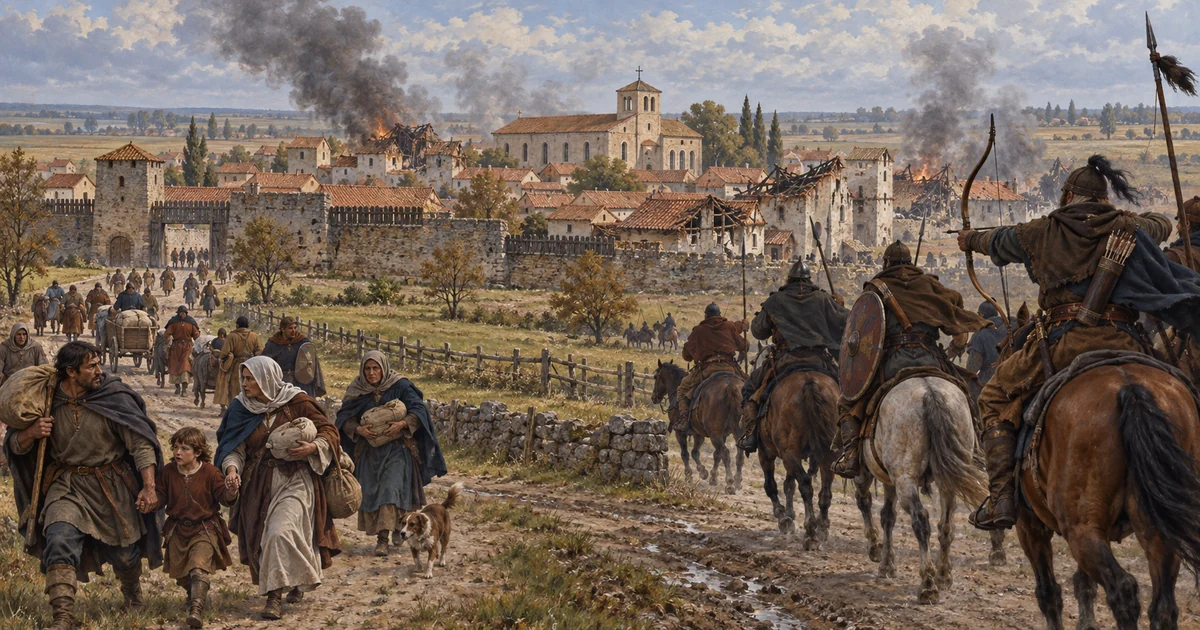
The decisive shock came from the east. In the winter of 406-407, several peoples, among them the Vandals, Alans and Suebi, crossed the frozen Rhine and spread across Gaul, sowing devastation in their wake. The towns of the North, Nemetacum among them, bore the full brunt of this surge. The chroniclers of the time, often clerics, describe cities looted and burned, populations in flight, a land given over to fire and sword. These accounts must be read with discernment, for they sometimes overstate to strike minds or teach a moral lesson. Archaeology nonetheless confirms traces of destruction and rupture in several towns of the region at this period. For Nemetacum, these invasions mark a fateful turning point: the city, already weakened, does not recover as before. This episode belongs to the great movement of peoples that, throughout the 5th century, redrew the map of the West and hastened the end of the Roman empire in Gaul. The land of Arras thus found itself at the heart of a turmoil that reached far beyond its borders.
The destruction of Nemetacum
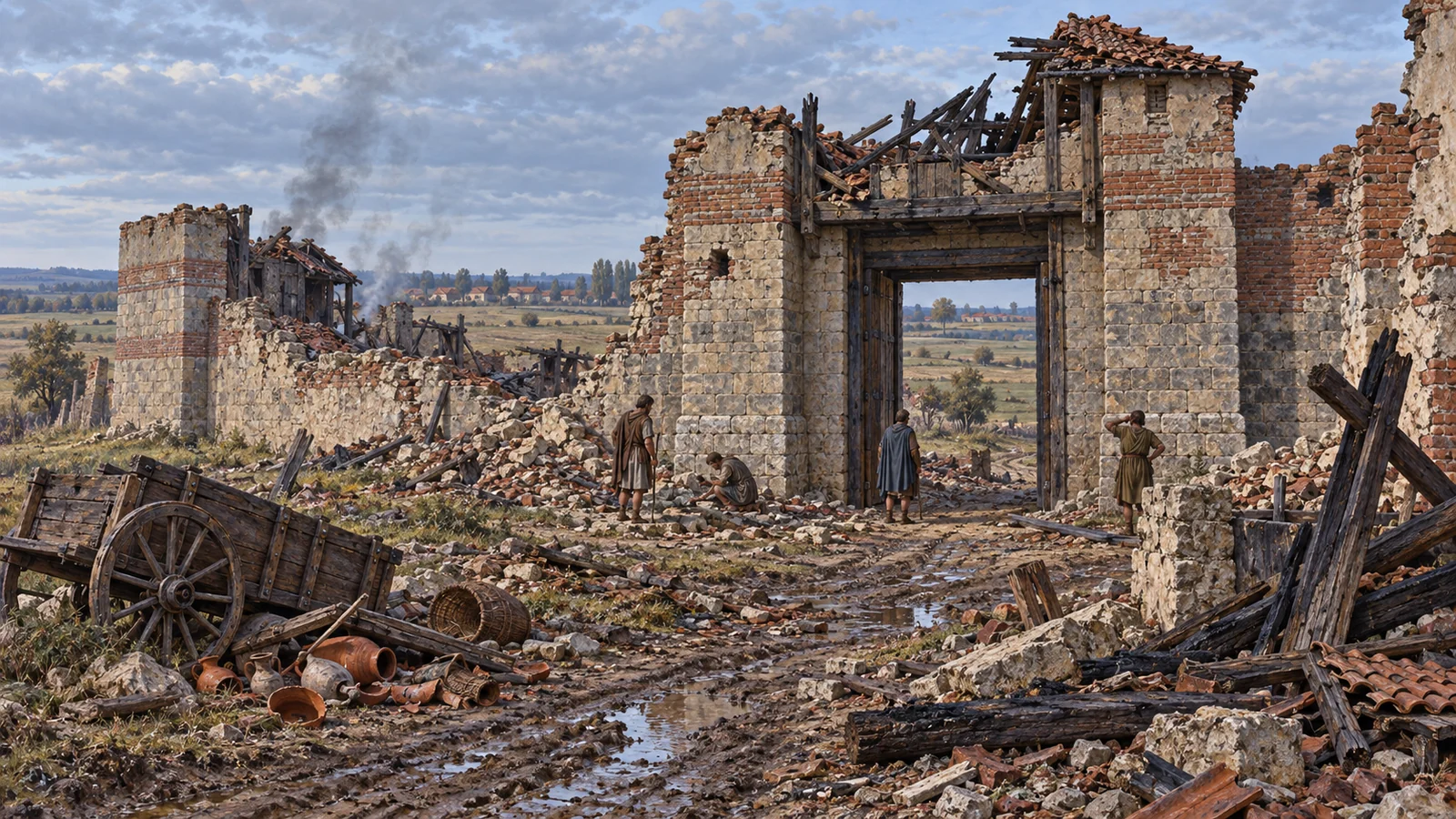
Of the brilliant Gallo-Roman city, the invasions left only a field of ruins. The destruction of Nemetacum, in the early 5th century, sounds the death knell of the first town of Arras. The public buildings, dwellings and workshops that were the city's pride were largely ruined or abandoned. The population, decimated or scattered, no longer sufficed to sustain an urban centre of this scale. One should not, however, imagine a total and instant disappearance: life did not go out at once, and a residual occupation may have persisted on the site or nearby. But the organised, open, prosperous town now belonged to the past. This rupture, archaeology reads in the destruction layers and the abandonment of whole districts. For historians, the end of Nemetacum illustrates the fate of many Gallo-Roman towns of the North, swept away by the conjunction of invasions, insecurity and the fading of Roman power. The ancient city of Arras thus died out, leaving behind buried remains and a name destined to change over the centuries.
Burying one's goods: the age of hoards
These troubled times left a precious, paradoxical trace: buried hoards. Faced with the threat, well-off inhabitants hid their most precious goods in the ground, hoping to recover them once the danger had passed. Many never came back for them, dead, exiled or ruined, and so hoards have reached us intact, as if frozen in the instant of fear. The territory of Arras has yielded a striking testimony, slightly earlier than these invasions but revealing the same anxiety, with the Beaurains hoard found in 1922. These deposits are for the historian an irreplaceable source: they date moments of crisis, reveal the wealth of the elites and tell, in their way, the anguish of an age. Each buried hoard is like an unopened letter, sent by the past to whoever can read it. That such deposits are found in the region confirms that insecurity there was real and lasting. Behind the gleam of gold, it is the fear of invasion that can be read, and the tragedy of families caught by the storm.
| Marker | Event |
|---|---|
| 406-407 | Crossing of the Rhine, invasions and devastation of northern Gaul |
| Early 5th c. | Destruction of Nemetacum, the Gallo-Roman city of Arras |
| 428 | The Franks of Clodio advance to the Somme |
| 451 | Passage of Attila and the Huns through the region |
The arrival of the Franks
On the ruins of Roman order advanced a people destined for greatness: the Franks. Around 428, their chief Clodio, nicknamed the Long-Haired, extended his rule over the region as far as the Somme, gaining a foothold in a country where Roman power was fading. This Frankish push was not a mere raid, but a lasting settlement, prelude to the formation of the kingdom that, under Clovis and his successors, would unify Gaul. Northern Gaul, including the land of Arras, was thus one of the cradles of the Frankish and Merovingian world. The transition was not only destructive: it also saw the setting up of new powers, new elites and, soon, the rise of Christianity that would reorganise society. The Franks, first seen as invaders, became the masters and heirs of the country. To understand their arrival is to grasp the shift from an ancient world to a medieval one, whose mark Arras would bear. It is not the end of local history, but the start of a new chapter, in which the town would be reborn in other forms and other names.
Attila and the Huns in the region
In the midst of this troubled 5th century rose a figure of terror: Attila, king of the Huns, whose name alone evoked devastation. In 451, his armies surged into Gaul, and tradition reports that they ravaged Arras before pressing on toward Amiens and Paris. Attila's passage belongs to a famous campaign that saw the Huns threaten all of northern Gaul before being stopped. These accounts must, however, be handled with caution: the memory of Attila, amplified by chronicles and legends, has sometimes exaggerated the real scale of destruction in this or that locality. What is certain is that the region went through, with the Huns, a new episode of violence, at the very moment it was barely recovering from the earlier invasions. The name of Attila remains attached, in regional memory, to this dark period. For the historian, what matters is less to draw up a precise material balance, hard to establish, than to understand the climate of extreme insecurity in which the inhabitants then lived, tossed from one threat to another at the twilight of the ancient world.
The Catalaunian Fields and the retreat
The Hunnic threat did not last. In 451, a coalition gathered by the Roman general Aetius, uniting Romans, Visigoths and Franks, faced Attila at the famous battle of the Catalaunian Fields, somewhere in Champagne. The bitterly disputed outcome forced the Huns to retreat and broke the momentum of their invasion of Gaul. Attila died soon after, and his empire quickly fell apart. For the Arras region, this retreat ended the immediate terror, but the harm was done: northern Gaul emerged drained from these decades of violence. The victory of the Catalaunian Fields is often presented as a turning point, but it did not stop the underlying process, the transformation of Roman Gaul into barbarian kingdoms. It recalls above all that the fate of a small city like Nemetacum was now decided in vast confrontations of which it was only one stake among others. The ancient world was fading, not through a single event, but through a series of shocks of which the invasions and Attila's passage were, for Arras, the most striking. The hour of a new world had come.
Invasions or migrations? a debate among historians
How should these events be named and interpreted? The question divides historians, and caution is called for. For a long time people spoke of barbarian invasions, an expression with strong connotations, stressing violence and destruction. For several decades, some researchers have preferred to speak of migrations or transformations, stressing that the settlement of peoples was also a process of exchange, alliance and integration, more complex than a mere destructive surge. The truth is doubtless both: there were indeed ravages, attested by sources and archaeology, but also continuities, recompositions and the birth of a new world. For Nemetacum, this invites us to nuance the image of a town wiped off the map overnight: the decline was real, but gradual, and life persisted on the site. This historiographical debate is fascinating, for it shows that history is constantly rewritten as methods are refined and sources questioned. To keep the complexity, rather than a simplistic image of barbarians destroying everything, is the best way to do justice to this pivotal period.
From the ancient city to the Frankish town
The end of Nemetacum was not the end of Arras, but a metamorphosis. After the chaos of the invasions, life gradually reorganised, under Frankish authority and thanks to the rise of Christianity. It was a little later, around a Saint-Vaast Abbey founded on these lands, that the medieval town would be reborn, shifted from the ancient city and animated by a new spirit. The rupture of the 5th century was thus also a beginning: that of the long Arras Middle Ages, Christian and building, which would give the town its lasting face. To look at the end of Nemetacum is not only to contemplate ruins, it is to understand how a city dies and how another prepares to be born on the same soil. This continuity beyond catastrophes is one of the great lessons of the history of Arras: two thousand years old, the town has survived invasions, wars and destruction, always rising again in a new form. The ancient twilight was but the dawn of another world, whose first pages the abbey and the medieval town would write.