
The Beaurains hoard, what Gallo-Roman gold was found near Arras?
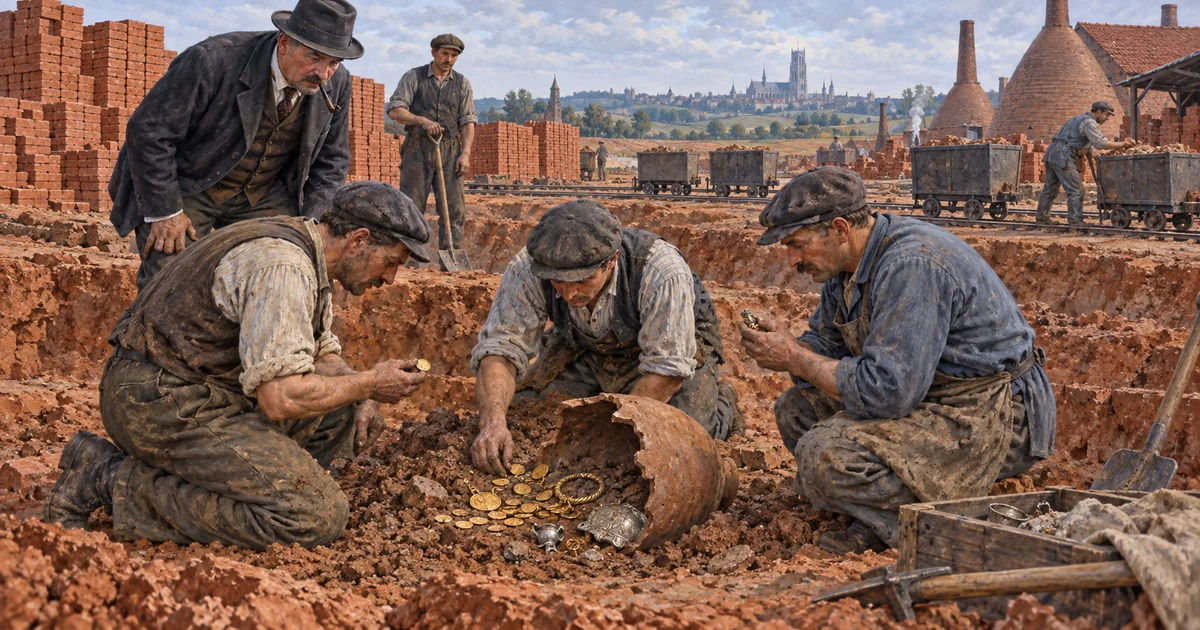
In 1922, on the edge of Arras, workers accidentally uncovered one of the most extraordinary sets of ancient gold ever found in France: the Beaurains hoard, often called the Arras treasure. Gold coins, imperial medallions and jewellery of unheard-of luxury made up this deposit buried in the early 4th century, when the Roman empire was reorganising under the Tetrarchy. Among these pieces was a unique jewel, the Arras Medallion, which bears the oldest known depiction of the city of London. But the story of this hoard is also one of waste, for its chaotic discovery led to its dispersal before any serious study. This is the tale of a fabulous treasure, its splendour and its fate, which lights up the ancient past of Arras with a gleam of gold.
A chance discovery in 1922
Nothing foretold such a find. Digging the ground at Beaurains, a commune next to Arras, workers came upon a set of gold coins and precious objects buried for nearly seventeen centuries. This kind of chance discovery is common in archaeology, but the scale and quality of this deposit made it at once an exceptional event. We are in a region whose soil keeps the traces of a long Roman presence, as recalled by the history of the Gallo-Roman city of Nemetacum, to which Beaurains was very close. The treasure therefore belonged to the world of this ancient town and its territory. Sadly, gold attracts greed as much as admiration: the find was not made under the rigorous conditions of a scientific dig, but in some confusion, where sharing and selling took precedence over study. Here lies the whole ambiguity of this discovery, at once a heritage miracle and a missed opportunity, whose consequences for our knowledge of the site historians and archaeologists still measure today.
Beaurains, on the edge of Arras
The place of the discovery is not incidental. Beaurains, today a commune of the immediate suburbs of Arras, lay within the orbit of the ancient city, on a territory densely occupied in Roman times. The outskirts of ancient towns held necropolises, farming estates, workshops and dwellings, and it is not rare to find coin deposits there. Burying a treasure was indeed, in Antiquity, a common way to shelter one's goods in times of insecurity, in the hope of recovering them later, a hope sometimes dashed by the death or exile of the owner. That this deposit was never reclaimed by the one who buried it says much about the troubles of the age. The location at Beaurains thus firmly ties the treasure to the Gallo-Roman past of Arras, and not to some distant origin. It is indeed a local testimony, buried in the soil of the Artois by a contemporary of the Roman city. This geographical anchoring makes the treasure a precious milestone of the ancient history of the town, even if the circumstances of its discovery blurred part of the context.
What the hoard contained
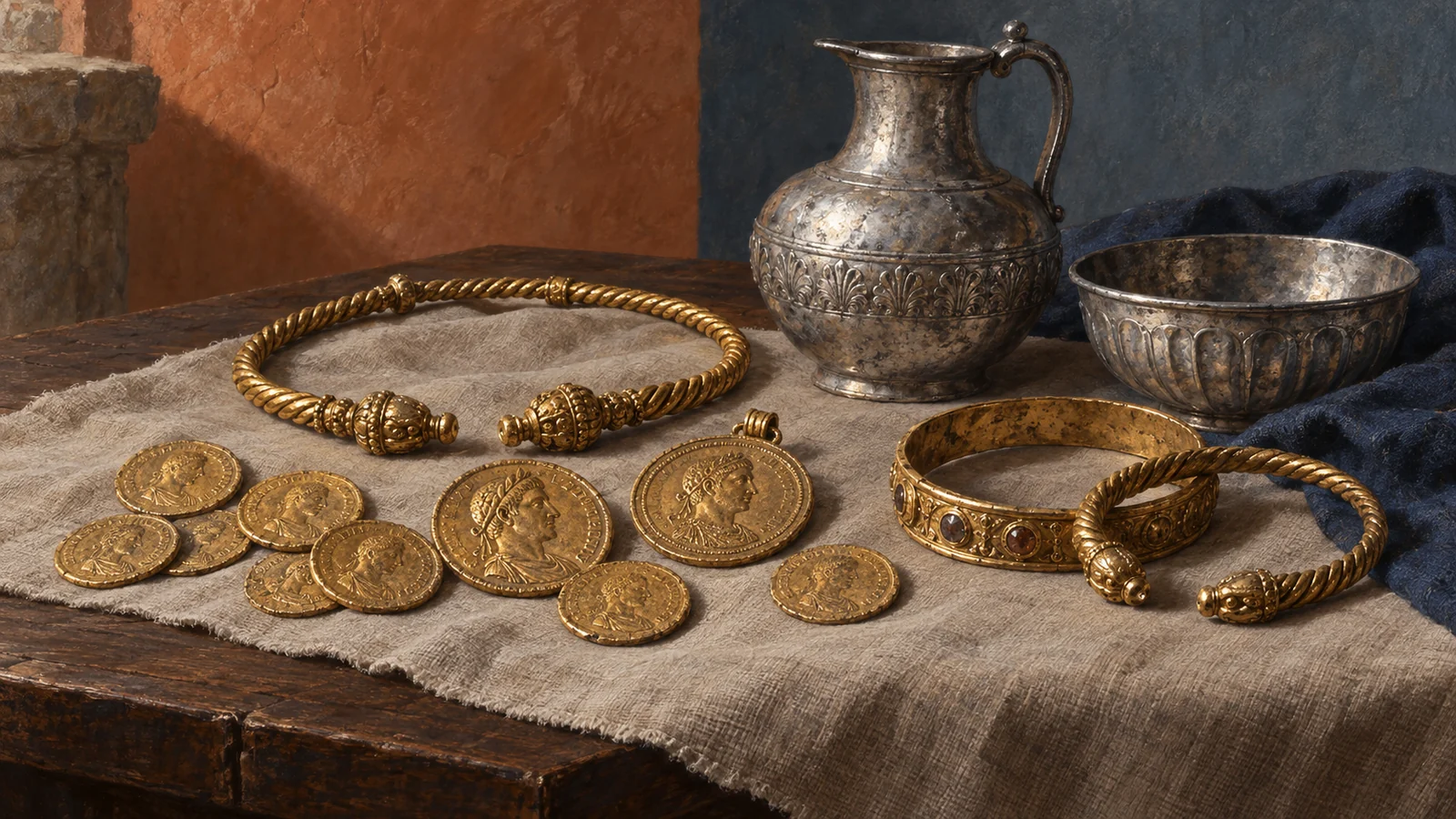
The content of the deposit was dazzling. The hoard gathered a remarkable set of gold coins, including ordinary pieces but also multiples and large-module medallions, rare objects reserved for exceptional uses. To these coins were added jewellery of very high quality, rings, ornaments and worked gold pieces, attesting to the skill of the craftsmen of the age. The whole represented a considerable fortune, far beyond the wealth of an ordinary individual, which fed the hypothesis of a high-ranking owner, perhaps an officer or a dignitary linked to imperial power. The very composition of the treasure, mixing coinage, prestige objects and distinctions, points to the idea of an official gift or an accumulation tied to service of the state. Without the precise context of a dig, one must remain cautious about the exact identity of the owner and the reasons for burial. But the nature of the pieces is enough to measure the exception: imperial gold medallions, reserved for the greatest, are not buried by chance. The Beaurains hoard belongs to the rarest category of ancient coin discoveries.
| Marker | Detail |
|---|---|
| Discovery | 1922, at Beaurains, on the edge of Arras |
| Period | Early 4th century, under the Tetrarchy |
| Content | Gold coins, imperial medallions, jewellery |
| Star piece | The Arras Medallion and the oldest image of London |
Gold coins and imperial medallions
At the heart of the hoard, the gold medallions hold a place apart. Unlike ordinary coins, these large-module pieces were not meant to circulate in trade: they served as exceptional gifts, offered by the emperor to his relatives, officers or dignitaries on great occasions such as a victory, a taking of office or an anniversary of reign. To receive such a medallion was a signal honour, a mark of imperial favour that one kept preciously. Their presence in the Beaurains hoard confirms the high rank of its owner and places him within the circle of power. These objects, at once monetary and political, bore a careful iconography in the service of imperial propaganda: they celebrated the ruler's virtues, his victories and the idea of the restoration of Roman order. To study these medallions is therefore to read a message as much as to admire a feat of goldsmithing. From this point of view, the Arras treasure offers a set of rare richness, where gold becomes discourse and each piece tells, in images, the ideology of an empire in full reorganisation.
The Arras Medallion, the star piece
If only one object were to be kept, it would be the famous Arras Medallion. This large gold piece celebrates the emperor Constantius Chlorus and his entry into London after the reconquest of Britain, in 296 AD, from the usurper who had seized the island. The image is striking: the emperor, on horseback, approaches the walls of a city personified by a kneeling figure who welcomes him, while a warship recalls the crossing of the fleet. This scene is the oldest known depiction of London, which gives the medallion an exceptional value, far beyond its weight in gold. It attests to a major episode of Roman history, the reintegration of Britain into the empire, and stages the restoring power of the ruler. As a curious footnote, it was therefore in the soil of the Artois that the oldest image of one of the world's most famous capitals was found. This unexpected link between Arras and London, woven by a gold medallion buried at Beaurains, perfectly illustrates the European dimension of the region's ancient heritage.
Nemetacum in late Roman Gaul
To understand the treasure, one must place it in its time. In the early 4th century, the empire was emerging from a period of deep crises and reorganising under the Tetrarchy, that multi-emperor government devised by Diocletian. Northern Gaul, long prosperous as shown by the ancient origins of Arras, then went through a time of military and administrative recovery, but also of persistent threats at the frontiers. It is in this context of imperial restoration, marked by the reconquest of Britain, that the Beaurains hoard belongs. Its owner, no doubt linked to the army or the administration, lived in a world where wealth could at any moment be threatened, hence the reflex to bury one's goods. The Arras region, close to the great roads and strategic zones, was directly concerned by these movements. The treasure is therefore not an object out of context: it is rooted in a precise period, that of an empire recovering while staying on its guard. This contextualisation, dear to historians, avoids reducing the treasure to its mere material value and restores its historical depth.
Jewellery and exceptional goldsmithing
The treasure was not limited to coins: it also included jewellery of great finesse. These gold objects, ornaments and worked pieces, reveal the refinement of the elites of late Antiquity and the technical mastery of the craftsmen. Gold, the noble material par excellence, was shaped here by processes inherited from a long Mediterranean tradition, combining casting, hammering and minutely detailed decoration. This jewellery had a double function: to adorn the wearer and to display their rank, for wealth, in the Roman world, was meant to be seen. Their presence alongside the medallions reinforces the image of a wealthy, well-connected owner, alive to the prestige conferred by display. For the art historian as for the amateur, these pieces are a precious testimony of the taste and luxury of an age too often imagined as only warlike and troubled. They recall that, even in uncertain times, the art of goldsmithing continued to flourish in the service of the powerful. The Beaurains hoard thus offers a complete panorama, from official coin to intimate jewel, of the wealth of a dignitary of Roman Gaul.
The dispersal, a heritage tragedy
The story of the treasure sadly has a dark side. For want of being discovered within a scientific dig, the set was quickly dispersed, shared and sold, before specialists could study it in its entirety and its context. This dispersal is an immense loss for knowledge: deprived of the context of their burial, the objects lose part of their meaning, and it becomes hard to reconstruct the original whole, its exact number of pieces and its organisation. Archaeologists regularly deplore this kind of mishap, which recalls the vital importance of a supervised discovery. The Beaurains hoard thus became a textbook case, cited to illustrate what is lost when the lure of gain prevails over rigour. Researchers later strove to find and identify the scattered pieces, a patient and never-finished task. This dispersal takes nothing from the value of the objects themselves, but it deprives Arras and science of part of their treasure. It is also a lesson on the fragility of heritage and the need to protect it from the very moment of its discovery.
Where the treasure can be seen and what it reveals
Where did the pieces of the treasure go? The dispersal scattered the set among several public and private collections, in France and abroad, so that no single place today holds the whole of the Beaurains hoard. Leading heritage institutions hold parts of it, and the town of Arras keeps the memory of this major discovery made on its soil. For the curious visitor, it is also a chance to take an interest in the ancient collections and local history shown in Arras, notably at the Arras museum of fine arts, housed in the former Saint-Vaast Abbey. Beyond its splendour, the hoard tells something essential about Arras: it proves that the territory of the ancient city was integrated at the highest level into the Roman world, to the point of sheltering the fortune of someone close to imperial power. It links the Artois to the great events of the age, from the reconquest of Britain to the reorganisation of the empire, and even, through the medallion, to the history of London. It recalls the depth of the ancient past of a town first associated with its Baroque squares and its belfry, but whose roots reach far further. The Beaurains hoard is not merely a numismatist's curiosity: it is a fragment of gold from the memory of Arras, brought back to the light to tell the forgotten grandeur of the Gallo-Roman city.