
The private mansions of Arras: what did aristocratic eighteenth-century Arras look like?
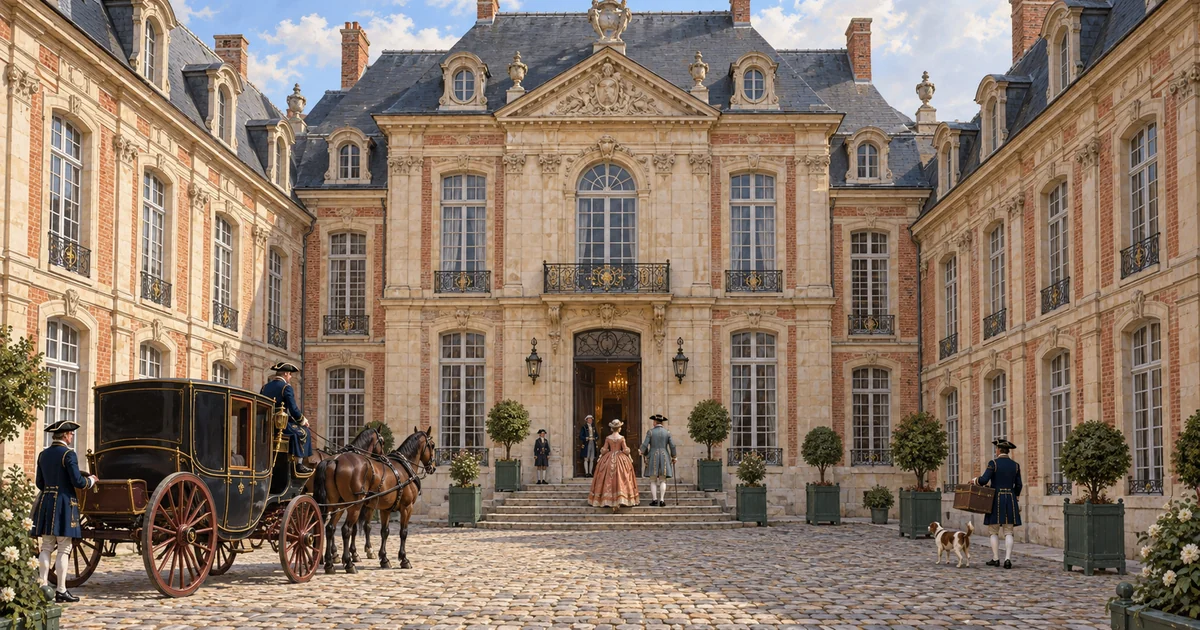
Behind the arcaded facades of the famous squares of Arras and in the streets that surround them hides a more discreet but just as precious heritage: that of the private mansions, the hôtels particuliers. In the eighteenth century, once the town had become durably French and prosperous, the nobility and rich bourgeoisie of Arras had built for themselves fine classical residences, combining brick and stone, the courtyard of honour and the garden. These mansions testify to a refined art of living and to a prosperity that is sometimes forgotten. A look back at aristocratic Arras of the century of the Enlightenment, through its most elegant residences, some of which survive today.
Aristocratic Arras of the eighteenth century
The eighteenth century was, for Arras, a period of recovered stability and prosperity. After the wars and sieges of the preceding centuries, the town, definitively attached to France and protected by Vauban's citadel, could finally develop in a peaceful setting. This lull benefited a wealthy elite, composed of nobles, magistrates, officers and rich bourgeois enriched by trade, land or offices. This affluent society, anxious to display its rank and its taste, launched itself into the construction or embellishment of residences worthy of its status. Far from the agitation of the merchant squares, it sought comfort, intimacy and elegance. The private mansions that then rose in the town reflect this aspiration to a refined life, in the image of what was done in the great towns of the kingdom and as far as Paris. Arras, capital of a rich agricultural province and seat of important institutions, counted a population of notables sufficiently numerous and wealthy to justify such an architectural boom. The administrative reform that, with the brick and stone facades, had already given the town its characteristic face, prolonged itself in the eighteenth century in the construction of these elegant residences. Aristocratic Arras of the century of the Enlightenment thus appears as an unknown facet of the town, that of a prosperous and cultivated city, where a refined elite cultivated the art of living and the taste for fine residences, far from the image of a merely military or merchant town.
What is a private mansion?
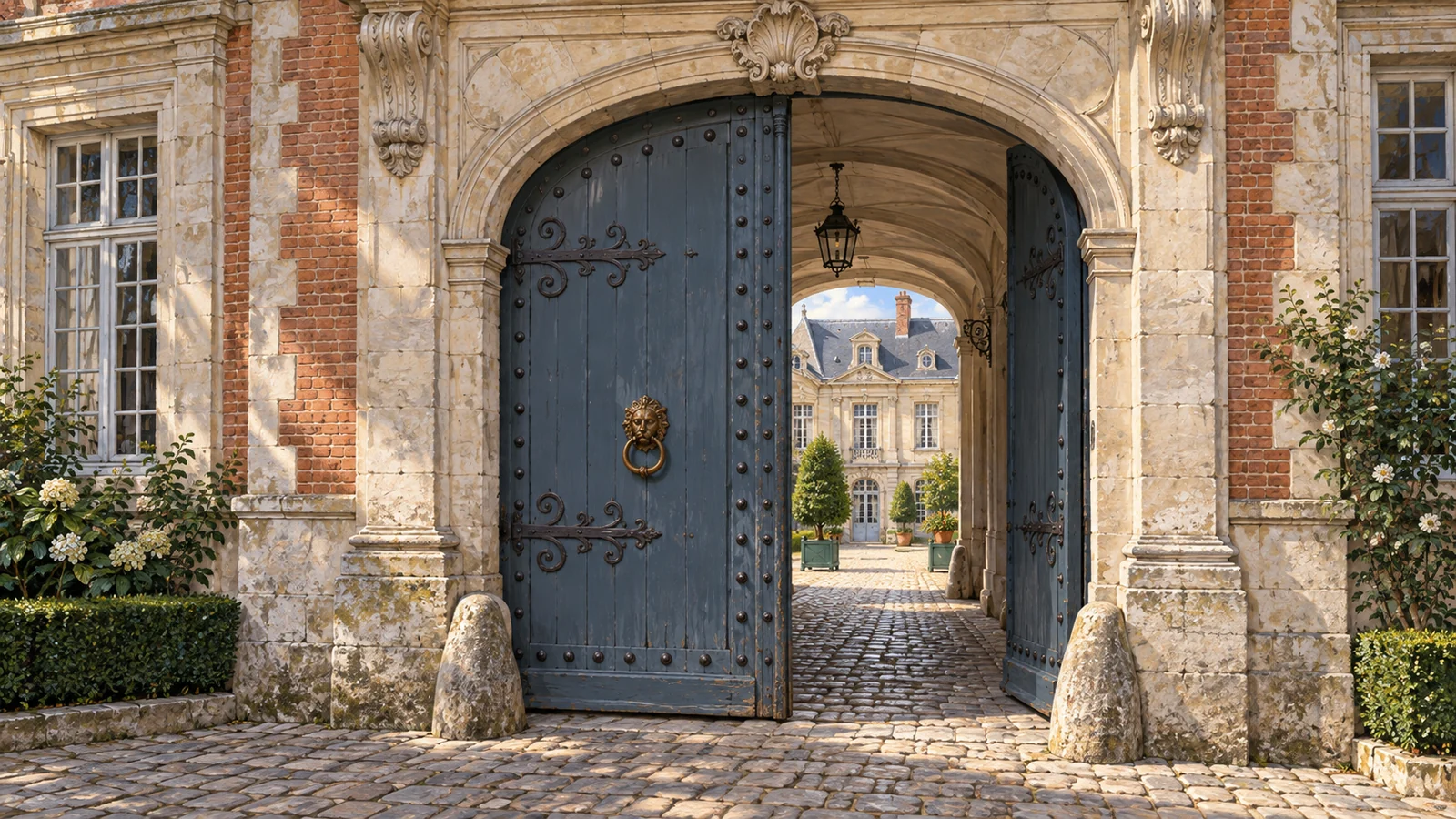
The hôtel particulier designates, under the Ancien Régime, a wealthy urban residence, built for a single family, as opposed to the ordinary house or the tenement building. It was the private residence of a notable, conceived to combine comfort, representation and intimacy. Its organisation obeyed well-established principles, inherited from classical French architecture. The typical plan generally comprised a courtyard of honour, onto which opened the main dwelling, and, at the rear, a garden that offered calm and greenery away from the street. The entrance was often through a monumental porch, crossing the street facade to reveal the interior courtyard. This arrangement, called « between courtyard and garden », placed the residence set back, sheltered from view and noise, while contriving perspectives and a staging of the arrival. Inside, the rooms were organised according to a precise hierarchy: reception rooms on the ground floor or the first floor, private apartments, outbuildings and common rooms for service. The private mansion was thus a small closed and hierarchical world, a reflection of the social order of its time. Its architecture favoured elegance and measure, in the classical taste that then dominated, made of symmetry, sobriety and harmonious proportions. Each detail, from the design of the windows to the ornamentation of the portals, took part in the expression of a refined art of building, at once discreet and prestigious. To understand what a private mansion was allows one to better appreciate these Arras residences, witnesses of a way of life and a conception of habitat proper to the aristocracy and the high bourgeoisie of the century of the Enlightenment.
The hôtel de Guînes, jewel of the eighteenth century
Among the private mansions of Arras, the hôtel de Guînes counts among the most remarkable and best preserved. This elegant eighteenth-century residence illustrates marvellously the art of building of the era and the refinement of the Arras aristocracy. With its courtyard, its harmonious dwelling and its careful decors, it offers a precious testimony of what these private residences of notables could be. The hôtel de Guînes has crossed the centuries and today forms part of the recognised heritage of the town, serving as a setting for cultural and associative activities. Its preservation allows visitors and the people of Arras to discover from the inside what was the living setting of a well-off family of the century of the Enlightenment. The balanced proportions of its facade, the quality of its arrangements and the layout of its spaces make it a model of the genre, representative of classical domestic architecture. This mansion was not isolated: it belonged to an urban fabric where several residences of this type punctuated the streets of the centre, not far from the great squares. Together, these mansions composed a discreet aristocratic landscape, made of portals, courtyards and gardens, which coexisted with the merchant animation of the town. The hôtel de Guînes, by its exceptional conservation, today offers one of the best gateways to understand and appreciate this heritage. It embodies, better than any other, the elegance of eighteenth-century Arras and allows one to measure the wealth and taste of an elite that knew how to endow itself with residences worthy of the finest towns of the kingdom.
Brick and stone, the elegance of Arras
The private mansions of Arras distinguish themselves by the characteristic use of brick and stone, emblematic materials of the regional architecture. This alliance, found on the facades of the famous squares of the town, gives the Arras residences their particular cachet, made of the warm contrast between the red of the brick and the white or light grey of the stone. The stone was reserved for the noble and structuring elements: window frames, corner chains, portals, cornices and bands, while the brick filled the surfaces. This way of building, economical and solid, had imposed itself in the region and conferred on the constructions a recognisable unity and elegance. In the private mansions, this architectural vocabulary was deployed with particular care, in the service of an effect of dignity and refinement. The classical facades, ordered and symmetrical, played with the polychromy of the materials to compose harmonious ensembles, neither ostentatious nor austere. The taste of the century, marked by the search for measure and balance, found in this architecture of brick and stone a perfectly adapted expression. Far from the excesses of the baroque, the Arras mansions cultivated a sober elegance, where beauty was born of the justness of proportions and the quality of execution. This aesthetic, deeply anchored in the identity of the town, makes the private mansions of Arras remarkable examples of northern classical architecture, where the influence of national models combined with local traditions and materials to produce a style at once refined and rooted in its terroir.
| Element | Feature |
|---|---|
| Plan | Between courtyard and garden, central dwelling |
| Materials | Red brick and white stone |
| Style | Classical, symmetrical and measured |
| Example | The hôtel de Guînes, preserved jewel |
A society of notables
Behind these residences stands a society of notables that made the wealth and prestige of eighteenth-century Arras. The patrons of these mansions belonged to the elite of the town: noble families, magistrates of the local jurisdictions, officers of the king, rich landowners and bourgeois enriched by trade or offices. This elite, both attached to its privileges and anxious about its image, expressed through its residences its rank, its taste and its success. To build or embellish a private mansion was a means of asserting one's social position, of rivalling one's peers and of leaving a lasting imprint on the town. These notables formed a restricted but influential community, which set the tone of the social and cultural life of Arras. They frequented the same circles, met in the learned institutions and societies of pleasure, and shared the same art of living. It is in this milieu that the members of the Academy of Arras and the lettered societies were recruited, uniting the taste for fine residences with that for belles-lettres. The private mansions were the material setting of this elite sociability: one gave receptions there, one held salon there, one received one's relations there in a decor worthy of one's rank. These residences were therefore much more than simple dwellings: they constituted the theatre of worldly life and the visible symbol of a social hierarchy that the Ancien Régime held to be natural. To understand this society of notables is indispensable to grasp the meaning of these mansions, which translated into stone and brick the social order and the values of a provincial elite at the height of its prosperity.
Decors and the art of living
If the facades of the private mansions seduce by their sober elegance, it is inside that all the refinement of the art of living of the eighteenth century was deployed. The reception rooms, salons and dining rooms, received careful decors, to the measure of the taste and fortune of their owners. Carved woodwork, marble fireplaces, ceilings adorned with stucco, parquet floors, painted overdoors and mirrors composed elegant interiors, conceived for representation as much as for comfort. These decors drew inspiration from the fashions in force in the great towns of the kingdom, adapted to the means and tastes of the province. The furniture, the hangings, the objects of art and the collections completed these arrangements, making of each mansion a setting where the personality and status of the family were expressed. The distribution of the rooms obeyed a growing search for comfort and intimacy, characteristic of the evolution of manners in the century of the Enlightenment. One now distinguished more clearly the reception spaces, devoted to social life, from the private apartments, reserved for family life. This quest for comfort and pleasantness translated a profound transformation of ways of living, where the individual and well-being took on a new importance. The art of living of the Arras private mansions thus took part in this refined civilisation of the end of the Ancien Régime, where the living setting, the decors and the objects were thought out for the pleasure of the senses and the pleasantness of existence. These interiors, some of which survive or are known to us, testify to a conception of habitat where beauty and comfort held an essential place, and where the residence was the faithful reflection of a civilisation of taste and of the sweetness of living.
The private mansions today
Time, wars and urban transformations have not spared the Arras heritage, but several private mansions have survived to our day and still testify to the elegance of eighteenth-century Arras. Some have kept their residential purpose, others have been converted into public facilities, seats of institutions, cultural or associative places, which has often allowed their preservation. This reallocation, in giving a new use to these old residences, contributes to maintaining them and making them live, while sometimes opening them to the public. The reconstruction of the town after the destructions of the twentieth century moreover took care, in many cases, to respect the spirit and appearance of the old building, in the line of this fidelity to heritage that characterises Arras. The preserved private mansions are today the object of a heritage attention, as precious witnesses of the architectural and social history of the town. Their preservation allows one to transmit to future generations the memory of aristocratic Arras of the century of the Enlightenment, and to enrich the discovery of the town beyond its most famous monuments. For the attentive walker, to spot these residences, to guess behind a portal a courtyard and a classical dwelling, is to access a more intimate and discreet stratum of the Arras heritage. These mansions, often ignored by the general public, deserve to be known and appreciated, for they constitute an essential part of the historical and architectural identity of a town whose heritage wealth is not limited to its squares and its most visited monuments.
A heritage to discover
The private mansions of Arras constitute a heritage to discover, an invitation to cast a fresh eye on the town and to explore its streets with curiosity. Far from the most frequented tourist circuits, these residences offer a discreet walk through the aristocratic and bourgeois history of the city. They recall that Arras is not reduced to its famous arcaded squares nor to its emblematic monuments, but also conceals, in the secret of its streets, treasures of domestic architecture. To understand and spot these mansions considerably enriches the visit: one learns to read the facades, to distinguish the monumental portals, to imagine, behind the walls, the courtyards and gardens that once housed the life of a refined elite. This discovery belongs naturally to the exploration of the historic centre, very close to the Place des Héros, around which the aristocratic town of the eighteenth century was deployed. This heritage, in dialogue with the knowledge and culture that the Academy of Arras then cultivated, draws the portrait of a prosperous and enlightened city, where the art of building accompanied the art of living and the love of letters. To rediscover the private mansions of Arras is therefore to find again an essential part of the soul of the town, that of a refined and prosperous eighteenth century, whose architectural heritage continues to enrich the urban landscape and to marvel those who know how to look at it.