
Émile Legrelle: how did the mayor open Arras by tearing down its ramparts?
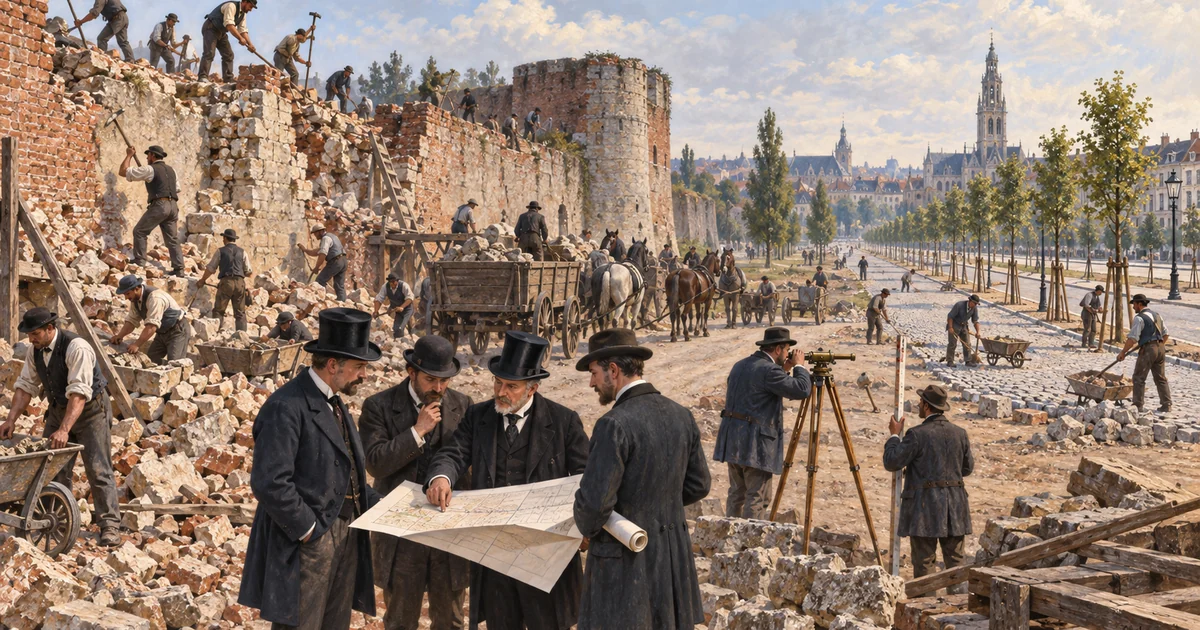
For centuries, Arras was a town enclosed within its ramparts, girdled with walls and fortifications that protected it but also prevented it from expanding. It is in the second half of the nineteenth century, under the impulse of the mayor Émile Legrelle, that the town tore down its urban enclosure to open itself at last onto the outside. This decisive gesture transformed the face of Arras and permitted its modern expansion. A look back at this major urban turning point and at the mayor who presided over the disappearance of the ramparts, opening a new era for the town.
Arras, a fortified town
Until the nineteenth century, Arras remained a fortified town, enclosed within a belt of ramparts inherited from its long past as a place of war. Since the Middle Ages, the city had protected itself behind its walls, ceaselessly reinforced over the eras and the threats. After the attachment to France, the fortifications had been modernised, notably in the wake of the work of Vauban and the citadel, making Arras a stronghold of the kingdom. This military vocation had shaped the town: enclosed within its walls, it could not expand, and its growth was constrained by the limits of the enclosure. The fortifications, with their bastions, their ditches and their gates, formed a physical and symbolic barrier between the town and the surrounding countryside. This situation, long necessary for defence, gradually became a handicap as the military function of the ramparts lost its importance. In the nineteenth century, with the evolution of the art of war and the retreat of threats, the urban fortifications of inland towns lost their reason for being, while continuing to hinder urban development. Arras, like many other cities, thus found itself prisoner of its walls, unable to expand to accommodate a growing population and meet the needs of a modern town. This constraint weighed on urbanism, hygiene and circulation, in an agglomeration more and more cramped. To understand what the fortified town represented is essential to grasp the scale of the change that the demolition of the ramparts was to constitute. Arras, enclosed within its walls, aspired to breathe and to expand, and this aspiration was to find, in the second half of the century, the conditions of its realisation.
Émile Legrelle, a builder mayor
It is to a mayor, Émile Legrelle, that history attaches the memory of the great urban transformation of Arras. In the 1870s and 1880s, at the head of the municipality, Legrelle strove to modernise the town and to give it the means of its development. A man of his time, anxious for progress and development, he embodied the figure of the builder mayor, preoccupied with the future of his city. Under his mandate, the question of the fortifications, which curbed the expansion of the town, was posed with acuity. Legrelle understood that the future of Arras depended on the disappearance of these ramparts become useless and cumbersome, in order to open the town and permit its growth. His action belonged to a general movement which, at the same era, led numerous French towns to demolish their fortifications to modernise themselves. The demolition of the ramparts of Arras is thus inseparable from his name, which remains attached to this major urban turning point. Legrelle was not only the architect of this demolition: he was also the promoter of a modern vision of the town, open, airy and turned towards the future. His mandate marked a decisive stage in the urban history of Arras, that of the passage from the fortified town to the open town. To understand the role of this mayor allows one to grasp how a political will could durably transform the face of the city. Émile Legrelle embodies this generation of nineteenth-century municipal officials who, carried by faith in progress, undertook to modernise their towns by tearing down the vestiges of a bygone military past, to make way for the new city that the needs of their time called for.
The declassification of the fortifications
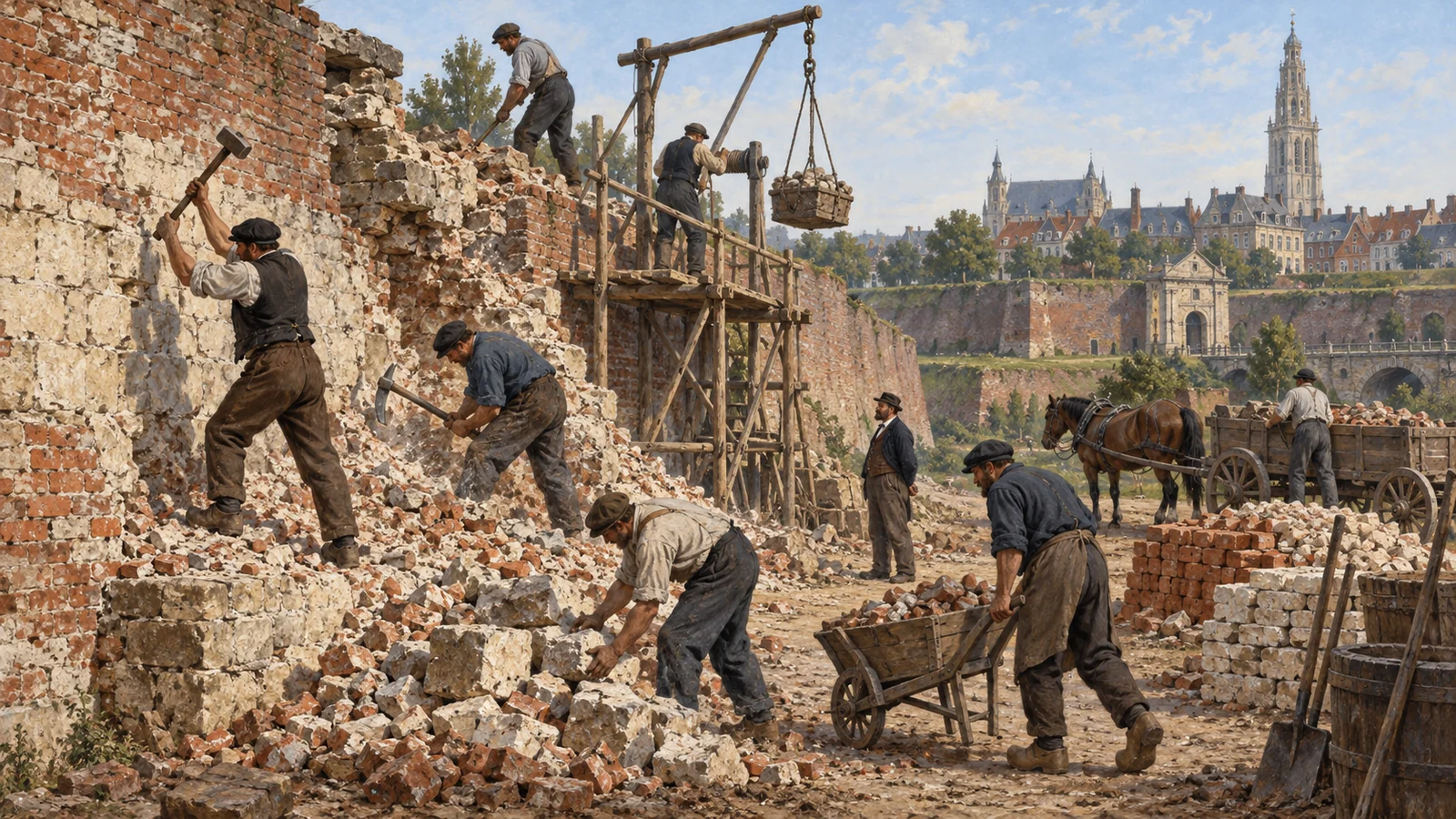
The demolition of the ramparts of Arras was made possible by the declassification of the fortifications. As long as the town retained its status as a stronghold, its walls came under military authority and could not be touched. It was therefore necessary that the fortifications officially lose their military function for the town to be able to dispose of them. This declassification, decided in the context of the evolution of military strategy, freed Arras from the constraint of the ramparts. With the retreat of threats on inland towns and the evolution of the art of war, the urban fortifications of numerous cities lost their reason for being. Their maintenance no longer had military justification, while they continued to hinder the development of the towns. The declassification thus allowed the transfer of the land and the works to the town, which could henceforth envisage their demolition and the development of the freed spaces. This procedure, often long and complex, was the indispensable precondition to any transformation. At Arras, as elsewhere, the declassification of the fortifications opened the way to a vast worksite of demolition and urban redevelopment. It marked the official end of the military vocation of the town, which ceased to be a stronghold to become an open city. This change of status, with considerable consequences, was the culmination of a long-standing evolution, that of the decline of urban fortification in the face of the progress of armament and the extension of towns. To understand the declassification of the fortifications allows one to grasp the legal and military framework that made possible the demolition of the ramparts. Without this preliminary stage, the urban transformation willed by Legrelle could not have taken place. The declassification was therefore the key that opened for Arras the possibility of freeing itself from its walls and of engaging in the path of modernity.
Tearing down the ramparts
Once the fortifications declassified, the town undertook to tear down its ramparts. This considerable worksite, which extended over several years, radically transformed the face of Arras. The walls, bastions and gates that had girdled the town for centuries were gradually demolished, making the old enclosure disappear. This demolition was not a simple destruction: it was accompanied by a vast project of redevelopment of the freed spaces. Where the fortifications once rose, the town now had vast plots of land, which had to be developed to accommodate urban growth. The demolition of the ramparts thus belonged to a logic of urbanism and modernisation, aiming to open the town and to give it the means of its development. It should be noted that the citadel of Vauban was not demolished: it is the urban enclosure, the ramparts that surrounded the town proper, that disappeared, while the fortress survived. This distinction is important: Arras lost its urban walls, but kept its citadel, a monument that still testifies today to its military past. The demolition of the ramparts was one of the great worksites of the urban history of Arras, comparable to what other French towns knew at the same era. It marked the end of the closed town and the beginning of the open town, freed from the constraint of its walls. This gesture, at once destructive and creative, opened the way to a new conception of the town, airy and extensible. To tear down the ramparts was to make a clean slate of a military past to build the urban future, in a movement characteristic of the spirit of progress of the nineteenth century.
Boulevards in place of the walls
The demolition of the ramparts freed vast spaces, on which the town could create new developments. In place of the walls rose boulevards, wide roads that now girdled the town where the fortifications once stood. These boulevards, traced on the footprint of the old ramparts, became major axes of the town, facilitating circulation and structuring urbanism. They also offered spaces for walking and pleasure, planted with trees, that improved the living environment. The transformation of the ramparts into boulevards is characteristic of nineteenth-century urbanism, which saw numerous towns replace their fortifications with great avenues. This type of development, sometimes called a ring boulevard, followed the trace of the old walls and created a transition between the historic heart and the new quarters. Besides the boulevards, the freed spaces permitted the creation of gardens and facilities, contributing to airing and embellishing the town. This reconquest of the land of the fortifications profoundly transformed the physiognomy of Arras, giving it a more modern and more open face. The old ditches and glacis gave way to green spaces and urban developments, which one finds today among the parks and gardens of Arras. This transformation illustrates the passage from the military town to the modern town, where the imperatives of defence gave way to the needs of urban life. The boulevards born of the demolition of the ramparts remain today structuring elements of the Arras landscape, witnesses of this great transformation. To understand how the walls gave way to the boulevards allows one to grasp the scale of the urban redevelopment that followed the demolition of the ramparts and durably shaped the town we know.
| Before | After |
|---|---|
| Fortified town, enclosed within its walls | Open town, freed from its enclosure |
| Ramparts, bastions and ditches | Boulevards, gardens and new quarters |
| Urban growth blocked | Expansion towards the outside |
| Military vocation | Modern town, the citadel preserved |
The expansion of the town
The disappearance of the ramparts opened for Arras the possibility of its expansion. Freed from the constraint of its walls, the town could finally extend beyond its old limits, gaining on the surrounding countryside. New quarters could develop, accommodating a growing population and new activities. This expansion answered the needs of a growing town, long curbed by the narrowness of the space available inside the ramparts. The opening of the town favoured its demographic and economic development, by offering space for housing, facilities and activities. Urbanism could deploy itself more freely, trace new streets and create new ensembles, within the framework of a town now extensible. This growth belonged to the wider context of the development of towns in the nineteenth century, carried by demographic growth and economic transformations. Arras, like other cities, thus knew a phase of expansion made possible by the disappearance of the fortifications. The opening of the town also favoured its connection to the new networks, notably railways, which were then transforming France. The open town could better integrate itself into the circuits of communication and exchange, taking part in the modernisation of the country. This expansion marked an important stage in the history of Arras, that of its passage to the modern town, capable of growing and developing. To understand the expansion permitted by the demolition of the ramparts allows one to grasp the lasting consequences of this urban turning point. In tearing down its walls, Arras did not only change appearance: it gave itself the means of its future, opening the way to the growth and development that were to shape the contemporary town, heir to this great transformation of the nineteenth century.
A turning point in urban history
The demolition of the ramparts constitutes a veritable urban turning point in the history of Arras. It marks the passage from the closed town, inherited from the Middle Ages and the era of strongholds, to the open and modern town of the nineteenth century. This change was not only physical: it translated a new conception of the town, turned towards progress, hygiene, circulation and development. The disappearance of the walls improved living conditions, by airing the town, facilitating movement and offering new spaces. It answered the preoccupations of modern urbanism, anxious for salubrity and functionality. This turning point belonged to the great movement of transformation of towns in the nineteenth century, marked by modernisation and urban extension. Arras, in tearing down its ramparts, joined the rank of towns that freed themselves from their military past to embrace modernity. This change had lasting consequences on the organisation and development of the town, whose current face still bears the mark. The urban turning point embodied by the demolition of the ramparts illustrates the capacity of a town to transform and reinvent itself, according to the needs and aspirations of its era. It also testifies to the decisive role of political choices and the will of municipal officials, like Émile Legrelle, in the transformation of towns. To understand this turning point allows one to grasp how Arras passed from the fortified town to the modern town, in a movement characteristic of its century. This transformation, one of the most important of the urban history of Arras, durably shaped the city and opened the way to its contemporary development, making the demolition of the ramparts a founding moment of the modern town.
The legacy of Legrelle
The action of Émile Legrelle and the demolition of the ramparts left a lasting legacy in the landscape and history of Arras. The town we know today, open and extended, is in great part the fruit of this nineteenth-century transformation. The boulevards traced on the footprint of the old fortifications, the quarters born of the expansion, the open physiognomy of the city: so many elements that testify to this urban turning point. The name of Legrelle remains attached to this great work, that of the mayor who tore down the ramparts and opened the town onto the future. His action illustrates the role of municipal officials in the transformation of towns and the lasting significance of their choices. The legacy of this period is read in the very organisation of the town, whose structure bears the mark of the disappearance of the ramparts and the expansion that followed. This opening also favoured the connection of Arras to the modern networks, of which the railway station of Arras notably testifies, a symbol of the connected town open onto the outside. The transformation willed by Legrelle durably inscribed Arras in modernity, giving it the means of its development. To remember this period and the role of this mayor is to understand how the current town was constituted, from the fortified town of former times. The legacy of Legrelle is not only material: it is also that of a vision, that of a modern town, open and turned towards the future. This vision, put into practice in the nineteenth century, durably shaped Arras and continues to mark its face today. To rediscover the history of the demolition of the ramparts and of the mayor who led it is thus to illuminate a decisive chapter of the urban history of Arras, that of the birth of the modern town, freed from its walls and open onto the world.