
Vauban's citadel at Arras: why is it called « the beautiful useless one »?
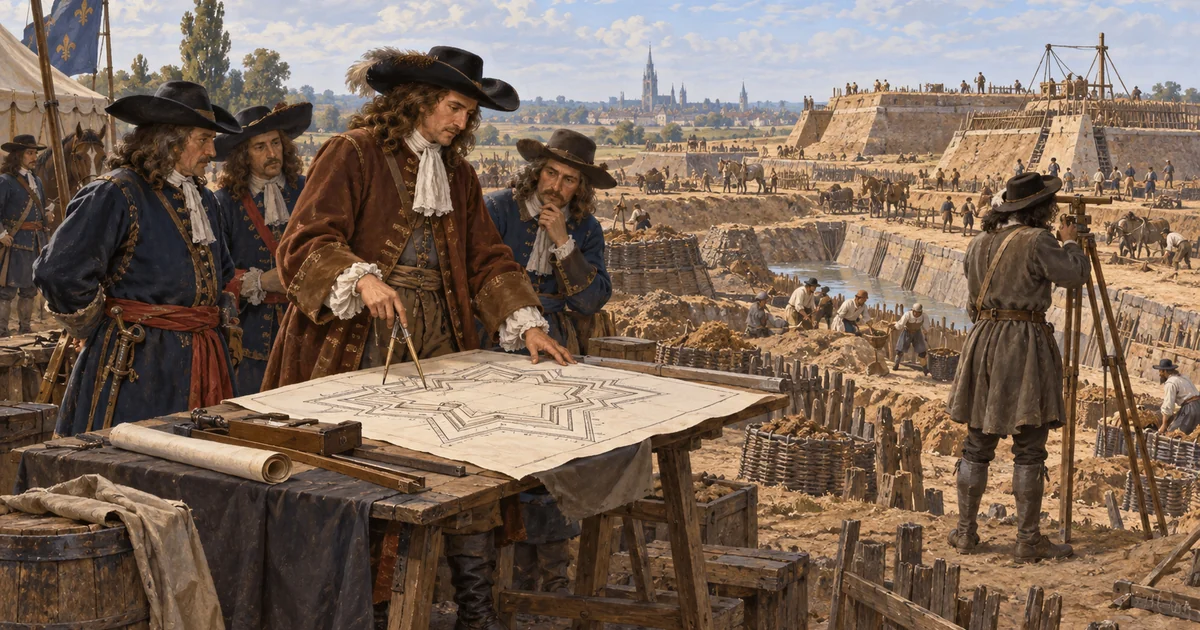
In 1668, a few years after the town's definitive attachment to France, King Louis XIV decided to endow Arras with a powerful citadel, entrusted to the greatest military engineer of his time, Sébastien Le Prestre de Vauban. This star-shaped fortress, raised at the gates of the town, was to lock the northern frontier of the kingdom and forbid any return of Spain. Yet, never besieged, it would enter the memory of Arras under a nickname that became famous: « the beautiful useless one ». To understand the citadel of Arras is to follow the passage of a town of war to the status of a stronghold of the king, and to discover one of the jewels of French military architecture, today recognised by all humanity.
A citadel for a frontier town
When the Treaty of the Pyrenees fixed in 1659 the belonging of Arras to France, the town found itself in a delicate strategic situation: French henceforth, but very close to the Spanish Netherlands from which it had just been detached. The frontier of the kingdom ran only a few leagues away, and Spain, humiliated by the loss of the Artois, had not renounced reconquering what it considered its own. In this context, Arras was not a peaceful interior town, but an exposed lock, an advanced place that had to be held at all costs. Louis XIV and his war minister, Louvois, quickly understood that the security of the kingdom depended on the systematic fortification of these frontier towns recently acquired. Arras, with its key position on the roads leading to Paris and the heart of the kingdom, ranked among the first priorities. It was not enough to have conquered the town and kept it by the treaties: it still had to be made impregnable. It is this necessity that gave birth to the project of a citadel, a fortress independent of the urban ramparts, capable both of protecting the town against an outside enemy and of keeping in check a population whose loyalty, after so many Spanish decades, remained uncertain. The citadel of Arras thus was born of a double imperative, defensive and political, common to all the places newly attached to the kingdom of France.
Vauban, the king's engineer
To conceive this fortress, the king called upon the man who would transform the art of fortification in France: Sébastien Le Prestre de Vauban. Born in 1633 in the Morvan, this gentleman of the minor nobility had distinguished himself very young in sieges, first in the service of the Fronde then, having rallied, in the service of the king. He already knew Arras, for he had taken part, as a very young engineer, in the fighting that had saved the town during the relief of 1654. Vauban was not only a builder: he was a theoretician, a tireless practitioner who, over the course of his career, directed the construction or the restoration of dozens of strongholds and himself conducted numerous sieges. His method, founded on the observation of the terrain, the calculation of the angles of fire and the adaptation of each work to its site, revolutionised the defence of the frontiers. He brought to perfection the bastioned system, inherited from the Italian engineers of the Renaissance, by adapting it to the progress of artillery. Under his authority, fortification ceased to be a piling up of walls to become a geometric science, where each bastion, each curtain, each ditch answered a precise logic. Named later commissioner general of fortifications, Vauban became the master builder of the belt of fortresses that protected the kingdom. Arras was to receive one of his most accomplished realisations, a citadel conceived as a model of the genre, where the engineer could apply without constraint the principles that made his glory.
The construction of the citadel
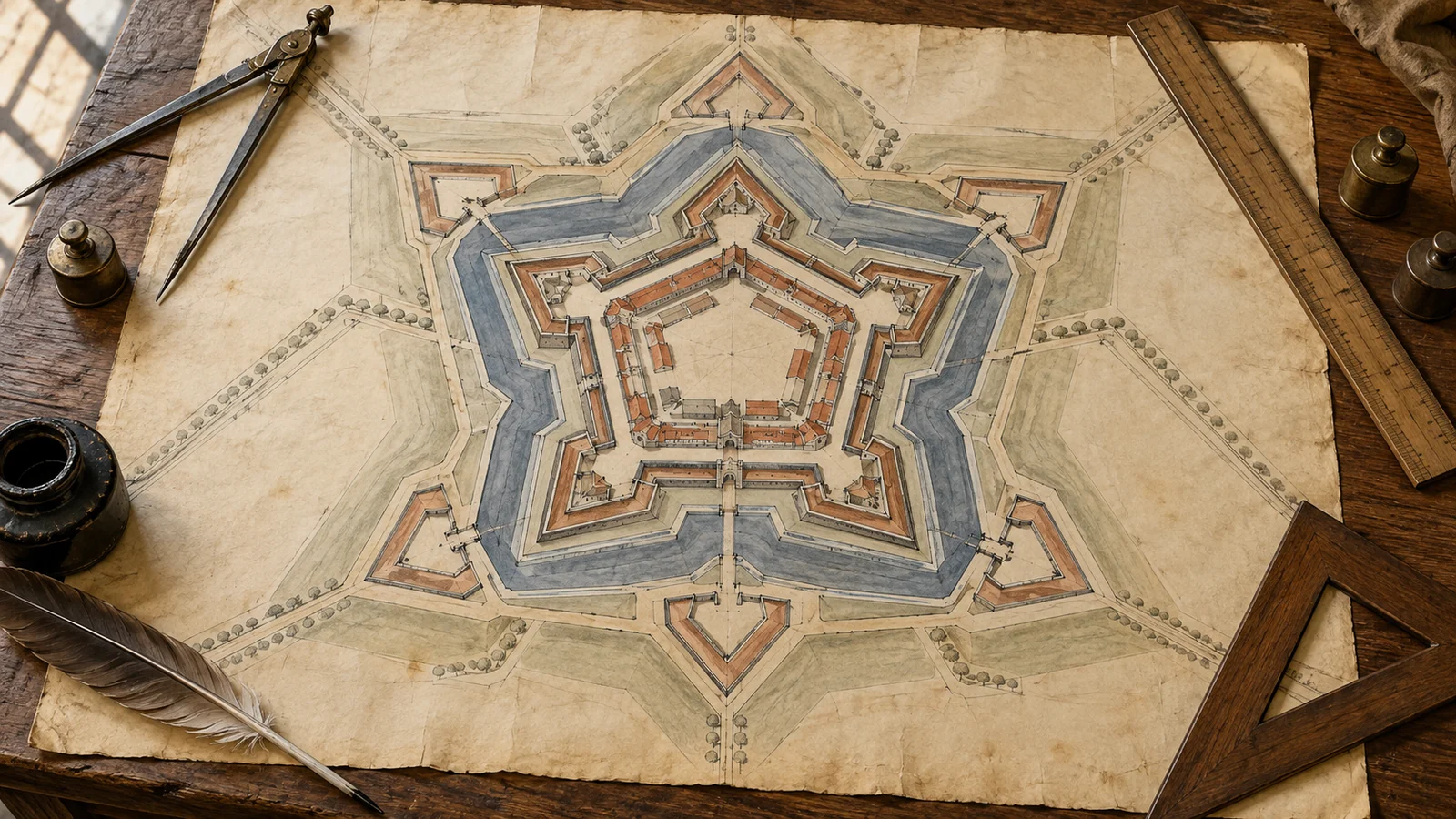
The works of the citadel of Arras began in 1668 and continued for several years, mobilising thousands of workers and soldiers. Vauban chose to establish the fortress to the south-west of the town, on a terrain that allowed it to cover both the built-up area and the threatened approaches. The construction imposed sacrifices: an entire suburb was razed to clear the field of fire and make room for the immense work. The citadel took the form of a regular pentagon, flanked by five bastions at the corners, surrounded by ditches, demi-lunes and glacis that multiplied the obstacles offered to an assailant. The materials employed, red brick for the facings and white stone for the frames and the noble parts, gave the whole that alternation of colours characteristic of the regional architecture, found on the facades of the town. Inside the enclosure was organised a veritable little military town: barracks for the troop, lodgings for the officers, powder magazines, arsenals, wells and, at the centre, a parade ground. Vauban saw to it that each element was thought out for the defensive function as for the daily life of a garrison called to hold out for a long time. The chapel of Saint-Louis, built in a sober and elegant classical style, crowned this ensemble and recalled that the fortress, like every institution of the kingdom, placed itself under divine protection and that of the most Christian king. Completed for the essential at the beginning of the 1670s, the citadel of Arras was then one of the most modern and best conceived places of the kingdom.
« The beautiful useless one »: the origin of a nickname
The citadel of Arras has passed to posterity under a nickname as flattering as it is ironic: « the beautiful useless one ». Tradition explains this expression by a paradox: this fortress, conceived with extreme care to resist the longest sieges, was never really attacked. Its very perfection condemned it never to serve. A work so formidable dissuaded the adversary from attempting anything, so that the citadel crossed the centuries without knowing the fire of the enemy cannons for which it had nonetheless been built. The nickname thus underlines the beauty of the architecture, unanimously recognised, and the military uselessness of a place that never had the occasion to demonstrate its value in combat. One must be careful not to take this formula literally: far from having been vain, the citadel fully played its dissuasive role, contributing to protecting the frontier without a single assault being necessary, which, in the eyes of Vauban himself, constituted the greatest success of a fortification. A place that discourages the enemy from attacking it has fulfilled its mission better than a place heroically defended then taken. « The beautiful useless one » is therefore not a failure, but the testimony of a silent success. The nickname, transmitted by local tradition and taken up by the historians of the town, says with mischief the admiration of the people of Arras for a monument that never had to shed blood.
An exemplary bastioned architecture
The citadel of Arras embodies to perfection the bastioned system brought to its apogee by Vauban. The principle is simple in its intention, formidable in its execution: to offer the assailant the least possible hold, and to allow the defenders to sweep with their fire the slightest point of approach. The pentagonal trace has nothing arbitrary about it: each bastion in the shape of a diamond point flanks the neighbouring faces, so that no blind angle remains and an attacker presenting himself before a curtain finds himself caught under the crossfire of the bastions that frame it. Before the main enclosure, a clever play of advanced works, demi-lunes and covered ways, forces the enemy to conquer position after position, at the cost of considerable losses, even before reaching the body of the place. The ditches, wide and deep, complete this device by forbidding the direct assault. What one still admires today at Arras is the geometric rigour of the whole, where aesthetics is born of function alone: the beauty of the citadel lies in its perfect defensive logic, without superfluous ornament. Vauban liked to say that a well-conceived place should be beautiful because it was just. The citadel of Arras, with its pure lines, its brick facings and its monumental stone gates, illustrates this credo. It constitutes an open-air manual of fortification, where each generation of engineers and visitors can read the principles that made the power of the frontiers of the kingdom of Louis XIV.
| Element | Feature |
|---|---|
| Plan | Regular pentagon with five bastions |
| Engineer | Sébastien Le Prestre de Vauban |
| Start of works | 1668, under Louis XIV |
| Materials | Red brick and white stone |
| Nickname | « The beautiful useless one », never besieged |
The Pré carré: Arras in the network of frontiers
The citadel of Arras is only fully understood when placed back within the vast design that was Vauban's for the defence of the kingdom: the famous « Pré carré », the square field. Worried to see the northern frontier of France draw a complicated and vulnerable line, the engineer proposed to Louvois to organise the strongholds into a double row of fortresses, in the manner of the lines of bastions of an enclosure, but on the scale of an entire territory. The image of the field surrounded by a solid fence summed up the idea: two lines of fortified towns, one behind the other, mutually supporting each other, would form a continuous and impassable obstacle. The first line, the most advanced, held the frontier facing the Spanish Netherlands; the second, behind, served as a recourse and a logistical base. Arras, somewhat set back from the extreme frontier after the conquests that followed, integrated itself into this device as a solid place of the rear, a point of support for the armies operating further north. This role prolonged the one the town had held during the relief of Arras of 1654, when its defence had already commanded the fate of the whole region. The conception of the Pré carré testifies to the strategic genius of Vauban, who never thought a fortification in isolation, but always as the link of a coherent whole. The citadel of Arras, in this perspective, was not a solitary monument, but an essential piece of an immense defensive chessboard covering the entire northern frontier of France.
From stronghold to town over the centuries
For more than three centuries, the citadel of Arras remained an active military place, occupied by successive garrisons that made the town a city of soldiers. Its barracks housed regiments, its magazines held powders and munitions, and its daily life long set the rhythm of that of the people of Arras, accustomed to the neighbourhood of the troop, to the bugle calls and the reviews. Over the eras, the function of the fortress evolved with the art of war. The perfecting of artillery, then the appearance of ever more powerful weapons, gradually rendered obsolete the ramparts of stone and brick, conceived for another age of combat. The citadel, without ever having been besieged, ceased to be a decisive piece of the national defence to become a vast barracks ensemble. The twentieth century, however, left there a tragic imprint: during the Second World War, the ditches of the citadel served as a place of execution, and the Wall of the Shot perpetuates today the memory of the resistance fighters and hostages who fell under the bullets of the occupier. This place of remembrance recalls that the fortress, long spared by war, nonetheless knew death and sacrifice. After the definitive departure of the army, the citadel changed its destiny: the town gradually reappropriated this vast space, long forbidden to the public, to make of it a place of walking, of culture and of memory, opening a new chapter of its already long history.
The citadel of Arras today
The prestige of the citadel of Arras has been consecrated at the highest level: in 2008, it was inscribed, with eleven other sites, on the World Heritage List of humanity under the « network of the fortifications of Vauban », international recognition of the exceptional value of the work of the king's engineer. This listing places the Arras monument alongside the finest realisations of European military architecture and testifies to the universal admiration that the genius of Vauban still arouses today. Returned to civilian life, the citadel of Arras has become a place of life and discovery, where green spaces, leisure facilities and cultural events mingle, while preserving intact the evocative power of its ramparts. The people of Arras stroll there, visitors admire the bastioned trace and the chapel of Saint-Louis, and each can measure, in walking through the ditches and the bastions, the scale of the design that presided over its construction. « The beautiful useless one » has thus found, more than three centuries after its birth, a new usefulness: that of transmitting the memory of a Grand Siècle when the town, scarcely become French, was endowed by the king with a masterpiece destined to protect it. Far from being a frozen relic, it remains a living piece of the identity of Arras, a bridge between the time of sieges and that of walks, where the history of the town is read in the stone and the brick of a fortress that never had to fight.