
The Treaty of the Pyrenees of 1659: how did Arras become French forever?

In 1659, a great treaty ended decades of war between France and Spain and sealed the destiny of Arras: the Treaty of the Pyrenees, by which the Artois and its capital became definitively French. After the conquest of 1640 and the fighting of the following years, this peace officially recognised the attachment of Arras to the kingdom of France, ending centuries of belonging to the Flemish, Burgundian then Spanish world. To understand the Treaty of the Pyrenees is to grasp the culmination of a long history, that of the passage of Arras into the French fold, now lasting and official. A look back at this major treaty, its circumstances and its significance for the town, which, at the end of a long process made of wars and negotiations, entered at last and for good into the destiny of France.
The end of a long war
The Treaty of the Pyrenees came to close an interminable war between France and Spain, which had lasted decades and exhausted the two kingdoms. This conflict, one of the longest of the era, belonged to the great struggle for the domination of Europe, opposing France to the power of the Habsburgs. Arras had been one of the theatres of this war, conquered by France in 1640 during the siege of Arras of 1640, then defended against the Spanish attempts at retaking. After so many years of fighting, the two kingdoms, drained, aspired to peace. The negotiations led, in 1659, to the signing of a treaty that ended the hostilities and settled the fate of the disputed territories. This peace was a major event, not only for Arras, but for the balance of Europe, marking the assertion of France as a great power. To understand the context of the end of this war is essential: the Treaty of the Pyrenees was not an isolated agreement, but the culmination of a long confrontation, the moment when the arms finally fell silent. For Arras, a bitterly disputed war town, peace meant the end of uncertainty and the consecration of its attachment to France. After decades during which its fate had been suspended on the outcome of the fighting, the town was finally to know a stable status. The Treaty of the Pyrenees, by ending the war, opened for Arras a new era, that of its assured and definitive belonging to the kingdom of France.
The Treaty of the Pyrenees and the Artois
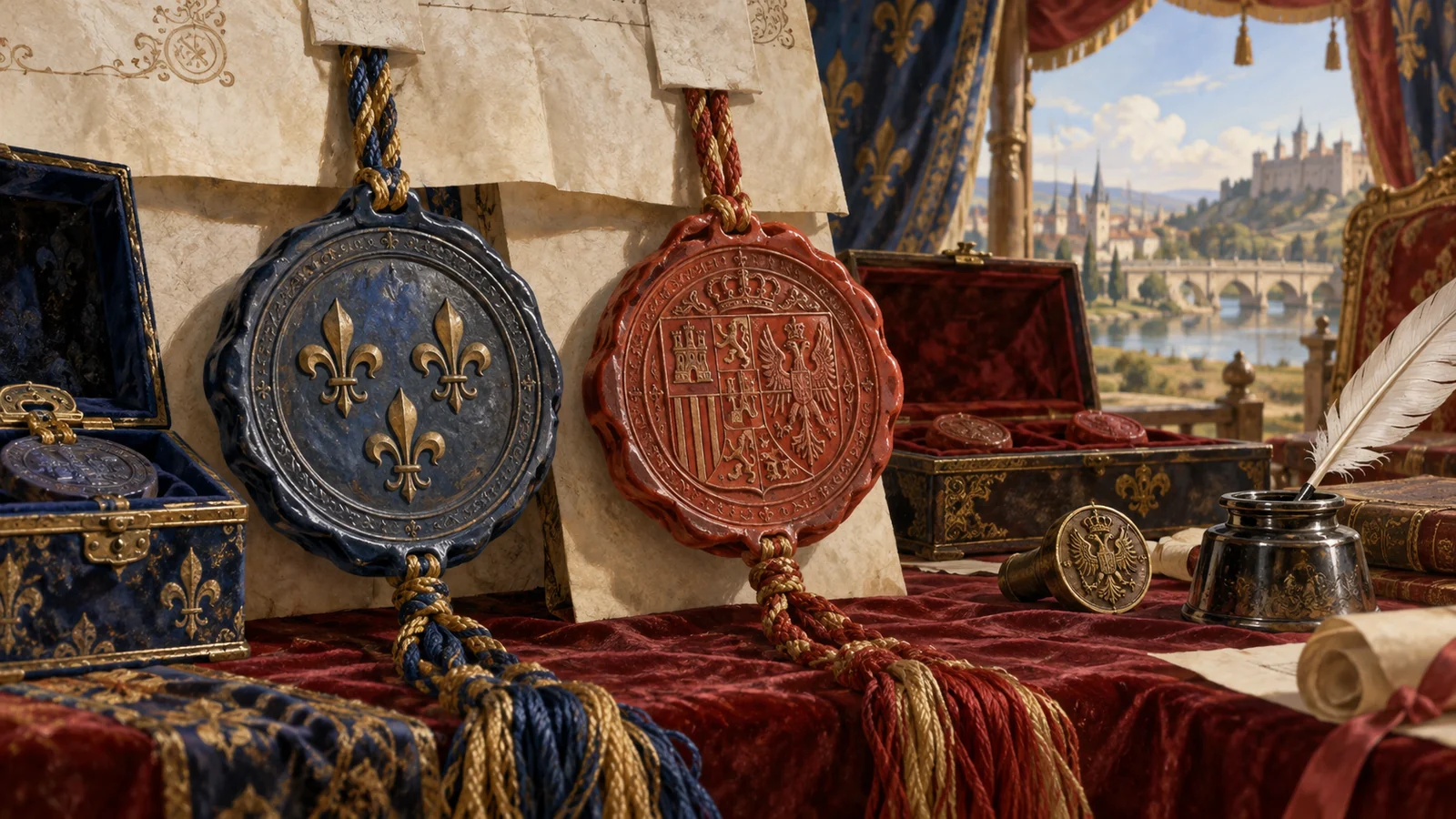
The Treaty of the Pyrenees, signed in 1659, settled notably the fate of the Artois and of Arras. By this agreement, Spain ceded to France several territories, including the Artois, officially recognising what arms had conquered. Arras and its region thus passed, in a lasting and recognised manner, under the authority of the king of France. This transfer was not a novelty on the ground, since the town had been French in fact since 1640, but it constituted its legal and diplomatic consecration. Henceforth, the belonging of Arras to France no longer rested only on the force of arms, but on a treaty in due form, recognised by Spain itself. This official recognition ended the uncertainty that had weighed on the status of the town. The Treaty of the Pyrenees also included other provisions, notably a princely marriage destined to seal the reconciliation between the two crowns. For Arras, the essential was the definitive attachment to France, acted by this great treaty. To understand the significance of this agreement is fundamental: it marks the final point of a long history, that of the disputed belonging of the Artois. After having been Flemish, Burgundian then Spanish, the region became French, and this time for good. The Treaty of the Pyrenees is thus the act that fixed, for the centuries to come, the belonging of Arras to France, ending centuries of uncertainty and changes of sovereignty. It is one of the most important documents of the history of the town, the one that sealed its French destiny.
| Marker | Detail |
|---|---|
| 1659 | Treaty of the Pyrenees, end of the Franco-Spanish war |
| The Artois | Ceded by Spain to France |
| Arras | Definitively and officially French |
| The seal | A royal marriage between the two crowns |
A French town, for good
With the Treaty of the Pyrenees, Arras became durably French. This attachment, this time definitive, ended the long series of changes of sovereignty that had marked the history of the town. After the relief of 1654, when the relief of Arras of 1654 had saved the town from the Spanish retaking, the peace of 1659 came to consecrate the French victory. Henceforth, Arras belonged to the kingdom of France, and this belonging was no longer to be called into question. The town entered a new era of its history, that of its integration into the kingdom, which endures today. This change of status had profound consequences: Arras became a fully-fledged French town, subject to the authority of the king, integrated into the administration and the territory of the kingdom. Its destiny now merged with that of France. To understand this definitive shift is essential: it closes the long period during which Arras had belonged to other ensembles, and opens that of its French belonging, still ongoing. The Treaty of the Pyrenees is thus a founding date of modern and contemporary Arras. It marks the moment when the town, after so many centuries of eventful history between several worlds, finally found its definitive place within the kingdom of France. This new stability, after so many uncertainties, was to allow the town to develop in a finally assured framework, that of France, of which it is today a fully participating city.
The end of Spanish Arras
The Treaty of the Pyrenees marks the end of Spanish Arras, closing a period that had lasted more than a century. Since the attachment of the Artois to the Habsburgs, then to Spain, inherited from the era when the town came under Charles V, Arras had belonged to the Spanish world, with all that this implied: loyalty to the king of Spain, belonging to the Low Countries, Catholicism, wars against France. This Spanish period, often forgotten, had deeply marked the town. Its end, in 1659, closed this chapter and opened another. One must measure what this change represented: for the inhabitants of Arras, to pass from Spanish sovereignty to French sovereignty was not trivial, even if the town had been French in fact since 1640. It meant a change of belonging, of political and administrative framework, of horizon. The long Spanish period of Arras, with its loyalties and its wars, now belonged to the past. To understand the end of this period allows one to grasp the scale of the transformation: Arras left the Spanish world, to which it had belonged for generations, to become fully French. This shift, prepared by arms and consecrated by the treaty, is one of the great turning points of the history of the town. It closes the long Spanish parenthesis and inscribes Arras in its definitive French destiny. To remember this end is also to recall that Arras was, for a long time, a town of Spain, before becoming the French town it is today.
Vauban and the fortification of the French town
Once Arras had become durably French, its defence had to be ensured, for the town remained close to the frontier and the former Spanish possessions. It is in this context that was undertaken, under Louis XIV, the construction of a powerful citadel, the work of the great engineer Vauban. This fortress, destined to lock the town and to protect the northern frontier of the kingdom, durably marked the Arras landscape. Arras, a newly acquired French place, became a strong town of the kingdom, a link in the network of fortifications that protected the frontiers of France. The Treaty of the Pyrenees, by fixing the belonging of the town to France, thus opened the way to this military transformation. The fortification of Arras by Vauban is the direct extension of its attachment: a border town of the kingdom, it had to be defended accordingly. To understand this link between the treaty and the fortification allows one to grasp the logic of the era: to integrate a town into the kingdom was also to fortify it to ensure its security. Arras, after having been conquered and attached, was thus endowed with powerful defences, making it one of the strongholds of the North of France. This military dimension, inherited from the Treaty of the Pyrenees and from the will of Louis XIV, was to mark the town for the following centuries. The attachment to France and the fortification by Vauban are thus the two faces of the same movement, the one that made Arras a French and fortified town, solidly anchored in the kingdom and in its system of frontier defence.
The royal administration takes over
The 1659 settlement was not merely a change of sovereign inked onto the parchment of a treaty: it set in motion a methodical reorganisation of administrative life in Arras. The king of France inherited a town that had lived for more than three-quarters of a century under the authority of the Spanish Habsburgs, with its own institutions, urban privileges and fiscal habits. The French monarchy, anxious not to antagonise a population still attached to its franchises, at first confirmed part of the municipal liberties while gradually installing its own instruments of control: a military governor, a royal garrison, and then the machinery of the intendancy which, over the following decades, would administer the province of Artois. The aldermen continued to sit, but real power shifted toward the king's representatives. This cautious transition, built on calculated concessions and military firmness, explains why the town saw no major revolt after 1659, unlike other freshly conquered territories. Historians of early-modern Artois stress that Louis XIV, still a young ruler, applied here a method of integration he would later generalise: respect local forms so long as they did not contradict central authority, and let time do its work.
A frontier that settles down
The Treaty of the Pyrenees fixed for Arras a situation that, after decades of uncertainty, was at last to endure. The town ceased to be a place disputed between two crowns and became a link in the French frontier system in the north of the kingdom. This stability did not mean the absence of threats: the wars of Louis XIV would continue, and the region would still know military campaigns, notably during the Dutch War and the War of the League of Augsburg. But Arras itself would never change sides again. Gradually the frontier moved north and east, as the kingdom annexed new strongholds, so that the town, once exposed on the front line, found itself little by little behind the front. This relative retreat of danger transformed the very function of the city: from a threatened lock it became a solid logistical and administrative base, a point of support for the royal armies operating further north. The fortifications inherited from Vauban kept their role, but the town could breathe, and this renewed security allowed, in the eighteenth century, an economic and cultural flowering that the periods of continual war had long held back.
The Treaty of the Pyrenees in the history of Arras
The Treaty of the Pyrenees occupies a founding place in the history of Arras, as the act that sealed its belonging to France. After centuries of eventful history, marked by changes of sovereignty and wars, the town found in 1659 its definitive status. This date closes the long period during which Arras had belonged in turn to Flanders, to Burgundy and to Spain, and opens that of its French belonging, still ongoing today. To understand the importance of this treaty is essential to grasping the history of the town: it marks the point of culmination of a long process, that of the attachment of the Artois to France, begun many centuries earlier and finally completed. For the people of Arras, the Treaty of the Pyrenees is a major date, that of the definitive entry of their town into the kingdom of France. To make this treaty known is to light up the moment when the destiny of Arras tipped for good, when the town ceased to be a disputed place to become a French city assured of its status. This new stability was to allow Arras to develop and to know, in the following centuries, a destiny of a French town, with its greatnesses and its ordeals. The Treaty of the Pyrenees is thus one of the most important milestones of the history of Arras, the one that, in 1659, made Arras a town of France forever, definitively closing the long chapter of its belonging disputed between the great powers of Europe.