
Arras under Charles V: what was the Habsburg town?
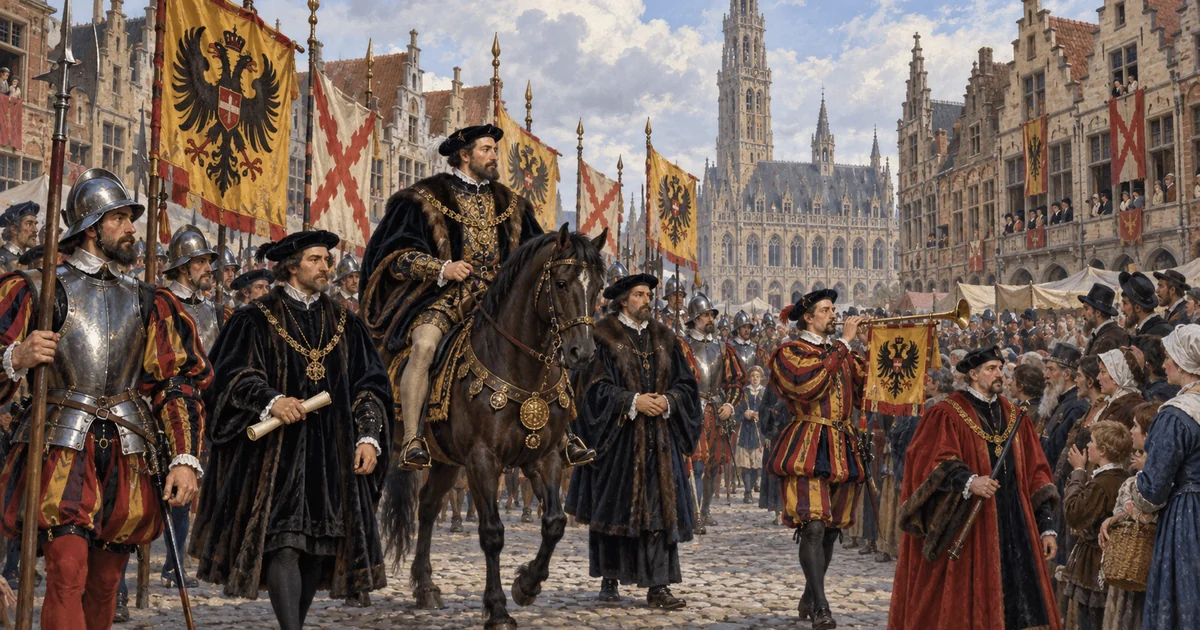
In the 16th century, Arras belonged to one of the greatest empires Europe has known: that of Charles V and the Habsburgs. Attached to the Habsburg Low Countries after the upheavals of the end of the Middle Ages, the town found itself in the sphere of the emperor over whom, it was said, the sun never set. A border town facing the kingdom of France, Arras lived to the rhythm of the rivalries between Charles V and the kings of France, in a 16th century marked by wars, the Reformation and mutations. To understand the Arras of Charles V is to grasp the town's entry into the modern era, under the authority of a universal sovereign, and to measure what it meant, for a town of the North, to belong to an empire of the dimensions of the world. A look back at this Habsburg period, often little known, of the history of Arras.
How Arras became Habsburg
The attachment of Arras to the Habsburgs was the culmination of the upheavals of the late 15th century. After the death of Charles the Bold and the struggles for the Burgundian inheritance, the Artois, for a time disputed between France and the house of Habsburg, finally returned to the latter, following the agreements concluded in the years that followed, notably around the Treaty of Arras of 1482. The region thus entered the whole of the Habsburg Low Countries, those rich northern provinces inherited from Burgundy. Charles V, born in these Low Countries, inherited this vast ensemble, to which were added, through the play of successions, the crown of Spain, the Italian possessions, the territories of the New World and the imperial dignity. Arras thus found itself, almost without having chosen it, part of an empire of unprecedented dimensions. This shift, long prepared, made the town a Habsburg city, turned toward Brussels, capital of the Low Countries, and toward the emperor. To understand how Arras became Habsburg is essential to grasping the rest of its history: the town was, for nearly two centuries, to belong to the Spanish and imperial world, before its attachment to France. This moment marks the entry of Arras into the modern era under a new authority, that of the Habsburgs, whose prestige and power exceeded anything the town had known until then, inserting it into a truly world history.
Charles V, an emperor of the dimensions of the world
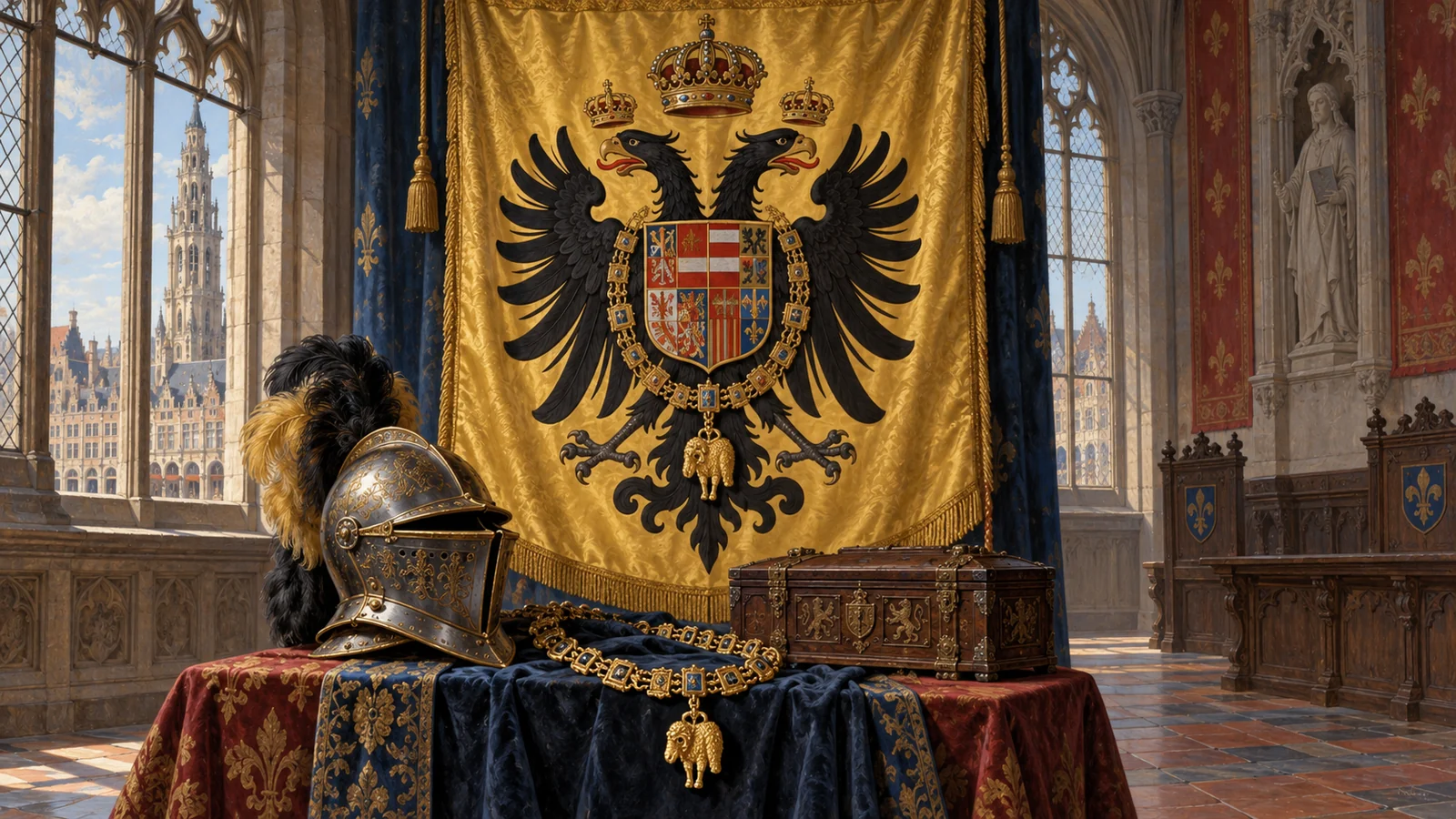
The figure of Charles V dominates the history of the 16th century. Heir of several dynasties, he reigned over a set of territories of unprecedented scale: the Low Countries, Spain and its colonial empire, part of Italy, the hereditary lands of the Habsburgs, and he was elected emperor of the Holy Roman Empire. It could be said of his empire that the sun never set on it, so far did it extend over the globe. For a town like Arras, to belong to such an ensemble was both a source of prestige and a source of constraints. The town was now a piece of a world empire, whose decisions were taken far from it, at the emperor's court or in Brussels. Charles V, an itinerant sovereign, governed his vast possessions with the help of administrators and regents, notably in the Low Countries. His reign was marked by great challenges: the wars against France, the struggle against the Ottoman advance, and the crisis of the Protestant Reformation that divided Christendom. Arras, a Catholic and border city, found itself at the heart of these stakes. To understand the figure of Charles V allows one to measure the context in which the town then evolved: that of an immense empire, with universal ambitions, engaged in the great conflicts of its time. Arras, modest on the scale of this ensemble, was nonetheless an important place, a border town whose loyalty and position counted in the emperor's strategy against neighbouring France.
| Marker | Detail |
|---|---|
| Attachment | The Artois to the Habsburgs after 1493 |
| Charles V | Emperor, king of Spain, master of the Low Countries |
| Arras | A Catholic border town facing France |
| Context | Wars, Reformation and rivalries of the 16th century |
A border town facing France
The situation of Arras in the 16th century was marked by its position as a border town, on the confines of the Habsburg possessions and the kingdom of France. This strategic location, on the edge of two great rival powers, made the city a military stake and a place exposed to tensions. The wars between Charles V and the kings of France, notably Francis I, took place in part in these border regions of the North, where the armies manoeuvred and clashed. Arras, a stronghold of the emperor, had to be defended and fortified against the French threat. This condition of a border town, Arras had known for a long time, having always been situated at the hinge of several worlds. But it took on a particular acuteness in the 16th century, in the context of the fierce struggle between the Habsburgs and France for the domination of Europe. The town thus lived under the threat of war, with the consequences that implied: fortifications, garrisons, uncertainties. This military and border dimension is essential to understanding the Arras of this era, a prosperous but exposed city, a strategic asset in the great confrontation of the century. To understand this position allows one to grasp why Arras was, throughout the Habsburg then Spanish period, a disputed and fortified place, a lock of the North that both camps coveted. This vocation of a border town was to culminate, in the following century, with the great sieges that finally decided its attachment to France.
Life in a great 16th-century city
Beyond the great political stakes, Arras remained a living and active city. The town pursued its economic activities, its trade and its craft, in a densely populated and prosperous region of the Low Countries. Urban life, with its markets, its trades, its institutions and its religious life, unfolded to the rhythm of the century. Arras kept its municipal organisation and part of its traditions, under the authority of the Habsburgs. The town, heir to its rich medieval past, remained an important centre, whose heart beat around its squares and its buildings. It is moreover to this long urban history that the Place des Héros still refers today, one of the great squares of Arras, a witness to the merchant and civic life of the city across the centuries. Under Charles V and his successors, Arras continued to be a town of fairs, exchange and sociability, despite the turbulence of the era. The daily life of the people of Arras, made of work, trade, religious practices and feasts, continued, inscribed in the frameworks inherited from the past. To understand this dimension of urban life is important so as not to reduce the history of the town to its political and military aspects alone. Arras in the 16th century was an inhabited, laborious and lively city, whose inhabitants lived their daily life under the distant aegis of a universal emperor, while remaining attached to their town, its streets and its age-old traditions.
The Reformation and religious tensions
The 16th century was also that of the Protestant Reformation and the deep religious divisions it brought about. The contestation of the Catholic Church, born in Germany, spread across Europe, including in the Low Countries, provoking considerable tensions. Charles V, a defender of Catholicism, fought against the diffusion of the new ideas in his states. The Low Countries, rich and open, were particularly touched by these religious upheavals, which were to lead, in the second half of the century, to grave conflicts. Arras, a Catholic city, found itself caught in these religious stakes that agitated the whole empire. The question of faith became a major factor of division and conflict, mixing the religious with the political. These tensions prepared the coming confrontations, notably the great revolt of the Low Countries against Spanish authority, in which the region of Arras was to play a role. To understand the religious context of the 16th century is essential to grasping the history of Arras at this era: the town was not only a border place in the Franco-Habsburg rivalry, but also an actor in the religious rifts that shook the Low Countries. This confessional dimension, inseparable from the history of the century, was to weigh heavily on the destiny of the region. Arras, remaining faithful to Catholicism, would soon side with Spain in the great conflict that was to divide the Low Countries between Catholic and Protestant provinces, a rift of which the town was one of the stages.
The Burgundian legacy under the Habsburgs
The belonging of Arras to the Habsburgs was part of a continuity with the Burgundian period. The Habsburg Low Countries were, essentially, none other than the inheritance gathered from the Burgundian state, of which Charles V was the descendant. Arras, which had known its golden age under the dukes of Burgundy, as the history of Burgundian Arras recalls, thus remained in the same territorial and cultural ensemble, now governed by the Habsburgs. This continuity is important: the passage from Burgundy to the Habsburgs was not a total rupture, but the transmission of an inheritance, that of the rich northern provinces, to a new dynasty. The institutions, traditions and organisation inherited from the Burgundian era largely maintained themselves under the Habsburgs. Arras thus kept part of what had made its prosperity and its identity under the dukes. To understand this continuity allows one to nuance the idea of a brutal change: if the sovereign had changed, the general framework, that of the Low Countries, remained. The town remained turned toward this northern ensemble, whose history, culture and interests it shared. This permanence of the Burgundian legacy under the Habsburgs is a key to understanding the Arras of the 16th century: a town which, while changing master, prolonged a long history begun under Burgundy, in the continuity of a destiny linked to the rich provinces of the Low Countries, before the wars of the following century came, again, to reshuffle the cards of its belonging.
A city in a world empire
To belong to the empire of Charles V meant, for Arras, being linked to an ensemble of planetary dimensions. The Habsburg empire extended over Europe and beyond, as far as the territories of the New World, on a scale unprecedented in history. For a town of the North, this belonging opened, at least symbolically, dizzying horizons. Admittedly, Arras remained a modest city on the scale of this empire, and its daily life remained above all local and regional. But it was now part of a world ensemble, whose affairs, wars and riches circulated on an unprecedented scale. The decisions taken at the emperor's court or in the great capitals could have repercussions as far as the northern provinces. Arras was inserted into the networks of this empire, economic, political and religious, which far exceeded the frame of the region. This dimension, often neglected, deserves to be underlined: the town was not isolated, but linked, by its imperial belonging, to a world in full expansion. To understand this insertion into a world empire allows one to measure the exceptional context in which Arras evolved in the 16th century. The town of the North, without leaving its region, took part in its way in the adventure of one of the greatest empires of history, before the religious and political upheavals came, in the second half of the century, to fracture this ensemble and drag Arras into new conflicts, with decisive consequences for its future.
From Charles V to Spain
The reign of Charles V ended with a resounding decision: his abdication, by which he divided his immense inheritance. The Low Countries, including the Artois and Arras, returned to his son, the king of Spain, while the imperial dignity passed to another branch of the Habsburgs. Thus, Arras, after having been a town of the empire of Charles V, became a city of the Spanish Low Countries, under the authority of the king of Spain. This passage marks a new stage of the history of the town, which was to remain Spanish for a good part of the 16th and 17th centuries. This Spanish period, heir to the Habsburg period, was marked by wars, revolts and, finally, the great sieges that decided the attachment of Arras to France. To understand the passage from Charles V to Spain allows one to grasp the continuity and the evolutions of this long Habsburg domination over the town. Arras remained, under the kings of Spain as under Charles V, a border city, Catholic and faithful, exposed to conflicts with France. This belonging to the Spanish world, often forgotten in the narrative of a town today fully French, is nonetheless an essential part of its history. It recalls that Arras was, for generations, a town of the Low Countries, turned toward Brussels and Madrid as much as toward Paris, in a European destiny whose legacy still marks, discreetly, its heritage and its memory.