
The Treaty of Arras of 1482: what fate for the Artois?
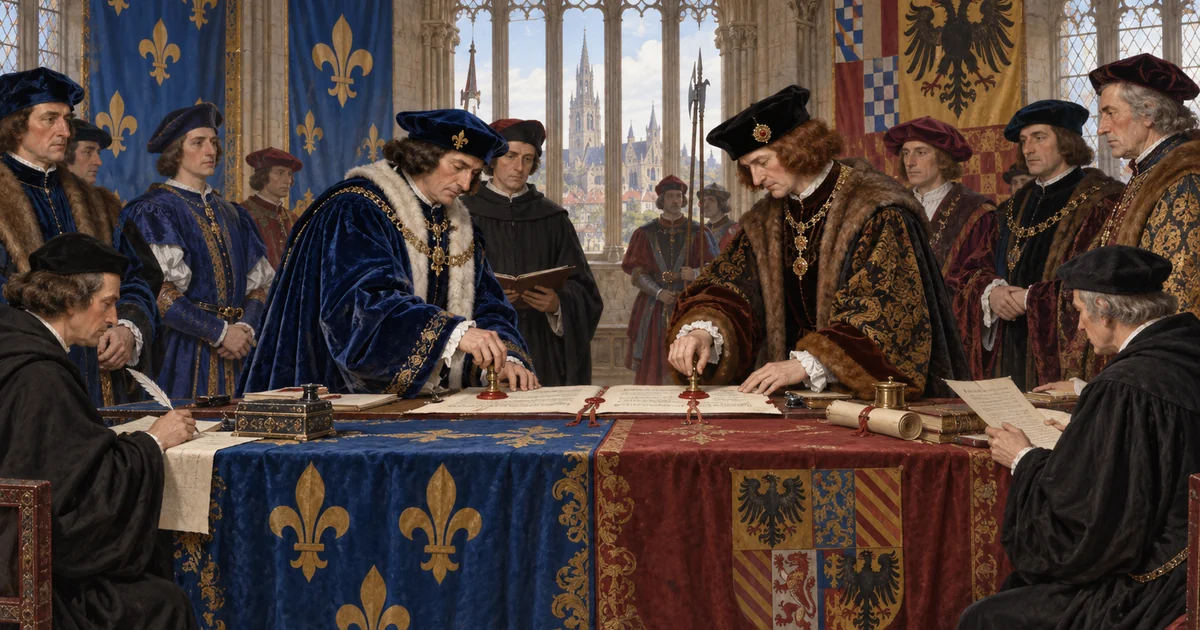
In 1482, a new treaty signed at Arras sealed, for a time, the fate of the Artois: the Treaty of Arras of 1482, concluded around the destiny of a child, Margaret of Austria. After the death of Mary of Burgundy, heiress of the great Burgundian state, the king of France Louis XI and the archduke Maximilian of Habsburg negotiated an agreement providing for the marriage of little Margaret to the dauphin of France, the Artois to constitute part of her dowry. This treaty, the third great agreement signed at Arras after those of 1191 and 1435, once again placed the town and its region at the heart of great European diplomacy. But history was to thwart these plans. To understand the treaty of 1482 is to follow an episode made of princely marriages, political calculations and reversals, on which the destiny of Arras depended.
After the death of Charles the Bold
The treaty of 1482 is the culmination of a crisis opened a few years earlier by the death of Charles the Bold. The disappearance of the last great duke of Burgundy had triggered a struggle for his immense inheritance, between the king of France Louis XI and the house of Habsburg, into which the duke's daughter had married. The Burgundian inheritance was a colossal stake: it included rich and strategic territories, among them the Artois and Arras. Louis XI had at once sought to seize part of these lands, while Maximilian of Habsburg, husband of Mary of Burgundy, defended the rights of his wife and their children. This Franco-Habsburg rivalry, which was to dominate European history for decades, had its source in this disputed partition of the Burgundian succession. Arras, like the whole region, found itself at the heart of this confrontation between two of the greatest powers of the time. The premature death of Mary of Burgundy, in 1482, precipitated events and made necessary an agreement to settle, at least provisionally, the fate of the contested territories. It is in this context that the Treaty of Arras was negotiated. To understand this backdrop is essential: the treaty of 1482 is not an isolated act, but a moment of the long struggle for the Burgundian inheritance, which opposed France and the Habsburgs. Arras, a stake of this rivalry, was to bear its consequences directly, its fate being decided by these powers fighting over the spoils of the great vanished Burgundian state.
A marriage to seal the peace
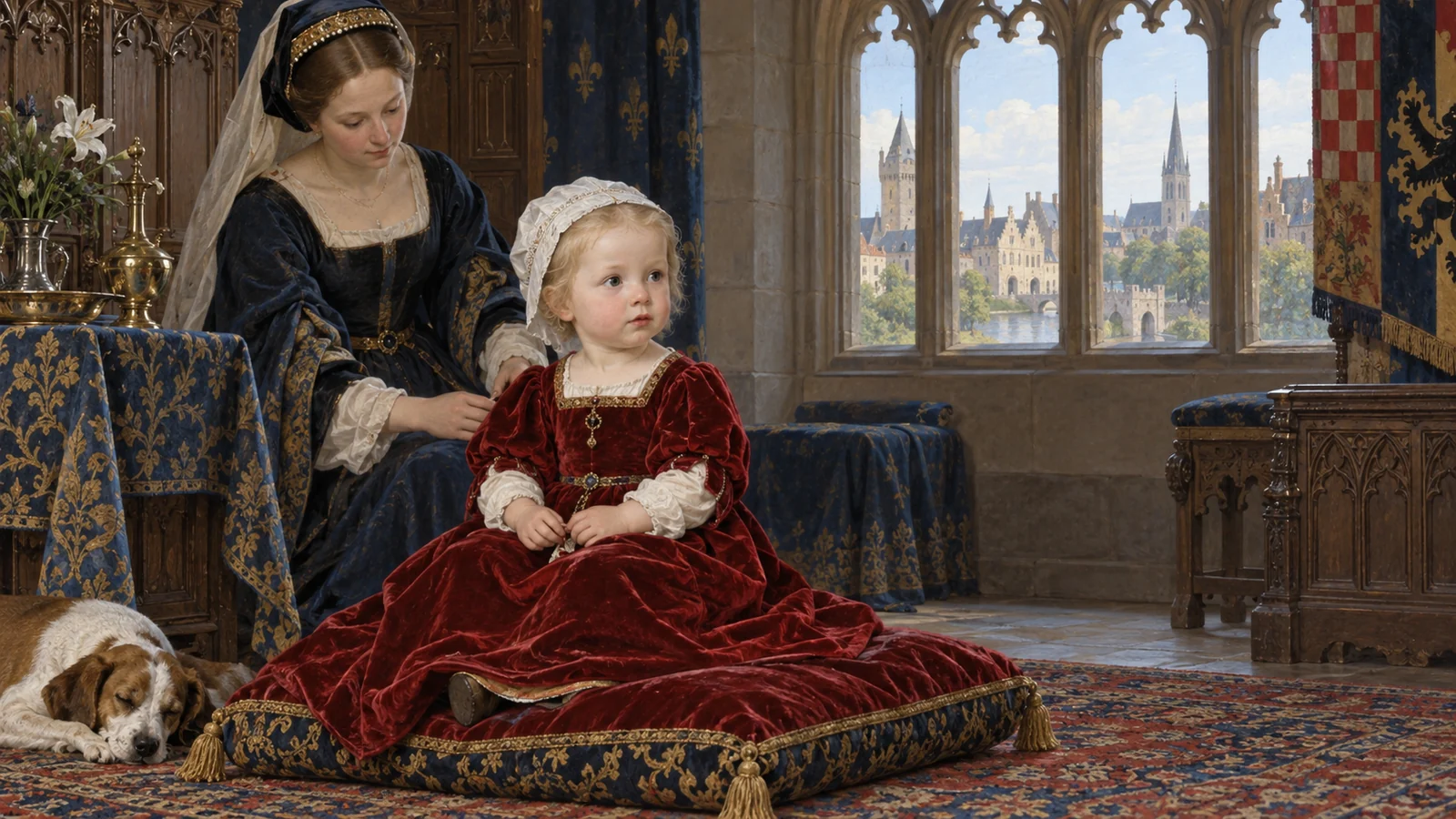
At the heart of the treaty of 1482 is a princely marriage, a classic instrument of the diplomacy of the era. The agreement provided that little Margaret of Austria, daughter of Maximilian of Habsburg and Mary of Burgundy, still an infant, would be betrothed to the dauphin of France, the heir to the throne. This future marriage was to seal the reconciliation between France and the Habsburgs and settle the fate of the disputed territories. To marry the children of princes to conclude peace and exchange territories was a common practice, where beings counted less than dynastic interests. Little Margaret was thus promised to the dauphin and sent to the court of France to be raised there, as was customary for future royal brides. This planned union joined two of the greatest houses of Europe and seemed to open an era of peace. It illustrates how, at that time, matrimonial alliances served to settle conflicts and redraw the political map. For the Artois and Arras, this marriage was heavy with consequences, since the region was involved in the territorial arrangements that accompanied it. To understand this planned union is essential to grasping the treaty of 1482: everything rested on this future marriage, meant to seal durably the peace and the partition of the Burgundian inheritance. The destiny of a little girl and that of a great region were thus linked, in an agreement that seemed, on paper, to resolve the rivalry between France and the Habsburgs.
| Marker | Detail |
|---|---|
| 1482 | Treaty of Arras between Louis XI and Maximilian |
| Margaret | Betrothed to the dauphin, raised in France |
| The Artois | Part of the dowry provided by the agreement |
| The sequel | The marriage broken, the Artois to the Habsburgs |
The Artois, stake of a princely dowry
The fate of the Artois was at the heart of the treaty's arrangements. The region, with Arras, was to enter Margaret's dowry, that is, to be brought to France within the framework of the planned marriage. Thus, through this princely union, the Artois again drew closer to the crown of France, prolonging the long history of its disputed belonging, which went back at least to the Treaty of Arras of 1191. This way of disposing of a region as a good transmissible by marriage may surprise us today, but it was common: territories followed dynastic alliances, changing hands according to unions and successions. For the inhabitants of the Artois and Arras, this meant seeing their fate decided far away, in the negotiations of princes, without their opinion weighing. The treaty of 1482 perfectly illustrates this logic, where a great region and its capital became the stake and the currency of a matrimonial agreement. To understand this dimension allows one to grasp the condition of territories at this time, objects of bargaining between the powerful. The Artois, rich and coveted, was a choice piece in this game. That its possession was linked to the marriage of a child shows how much the geopolitics of the time rested on the family alliances of the reigning dynasties. Arras, capital of this disputed Artois, found itself once more at the centre of the great manoeuvres that decided its future, tossed between France and the Habsburgs according to the calculations of princes.
An agreement soon broken
History, however, did not follow the plan drawn in 1482, and the agreement was soon broken. The planned marriage between Margaret of Austria and the dauphin never took place. For political reasons, the future king of France finally married another princess, and little Margaret, raised at the court of France for years in the prospect of this marriage, was sent back, not without humiliation for her family. This rupture led to the calling into question of the treaty's territorial arrangements. The fate of the Artois found itself again in suspense, and the region, after many vicissitudes, finally returned to the fold of the Habsburgs, following another agreement concluded shortly after. Thus, the Treaty of Arras of 1482, which seemed to have settled the fate of the Artois by drawing it closer to France, was finally thwarted by the reversals of politics. This turnaround illustrates the fragility of the treaties of the era, constantly called into question by the changing interests of princes. It also shows that the destiny of the Artois remained undecided, the region oscillating between France and the Habsburgs. For Arras, this meant continuing to live in uncertainty, its future depending on the great powers. To understand this rupture is essential: it explains why the treaty of 1482, despite its importance, did not durably fix the fate of the region, and why the Artois was, for a long time yet, to belong not to France, but to the house of Habsburg, opening a new chapter of its history.
Margaret of Austria, a European destiny
Beyond the treaty, the figure of Margaret of Austria deserves attention, so exceptional was her destiny. This princess, whose childhood was marked by the failed marriage with the dauphin of France, then knew a remarkable trajectory. Become a great lady of her time, she played a leading political role, governing the Low Countries on behalf of the Habsburgs and proving a skilful and respected stateswoman. Her early link with the Artois, through the Treaty of Arras, was but an episode of a life rich in dramatic turns. That the name of Margaret of Austria is associated with Arras, through this treaty of her early childhood, adds a particular touch to the history of the town. It recalls that Arras was mixed up in the destinies of the greatest figures of Renaissance Europe. The treaty of 1482, by linking the fate of the region to that of this princess, inscribes Arras in the great dynastic history of the continent. To understand Margaret's destiny allows one to measure the stakes that were tied around the Artois: nothing less than the balance between France and the Habsburgs, the two powers that were to dominate Europe. The little girl of the Treaty of Arras became one of the most influential women of her era, and her memory remains attached, among other places, to this town of the North where a treaty had, for a time, made her the key to the fate of the Artois.
Arras between France and the Habsburgs
The treaty of 1482 marks a turning point in the long swing of Arras between France and the Habsburgs. At the end of the vicissitudes of this late 15th century, the Artois finally escaped France to pass under the authority of the house of Habsburg. Arras was thus to enter a long period, that of the domination of the Habsburgs then of Spain, which would last well beyond the Middle Ages. This shift toward the Habsburg world, prepared by the events of the 1480s, was to make Arras a town of the Spanish Low Countries for nearly two centuries. The treaty of 1482, despite its failure to unite Margaret and the dauphin, belongs to this shift. It recalls that the destiny of Arras was not linear: after having been Flemish, then linked to France, then Burgundian, the town became Habsburg, according to the great treaties and dynastic rivalries. This instability, this passage from one power to another, is one of the characteristics of the history of Arras, a border town disputed between the great states. To understand the treaty of 1482 is to grasp one of the key moments of this eventful history, the one when, after the French interlude of Louis XI, the Artois tipped toward the Habsburgs. For Arras, a new era began, that of its belonging to a vast empire, whose destiny it was to follow, between grandeur and ordeals, until its definitive attachment to France, many generations later.
Three treaties of Arras, a town at the centre
The treaty of 1482 invites a striking observation: Arras was, several times, the place of great treaties and agreements that decided the fate of the region and weighed on the history of Europe. The treaty of 1191, which attached it to the royal domain, the great congress of 1435, which reconciled France and Burgundy, and the treaty of 1482, which provisionally settled the Burgundian inheritance, mark out this history. That so many major agreements were concluded at Arras is no accident: the town, by its strategic position, its wealth and its importance, was a natural place for these great negotiations. It stood at the border of the French, Flemish, Burgundian and Habsburg worlds, at the crossroads of the rivalries that structured European politics. This diplomatic vocation is part of the historical identity of Arras, a town where peace was negotiated and where maps were redrawn. To understand the treaty of 1482 in this perspective is to measure the eminent place the city held in the great history. Few towns can boast of having hosted so many decisive agreements. This dimension, often little known, deserves to be underlined: Arras was not only a town of trade, culture and war, but also a high place of European diplomacy. The treaty of 1482, the last great medieval agreement signed within its walls, perfectly illustrates this role, and recalls that at Arras, more than once, the destiny of the region and of the continent was played out.