
The Congress of Arras of 1435: how did the peace change the war?
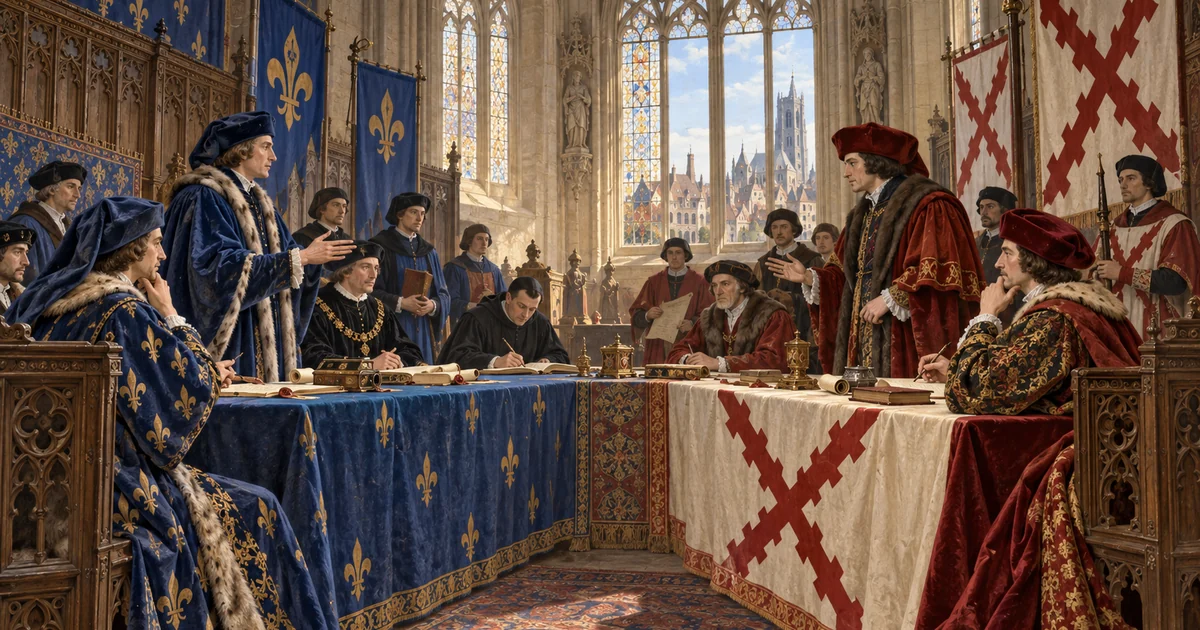
In 1435, Arras was the stage of one of the major diplomatic events of the Middle Ages: the Congress of Arras, which sealed the reconciliation between the king of France and the duke of Burgundy. By breaking the alliance between Burgundy and England, this great peace congress changed the course of the Hundred Years' War and prepared France's final victory. Bringing together ambassadors, princes and mediators from all Christendom in the abbey of Saint-Vaast, it made the town, for a few weeks, the diplomatic capital of Europe. To understand the Congress of Arras is to grasp a decisive turning point of the history of France, and to measure the leading role the city played in the settlement of a conflict that had bloodied the kingdom for nearly a century. A look back at these days that made Arras a name inscribed in the great history.
A kingdom torn by the Hundred Years' War
To grasp the importance of the congress, one must recall the dramatic situation of France in the 1430s. The kingdom was torn by the Hundred Years' War, that long conflict against England, aggravated by the civil war between Armagnacs and Burgundians. The duke of Burgundy, one of the most powerful princes of Europe and master of the Artois of which Arras was the capital, was allied to the English against the king of France. This Burgundian-English alliance had weighed heavily in the misfortunes of the kingdom, and it was this alliance that had sealed the fate of Joan of Arc, captured by the Burgundians then handed to the English a few years earlier. Despite the victories that the epic of the Maid had allowed, France remained weakened and divided, part of its territory escaping the king's authority. In this context, breaking the alliance between Burgundy and England became the major stake: to detach the powerful duke from his English alliance and reconcile him with the king of France could tip the conflict. This is precisely the object of the Congress of Arras. To understand this stake supposes measuring the weight of Burgundy, whose rallying or hostility could decide the outcome of the war. The kingdom, exhausted by decades of conflict, aspired to peace, and the Congress of Arras represented a historic chance to end the rupture, by reconciling the two great French powers that everything, until then, had opposed.
Arras, diplomatic capital of Europe
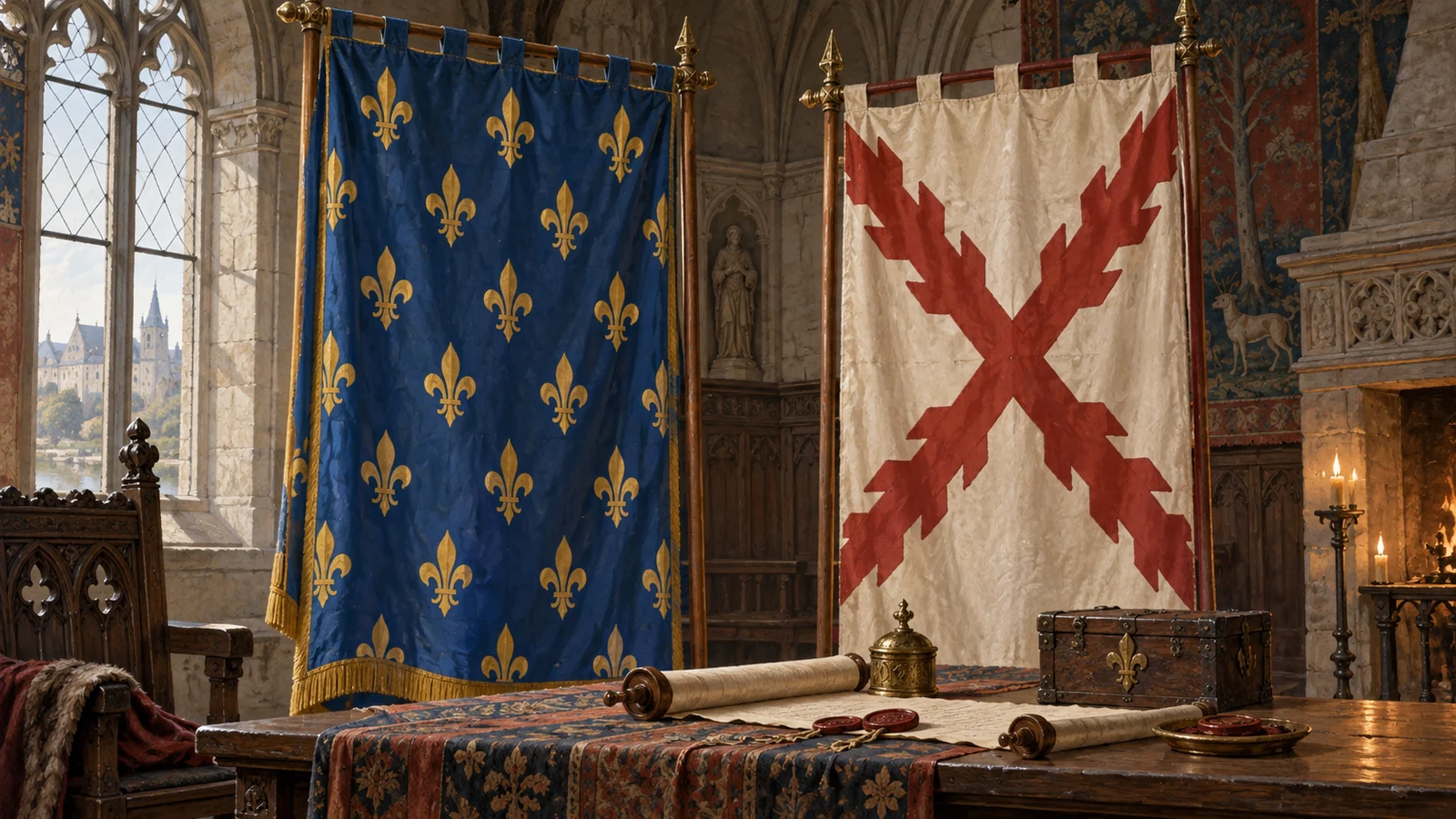
The choice of Arras to host such a congress was no trifle: it consecrated the role of the town as a great city of Burgundy, in an ideal position for a negotiation involving the duke. During the weeks of the congress, Arras became the centre of the diplomatic world, welcoming an extraordinary influx of ambassadors, princes, prelates and their retinues, come from France, Burgundy, England and elsewhere. Mediation was ensured by the highest authorities of Christendom, with the presence of representatives of the pope and the council, a sign of the universal importance given to the event. The town filled with sumptuous delegations, vying in prestige, in an atmosphere mixing tight negotiations and demonstrations of magnificence. The abbey of Saint-Vaast, one of the great religious establishments of the city, served as the setting for the discussions. This concentration of European diplomacy at Arras made the town, for the time of the congress, a de facto capital, where the future of the kingdom of France and the balance of the continent were played out. For the city, to host such a gathering was an honour and a recognition of its rank. The event mobilised its resources, its organisation and its hospitality. To understand the congress is also to imagine this ferment, this town of the North suddenly propelled to the forefront of history, where the great of this world crowded. Arras, a great merchant and Burgundian city, transformed itself for a few weeks into the stage of high European politics, in a moment that was to durably mark its history and its memory.
| Marker | Detail |
|---|---|
| 1435 | Congress and Treaty of Arras |
| Place | The abbey of Saint-Vaast, in Arras |
| Actors | Charles VII and Philip the Good, under mediation |
| Result | End of the Anglo-Burgundian alliance |
The reconciliation of the king and the duke
The heart of the congress was the reconciliation of the king of France and the duke of Burgundy. After bitter negotiations, a treaty was concluded, by which the duke of Burgundy detached himself from his alliance with England to reconcile with the king of France. This agreement, known as the Treaty of Arras, ended years of hostility between the two greatest French powers. It included important concessions from the king to the duke, a pledge of the reconciliation, and sealed a long-awaited peace. The English, whose representatives had taken part in the first phases, left the congress when it became clear that Burgundy was about to abandon them: the breaking of the alliance dealt them a terrible blow. The Treaty of Arras of 1435 is thus a major turning point of the Hundred Years' War: by depriving the English of their Burgundian ally, it unbalanced the conflict in France's favour. One must measure the significance of this act, which reoriented the whole conflict. The reconciliation was not free of ulterior motives and political calculations, on both sides, and the peace between the king and the duke still knew tensions. But the essential was achieved: France no longer had Burgundy against it. To understand this shift, negotiated within the walls of Arras, is indispensable to grasping how the kingdom could, in the following decades, regain the advantage and, finally, prevail in the long war against England.
Saint-Vaast, setting of a great congress
The congress was held in a prestigious setting: the powerful abbey of Saint-Vaast, one of the greatest monasteries of northern France, at the heart of Arras. The choice of this place was not fortuitous: a vast, dignified and neutral space was needed to host numerous and high-ranking delegations. The abbey, rich and influential, heir to a long history going back to the first bishop of Arras and whose role is known since Saint-Vaast Abbey in medieval times, offered this setting. That European diplomacy gathered within its walls testifies to the prestige of the establishment and its importance in the life of the city. The abbey of Saint-Vaast was thus, for the time of the congress, the nerve centre of the negotiations, the place where the future of the kingdom was decided. This religious and monastic dimension of the congress is not incidental: in the Middle Ages, the Church played a central role in the mediation of conflicts, and the great religious establishments were actors of political life. The Congress of Arras, placed under ecclesiastical mediation and held in an abbey, illustrates this interweaving of the spiritual and the temporal. For Arras, that its great monastery hosted an event of such significance is a source of pride and a testimony to the eminent place of the city. The memory of the congress thus remains attached to the abbey of Saint-Vaast, whose buildings, transformed over the centuries, remain one of the jewels of the Arras heritage, laden with this exceptional diplomatic memory.
The consequences: toward French victory
The consequences of the Congress of Arras were considerable and lasting. By detaching Burgundy from England, the treaty of 1435 rebalanced the Hundred Years' War in favour of the king of France. Deprived of their most powerful ally, the English saw their position deteriorate inexorably in the following years. The reconquest of the kingdom by the king of France could henceforth accelerate, up to the almost total expulsion of the English from the territory, a few decades later. The Congress of Arras thus appears as one of the decisive turning points that led to the end of the Hundred Years' War and to French victory. This significance goes far beyond the local frame: it is the destiny of the kingdom that was played out, in part, at Arras in 1435. The Franco-Burgundian reconciliation, even imperfect and subject to new tensions, changed the strategic situation. It recalls that great wars are not won only on the battlefields, but also in negotiations and alliances. The Congress of Arras, in this, is a textbook case of effective diplomacy, which obtained through negotiation what years of war had been unable to accomplish. For Arras, to have been the place of such a turning point is a glorious page of its history. The town that, a few years earlier, had been mixed up in the captivity of Joan of Arc on the Burgundian side, became the stage of the reconciliation that was to save the kingdom, illustrating the striking reversals of this troubled period.
A negotiated peace, not without ulterior motives
The Treaty of Arras was the fruit of a complex negotiation, in which each advanced their interests. To rally the duke of Burgundy, the king of France had to grant important concessions, notably territorial, and gestures apt to satisfy the honour of the duke, whose father had been assassinated in circumstances that had fed the hatred between the two camps. The reconciliation supposed settling this heavy dispute, which was not without difficulty. The negotiators, versed in diplomacy, weighed each clause, in a subtle game of demands and compromises. This peace, however decisive, thus rested on a fragile balance, in which the rancours were not all extinguished. The following decades moreover knew new tensions between France and Burgundy, up to later confrontations. One must therefore beware of seeing in the Treaty of Arras a perfect and definitive reconciliation: it was a political agreement, dictated by circumstances and interests, more than a rediscovered friendship. This lucidity takes nothing from its significance: even imperfect, the agreement reached its essential goal, to detach Burgundy from England. To understand the ulterior motives and the limits of the treaty allows one to grasp its real nature, that of an act of high politics, where pragmatism prevailed over grudges, at least for a time. This dimension, far from diminishing the event, reveals all its complexity, and recalls that great diplomacy is a matter of calculations as much as of principles, an art of which the Congress of Arras offers a remarkable example.
The height of Burgundian Arras
The congress of 1435 also marks the height of Burgundian Arras, at the peak of its prosperity and its political role. Under the dukes of Burgundy, the town knew a golden age, carried by the wealth of its trade, the brilliance of the ducal court and its strategic importance. To host the congress was the consecration of this status. The city, a great drapery and financial marketplace, was then one of the pearls of the Burgundian state, that territorial ensemble that ranked among the richest and most brilliant of Europe. This radiance, a distant heir of the power forged since the time of the counts and of the Hundred Years' War, of which the battle of Agincourt had strengthened Burgundy, made Arras a leading town. The congress was its climax, but also, in a way, the swan song of an era. For the following decades were to see the end of the Burgundian state and the return of Arras to the fold of the kingdom of France, at the end of new upheavals. In 1435, however, the town was at its zenith, able to host all of Europe. This Burgundian period, of which the congress is the summit, constitutes one of the great moments of the history of Arras, when the city shone as rarely. To understand the congress is also to measure this greatness, that of a town then at the height of its power and prestige, before the turning points that were, soon, to reshuffle the cards of its destiny.
The Congress of Arras in memory
Six centuries later, the Congress of Arras of 1435 remains one of the town's great titles of glory in national history. A leading diplomatic event, it inscribed the name of Arras in the manuals and accounts of the Hundred Years' War, alongside the battles and the great figures. Historians, notably specialists of the Burgundian state, have studied this congress in detail, its actors, its stakes and its results, making it one of the best-known episodes of medieval diplomacy. This scholarly attention testifies to the importance of the event. For the town, to keep alive the memory of the congress is to recall that Arras was, for a moment, at the centre of the history of France and Europe. This prestigious page adds to the many titles of the city, between its past as a great drapery town, its medieval literary centre and its military role. The Congress of Arras perfectly illustrates the eminent place the town held in the Middle Ages, able to host a gathering of such scope. To make this episode known is to do justice to the history of Arras and to recall that this town of the North was far more than a provincial town: an actor of the great history, whose name remains attached to one of the major turning points of the ending Middle Ages. The Treaty of Arras of 1435 thus remains, for the town, a glorious memory and a powerful marker of its historical identity, in which it can rightly take pride.