
The battle of Agincourt (1415): what disaster for the Artois?
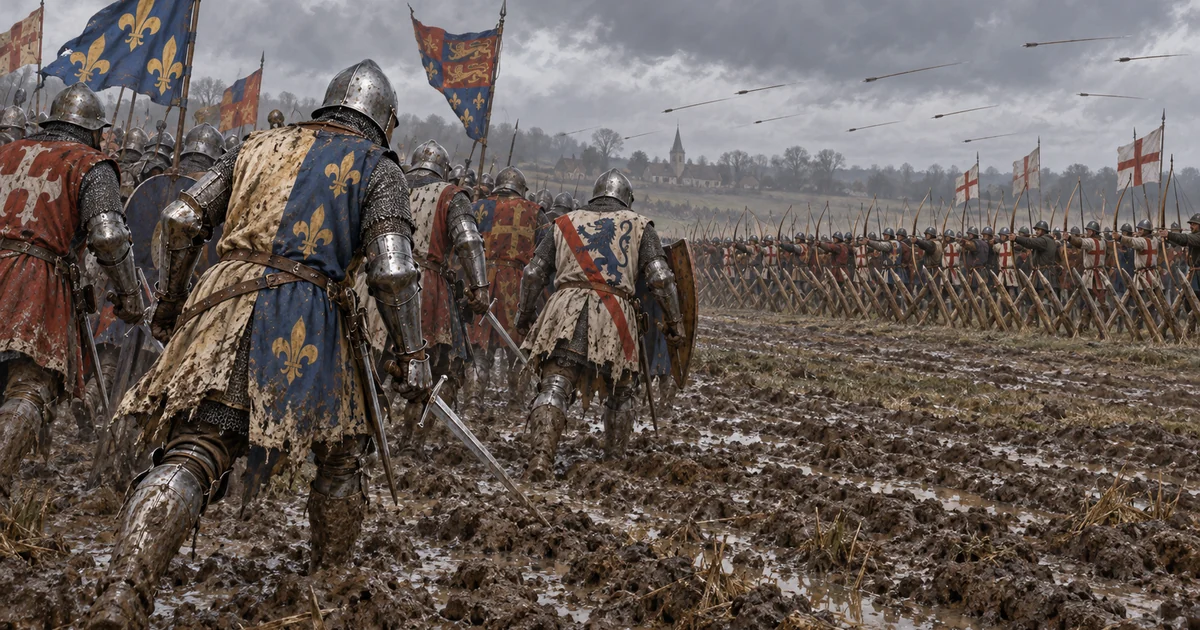
On 25 October 1415, a few dozen kilometres from Arras, one of the most terrible defeats in the history of France was played out: the battle of Agincourt. On this muddy field of the Pas-de-Calais, the flower of French chivalry, in which the Artois held a large place, was crushed by the English army of Henry V. This disaster, which plunged the whole nobility of the North into mourning, deeply marked the region and belonged to the long Hundred Years' War. To understand Agincourt is to grasp a tragic moment of the history of the Artois, so many of whose lords perished that day, and to measure the close link between this corner of Picardy and Arras, its great neighbouring city. A look back at a battle whose name still resounds, and at what it meant for Arras and its people.
Agincourt, a battle at the gates of the Artois
The battle of Agincourt took place very close to Arras, in the Pas-de-Calais, on the very lands of the Artois. This geographical proximity is no detail: it explains the massive involvement of the region's lords in the fight and the impact of the disaster throughout the Arras country. Agincourt was not a distant battle, but a drama that played out on the soil of the Artois, at the gates of the city. The nobles of the North, like those of the whole kingdom, had answered the call of the king of France to bar the road to the English army. The Artois, a land of ancient chivalry linked to the counts of Artois and to the crown, provided its contingent of lords, many of whom never returned. The region was then at the heart of the clashes of the Hundred Years' War, that long conflict between France and England that ravaged the kingdom. To understand that Agincourt was a battle of the Artois, and not an event foreign to the region, is essential to grasping its local significance. For the inhabitants of Arras and its surroundings, the news of the disaster was an immense shock, touching whole families and depriving the region of part of its nobility. This intimate link between the battlefield and the neighbouring city gives Agincourt a particular dimension in the history of Arras, that of a nearby tragedy, experienced as a wound of the whole territory.
The context: the Hundred Years' War and the civil war
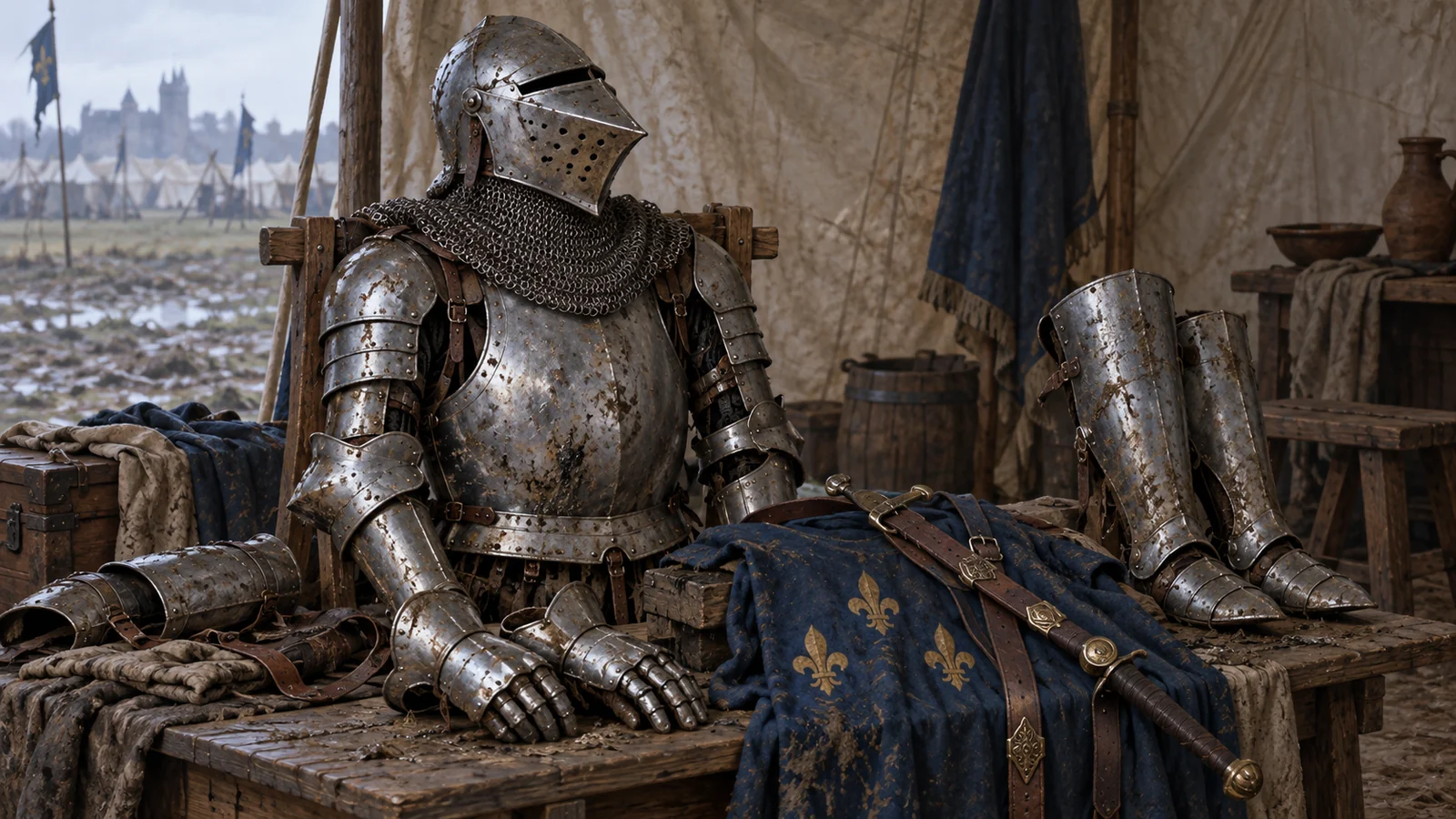
Agincourt cannot be understood without its troubled context. At the beginning of the 15th century, France was weakened by a double crisis: the Hundred Years' War against England, and a civil war tearing the kingdom apart between two rival factions, the Armagnacs and the Burgundians. This internal division, opposing the partisans of the duke of Orleans to those of the duke of Burgundy, paralysed the defence of the kingdom and offered the king of England a dreamed-of opportunity. Henry V of England revived the conflict and landed in France, taking Harfleur before marching north. It was in trying to cut off his road that the French army faced him at Agincourt. French disunity weighed heavily in the disaster: poorly coordinated, the royal army accumulated errors. The Artois and Arras were moreover at the heart of these tensions, the region being linked to the powerful house of Burgundy, which controlled Flanders and the Artois. This entanglement of the Franco-English conflict and the French civil war forms the indispensable backdrop for understanding Agincourt. The battle was not only a military defeat: it occurred in a kingdom divided against itself, which aggravated its consequences. To restore this context is to avoid reducing Agincourt to a mere clash of armies, and to understand that it was the product of a deep political crisis, whose effects the Artois, a disputed and divided land, bore head-on.
| Marker | Detail |
|---|---|
| Date | 25 October 1415 |
| Place | Agincourt, in the Artois (Pas-de-Calais) |
| Opponents | French chivalry against Henry V's army |
| Outcome | Disaster for the French and Artesian nobility |
The disaster of French chivalry
The course of the battle turned into a massacre of French chivalry. Confident of its numerical superiority, the French nobility launched into a disorderly charge on ground soaked by rain, a muddy soil where the heavy knights in armour became bogged down. The English archers, protected by stakes and firing at a rapid rate, wrought havoc in the French ranks, cramped and immobilised. The crush, the mud and the English firepower turned the assault into a deadly trap. Thousands of French knights were killed or taken prisoner, in sometimes atrocious conditions. It was one of the heaviest losses ever suffered by the kingdom's nobility in a single day. The Artois lost many of its lords there, and whole families were struck. This disaster illustrated strikingly the decline of heavy chivalry before new forms of combat, where infantry and archers, well used, could annihilate the most prestigious cavalry. Agincourt entered military history as a turning point, on a par with other defeats of French chivalry of the century. For the historian, one must beware of legendary figures and embellished accounts, while recognising the real scale of the disaster. That day, on the soil of the Artois, a generation of the French and regional nobility was decimated, leaving an immense void and a lasting trauma in the memory of the kingdom and of the region of Arras.
The Artois in mourning
For the Artois and Arras, Agincourt was above all a regional mourning. So many lords of the country had fallen that the news plunged the region into consternation. The great families of the Artesian nobility paid a heavy tribute, losing fathers, sons, brothers. This slaughter durably weakened the local nobility and upset the balance of lineages. Beyond the dead, the defeat opened a period of uncertainty and danger, the road now being less safe before the English and the troubles of the civil war. The chroniclers of the time echoed this pain, and the memory of the fallen of Agincourt was inscribed in family and regional traditions. It is likely that inhabitants of Arras and lords close to the town figured among the victims, so great was the involvement of the Artois, even if the detail of identities demands the historian's caution before sometimes uncertain sources. What is certain is the scale of the shock and the depth of the mourning. Agincourt was not only a page of national history: it was, for the Artois, an intimate tragedy, experienced in the flesh of its families. This human dimension, often eclipsed by military analyses, deserves to be recalled. Behind the name become famous of Agincourt, there is the mourning of a region, that of the Artois and its city of Arras, struck at the heart by the loss of part of their living forces in a single terrible autumn day.
Agincourt and the destiny of the Artois
The disaster of Agincourt also had major political consequences for the Artois and for Arras. The weakening of the kingdom of France benefited the house of Burgundy, which controlled the region and was, in the following decades, to play a leading role. The division between Armagnacs and Burgundians, far from calming, worsened after the battle, with dramatic episodes that bloodied the kingdom. The Artois, held by the dukes of Burgundy, found itself at the heart of these recompositions, in a period when the region tipped still more clearly into the Burgundian orbit. The link of the Artois with the crown, inherited from the attachment of the Artois to the royal domain, loosened in favour of the great duke of the West. Agincourt thus belongs to a sequence that saw the Artois and Arras deeply marked by the Franco-Burgundian rivalry, up to the great events that followed, including the famous congress of Arras. To understand Agincourt in the long term is to place it back in this eventful history in which the Artois passed from one hand to another, according to wars and treaties. The battle of 1415 was not a mere isolated episode, but a link in a chain of events that decided the fate of the region for decades. For Arras, it marks the entry into a troubled 15th century, made of wars, sieges and upheavals, of which the town was, several times, the stage and the stake.
The new weapons of war
Agincourt struck minds by the demonstration of a new way of making war. The superiority of the English archers, able to loose devastating volleys of arrows, burst into the open there, facing a French chivalry still faithful to the ideal of the frontal clash. The terrain, narrow and muddy, cancelled the advantage of numbers and of the power of heavy cavalry, turning the charge into a trap. This tactical lesson, already glimpsed in other French defeats of the century, imposed itself with unprecedented brutality at Agincourt. It heralded the slow decline of medieval chivalry as a decisive force, in favour of infantry, archers and, later, artillery. For the lords of the Artois raised in the cult of arms and chivalric honour, this shift was also a cultural shock: individual bravery no longer sufficed before collective tactics and missile weapons. To understand this military dimension helps to grasp why Agincourt made such an impression, far beyond the number of the dead. The battle became a textbook case, studied by captains and pondered by chroniclers, as the sign of a changing world. For the Artois, a land of old nobility, this evolution of the arts of war heralded new times, in which power would no longer be measured only by the courage of knights, but by organisation, discipline and the mastery of techniques, with which the states under construction would soon equip themselves.
The Burgundian Artois after the battle
In the years that followed Agincourt, the Artois anchored itself more firmly in the sphere of the powerful house of Burgundy. The dukes of Burgundy, who already held Flanders and the Artois, took advantage of the weakening of the kingdom of France to assert their authority and build a vast territorial ensemble, one of the richest in Europe. Arras, a great town of this Burgundian Artois, thus found itself at the heart of a brilliant principality, a distant heir of the domain of the counts of Flanders, whose court was among the most sumptuous on the continent. This Burgundian period was to be, for the town, a time of prosperity and radiance, but also of tensions, so lively did the rivalry between France and Burgundy remain. Agincourt, by weakening the crown, had indirectly favoured this Burgundian rise from which the Artois benefited. The battle thus belongs to a broader dynamic, that of the rise of the Burgundian state, of which Arras was one of the great cities. To understand this sequence, from the French defeat to the Burgundian assertion, allows one to measure the political consequences of Agincourt for the region. Far from being only a military tragedy, the battle had lasting extensions, which shaped the destiny of the Artois and of Arras for a large part of the 15th century, until the upheavals that would, later, bring the region back into the fold of the kingdom of France.
Remembering Agincourt today
Six centuries later, the memory of Agincourt remains vivid, in France as in England, where the battle occupies a particular place in the national narrative. On the very site, in the Pas-de-Calais, the memory of the clash is maintained and transmitted, making the place a site of memory and of visit. For the Artois and Arras, to remember Agincourt is to recognise a tragedy that struck the region at the heart, and to honour the memory of those who fell there. It is also an occasion to reflect on war, on its ravages and its lessons. The battle, long recounted through the prism of heroism or fatality, is today studied with the tools of critical history, which strives to distinguish facts from legends and to understand the real causes of the disaster. This rigorous approach takes nothing from the emotion aroused by the memory of so many dead. Agincourt belongs to the historical heritage of the Artois as much as to that of the nation. To make this link between the battle and the region of Arras known is to inscribe local history in the great history, and to recall that the great events of the kingdom were often played out on these lands of the North. For whoever takes an interest in the past of Arras, Agincourt is not a foreign battle, but a painful and nearby page of the history of the Artois, whose memory deserves to be preserved and passed on to future generations.