
The counts of Artois: who were Robert I and Robert II?
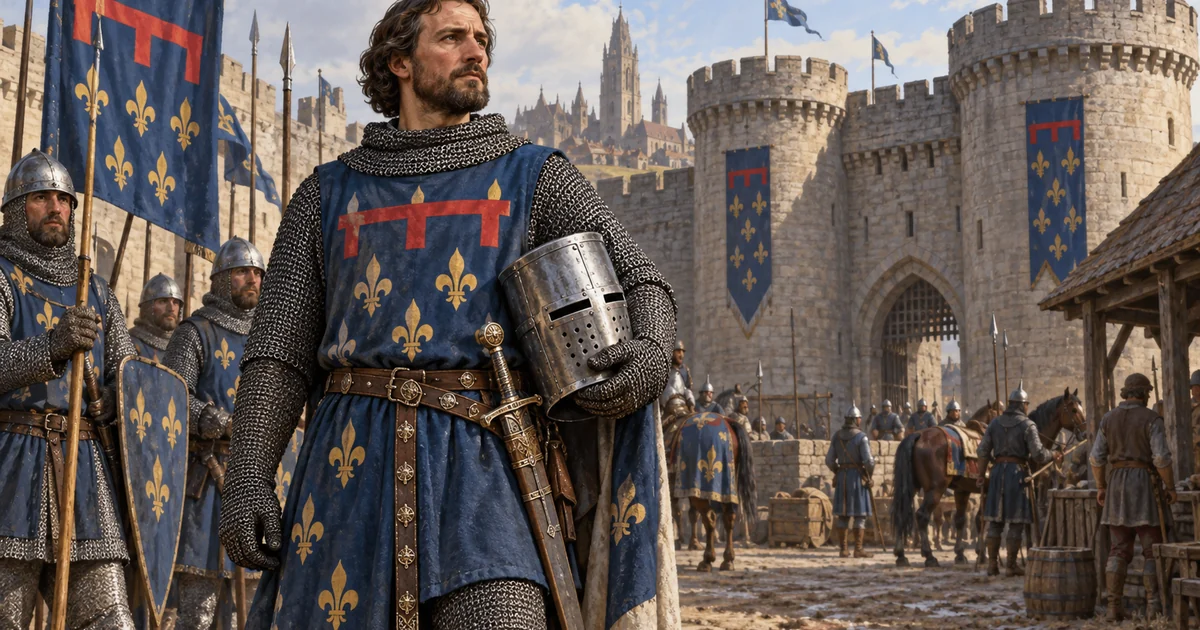
In the 13th century, Arras ceased to be only a great merchant town to become the capital of a principality: the county of Artois, governed by the Roberts. Created in 1237 as an apanage for a brother of the king of France, this county was first held by Robert I, who died on crusade, then by his son Robert II, one of the great captains of the kingdom, who fell on the battlefield of Courtrai. Two men, two warrior destinies, who placed Arras and the Artois at the heart of the history of medieval France. To understand the counts of Artois is to grasp how the town entered the direct orbit of the crown, how it was governed by princes of the blood, and how the great succession quarrel that was to follow was prepared. A look back at the birth of a county and at the two Roberts who gave it its brilliance.
The birth of a county: the apanage of 1237
The history of the counts of Artois begins with a royal act. In 1237, the king of France Louis IX, the future Saint Louis, erected the Artois into a county and gave it as an apanage to his brother Robert. The apanage was a practice by which the king endowed his younger sons with a principality, to establish them while keeping these territories within the crown's sway. The Artois, a rich drapery region detached from the old possessions linked to Flanders, thus became the base of a new princely house, that of the counts of Artois, a junior branch of the Capetian dynasty. This creation marks a turning point for Arras: long a town of the counts of Flanders, it now passed under the authority of a French prince, a close relative of the king. The town became the capital of a county, seat of a prestigious princely power. This shift into the Capetian orbit is essential to understanding the rest of the history of Arras, increasingly linked to the destiny of the kingdom of France. The apanage of 1237 was not a mere administrative act: it made Arras and the Artois a stake of the first order, a principality held by royal blood, endowed with considerable resources. To understand this origin is to grasp why the town would, for decades, live to the rhythm of the great princely families and their ambitions, and why its history mingled so closely with that of the French monarchy.
Robert I, the crusader of Mansurah
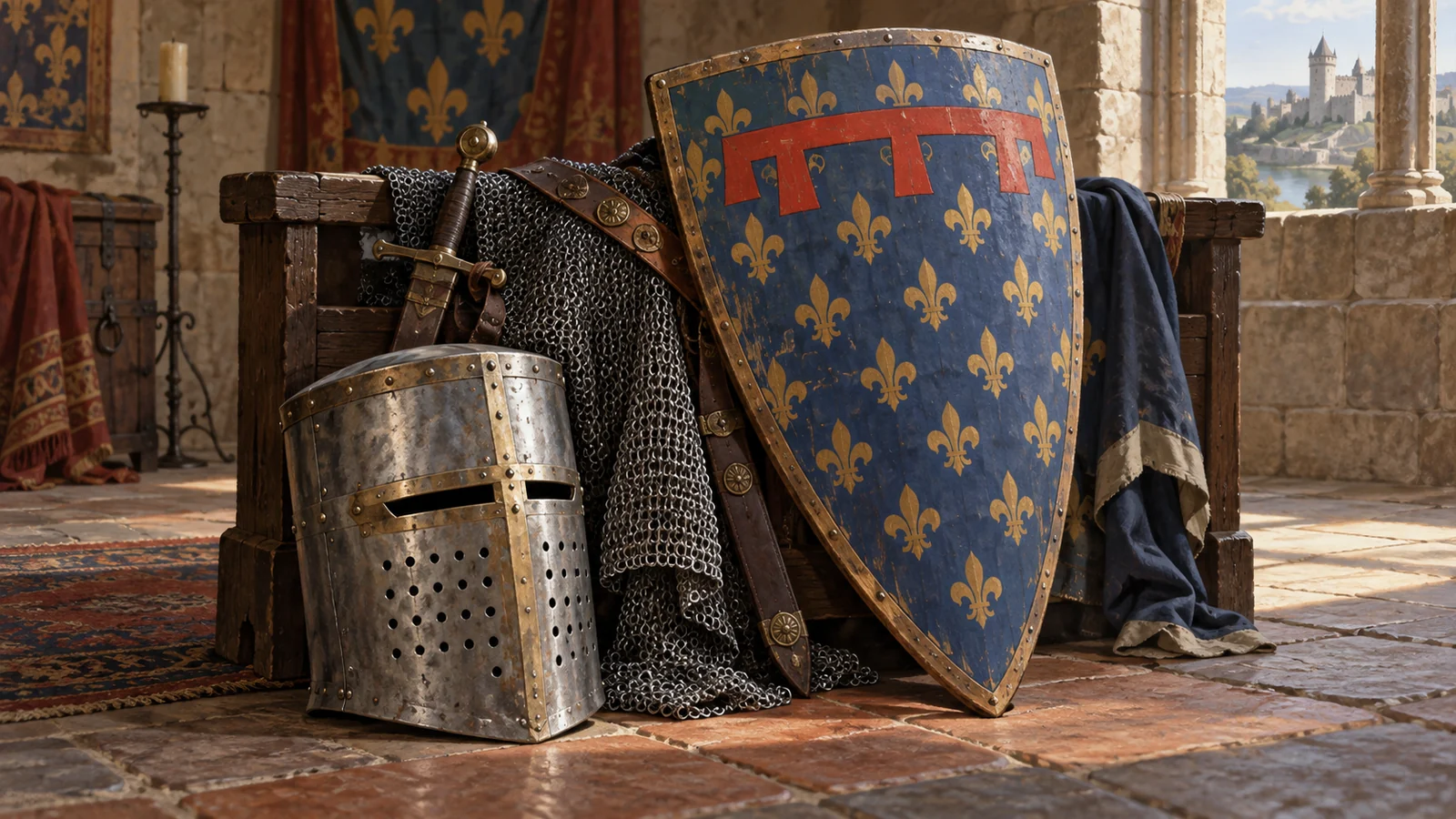
The first count, Robert I of Artois, was a man of his time: a knight, a crusader, hungry for military glory. A younger brother of Saint Louis, he accompanied the king on the seventh crusade, that expedition to Egypt meant to carry Christian arms against the sultan. It was there, in 1250, at the battle of Mansurah, that Robert I met his death. Tradition, reported by the chroniclers, attributes to him a share of responsibility in the disaster: carried away by his ardour, he is said to have charged rashly into the town, pushing too far without waiting for the bulk of the army, and to have been killed with his men in the streets of Mansurah. This episode, to be taken with the historian's caution before sometimes biased accounts, illustrates the chivalric ideal and its excesses, where bravery could verge on recklessness. The death of Robert I on crusade earned him a reputation as a brave knight, but also the reproach of having compromised the expedition. For the nascent county, this premature disappearance was heavy with consequences: the first count left a son as yet unborn or an infant, opening a period in which power had to be exercised by others. The figure of Robert I, a crusader dead far away, places the house of Artois from the outset in the epic of the crusades and in the service of the king. It also recalls how much, at that time, the destiny of princes was often played out on distant battlefields, in the name of faith and honour.
| Marker | Detail |
|---|---|
| 1237 | Creation of the county of Artois, a royal apanage |
| Robert I | First count, died at Mansurah (1250) |
| Robert II | Great captain, died at Courtrai (1302) |
| After 1302 | A disputed succession, toward Mahaut of Artois |
Robert II, great captain of the kingdom
The first count was succeeded by his son, Robert II of Artois, whose rule was long and brilliant. A great lord and an accomplished man of war, he put himself at the service of the kings of France, his cousins, and distinguished himself in many campaigns. His military reputation was considerable: he was held to be one of the best war leaders of his time, experienced and respected. Robert II played a leading role in the affairs of the kingdom, both on the battlefields and in the councils. He served the crown faithfully, taking part in the defence and expansion of royal power, notably against the Flemings, turbulent neighbours of the North. Under his government, the county of Artois knew a period of stability and prosperity, benefiting from the wealth of its drapery towns, Arras foremost. Robert II embodies the figure of the accomplished Capetian prince, combining territorial power with loyalty to the king and military excellence. His longevity in power, after the premature death of his father, gave the house of Artois a solid footing. But his destiny, like that of Robert I, was to end on a battlefield, in dramatic circumstances that were to mark the history of France. To understand Robert II is to measure the prestige attained by the counts of Artois, become major actors of the kingdom, and to grasp why the question of their succession would take on such importance.
Courtrai 1302: the death of the count
The destiny of Robert II changed on 11 July 1302, on the battlefield of Courtrai, in Flanders. That day, the French royal army, in which the count of Artois held a leading command, faced the Flemish militias in revolt against the king's authority. Against all expectation, the French chivalry, reputed invincible, was crushed by the Flemish foot soldiers, in a battle that remained famous under the name of the Battle of the Golden Spurs, because of the many gilded spurs gathered from the fallen knights. Robert II of Artois perished in this disaster, like so many French nobles. This resounding defeat was a shock for the kingdom and a major event of military history, marking the vulnerability of heavy cavalry before a determined infantry. For the county of Artois, the death of Robert II opened a crisis: the count disappeared without a living direct male heir, his son having died before him. The succession of the county would thenceforth find itself at the heart of a fierce quarrel. Thus, like his father at Mansurah, Robert II died with arms in hand, in the service of the king, on a battlefield. The first two counts of Artois share this warrior destiny, fallen far from Arras in great battles of their time. Their death in combat seals the image of a princely house devoted to the military service of the crown, and prepares the decisive turning point that was the disputed succession of the county.
A disputed succession: toward Mahaut of Artois
The death of Robert II without a living son opened one of the most famous succession quarrels of the Middle Ages. Two claimants stood opposed: on one side Mahaut, daughter of Robert II, on the other Robert, grandson of the count through a son who had died before his father. The question was who, of the daughter or the grandson born of the predeceased son, should inherit the county, a complex legal problem that divided opinion. The decision came in favour of Mahaut, who became countess of Artois, to the great displeasure of her nephew Robert, who felt cheated. The latter never renounced his claims, and the conflict between aunt and nephew would poison the life of the county for decades, feeding intrigues, lawsuits and dramatic turns. This quarrel, one of the most resounding of its time, goes beyond the local frame: it involved the highest spheres of the kingdom and knew dramatic developments. It will be the subject of a story in its own right, so much does the figure of Mahaut, a building countess and woman of power, deserve attention. For now, let us note that the death of Robert II at Courtrai does not only close the reign of the first two counts: it opens a new era, dominated by this disputed succession. The Artois, and Arras its capital, thus entered a period of tensions, in which the destiny of a great principality was played out in a bitter family quarrel with considerable ramifications.
Arras, capital of a prosperous county
Under the counts of Artois, Arras confirmed its role as capital of a rich principality. The town, strong in its drapery and its business bourgeoisie, was the economic jewel of the county, a prosperous and populous city whose wealth made the power of its princes. The urban liberties, guaranteed by the communal charter of 1163, coexisted with comital authority, in a sometimes tense balance between the bourgeois commune and the prince. The counts drew from the town and the county considerable resources, which financed their lifestyle, their wars and their prestige. The Artois of that time ranked among the most developed regions of the kingdom, with its active towns, its fertile countryside and its renowned craft. Arras was its nerve centre, the place where power, money and culture were concentrated. This prosperity explains the strategic importance of the county and the bitterness of the quarrels for its possession. To be count of Artois was to hold one of the richest principalities, with a first-rate capital. This economic dimension is inseparable from the political history of the counts: their power rested on the wealth of their towns, and Arras was the finest. To understand the county of Artois is thus also to understand the central place its capital held there, a town whose fortune made, for a large part, the greatness of its princes and the object of covetousness.
Governing a county in the 13th century
Behind the warrior figures of the two Roberts, there was the concrete reality of the government of a principality. To administer a county as rich as the Artois required a whole organisation, made of officers, bailiffs and receivers charged with dispensing justice, levying taxes and managing the domains in the count's name. The prince could not be everywhere: he relied on these agents to enforce his authority throughout the territory. This comital administration, increasingly elaborate over the 13th century, testifies to the growing sophistication of princely power, which drew on the royal model. The count also had to deal with the towns, and notably with the powerful bourgeoisie of Arras, jealous of its communal liberties. Relations between the prince and his capital were not always simple: one had to negotiate, arbitrate, sometimes repress, in a permanent interplay between comital authority and urban autonomy. The count drew from his towns essential fiscal resources, but had to respect their privileges to avoid conflicts. This delicate balance, characteristic of the urbanised principalities of the North, was at the heart of the county's political life. To understand the government of the Artois is to grasp that the power of the counts rested not only on arms or royal blood, but also on an organised administration and on a constant relationship, made of tensions and compromises, with the towns that made the wealth of their principality. This managerial dimension, less spectacular than the battles, was nonetheless the daily foundation of their authority.
The counts, the Church and princely prestige
Like all the great princes of their time, the counts of Artois maintained close ties with the Church and religious institutions, sources of legitimacy and prestige. They protected the abbeys and churches, financed pious foundations, and displayed a devotion befitting their rank. The closeness of the house of Artois to Saint Louis, a canonised king, further reinforced this dimension: to belong to the kinship of a holy king was a considerable honour, from which the counts drew added prestige. This princely piety was not only a matter of conviction: it was part of the staging of power, in a society where the sacred and the political were closely mingled. The counts also sought to mark their territory with their imprint, through constructions, residences and a sumptuous lifestyle, in keeping with their rank as princes of the blood. Their court, their domains and their largesses contributed to the radiance of the house of Artois. This concern for prestige partly explains the artistic and architectural richness of the region at that time, nourished by princely patronage as much as by that of the bourgeoisie. The counts of Artois were therefore not only war leaders: they were also protectors of the Church, builders and patrons, anxious to embody their rank worthily. This dimension completes the portrait of these princes, whose power manifested itself as much through devotion and splendour as through valour on the battlefields where they met their death.
The Artois in the kingdom of France
The history of the counts of Artois belongs to a broader movement: the anchoring of the Artois in the kingdom of France. By creating this county as an apanage, the crown had durably attached the region to the Capetian house, moving the Artois away from the Flemish orbit in which it had long evolved. The counts, princes of royal blood, were relays of French influence in a border region, in contact with the Flemish world. Their faithful service to the king, even on the battlefields where they died, illustrates this integration into the kingdom. Arras and the Artois, once turned toward Flanders, now also looked toward Paris. This evolution had deep and lasting consequences, preparing the definitive entry of the region into the French destiny, over the following centuries and their vicissitudes. The county would know many more dramatic turns, passing later under the authority of other houses, including that of Burgundy, before the great recompositions of the end of the Middle Ages. But the age of the Roberts marks a founding stage: the one in which Arras became the capital of a princely county linked to the crown, rich in its drapery that inspired even the famous tapestries of Arras. To understand the counts of Artois, Robert I the crusader and Robert II the captain, is to grasp a key moment of the town's history, in which its destiny was tied more closely than ever to that of the kingdom of France and its great princely families.