
The tapestries of Arras: why did 'arras' mean the hanging?
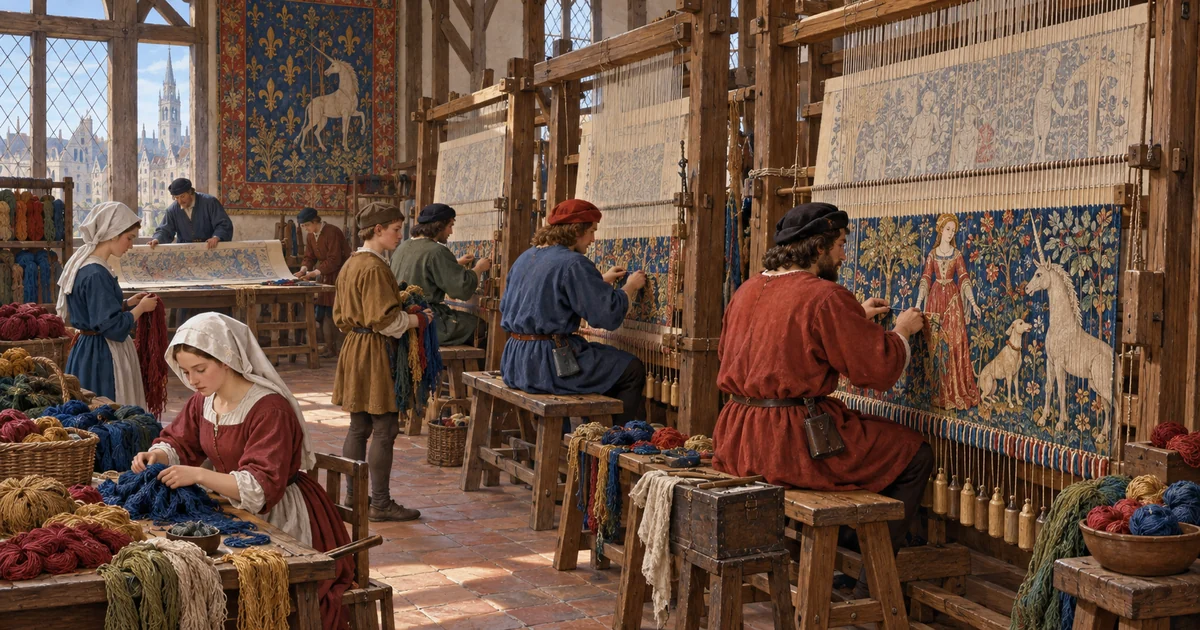
There are few towns that have given their name to a work of art, and yet Arras is one of them: in the 14th and 15th centuries, the tapestries of Arras were so renowned across Europe that the word arras long designated the tapestry itself, from England to Italy. This textile glory, born of drapery wealth and the communal rise, made the city a leading artistic centre, whose hangings adorned the palaces of kings and princes. To understand the tapestries of Arras is to grasp the peak of the town's medieval golden age, when its name shone far beyond the Artois. It is also to measure the fragility of a glory, for of this immense production almost nothing survives in Arras itself. A look back at a luxury industry that carried the town's name to the firmament of European art, and at the reasons for its brilliance as for its decline.
When 'arras' meant tapestry
The fact is rare enough to be underlined: the town's name became, in several languages of Europe, a common noun designating the wall hanging. In English, the word arras long served to name a tapestry, and its trace is found even in literature, notably among the authors of the English Renaissance. In Italian as elsewhere, terms derived from Arras designated these precious storied fabrics. This linguistic consecration is the most striking testimony to the reputation the Arras production attained. Resting on the wealth born of the town's rise and of the communal charter of 1163, the tapestry industry made Arras an absolute reference in textile luxury. When a prince wanted the finest to hang the walls of his palace, he thought of Arras. This prestige rested not only on technical quality, but on a whole reputation of excellence, patiently built and jealously maintained. That the name of a town of the North thus passed into the everyday language of several nations says much about the place Arras held in the imagination of medieval luxury. Few cities can boast such an honour, which makes the tapestries of Arras far more than a mere economic activity: a true marker of civilisation.
From drapery to high-warp weaving
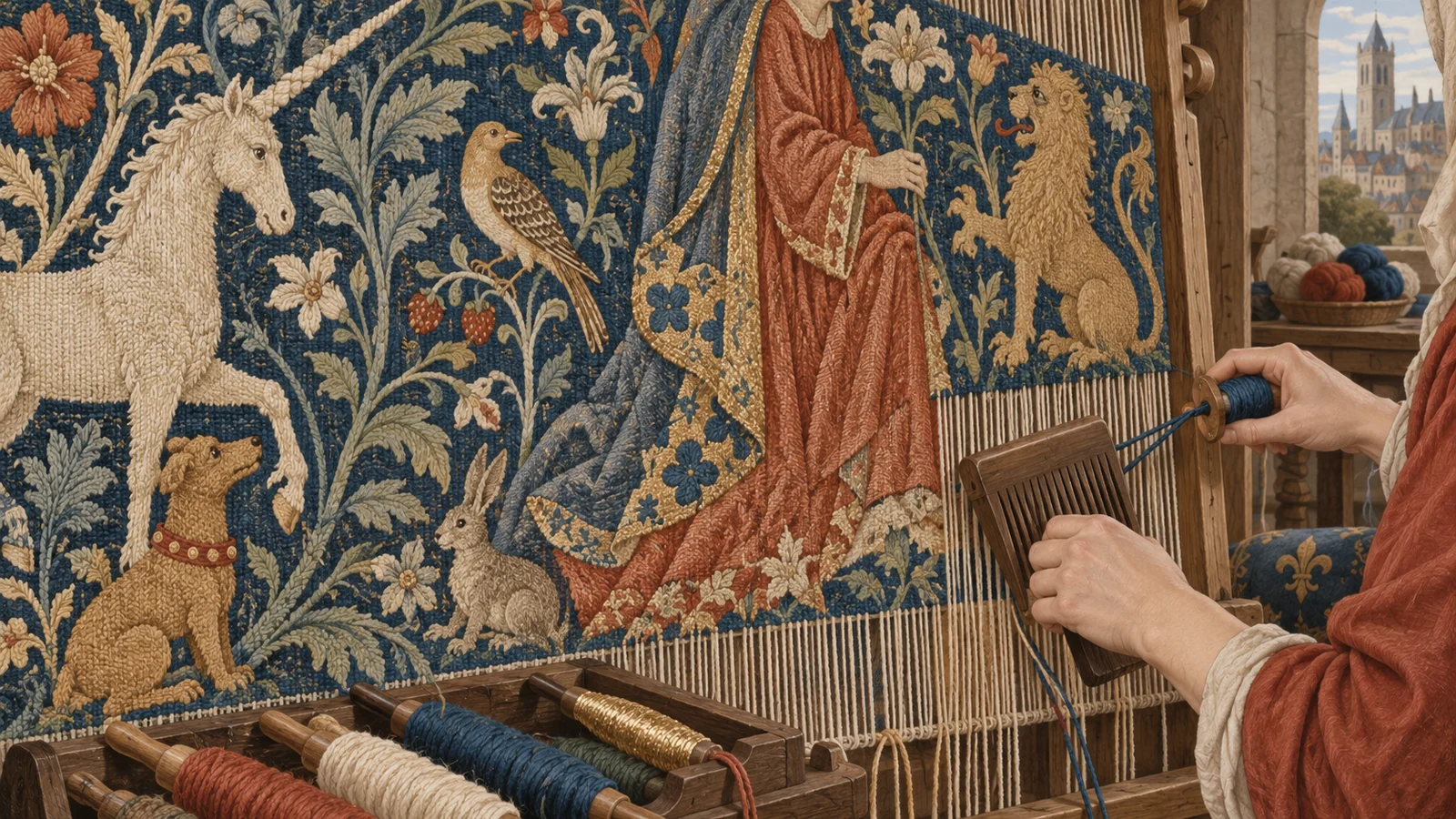
The tapestry did not spring from nothing: it prolonged and crowned a long textile tradition. Arras had for centuries been a capital of drapery, that woollen-cloth industry that made the fortune of the Flemish towns. The mastery of wool-working, dyeing, weaving, the commercial circuits, all this formed an ideal seedbed for the rise of a still more refined art, that of high-warp tapestry. The Arras weavers, heirs to this know-how, carried weaving to a level of artistic excellence, transforming wool and sometimes threads of gold and silk into true woven pictures. The passage from utilitarian cloth to luxury hanging illustrates a move upmarket characteristic of the great medieval towns, where the accumulation of skills and capital allowed the flowering of prestige industries. The tapestry required organised workshops, highly skilled craftsmen, wealthy patrons and artists able to supply the models, the cartoons, on which the weavers worked. This complex chain could only exist in a rich, populous city endowed with a strong artisanal culture. Arras met all these conditions. The splendour of its tapestries was thus the ripe fruit of a long economic history, the culmination of a textile know-how several centuries old, raised by talent and wealth to the rank of the greatest arts of its time.
| Marker | Detail |
|---|---|
| Peak | 14th and 15th centuries |
| Technique | High-warp tapestry, wool, silk, gold thread |
| Renown | The word arras means the hanging in Europe |
| Clientele | Kings, princes, great courts of the West |
An art for the courts of Europe
The tapestries of Arras were no ordinary objects: they were goods of the very highest luxury, reserved for the most powerful. Kings, dukes, princes of the Church and great lords vied for these hangings that adorned their dwellings, warmed and decorated the vast stone halls, and displayed their wealth for all to see. A quality tapestry represented a fortune, both by the value of the materials, fine wool, silk, threads of gold and silver, and by the months of work needed for its making. They were transported from residence to residence, given as diplomatic gifts, bequeathed as treasures. The courts of France, Burgundy, England and elsewhere were among the great clients of the Arras production. The dukes of Burgundy in particular, whose court was one of the most sumptuous in Europe and to which Arras was long attached, were great lovers and patrons of tapestries. These hangings illustrated religious scenes, episodes of ancient history, chivalric tales or allegories, mixing art and political message. To own fine tapestries of Arras was to display one's rank, culture and power. This princely clientele made the fortune of the Arras workshops and carried the town's name to all the great palaces of the West, making the tapestry as much an instrument as a symbol of the prestige of the courts.
Workshops, weavers and merchants
Behind the splendour of the hangings, there was a whole world of work, meticulously organised. Production rested on workshops of weavers, those specialised craftsmen who, bent over their looms, patiently transformed the painted models into woven surfaces, thread by thread. It was long and demanding labour: a large tapestry could mobilise several workers for months, even years. Around them gravitated the painters who supplied the cartoons, the merchants who marketed the works across Europe, the dyers, the suppliers of wool, silk and precious metals. This luxury industry supported a large part of the Arras population and generated considerable profits, from which the powerful merchant bourgeoisie of the town benefited. The trades were framed by strict rules, guarantors of the quality that made the reputation of Arras. One can today admire, at the Museum of Fine Arts and in public collections, testimonies of this art and its environment. The organisation of this production, studied by historians of the economy and of medieval art, reveals a true artistic industry, where creation, high-technical craft and international trade were combined. Far from the image of the simple isolated craftsman, the Arras tapestry was a collective enterprise, the fruit of the collaboration of multiple trades in the service of a single ideal of excellence.
The decline of a glory
Every greatness knows its end, and that of the tapestries of Arras was no exception. From the end of the 15th century, the Arras production declined, challenged by other centres, notably Tournai then Brussels, which took over and gradually eclipsed the city. The political and military troubles that struck Arras also played their part: the wars, sieges and upheavals that shook the town and the Artois in the 15th and 16th centuries gravely disrupted a luxury industry, dependent on peace and prosperity. The attachment of Arras to the royal domain, the conflicts between France and the house of Burgundy then the Habsburgs, the impoverishment and destruction, all this contributed to the effacement of an art that had made the glory of the town. Little by little, the great workshops fell silent, the weavers emigrated or changed activity, and the name of Arras, while remaining synonymous with tapestry in the language, ceased to be its great producing centre. This decline illustrates the fragility of prestige industries, hung on a delicate balance between wealth, security and know-how. When this balance breaks, the most dazzling glory can go out in a few decades, leaving behind it only a memory and, in the case of Arras, a word that passed into several languages of Europe.
Hangings that tell stories
A tapestry of Arras was not a mere coloured ornament: it was a woven image, bearer of narratives and meanings. The great hangings unrolled before the viewers' eyes whole cycles, biblical episodes, scenes from the life of Christ or the saints, great deeds of ancient history, chivalric romances, moral allegories or scenes of hunting and courtly life. Some came as suites of several pieces meant to cover all the walls of a hall, forming a total and immersive setting. Others, called mille-fleurs, scattered on a dark ground a profusion of plants and small animals, with a remarkable botanical refinement. To read a tapestry, for the medieval person, was to recognise in it characters, mottoes, coats of arms, a whole visual language in which the prestige of the patron mingled with edification and the pleasure of the eyes. The cartoons, those painted models the weavers followed, were sometimes the work of excellent artists, which raised the tapestry to the rank of the major arts. To understand this narrative and symbolic dimension is essential: the Arras hanging was not only a luxury object, but a support of memory, faith and power, a monumental picture-book that could be hung, transported and displayed, and whose iconographic richness still today makes its documentary value for historians of medieval culture.
An instrument of prestige and diplomacy
Beyond their beauty, the tapestries of Arras fulfilled a properly political function. In a world where appearance counted as much as being, these sumptuous hangings displayed without a word the power, wealth and refinement of their owner. A prince who received his guests in a hall hung with Arras works signified to them at once his rank and his means. Better still, the tapestry travelled: it was taken along on court journeys, it temporarily dressed the places of a solemn entry, a princely wedding or a negotiation, transforming an ordinary space into a setting of majesty. It also served as a first-rate diplomatic gift, offered to seal an alliance or honour a sovereign. The choice of subjects was not neutral: by having a certain heroic episode or a certain allegory woven, a patron could slip in a message about his own legitimacy, ambitions or virtues. The tapestry then became an instrument of propaganda before the word existed, a discourse rolled up in wool and silk. This dimension explains the enthusiasm of the most powerful courts, and notably of the house of Burgundy, for these works. In producing these objects laden with meaning, Arras did not only sell luxury: it provided the great of this world with a language of power, which adds still further to the historical importance of its production.
Arras, Tournai and Brussels: the map of the great centres
The tapestry of Arras cannot be understood without replacing it in the geography of the great centres of production of the former Low Countries. Alongside Arras, towns such as Tournai, then above all Brussels, developed rival industries of a very high level. These centres exchanged know-how, vied for artists and patrons, and knew varied fortunes over the centuries. Arras shone first and gave its name to the object, but it was gradually supplanted, from the end of the 15th century, by competitors better placed or more spared by the troubles. This circulation of men and techniques moreover makes the precise attribution of many old pieces delicate: a hanging long said to be from Arras may, on examination, prove to be from another workshop, so alike were the styles and methods and so far did they travel. Art historians today deploy patient analyses, from selvage marks to technical characteristics, to try to restore to each centre its production. This caution in attribution is a lesson in method: the glory of Arras was so great that its name far overflowed its actual production, absorbing into the common imagination works born elsewhere. Far from diminishing its merit, this observation says its strength: Arras had imposed a brand, in the almost modern sense of the term, become the universal synonym of an excellence that others, afterwards, strove to equal.
What remains of the tapestries of Arras?
Here is the cruellest paradox of this history: of the immense production that made the town famous, almost nothing survives in Arras itself. The authentically Arras tapestries preserved today are rare and scattered in the great museums and collections of the world, far from their city of origin. Wars, partitions, sales and destruction have dispersed or annihilated most of these fragile treasures. One must therefore look elsewhere, sometimes very far, to admire what the weavers of Arras produced, and the distinction between a tapestry actually woven in Arras and a work from another centre is not always easy, so far did the Arras reputation extend to neighbouring productions. This very rarity adds to the prestige and mystery of these works. It also recalls how vulnerable artistic heritage is, and how a town can lose the material trace of its own greatness. Under the authority of the counts of Flanders then of the dukes of Burgundy, Arras had reached an artistic summit of which little remains at home but the memory and a few pieces. To make the tapestries of Arras known is to do justice to a dazzling and little-known chapter of the town's history, the one in which a city of the North gave its name to one of the finest arts of the medieval West.