
Louis XI and Arras: how did the king reconquer the Artois?
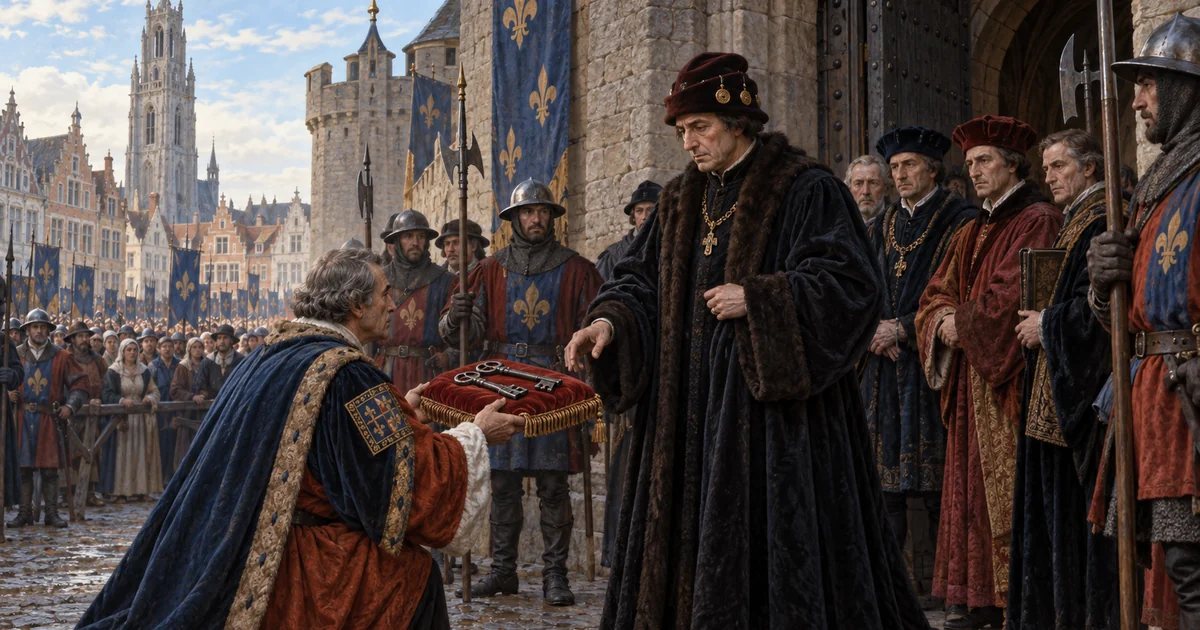
At the end of the 15th century, a cunning and pitiless king attacked Arras with a brutality that remained famous: Louis XI and the reconquest of the Artois. Taking advantage of the collapse of Burgundian power, the king of France undertook to attach Arras to the crown, using in turn money, arms and an unprecedented policy of repopulation. The town, faithful to Burgundy, paid dearly for its resistance: Louis XI expelled part of its inhabitants and tried to refound it, going so far as to rename it. This dramatic episode, between reconquest and punishment, marks a decisive turning point toward the attachment of Arras to France. To understand Louis XI's action is to grasp the methods of a great state-building king, and to measure what its definitive entry into the French destiny cost Arras. A look back at these decisive years.
The end of Burgundy and the royal ambition
Louis XI's action at Arras belongs to a grand design: the reconstruction of royal authority and the expansion of the crown's domain. Facing him stood the powerful house of Burgundy, of which the Artois and Arras were part, and which had known its peak a few decades earlier, as the Congress of Arras of 1435 testifies. Louis XI, a cunning and tenacious king, made the weakening of Burgundy one of the great objectives of his reign. He played patiently, through diplomacy, money and alliances, seeking to recover the territories the crown deemed its own. The rivalry between the king of France and the duke of Burgundy, in particular the formidable Charles the Bold, dominated the politics of the era. This struggle, made of wars and truces, was played out largely over the control of the rich provinces of the North, including the Artois. Arras, a great Burgundian city, was thus at the heart of this confrontation between two powers. To understand Louis XI's ambition is essential to grasping his action at Arras: it was not a whim, but a determined policy of reconquest and consolidation of the kingdom. The king saw in the recovery of the Artois a major stage of his work. The town of Arras, by its wealth and its position, was a stake of the first order in this great game that was to decide the fate of Burgundy and, with it, of part of the north of the kingdom.

The buy-back of the northern towns
Louis XI's first method was not war, but money. From the first years of his reign, the king negotiated the buy-back of northern towns that had been ceded to Burgundy, disbursing considerable sums to recover them. This buy-back policy illustrates Louis XI's manner, who often preferred gold and cunning to arms, when it served his interests. By thus retaking, through the financial route, strategic places, the king patiently nibbled at Burgundian power and extended his influence northward. These transactions, even if they did not all directly concern Arras, created a climate of tension and prepared the coming confrontations. They also show the value the king attached to these territories, ready to pay dearly to recover them. This buy-back phase belongs to the long chess game between Louis XI and Burgundy, made of advances and retreats. It reveals a pragmatic king, using every means, financial as well as military or diplomatic, to reach his ends. To understand this dimension is important so as not to reduce Louis XI's action to brutality alone: before employing force against Arras, the king had deployed a long strategy mixing money and diplomacy. This calculating patience, joined to an absence of scruples, is one of the marks of his reign, which made him one of the great architects of the construction of the French royal state, at the cost of often pitiless methods.
| Marker | Detail |
|---|---|
| Reign | Louis XI, king of France (1461-1483) |
| Methods | Buy-back, diplomacy, war, repopulation |
| 1477 | Death of Charles the Bold, reconquest of the Artois |
| Arras | Taken, punished and repopulated by the king |
The death of the Bold and the reconquest of the Artois
The decisive turning point came with the death of Charles the Bold, the last great duke of Burgundy, killed in battle in 1477. This brutal disappearance, without a male heir, opened a major crisis and an unhoped-for opportunity for Louis XI. The king of France hastened to take advantage of the situation to seize the Burgundian territories, including the Artois. He launched his armies northward, undertaking the reconquest of the region. Arras, a city faithful to Burgundy, found itself on the front line before the royal forces. The death of the Bold had reshuffled the cards: the powerful house of Burgundy, long invincible, was faltering, and Louis XI intended to gather its spoils. This reconquest was not without resistance, for the Burgundian towns, attached to their duke and their liberties, did not always welcome the king of France as a liberator. Arras, in particular, resisted, which was to earn it a severe treatment. To understand this moment is essential: the death of the Bold was the event that allowed Louis XI to go on the offensive and to try to realise his grand design on the Artois. The reconquest of 1477 marks the beginning of the end of the Burgundian period for Arras, and the opening of a painful episode, in which the town was to bear the full brunt of the will of a king determined to bring it back, willingly or by force, into the fold of the crown of France.
The taking of Arras and the punishment of the town
The resistance of Arras provoked the king's anger and an exemplary punishment. After the taking of the town, Louis XI, to break any inclination to rebellion and to punish the loyalty to Burgundy, decided to strike hard. He had part of the Arras population expelled, dispersing the inhabitants deemed hostile or unreliable. This brutal measure aimed to break the Burgundian identity of the town and to eliminate the hotbeds of resistance. The communal liberties Arras had long enjoyed, inherited from the communal charter of 1163, were flouted, the town being treated as a conquered and subdued city. This punishment illustrates Louis XI's harshness toward those who resisted him, and his will to definitively subject Arras. For the town, it was a considerable trauma: to see part of its inhabitants driven out, its privileges trampled, its identity denied. This scorched-earth policy, applied to a great city, is one of the most striking and darkest episodes of the history of Arras. It testifies to the expeditious methods of a king who stopped at nothing to reach his ends. To understand this punishment is to measure the price Arras paid for its loyalty to Burgundy and its resistance to the king. The town, long prosperous and proud, found itself humiliated and depopulated, at the mercy of a sovereign determined to make an example of it for all the other cities tempted to resist him.
The repopulation: Arras renamed
Louis XI's most spectacular measure was his attempt to entirely refound the town. Not content with expelling its inhabitants, the king wanted to repopulate Arras with people from other regions of the kingdom, supposed to be more faithful to the crown. He went so far as to want to change the very name of the city, renaming it to erase its Burgundian past and mark its refoundation under royal authority. This repopulation enterprise, radical and voluntarist, aimed to create a new town, French and docile, on the ruins of Burgundian Arras. But it came up against reality: to displace populations and refound a great city by decree is a challenge, and the operation knew great difficulties. The repopulation did not succeed as the king had hoped, and, with time, part of the former inhabitants returned. This episode illustrates both the excess of Louis XI's ambitions and the limits of power, even royal, before the life of towns. To want to remake a town from scratch, to change its people and its name, is a matter of an almost absolute will to power, but proved largely illusory. For Arras, this attempt at forced refoundation was an additional ordeal, a moment when its very existence seemed called into question. To understand this episode is to grasp how far the will of a king determined to subject a town could go, but also the resilience of a city that, despite everything, survived this attempt at erasure and ended by recovering its name and part of its soul.
A pitiless king before a wounded town
Louis XI's action at Arras durably marked the memory of the town and shaped the image of the king. Louis XI has remained in history as a cunning, calculating and pitiless sovereign, ready for anything to expand and consolidate his kingdom. His treatment of Arras is a striking illustration of it. For the town, these years were among the darkest of its history, marked by war, expulsion and humiliation. One must, however, as a historian, beware of caricature: Louis XI was also a great state-building king, whose action, however brutal toward Arras, belonged to a coherent policy of reconstruction of the kingdom after the disasters of the Hundred Years' War. The town, for its part, was barely emerging from other ordeals, including the terrible Vauderie of Arras that had bloodied it a few years earlier. These decades were, for Arras, a succession of traumas, from the witch-hunt to the royal punishment. To understand this period is to measure how much the town was tried at the end of the Middle Ages, caught in the great upheavals of its time. The image of a pitiless Louis XI, if it corresponds to a reality of his action at Arras, must be nuanced by the understanding of his political objectives. But for the people of Arras of the time, it was above all the brutal experience of a king who subjected them by force and tried to erase their town, leaving a lasting imprint in the collective memory of the city.
Toward the definitive attachment to France
Beyond its brutality, Louis XI's action belongs to a deep movement: the attachment of the Artois to France. By seizing Arras and its region, the king took up the thread of an old history, that of the belonging of the Artois to the royal domain, going back several centuries. Admittedly, the fate of the region was not definitively fixed under his reign: according to treaties and successions, the Artois was to change hands again, passing notably under the authority of the Habsburgs following an agreement concluded, too, at Arras. But Louis XI's action marked an important stage in the long march of the region toward its definitive integration into the kingdom, which would only come much later. It illustrates the tenacious will of the kings of France to recover the Artois, considered part of the domain. To understand Louis XI's action in this long perspective allows one to grasp its historical significance, beyond the brutal episode of the taking of Arras. The cunning king was one of the architects of this slow process that, from attachments to reconquests, was finally to anchor Arras and the Artois in France. For the town, the episode of Louis XI, however painful, belongs to this long history of its French destiny. It recalls that the attachment of a region to a kingdom was not always peaceful, but often resulted from wars, conquests and constraints, of which Arras made, at the end of the 15th century, the harsh experience.