
The Vauderie of Arras: how did a witch-hunt arise?
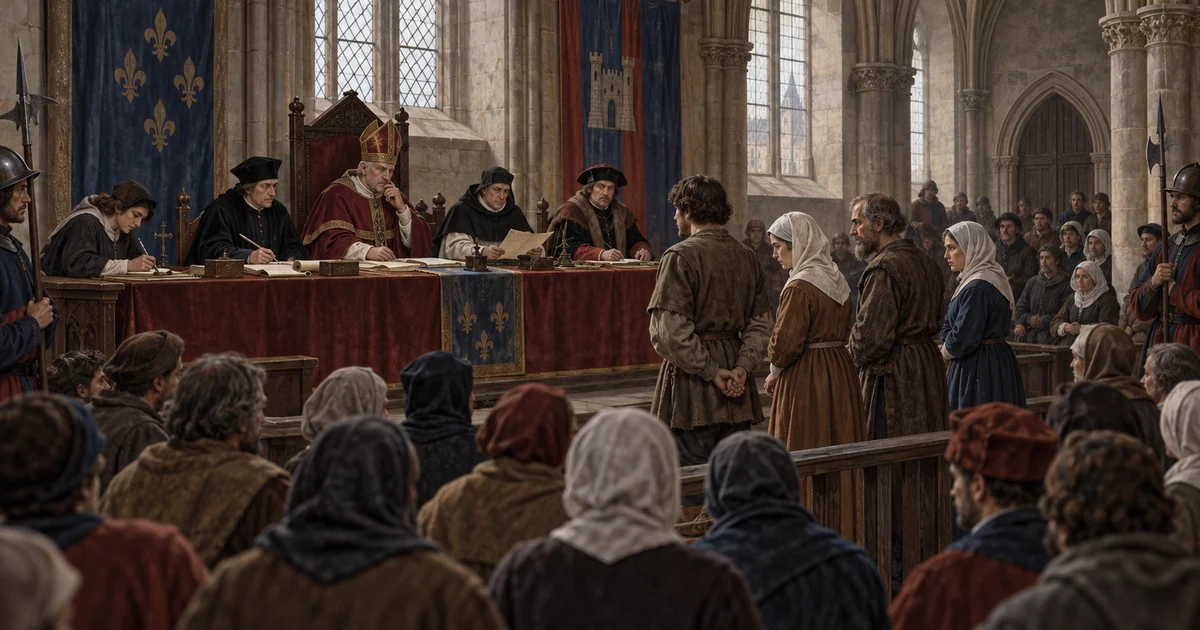
In 1459 and 1460, Arras was the stage of one of the darkest episodes of its history: the Vauderie of Arras, a witch-hunt that sent to the stake innocent people accused of witchcraft. This affair, one of the first great persecutions of this kind in the West, saw inhabitants of the town tortured, forced to confess imaginary crimes, then condemned. Long after, justice recognised the injustice committed. Studied by historians as a revealing case of the birth of the great witch-hunt, the Vauderie of Arras lights up the fears, mechanisms and excesses of an ending medieval society. To understand this episode, distinguishing facts from fantasies, is to plunge into a tragic and instructive moment, when a town tipped into persecution. A look back, with the caution and rigour such a subject demands, at the Vauderie of Arras.
What is the Vauderie of Arras?
The word vauderie first deserves an explanation. It derives from the name of the Waldensians, a medieval religious movement, but came to designate, by a shift, witchcraft and the alleged sect of sorcerers. The Vauderie of Arras thus designates an affair of persecution for witchcraft that unfolded in the town in the late 1450s. People were accused of belonging to a sect of sorcerers, of engaging in diabolical practices and of taking part in the sabbath, that imaginary nocturnal assembly where sorcerers were said to worship the devil. Arrested, they were subjected to torture, confessed under duress to crimes they had not committed, denounced other people, and were finally condemned, several of them perishing at the stake. This affair is not an isolated incident: it belongs to the long history of the persecution of deviance, of which Arras had already known a distant episode with the Synod of Arras of 1025, devoted to heresy. The Vauderie marks a stage in the construction of the figure of the sorcerer and in the establishment of the mechanisms of the witch-hunt, which were to bloody Europe in the following centuries. To understand what the Vauderie is, is to grasp that it is not a reality, but a construction: a fabricated accusation, imposed by torture, revealing the fears and persecuting logics of the society that produced it.
The course of the affair
The course of the Vauderie follows an implacable mechanism, sadly characteristic of witch-hunts. It all began with a few accusations, which, under the effect of torture, spread into a spiral of denunciations. Each accused, put to the question, ended by confessing and by naming other people, feeding the affair and widening the circle of suspects. The inquisitors and the authorities conducted the interrogations, wresting confessions conforming to what they wanted to hear: participation in the sabbath, pact with the devil, maleficent practices. These confessions, obtained by suffering, had no value of truth, but served to justify the condemnations. Several accused were burned, others suffered various penalties. The affair took on such a scale that it sowed terror in the town, everyone able to fear being denounced in turn. Notably, the persecution did not target only marginals, but also reached well-off people, which shows that the logic of the hunt could strike widely. This self-feeding mechanism, where torture produces confessions that produce new accusations, is at the heart of the phenomenon. Historians have analysed it in detail, showing how a society could lock itself into a logic of collective persecution. The course of the Vauderie of Arras perfectly illustrates this gearing, where fear, torture and belief in the diabolical plot combined to produce a tragedy, striking innocents in the name of an entirely imaginary threat.
| Marker | Detail |
|---|---|
| 1459-1460 | The witch-hunt at Arras |
| Accusation | Witchcraft, sabbath, pact with the devil |
| Method | Torture, forced confessions, chain denunciations |
| 1491 | Rehabilitation of the victims by the Parlement |
The myth of the sabbath and the making of the sorcerer
At the heart of the Vauderie is a belief: the myth of the sabbath. According to this representation, sorcerers gathered at night in secret assemblies, where they denied God, worshipped the devil and engaged in abominable practices. This myth, which was built up progressively at the end of the Middle Ages, is a pure fabrication of the imagination, without any reality. Historians of witchcraft have shown how this figure of the sorcerer and the sabbath was elaborated by theologians, inquisitors and judges, from diverse elements, fears, ancient beliefs, stereotypes. Reference works, such as those devoted to the construction of the myth of the sabbath, have lit up this process, showing that the sorcerer is an invention, a scapegoat fabricated by the society that persecutes it. The Vauderie of Arras is one of the first cases where this myth unfolds on a large scale, which makes it an important milestone in the history of the witch-hunt. To understand this dimension is essential: it is not a matter of judging whether the accused were really sorcerers, which makes no sense, but of understanding how a society came to believe in the existence of sorcerers and to persecute them. The Vauderie thus reveals the intellectual and social mechanisms of the construction of an imaginary enemy. This approach, which shifts the gaze from the supposed guilt of the victims to the logic of the persecutors, is that of the modern history of witchcraft, and it gives the affair of Arras all its significance and interest.
A town in fear
The Vauderie plunged Arras into a climate of terror and suspicion. As arrests multiplied and the stakes were lit, fear gripped the population, everyone able to dread being the next accused. This atmosphere of delation and anguish is characteristic of witch-hunt episodes, where society turns against itself. The affair struck a great town, prosperous and populous, whose rich bourgeoisie of Arras was not spared: people of well-off condition figured among the accused, which increased the trouble and the anxiety. The persecution no longer knew clear limits, and uncertainty reigned. This collective dimension of fear is an essential aspect of the affair: beyond the direct victims, it was the whole town that lived under threat, in a climate poisoned by suspicion. The mechanisms of panic, once triggered, were difficult to stop. The affair nonetheless ended by arousing resistance and doubts, including among the elites, some voices rising against the excesses of the persecution. This rise of reluctance was to contribute to putting an end to the hunt. To understand the climate of fear that reigned at Arras during the Vauderie allows one to grasp the social dimension of the phenomenon, which is not reduced to the trials and the stakes, but pervades the whole life of a city suddenly given over to the dread of the sorcerer and the diabolical plot, in an outburst of collective fear with tragic consequences.
The rehabilitation of the victims
One of the most remarkable aspects of the Vauderie of Arras is its subsequent condemnation by justice. Years after the events, the affair was re-examined, and the highest jurisdiction of the kingdom, the Parlement of Paris, ended by quashing the judgments and rehabilitating the victims, recognising the injustice that had been committed. This rehabilitation, which came in 1491, is a notable fact: it shows that, even in a society believing in sorcerers, the persecution could be denounced and corrected. It constituted a form of late justice for the victims and their families, and a condemnation of the excesses of the judges of Arras. This judicial epilogue gives the Vauderie a particular place in the history of witchcraft: it was not only an early case of witch-hunt, but also a case where the error was officially recognised. This recognition did not resurrect the dead nor erase the sufferings, but it re-established the truth and the honour of the victims. It also testifies to the existence, within medieval society itself, of critical forces able to oppose the persecuting logic. To understand this rehabilitation is important so as not to reduce the Middle Ages to a caricatural image of obscurantism: the same society that produced the Vauderie also knew how, later, to condemn it. This capacity to recognise the error, however imperfect and late, is an essential element of the history of the affair, and gives it a significance that goes beyond the mere tragedy of the stakes.
What the Vauderie teaches us
The Vauderie of Arras is not only a tragic memory: it is a lesson of history of universal significance. It shows how a society can, under the effect of fear, beliefs and perverted judicial mechanisms, turn against innocents and fabricate the guilty. The springs it reveals, the construction of an imaginary enemy, the role of torture in the production of false confessions, the gearing of denunciations, collective panic, are unfortunately not proper to the Middle Ages: they are found, in other forms, in many persecutions of history. To study the Vauderie is thus to reflect on the mechanisms of mass injustice and on the fragility of societies before fear. The historians who have worked on this affair, relying on the trial archives, have done a work of truth, restoring the fate of the victims and dismantling the workings of the persecution. Their work recalls the importance of historical method and critical spirit before accusations and rumours. The Vauderie of Arras, by its precocity, its documentation and its rehabilitation, is a major case study, which goes far beyond local history. For Arras, it is a painful page, but one that it matters to know and to pass on, not out of a taste for the morbid, but because it lights up the dangers that lie in wait for any society. To remember the victims of the Vauderie is to honour their memory and to draw the lessons of an episode that, across the centuries, keeps a troubling relevance.
Arras on the eve of Louis XI
The Vauderie broke out in an Arras still Burgundian and prosperous, about a quarter of a century after the great diplomatic gathering of which the town had been the stage, as the Congress of Arras of 1435 recalls. The city, rich and populous, lived under the authority of the duke of Burgundy, within one of the most brilliant states of Europe. It was in this context of apparent power that the persecution was unleashed, which shows that a witch-hunt could arise not in misery, but at the heart of a prosperous society. This paradox has intrigued historians: why did such a flourishing town tip into such madness? The explanations put forward mix social tensions, rivalries, religious climate and logics proper to the judicial and inquisitorial apparatus. The Vauderie also occurred at a pivotal moment, on the eve of major political upheavals: a few years later, the death of the last great duke of Burgundy was to open a crisis that would see the king of France, Louis XI, try to retake the Artois and Arras. The town of the Vauderie was thus a city at the height of its Burgundian opulence, but also on the threshold of a period of troubles. To understand this context allows one not to isolate the affair from its frame: the persecution was not the deed of a backward society, but of a great rich town, at a turning point of its history. This putting in perspective, far from excusing anything, helps to grasp the complexity of an episode where opulence and terror, culture and barbarism, coexisted within the same walls.
The Vauderie in the history of witchcraft
Placed back in the long history of the witch-hunt, the Vauderie of Arras occupies a choice place. It occurred at a pivotal moment, that when the great persecution was being established which was to culminate in the 16th and 17th centuries, making tens of thousands of victims across Europe. By its precocity and its scale, the affair of Arras is often cited as one of the first great witch trials of a new type, where the myth of the sabbath plays a central role. It therefore interests first of all the historians of witchcraft, who see in it a milestone in the construction of the phenomenon. The specialists of the question, several of whom have devoted in-depth studies to the Vauderie, have shown how this affair articulates with the religious, social and political context of its time. To understand the Vauderie in this long perspective allows one to grasp all its significance: it is not an isolated accident, but a link in a tragic chain that runs through several centuries of European history. For Arras, to be associated with such a studied episode gives its history a dimension that goes beyond the local. The town thus figures, quite despite itself, in the great accounts of the history of witchcraft and persecution. To make the Vauderie known, resituating it in this frame, is both to honour the memory of the Arras victims and to contribute to the understanding of a major phenomenon of Western history, whose lessons remain, even today, of burning relevance.