
The Synod of Arras of 1025: how did the Church judge heresy?
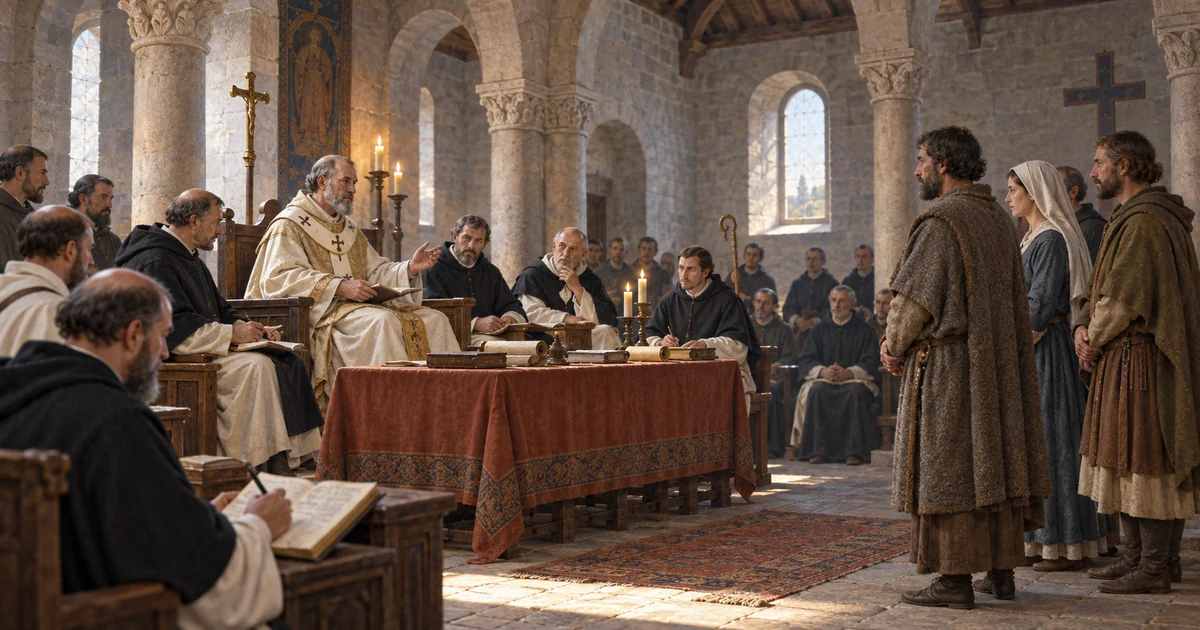
In 1025 an event of a scope that far exceeds the town's boundaries was held in Arras: the Synod of Arras, convened by bishop Gerard of Cambrai to judge a small group accused of heresy. What might have been only a minor religious affair became, thanks to the account that has come down to us, one of the very first documents on religious dissent in the medieval West. Through the interrogation of these men said to have come from Italy, the whole way in which the Church began to define faith, error and orthodoxy can be read. The Synod of Arras is thus a major source for historians of the Middle Ages, studied far beyond local history. To revisit this episode is to understand how, in the 11th century, the town was the stage of a founding debate on belief and repression, at the dawn of a long history of persecution.
Arras in the 11th century: an episcopal City
To situate the synod, one must recall the religious organisation of the region at that time. Arras then lived under a double authority, that of the count for temporal matters and that of the Church for spiritual ones, in a town divided between the City, gathered around the cathedral, and the abbey borough. For centuries the diocese of Arras had been united to that of Cambrai, and so it was the bishop of Cambrai who exercised spiritual authority over the town; Arras would not regain its own bishop until the end of the century. This episcopal City, whose cathedral of the City was the heart, was a considerable pole of power, where clerics, canons and great laymen crossed paths. The bishop there was at once a religious head and a temporal lord, guarantor of order and faith. It is in this frame that the holding of a synod is to be understood, that assembly of bishops and clerics gathered to settle the affairs of the Church. That Arras was chosen to judge a matter of heresy speaks of the religious importance of the town in the region. In the 11th century, Christian Arras, heir to its first bishop and its great abbey, was a spiritual centre of the first rank, able to host an event whose memory would cross the centuries.
Gerard of Cambrai, a bishop of his time
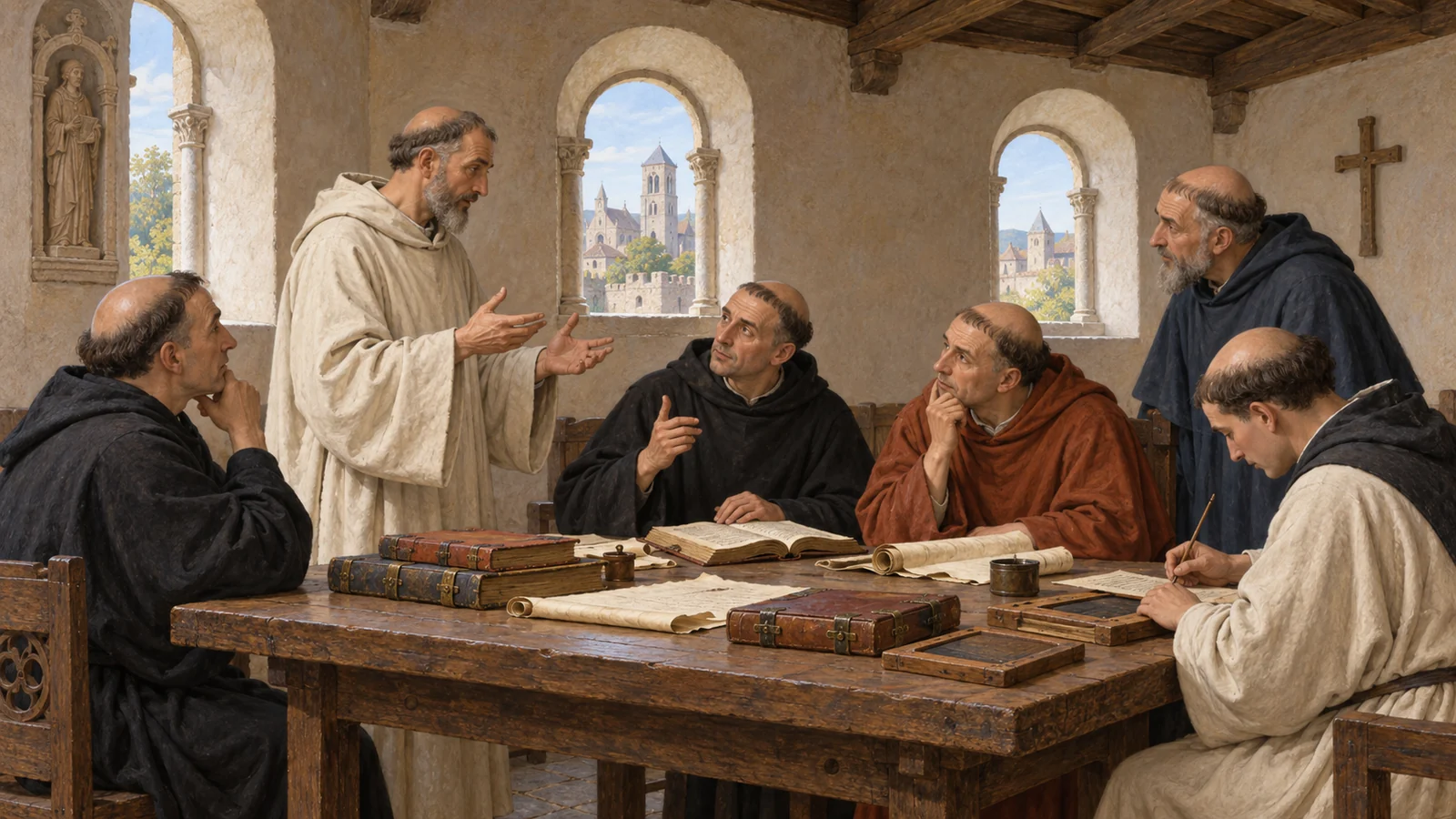
At the centre of the affair stands a leading figure, Gerard I of Cambrai, bishop of Cambrai and of Arras. A cultivated man, close to imperial power, he embodies the lettered and political prelate of the 11th century, concerned at once with social order and the purity of the faith. Gerard has remained famous among historians for having been one of the first to state clearly the theory of the three orders, that vision of a society divided between those who pray, those who fight and those who work. Georges Duby, in a book that became a classic, made the bishop of Cambrai one of the great witnesses of this feudal imaginary in the making. This dimension lights up his reaction to the heretics of Arras: for a man convinced that society rests on an order willed by God, religious dissent was also a threat to the order of the world. Gerard was not a bloodthirsty persecutor but a pastor anxious to bring the strayed back to the right path through demonstration and persuasion. His way of handling the affair, by interrogation and refutation rather than by torture, testifies to a moment when the Church was still seeking its answers in the face of contestation. To understand Gerard is to understand the spirit in which the Synod of Arras was conducted.
Who were the heretics of Arras?
The accused formed a small group which, according to the account, claimed a master come from Italy named Gundolfo. Their religious ideas clashed head-on with the established Church: they are said to have rejected infant baptism, the eucharist, the cult of saints and relics, the value of stone churches, even marriage, advocating a life founded on the Gospel, work and a rigorous morality. This programme, made of the refusal of the sacraments and a return to a supposed purity of Christian origins, foreshadows currents that would run through the whole Middle Ages. Should one, however, see in it a structured sect with coherent doctrines? Historians are cautious. The text that describes them to us comes from their judges, not from themselves: it presents their beliefs through the filter of accusation, perhaps drawing them close to known heresies the better to condemn them. It is possible that we are dealing less with theologians of dissent than with pious laymen, in search of a simpler and more demanding religion, whose words were hardened and systematised by the clerics. This uncertainty lies at the heart of the historian's work: to reconstruct the thought of the dominated from the sole words of their dominators, while remaining aware of the possible distortion. The heretics of Arras remain, in many respects, enigmatic figures.
| Marker | Detail |
|---|---|
| Date | 1025, synod held at Arras |
| Authority | Gerard I, bishop of Cambrai and Arras |
| Accused | A group claiming an Italian master |
| Source | The Acts of the Synod of Arras (Acta synodi) |
The course of the synod
The account, known as the Acts of the Synod of Arras, describes an orderly confrontation. The accused were brought before the assembly, questioned on their beliefs, then the bishop undertook to refute each of their errors at length, point by point, drawing on Scripture and the doctrine of the Church. It was less a trial in the modern sense than a vast lesson in theology, meant to demonstrate the truth of the Catholic faith and the falseness of the opposing theses. At the end of this demonstration, the accused, according to the text, recognised their wrongs, abjured their errors and were reconciled with the Church. There was thus, in this precise case, neither condemnation to the stake nor bloody punishment: the affair ended in a return to the bosom of the Christian community. This measured outcome distinguishes the Synod of Arras from later episodes, where the repression of heresy would take a far more violent turn. It reflects a moment when the Church, faced with a contestation still rare and ill-defined, favoured persuasion and instruction. The care taken to set down in writing the whole refutation also shows the importance given to the event: they wanted to keep a record of the way truth had triumphed over error, for the edification of future generations and the doctrinal arming of the clergy.
A very rare document on medieval heresy
What gives the Synod of Arras a place apart is less the affair itself than the text that relates it. For the 11th century, documents describing dissident beliefs in detail are extremely rare, and the Acts of Arras are among the most precious. They offer historians an exceptional window onto the beginnings of religious dissent in the West, at a time when heresy was starting to reappear after centuries of relative silence. Scholars such as R. I. Moore, a specialist in the birth of persecution in medieval Europe, have widely drawn on this type of source to understand how Christian societies gradually defined and hunted deviance. The Arras document allows us to observe, almost live, the construction of the boundary between orthodoxy and heresy, that division between the true and the false that the Church strove to establish. It must, however, be handled with the usual precautions: written by the winners of the debate, it reflects their point of view and their categories. The historian reads in it not the raw word of the accused but the way the ecclesiastical institution saw, named and fought dissent. It is precisely this value as a testimony on mentalities and mechanisms of control that makes the Acts of the Synod of Arras a source studied far beyond the circle of local historians.
Orthodoxy, heresy and power
Beyond the anecdote, the Synod of Arras invites reflection on a fundamental question: how does a society decide what is legitimate belief or condemnable error? In the 11th century, the Church is in the midst of reform, seeking to strengthen its authority, discipline the clergy and frame the faith of the faithful. To define heresy is also to assert who holds the right to say the true in religious matters. Historians have shown that the repression of dissent often accompanied the strengthening of powers, ecclesiastical as well as lay, which found in the fight against error a powerful instrument of cohesion and control. R. I. Moore has spoken of a society that, from this era, gradually learns to persecute, to designate and to exclude those who do not conform to the norm, whether heretics, lepers or other marginals. The Synod of Arras stands at the beginnings of this movement, at a moment when the response was still gentle, made of demonstration more than violence. It nonetheless heralds the great affairs to come, up to the terrible trials that would strike the town itself some centuries later. To study 1025 is thus to grasp the root of a long history, that of the relations between belief, truth and power in the Christian West.
What the Synod of Arras teaches us today
What remains, for today's reader, of this episode a thousand years old? First the reminder that Arras was, from the 11th century, a religious and intellectual centre important enough for a debate of European scope to be played out there. Then a lesson in historical method: faced with a unique, partial and fascinating text, the historian learns to read between the lines, to weigh what belongs to fact and what belongs to construction, to restore the voice of the absent without ever betraying it. The Synod of Arras also shows that questions of faith, conscience and freedom to believe were not born with modernity, but run through the whole history of human societies. This legacy joins other great narratives of the town, from the miracle attributed to the Virgin, whose miracle of the Holy Candle we have told, to the darker dramas of repression. Together they draw the portrait of a city where religious life was, for centuries, intense and sometimes tragic. To look into the synod of 1025 is not only to exhume an erudite curiosity: it is to recover a moment when a small assembly, in a town of the North, took part unknowingly in the invention of a lasting relationship between society and those it places on the side of error.