
The miracle of the Holy Candle: what was the burning sickness?
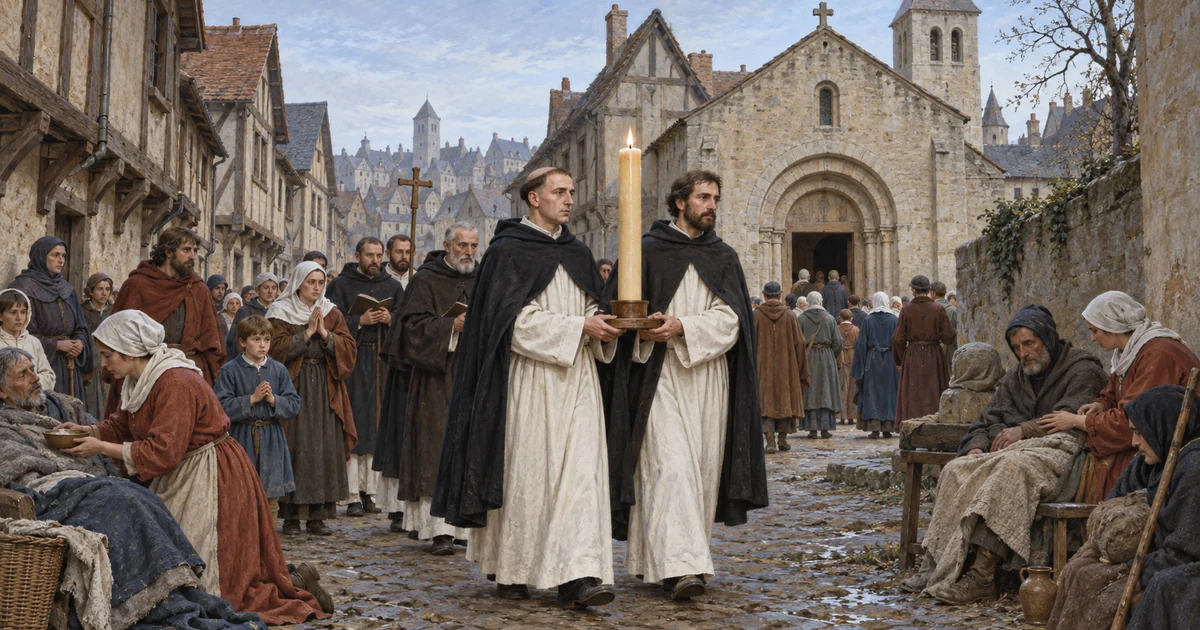
In 1105, a terrifying epidemic ravaged Arras, and the account that accompanies it would mark the town for centuries: that of the miracle of the Holy Candle. As the burning sickness, a disease that scorched the flesh, decimated the population, tradition holds that a miraculous intervention by the Virgin, through a taper handed to two minstrels, saved the sick. From this episode was born one of the oldest and most famous confraternities of the town, keeper of a relic venerated until the Revolution. Behind the legend lies a well-identified medical reality, ergotism, and a remarkable window onto medieval piety. To untangle the attested fact from the devotional account, to understand what the burning sickness really was and why its memory mattered so much in Arras: such is the aim of this dive into 12th-century Arras.
Arras in 1105: a town struck by the scourge
At the beginning of the 12th century, Arras is a booming town, rich from its trade and protected by the powerful Saint-Vaast Abbey, whose borough concentrated men and activity. It is in this prosperous but overcrowded city that, according to tradition, the burning sickness struck, a brutal scourge that hit rich and poor alike. The sick were seized with atrocious pains, as if an inner fire consumed their limbs, whence the name given to the disease. Panic gripped a population helpless before an ill it did not understand and that no remedy seemed to halt. In the medieval world, such an epidemic was not only a health disaster: it was experienced as a sign, a trial sent from on high, calling for prayer and penance as much as for care. The town turned to its saints and to the Virgin, in a climate mixing terror and fervour. It is this context of collective distress that gives full meaning to the account of the miracle: faced with the powerlessness of men, help was awaited from heaven. To understand the anguish of Arras in 1105 is already to understand why the story of the Holy Candle could take root there so deeply and become a pillar of urban identity.
The burning sickness: what was it really?
Behind this frightening name lies a very real disease, identified today: ergotism, a poisoning caused by a fungus parasitic on rye, ergot. When harvests were contaminated and the flour was used to make bread, the toxic substances of ergot caused terrible symptoms in those who ate it: a sensation of burning, gangrene of the extremities, convulsions, sometimes hallucinations. Ignorant of the cause, the people of the Middle Ages spoke of holy fire, Saint Anthony's fire or the burning sickness, so many names for a single ill. The great famines, by pushing people to eat poor-quality grain, favoured these epidemics that struck Europe repeatedly. The historian of medicine reconstructs this mechanism thanks to the chroniclers' descriptions and modern knowledge of the fungus, without projecting anything anachronistic onto the beliefs of the time. One must indeed beware of imposing our knowledge on people who lived the scourge as a punishment or a mysterious trial. To recognise in the burning sickness a rye poisoning in no way diminishes the real suffering of the sick nor the sincerity of the religious recourse: it only allows us to understand, with the hindsight of science, what struck Arras in 1105, and why the scourge could seem so sudden and inexplicable there.
The account of the miracle: the Virgin and the two minstrels
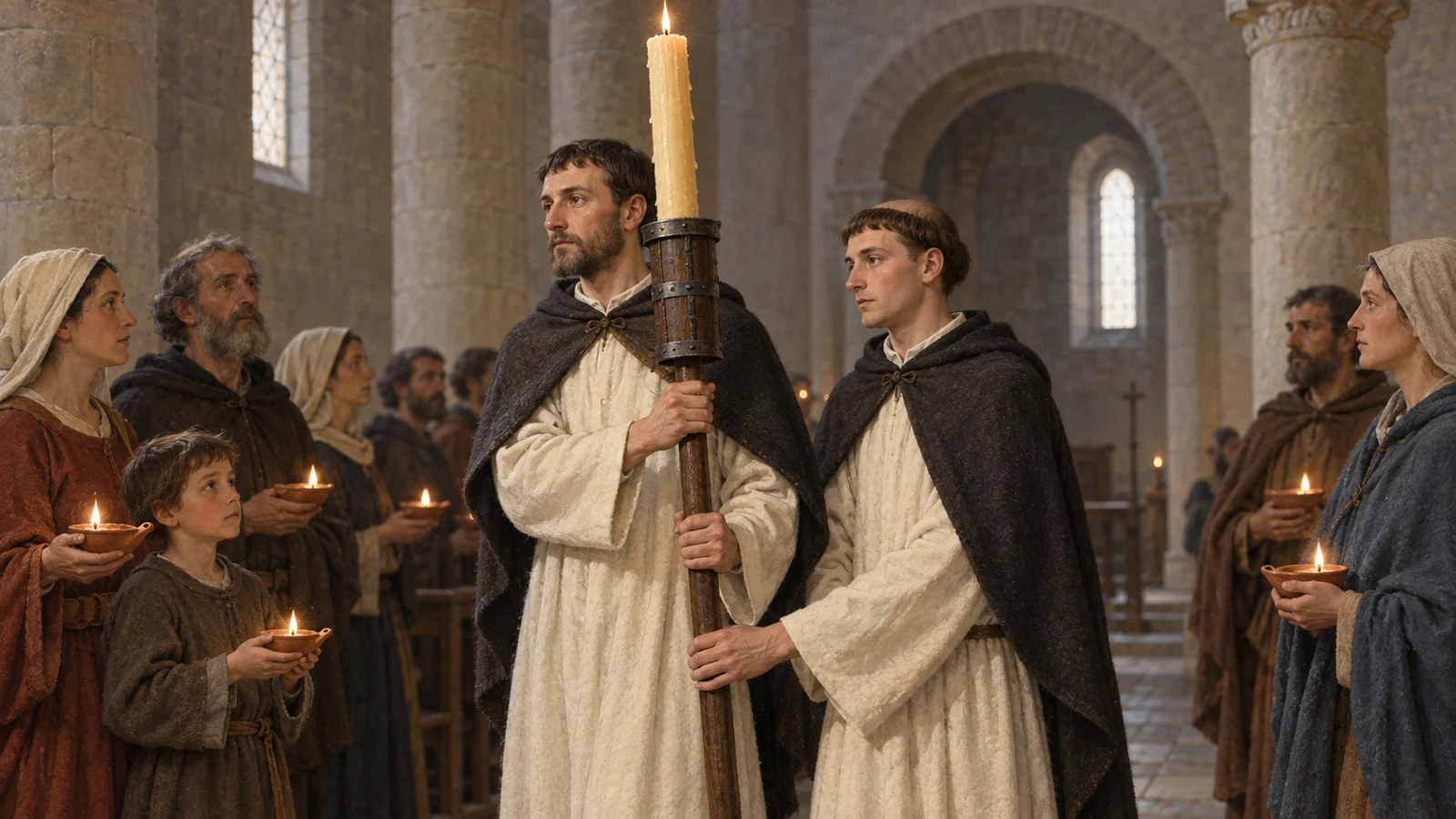
Then comes the heart of the tradition, the founding account handed down by the confraternity's texts. Two rival and enemy minstrels, it is said, Itier of Brabant and Norman, were each visited separately by the Virgin Mary, who ordered them to reconcile and to go to the cathedral of Arras. There, before the bishop and the crowd of the sick, the Virgin is said to have appeared to them carrying a taper, a candle, from which she let fall a few drops of wax into the water of a basin. This water, given to the burning sick to drink or applied to their sores, is said to have at once healed the sick. Such is, in its broad lines, the account of the miracle of the Holy Candle, as devotion fixed it. The historian of course does not take it as the record of a proven supernatural event: he reads it as a founding narrative, laden with meaning, which explains and legitimises the existence of the relic and the confraternity born in Arras. The reconciliation of the two enemies plays a central role in it, illustrating the Christian ideal of peace regained through Marian intercession. What matters, to understand the history of Arras, is not to settle the reality of the wonder, but to grasp the power of this account and its extraordinary posterity in the town.
| Marker | Detail |
|---|---|
| Date | 1105, epidemic of the burning sickness in Arras |
| Medical reality | Ergotism, poisoning by rye ergot |
| Account | The Virgin, a taper and two reconciled minstrels |
| Relic | The Holy Candle, venerated until the Revolution |
The confraternity of Our Lady of the Ardents
From the miracle was born a lasting institution, one of the oldest in the town: the confraternity of Our Lady of the Ardents, also called the charity or confraternity of the Holy Candle. Charged with keeping the precious relic and maintaining its devotion, it gathered members of every condition, from clergy to burghers, united by the service of the Virgin and the assistance of the sick and the poor. Like many medieval confraternities, it mixed piety, mutual aid and sociability, playing a social role as much as a religious one. It organised processions, masses and distributions, and watched over the chapel that housed the miraculous candle. This institution crossed the centuries, testifying to the deep rootedness of the cult in the life of Arras. Confraternities of this type, studied by historians of medieval religion, were in the Middle Ages essential cells of collective life, framing the devotion of the laity and weaving solidarities against the misfortunes of the time. That of the Ardents had this particularity, that it rested on a relic and an account proper to Arras, which made it an object of local pride as much as an instrument of charity. Through it, the memory of 1105 never ceased to be revived, generation after generation, and the Holy Candle became little by little one of the great symbols of the town.
A relic at the heart of life in Arras
The Holy Candle itself, that taper which tradition said had been handed over by the Virgin, was preserved and honoured in Arras for nearly seven centuries. An object of veneration, it drew the faithful and pilgrims, and its cult paced the religious life of the city. It was credited with protective virtues, and its presence was supposed to preserve the town from epidemics and misfortunes. Around it were organised feasts and processions, in which the confraternity held the leading role. This singular relic, a candle rather than a saint's bone as was customary, made the originality of the devotion of Arras. It disappeared during the French Revolution, in the turmoil that struck so many religious objects and institutions, and only its memory, kept alive by local remembrance and later reconstitutions, survives today. The historian who studies this relic is less interested in its nature than in what it reveals: the central place of sacred objects in medieval piety, their role in the identity of a community, the way in which an account of a miracle could materialise into a lasting cult. The Holy Candle of Arras is from this point of view a textbook case, in which can be read both the fervour of a town and the mechanisms of the devotion to relics, so characteristic of the Christian Middle Ages.
Minstrels, jongleurs and urban culture
That the account of the miracle stages two minstrels is no trivial detail, and it lights up a major trait of medieval Arras. The town was indeed, in the 12th and 13th centuries, an exceptional centre of the culture of jongleurs and trouvères, those poets and musicians who made its literary fame. That the founding legend of the Holy Candle places at its centre men of this trade shows how present this culture was in the imagination of the city. The confraternity born of the miracle moreover maintained links with the world of minstrels, in a town where a famous confraternity of jongleurs and burghers gathered. This meeting of devotion and artistic creation heralds the great literary century of Arras, the one that would see the flowering of authors such as Adam de la Halle, a pioneer of medieval theatre. The miracle of 1105 thus takes its place in a broader history, that of a town where speech, song and story held a choice place, and where the sacred and the profane constantly rubbed shoulders. Far from being a mere pious anecdote, the episode of the Holy Candle reveals a lively urban society, where artists were present enough to figure even in accounts of miracles, and where the boundary between the stage and the altar remained porous.
History and legend: the historian's reading
How does today's historian approach such a dossier, where real disease, wondrous account and lasting cult intermingle? His method consists of distinguishing the levels without confusing them. The established fact is the existence of ergotism epidemics in the Middle Ages, and very probably of an episode that struck Arras at the beginning of the 12th century. The account of the miracle, for its part, belongs to devout tradition: it is not verifiable and is not to be judged by the criteria of historical fact, but studied as a testimony to the beliefs, fears and hopes of an era. Between the two, the confraternity and the relic constitute institutional and material realities, documented and analysable. This approach, that of critical history, seeks neither to deny the faith of the people of Arras nor to validate the wonder: it aims to understand how a scourge could engender an account, a cult and an institution that structured the life of the town. The sources, often late and shaped by devotion, impose caution on the details, the names and the dates. The essential is not there: it is in the way a community, confronted with the horror of an epidemic, gave itself a founding account and a shared symbol. On this account, the Holy Candle is as much an object of the history of mentalities as a page of the medical history of Arras.
A memory still alive in Arras
The memory of the miracle of 1105 never quite left Arras, even after the disappearance of the original relic. The name of Our Lady of the Ardents remains attached to the town, through places of worship, devotions and a memory kept alive by the people of Arras attached to their history. This permanence testifies to the strength of an account able to cross the centuries, the revolutions and the wars that nonetheless so tried the city. It recalls that the identity of a town feeds on such episodes, in which a trial overcome and a hoped-for protection crystallise. Like the figure of its first bishop or the story of its long belonging to the counts of Flanders, whose Flemish castellany of Arras we have retraced, the miracle of the Holy Candle belongs to the bedrock of the great narratives of Arras. To know it is to understand a little better how this town thought of itself over time, between faith, trials and pride. Behind the wonder of the account, there is the reality of a population struck by a terrible ill and seeking, like all human societies, to give meaning to suffering. It is this humanity, as much as the wonder, that the story of the Holy Candle transmits to us today.