
The bourgeoisie of Arras: how did the merchants become bankers?
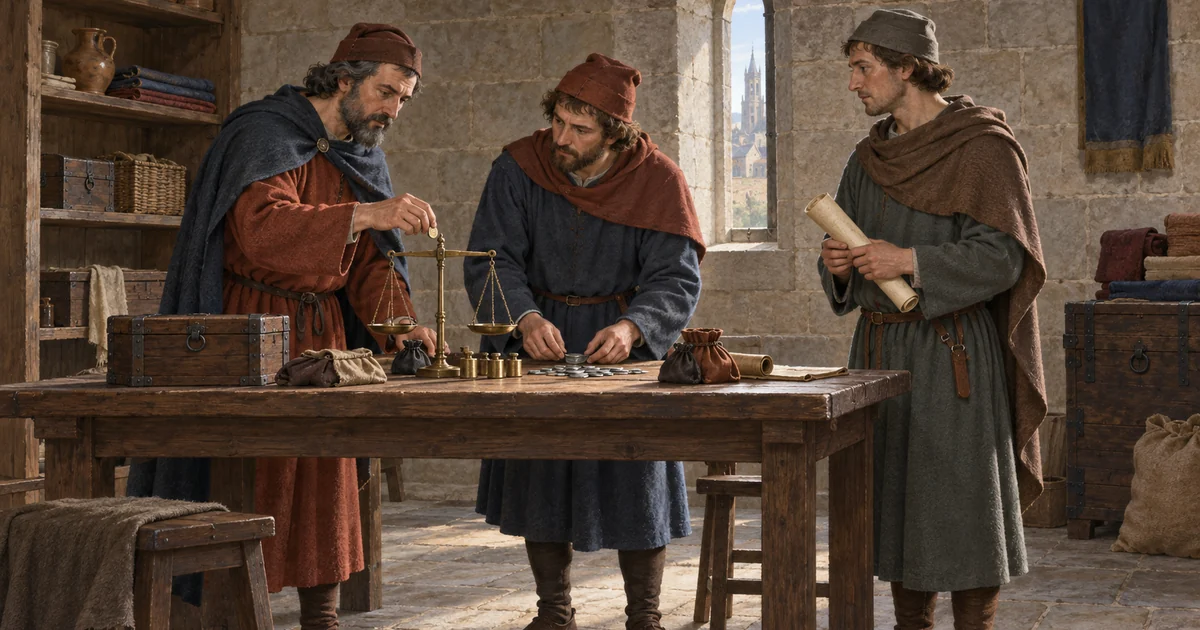
Behind the splendour of the tapestries and the brilliance of the trouveres lies the true power of medieval Arras: its bourgeoisie of merchants and financiers. Enriched by the cloth trade, the great burghers of the town became, in the 12th and 13th centuries, among the most skilful handlers of money in the West, lenders and bankers whose reputation far exceeded the ramparts. So much so that the name of Arras ended up evoking, in the literature of the time, money, credit and sometimes usury. To understand this bourgeoisie is to grasp what really made the strength of the city: not arms or nobility, but trade, finance and the entrepreneurial spirit of an urban elite without equal. A look back at these merchants turned bankers, at the fortune they built and at the mark they left in the history of a town they long dominated.
From cloth to fortune: the birth of an elite
The Arras bourgeoisie did not fall from the sky: it was born of the cloth trade. The town was one of the great drapery centres of the North, and from the drapery of Arras flowed the accumulation of capital that would make everything possible. The merchants who bought the wool, organised production and sold the cloth on distant markets amassed considerable fortunes, making them a new class, neither noble nor peasant. This merchant elite, sure of its wealth, soon aspired to weigh on the destiny of the town. It took the reins, holding the offices of aldermen and governing the commune. The passage from the cloth trade to finance was natural: as commerce intensified, the need for credit made itself felt, and those with liquidity knew how to profit from it. To lend money became an activity as lucrative as trade itself, sometimes more. Thus was formed, over the generations, a powerful business bourgeoisie, whose fortune rested both on cloth and on money. This economic base made Arras far more than one drapery town among others: a true financial marketplace, where money circulated, was lent and bore fruit. To understand this genesis is essential, for the whole history of the Arras bourgeoisie flows from it, from the prudent trader to the bold banker lending to the greatest princes of his time.
Arras, financial marketplace of medieval Europe
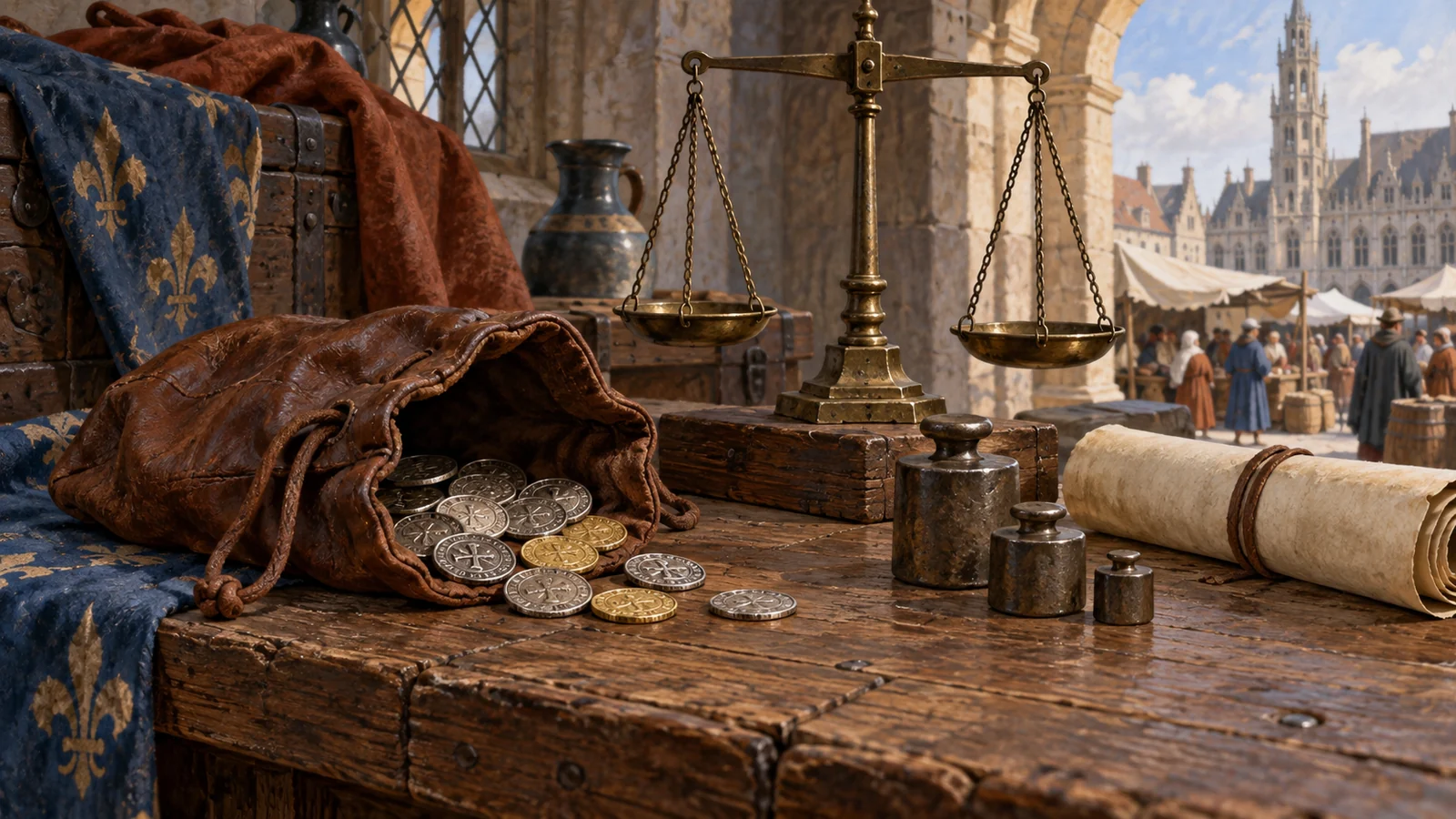
What distinguishes Arras from the other drapery towns is the scale that financial activity took there. In the 12th and 13th centuries, the town established itself as one of the great money markets of north-western Europe. Its burghers did not merely trade: they lent, to individuals, to towns, to lords and even to princes, mobilising large sums. This specialisation in credit made the fame, and sometimes the ill repute, of the city. Arras capital circulated far, taking part in the financing of varied ventures across Christendom. Historians, following works devoted to the financiers of Arras, have shown how developed and organised this activity was, making the town a leading marketplace. This financial reputation even found an echo in medieval literature, where the name of Arras was associated with money and usury, a sign of the place the city held in the economic imagination of the time. One must beware of anachronism: medieval banking did not have the form of modern institutions, and the Church condemned lending at interest, which forced sometimes complex arrangements. But the essential remains: Arras was, at its peak, a capital of finance, where a rare expertise in credit was concentrated for the time, and where considerable fortunes were built on the handling of money as much as on the trade in fabrics.
| Marker | Detail |
|---|---|
| Origin | The trade in cloth and wool |
| Activity | Trade, credit and money-lending |
| Power | The aldermen, from the great families |
| Reputation | Arras associated with money and credit |
Lenders, bankers and the suspicion of usury
The role of lender earned the burghers of Arras an ambivalent reputation, between admiration and the suspicion of usury. In a society where the Church condemned lending at interest, credit activity was morally suspect, even if it was indispensable to the working of the economy. The Arras financiers had to deal with this prohibition, resorting to forms of loan and annuity that got around the letter of the condemnation. This ambiguity explains the ill repute that sometimes attached to the town, mocked or criticised for its taste for money. The satirical literature of the time did not refrain from mocking the burghers of Arras, presented as grasping. It would, however, be unjust to reduce this bourgeoisie to the caricature of the usurer. These men were above all entrepreneurs, who took risks, financed trade and the economy, and contributed to general prosperity. Their credit activity, however decried, answered a real need, that of an expanding economy short of liquidity. To understand this paradox, between moral condemnation and economic necessity, is indispensable to grasping the place of financiers in medieval society. The Arras bourgeoisie embodies this tension wonderfully, building its fortune on an activity at once vital and suspect, which aroused as much envy as reprobation in an age divided between the Christian ideal and the realities of trade.
An oligarchy that governs the town
Wealth was not without effect on power: the great burghers of Arras formed a true urban oligarchy, master of the town's government. Thanks to the liberties recognised by the communal charter of 1163, the commune was administered by aldermen, and these offices were monopolised by a small group of wealthy families. Municipal power was thus passed within a narrow elite, which managed the town in its interest as much as in that of the community. This concentration of economic and political power in the same hands is characteristic of the great medieval merchant towns. The aldermen decided on taxes, justice, works, relations with the prince, steering the life of the city according to the views of the business bourgeoisie. This oligarchic government was not without tensions: the common people of the trades, the craftsmen and textile workers, bore the domination of the rich poorly, which sometimes provoked conflicts. But overall, the high bourgeoisie held the town with a firm hand, making the communal institutions the extension of its power. This grip partly explains the dynamism of Arras, governed by those who made its wealth, but also its social fractures. To study this oligarchy is to understand how, in the medieval town, money translated into power, and how a business class could, durably, hold the reins of a great city.
Patronage: when money nourishes the arts
The fortune of the burghers of Arras did not only serve to enrich them: it also irrigated the cultural and artistic life of the town. It was largely thanks to the patronage of this elite that the extraordinary poetic centre of which the Puy of Arras was the heart could flourish. By protecting the trouveres, financing the feasts and confraternities, surrounding themselves with artists, the burghers made their wealth an instrument of prestige and radiance. This urban patronage, less known than that of princes, played a decisive role in the intellectual life of the city. The bourgeoisie did not merely accumulate: it also spent, for its pleasure, its honour and the glory of the town. This wealth could be read in the fine dwellings, in the luxury of clothes and tables, in the support of the arts and the Church. Far from the image of the miserly burgher, this elite knew how to make a brilliant use of its fortune, helping to make Arras a town of culture as much as of trade. This link between money and culture is a major trait of urban history: the great artistic flowerings often arise where wealth is concentrated. Arras offers a dazzling example, where the financial power of the bourgeoisie turned into cultural brilliance, making the town, at its peak, a place where money and spirit met and nourished each other for the greater prestige of the city.
Great families and bourgeois destinies
Behind the bourgeoisie in general, there were particular families and destinies, some of which marked the history of the town. Great lineages of merchants and financiers were formed, passing fortune, offices and networks from generation to generation. These families allied among themselves through marriages, consolidating their power and forming a true aristocracy of money. Some sought to be ennobled or to imitate the lifestyle of the nobility, a sign of their social ascent. Historians have been able, thanks to the archives, to reconstruct part of these trajectories, lighting up the concrete life of this elite. One discovers there shrewd businessmen, skilful lenders, but also benefactors, founding pious or charitable works for the salvation of their souls, another characteristic trait of the mentality of the time. These individual destinies give flesh to the history of the bourgeoisie, which is not only an economic abstraction but a human reality, made of ambitions, successes and sometimes setbacks. One must, however, remain cautious, for the sources, however precious, remain partial and must be interpreted with method. To reconstruct these lives is to do the work of a historian, crossing the documents and avoiding hasty conclusions. These great Arras families, today forgotten by the general public, were in their time leading actors, whose power radiated far beyond the town and whose history deserves to be known and passed on.
Credit, engine of an expanding economy
To measure the importance of the Arras financiers, one must understand the vital role of credit in the medieval economy. The central Middle Ages were a period of strong growth, marked by the rise of towns, trade and fairs. Now this expansion demanded capital: to buy goods, finance journeys, advance production costs, available money was needed, which not everyone had at the right moment. This is where the lenders intervened, providing the liquidity necessary for the working of exchange. Without credit, the great international trade that made the wealth of the northern towns would have been impossible. The burghers of Arras, by specialising in this activity, thus held an essential function, that of lubricating the workings of the economy. They lent to merchants for their business, to towns for their expenses, to lords for their wars or their lifestyle. This circulation of money, far from being sterile, fed all economic activity. It would therefore be wrong to see in these financiers only profiteers: they were the cogs of a system, the indispensable intermediaries of a booming economy. This function explains their wealth, but also their power and influence. To understand medieval credit is to understand why a town like Arras could become a leading financial marketplace, and why its burghers, masters of money, held such a central place in the society of their time, far beyond the simple trade in fabrics that had made their first fortune.
Money, faith and pious foundations
The burghers of Arras lived in a deeply Christian society, and their relationship to money was crossed by a tension between wealth and salvation. The Church taught mistrust of money and condemned usury, which placed the financiers in an uncomfortable moral position. To reconcile their activity and their faith, many multiplied pious foundations and charitable works: gifts to churches, financing of hospitals, chapels, alms to the poor. These largesses were not only generosity: they answered the concern for the soul's salvation, in an age when one believed one could redeem, through good works, part of the sins linked to gain. The rich burgher who founded a chapel or endowed a hospital sought to secure his afterlife as much as to assert his rank. This religious dimension is essential to understanding the mentality of the Arras elite, torn between the lure of gain and the fear of judgment. It explains the profusion of charitable and religious foundations in the town, financed by bourgeois fortune. Far from being contradictory, the accumulation of wealth and piety complemented each other in a single logic: to earn much, then redistribute a part for salvation. This trait, common to the whole medieval bourgeoisie, takes on a particular relief in Arras, so great was the wealth there. It recalls that these men of money were also men of faith, inscribed in the beliefs and anxieties of their time.
The decline and legacy of a bourgeoisie
Like the drapery that had nourished it, the great business bourgeoisie of Arras knew a decline at the end of the Middle Ages. Economic crises, the retreat of the textile industry, the wars and political upheavals that struck the Artois shook the bases of its prosperity. The great financial fortunes withered or moved, as other marketplaces took over. This ebb accompanied the end of the town's golden age, whose economic and cultural power had rested on this elite. Yet the legacy of the Arras bourgeoisie did not entirely disappear. It survives in the memory of a town that was, at its peak, a great merchant and financial marketplace, in the traces left by the fine dwellings and the foundations, and in the very history of a city shaped by trade and money. This legacy invites a different look at medieval Arras: not only as a town of monuments and legends, but as a living economic centre, dominated by a class of bold entrepreneurs. To understand the bourgeoisie is to understand the deep engine of the town's greatness. Behind each tapestry, each poem, each monument, there was the wealth patiently accumulated by these merchants and bankers. Their history, discreet but essential, is that of the true builders of Arras prosperity, and one of the most instructive chapters of the town's history.