
The Puy of Arras: why was the town the capital of the trouveres?
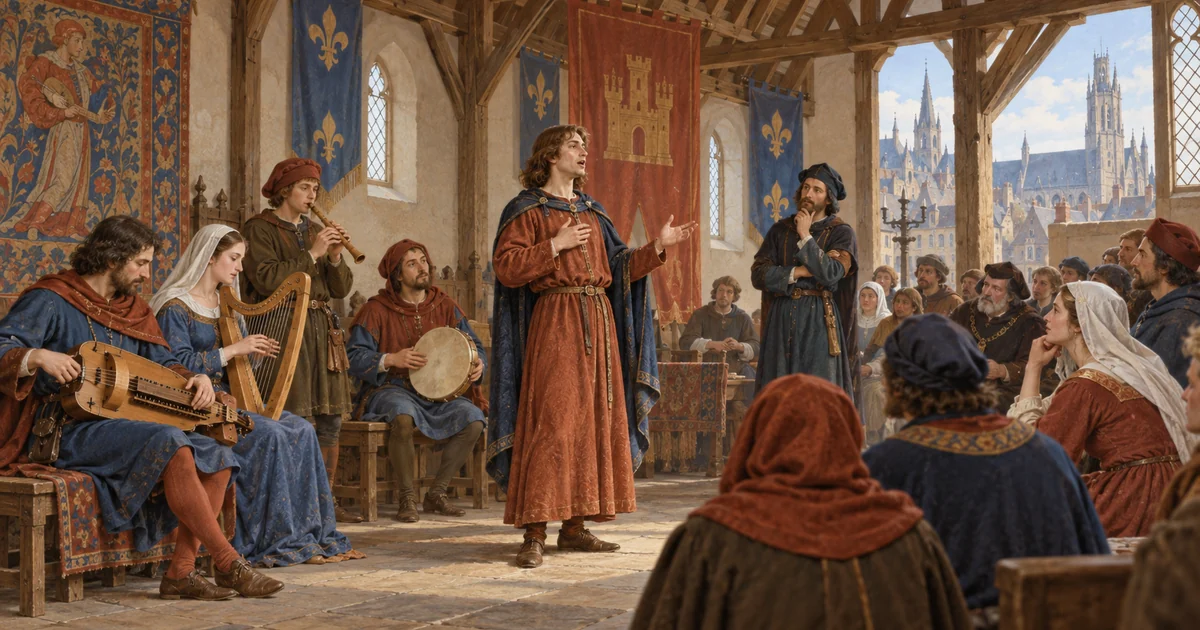
In the 13th century, Arras was not only a capital of cloth and money: it was also a poetic centre unique of its kind, around an original institution, the Puy of Arras and its confraternity of jongleurs and burghers. In this rich and lettered town gathered poets, musicians and notables, united in a pious and literary society that organised poetry contests and honoured the Virgin. There the greatest trouveres of the langue d'oil shone, making Arras the most important centre of French poetry of its time. To understand the Puy is to grasp how a merchant city also became a city of culture, where the money of the burghers was put at the service of the arts. It is also to discover a form of collective literary life, halfway between the religious confraternity, the poetic club and the mutual-aid society, of which Arras offers one of the finest examples of the Middle Ages.
A confraternity of jongleurs and burghers
At the origin of this centre lies a singular association, the confraternity of jongleurs and burghers of Arras, often linked in its history to the Marian cult and to charity. This society gathered, remarkably, men of very diverse conditions: jongleurs and professional poets, those artists who lived from their art, but also rich burghers, merchants and notables of the town. It was closely associated with the cult of Our Lady, in the lineage of the devotion born of the miracle of the Holy Candle, which had already staged minstrels saved by the Virgin. The confraternity thus mixed piety, charity and artistic creation, offering its members a frame of sociability, mutual aid and recognition. It kept registers, celebrated its dead and organised ceremonies. This meeting, within one and the same institution, of the artist and the burgher, the poet and the merchant, is revealing of Arras society, where commercial wealth opened to patronage and culture. It also testifies to the particular status attained by people of letters and music in Arras, admitted to rub shoulders with the urban elite. This confraternity was the crucible from which sprang the extraordinary poetic flowering of the town, a place where art found at once practitioners, an audience and protectors.
What is a 'puy'?
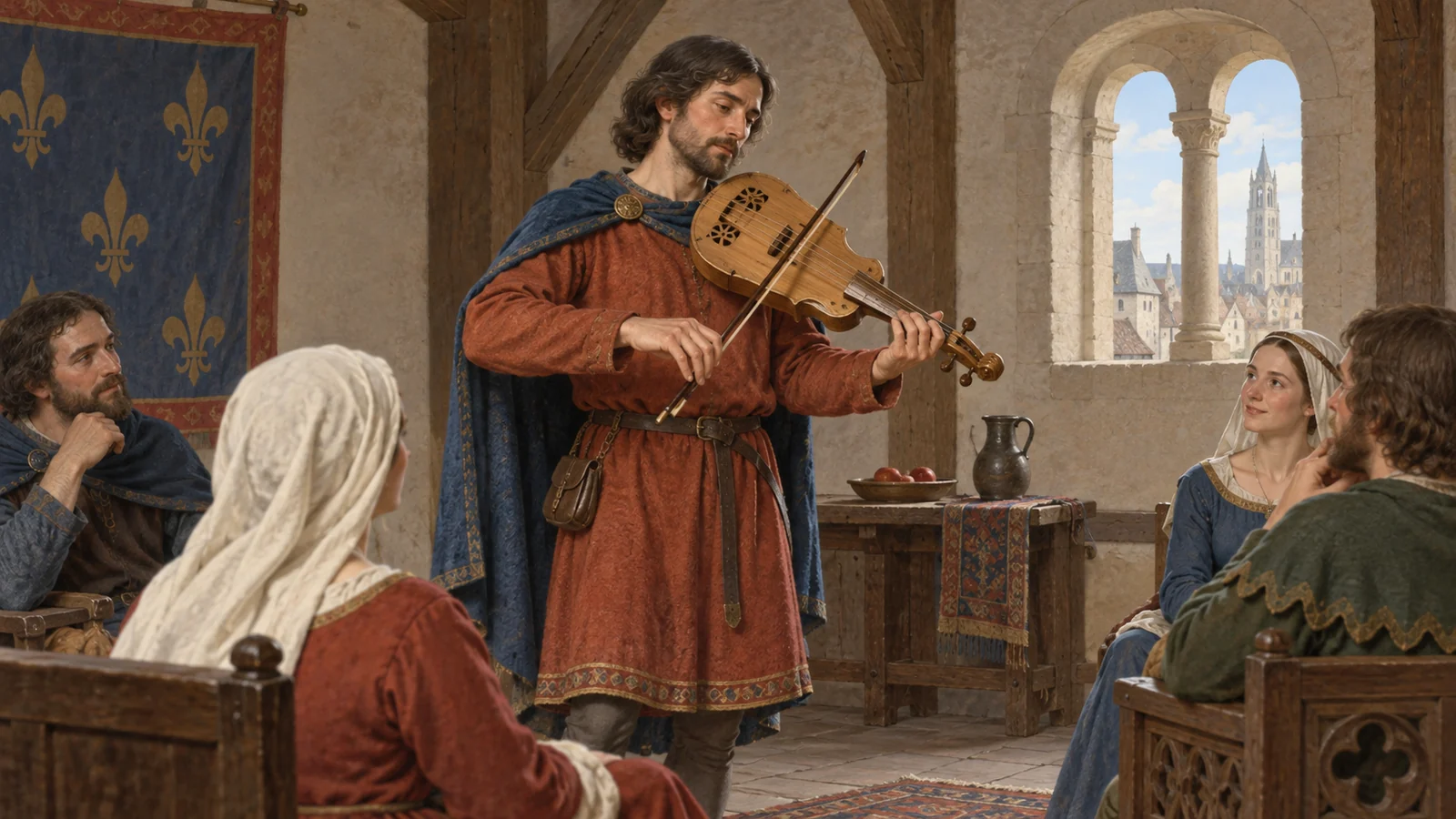
The word itself deserves explanation, for it designates a cultural institution typical of the northern Middle Ages. A puy was a society, often of religious and confraternal character, organising contests of poetry and song in honour of the Virgin. The term, whose origin is debated, came to designate these literary jousts where poets vied in talent before an audience and a jury, the winner being crowned. Several towns of northern France knew such puys, but that of Arras was among the most famous and active. These contests were not mere entertainments: they obeyed precise rules, bore on defined genres and engaged the honour of the participants. The puy thus encouraged emulation, creation and formal perfection, playing a role comparable, all proportions kept, to that of an academy or a literary circle. It offered poets a frame to perform, to measure themselves and to make themselves known, and the public a prized spectacle. By linking poetry to Marian devotion and confraternal life, the puy inscribed creation in the social and religious fabric of the town. To understand what a puy was allows one to measure the originality of medieval literary life, very different from ours, where the written word was spoken and sung in public, in a collective and ritualised frame, far from the romantic image of the solitary poet.
| Marker | Detail |
|---|---|
| Nature | Pious, charitable and literary confraternity |
| Members | Jongleurs, trouveres and burghers of Arras |
| The puy | Poetry contest in honour of the Virgin |
| Peak | 13th century, poetic golden age of the town |
Arras, capital of the trouveres
The result of this ferment was extraordinary: Arras became, in the 13th century, the greatest centre of trouveres in all the langue d'oil domain. The trouveres, those poet-musicians of the North who composed and sang in French, were there more numerous and productive than anywhere else. The town concentrated an impressive number of poets, whose works have partly come down to us, making it a literary centre without equal. This unique poetic density is explained by the conjunction of several factors: the wealth of the town, which offered patrons and an audience; the confraternal life, which structured the milieu; and a tradition of emulation maintained by the puy. Historians of medieval literature, such as Michel Zink, have stressed the capital importance of Arras in the history of French poetry, at a moment when it was asserting itself with brilliance. Varied genres were practised there, from the courtly song to the jeu-parti, that poetic debate in which two authors discussed a question of love or morality. This production, rich and diverse, testifies to an intense creative milieu, where poetry was a social and living activity. That a town of the Artois held such a rank in the history of French letters remains a remarkable fact, too often ignored, and one of the most authentic titles of glory of medieval Arras.
Jean Bodel, Adam de la Halle and the great names
This flowering had its major figures, whose names rank among the greatest of medieval literature. The trouvere Jean Bodel, author of a considerable body of work, deeply marked the literary life of Arras and the nascent theatre, while, later, Adam de la Halle carried this art to a summit, notably in the domain of secular theatre and polyphonic music. Around these two great names gravitated a multitude of other poets, more or less known, who animated the Arras scene. Many were linked to the confraternity and took part in its life. Their works, songs, jeux-partis, occasional poems, draw the portrait of a teeming milieu, where creation fed on exchanges, rivalries and friendships. Some sang courtly love, others the daily life of the town, sometimes with a surprising satirical or realistic verve. This gallery of authors makes Arras a privileged case study for understanding the literary life of a medieval town, grasped not through an isolated genius, but in all the thickness of a milieu. That two of the greatest names of French medieval theatre and poetry came from this same city says much about the vitality of its cultural centre, and amply justifies speaking of a true literary golden age of Arras.
The Necrology, memory of the confraternity
How do we know this confraternity and its members? In large part thanks to an exceptional document, the Necrology of the confraternity, that register in which the names of deceased members were inscribed, so that one might pray for their souls. This type of source, rare and precious, offers historians a mine of information on the composition of the society, its numbers and its evolution over time. By reciting the names of the departed brothers, jongleurs and burghers mingled, it allows one to reconstruct, at least in part, the milieu that carried the literary life of Arras. It is by crossing this kind of document with the preserved works that researchers have been able to measure the extent and nature of the poetic centre of Arras. The patient work of editing and analysing these sources, carried out by scholars and historians of literature, was decisive in drawing this brilliant page from oblivion. The Necrology also recalls the religious and funerary dimension of the confraternity, where solidarity extended beyond death, in prayer for the dead. It illustrates perfectly the historian's approach, reconstructing a vanished world from fragmentary traces, a register of names, a few poems, mentions in archives. Without such documents, a whole part of the medieval cultural life of Arras would remain invisible to us, and it is to them that we owe the ability to write its history.
Money, culture and the prestige of a town
The Puy of Arras illustrates a more general truth about medieval towns: the close link between wealth and culture. If Arras could become a poetic capital, it was because it was first a rich town, whose prosperity, founded on cloth and trade, also rested on the liberties acquired by the communal charter of 1163. This wealth gave the burghers the means to protect the arts, to finance the feasts and to surround themselves with poets. Urban patronage, less known than that of princes, played an essential role here: it was merchants and notables, and not great lords, who supported creation. This alliance of money and culture made literary prestige an element of the identity and pride of the city. It shows that the greatness of a town is measured not only by its monuments or its economic power, but also by its life of the mind. The case of Arras invites reflection on the conditions that allow the flourishing of the arts: peace, wealth, an elite open to culture, favourable institutions. Gathered in the 13th century in this town of the Artois, these conditions gave birth to an exceptional poetic centre, whose memory remains one of the finest jewels of the history of Arras and a model of what the successful marriage of prosperity and spirit can produce.
Jeux-partis, songs and congés: the palette of genres
The production of the Arras trouveres was not limited to a single type of poem: it deployed a rich palette of genres, revealing the vitality of the milieu. The courtly song, inherited from the tradition of the troubadours of the South, celebrated the idealised love of the lady and remained a prized exercise. But Arras excelled particularly in the jeu-parti, that poetic debate in which two authors, in turn, defended opposing positions on a question of love or morality, in a regulated joust that gave pride of place to wit and argument. This genre of dialogue, very present in the town, testifies to the Arras taste for elegant controversy and intellectual play. One also finds there dits, occasional poems, and more personal pieces. Among them, the Arras congés occupy a singular place: these poems of farewell, by which an author took leave of his friends and his town, rank among the most moving and original texts of medieval literature. This diversity of forms shows a mature creative milieu, able to renew the inherited genres and to invent its own. It offers historians of literature a field of study of rare richness, in which can be read both the codes of an era and the singular voices of very real authors, anchored in a precise town and time.
A poetry anchored in the life of the city
What is striking, in the Arras production, is its anchoring in the town and its era. Far from being a disembodied poetry, it often gives place to the concrete reality of the city, to its inhabitants, its trades, its streets. Some poems evoke daily life, local figures, the very material concerns of the people of Arras, sometimes with a satirical verve or a biting realism that contrasts with courtly idealism. This urban and realistic dimension is one of the great originalities of the Arras centre: poetry there comes down into the street, seizes the present, mingles with the life of the commune. It reflects a society of burghers and craftsmen, mindful of its immediate world as much as of chivalric ideals. Historians see in it a precious testimony on the mentality and life of a medieval town, grasped by those who inhabited it. This rootedness also explains why the literature of Arras still touches today's reader: behind the conventions of the time, one hears human voices, laughter, complaints, farewells. By showing the city and its people, these works prolong and light up all that we know otherwise of medieval Arras, making poetry a source of history in its own right, complementary to the archives and the monuments, and irreplaceable for approaching the sensibility of an era.
A literary legacy to rediscover
What remains today of this poetic golden age? A precious but little-known legacy, which deserves to be rediscovered. The works of the Arras trouveres are still read and studied, they figure in the anthologies of medieval literature and are the object of scholarly works. But the general public often ignores that Arras was, in its time, a summit of French poetry. To make the Puy and its confraternity known is to give back to the town an essential part of its identity, alongside the drapery, the tapestries and its rich religious heritage. It is also to recall that culture was, from the Middle Ages, an engine of urban life, and that a city could shine as much by its poets as by its merchants. This legacy resonates particularly in a town today attached to culture, festivals and letters. To recover the thread that links contemporary Arras to that of the trouveres is to inscribe today's cultural life in a long and prestigious tradition. The Puy of Arras is not only an erudite curiosity: it is the living testimony of an era when a town of the North sang higher and louder than all the others, and made poetry one of the jewels of its crown, alongside the gold of cloth and the silk of hangings.