
The drapery of Arras: how did cloth make the town's fortune?
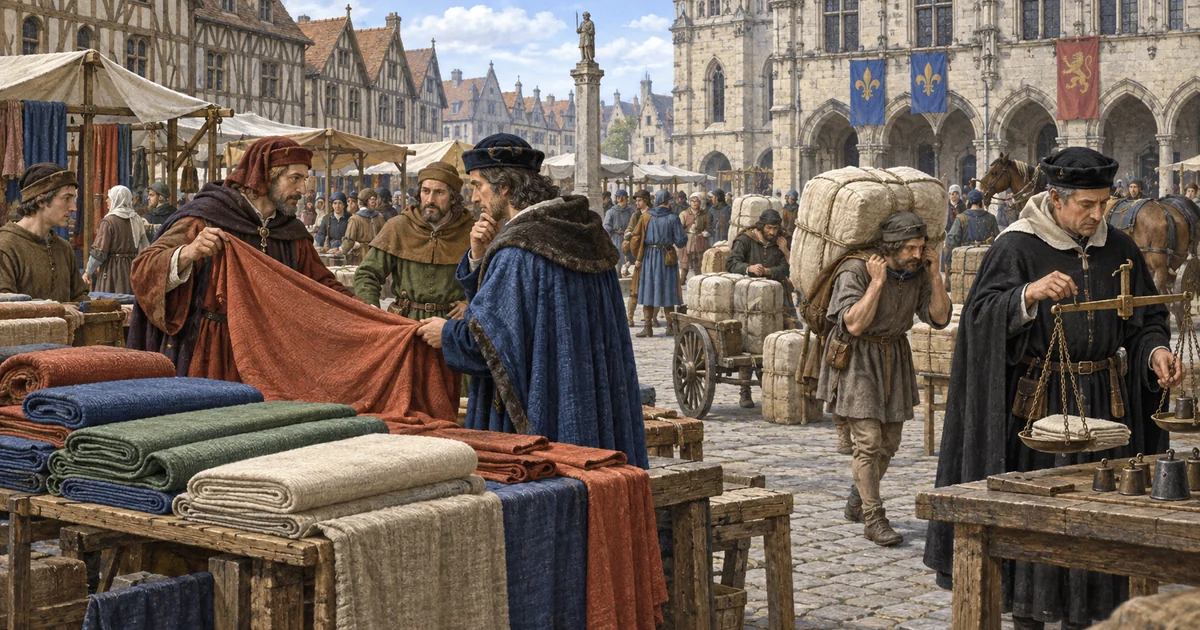
Before the tapestries and their European glory, there was cloth. It was on the drapery of Arras, that great woollen-cloth industry, that the fortune of the town and its bourgeoisie was built from the Middle Ages. For centuries, Arras ranked among the textile capitals of northern Europe, alongside Ghent, Ypres or Douai, exporting its fabrics as far as the fairs of Champagne and beyond. This drapery wealth irrigated the whole life of the city: it fed its merchants, financed its monuments, shaped its society and made possible the flowering of the arts that made its fame. To understand the drapery is thus to go back to the source of the prosperity of Arras, to grasp the workings of a sophisticated medieval economy and to measure why a town of the Artois could, for a time, rival the greatest. A look back at the industry that first made Arras a power.
Wool, the white gold of the Middle Ages
At the heart of this history lies a raw material become strategic: wool. In medieval Europe, woollen cloth was the textile par excellence, indispensable for clothing, and its production constituted the first great industry of the continent. The Flemish and Artesian towns, including Arras, specialised in transforming this material into quality cloth, sought after throughout Christendom. A large part of the wool worked came from England, whose fleeces were reputed the best, which very early wove close commercial ties between the isles and the drapery cities of the continent. This dependence on English wool was moreover a major political factor, able to weigh on relations between princes. As the tapestries of Arras would later do for luxury, cloth constituted the economic base on which the power of the town rested. To transform raw wool into finished fabric required a long chain of operations and know-how, mobilising a multitude of trades. The mastery of this sector made the wealth of Arras and placed it at the heart of the great currents of exchange of its time. To speak of drapery is thus to speak of the white gold of the Middle Ages, that wool around which an essential part of the northern urban economy and life was organised.
The cloth trades: a long chain of know-how
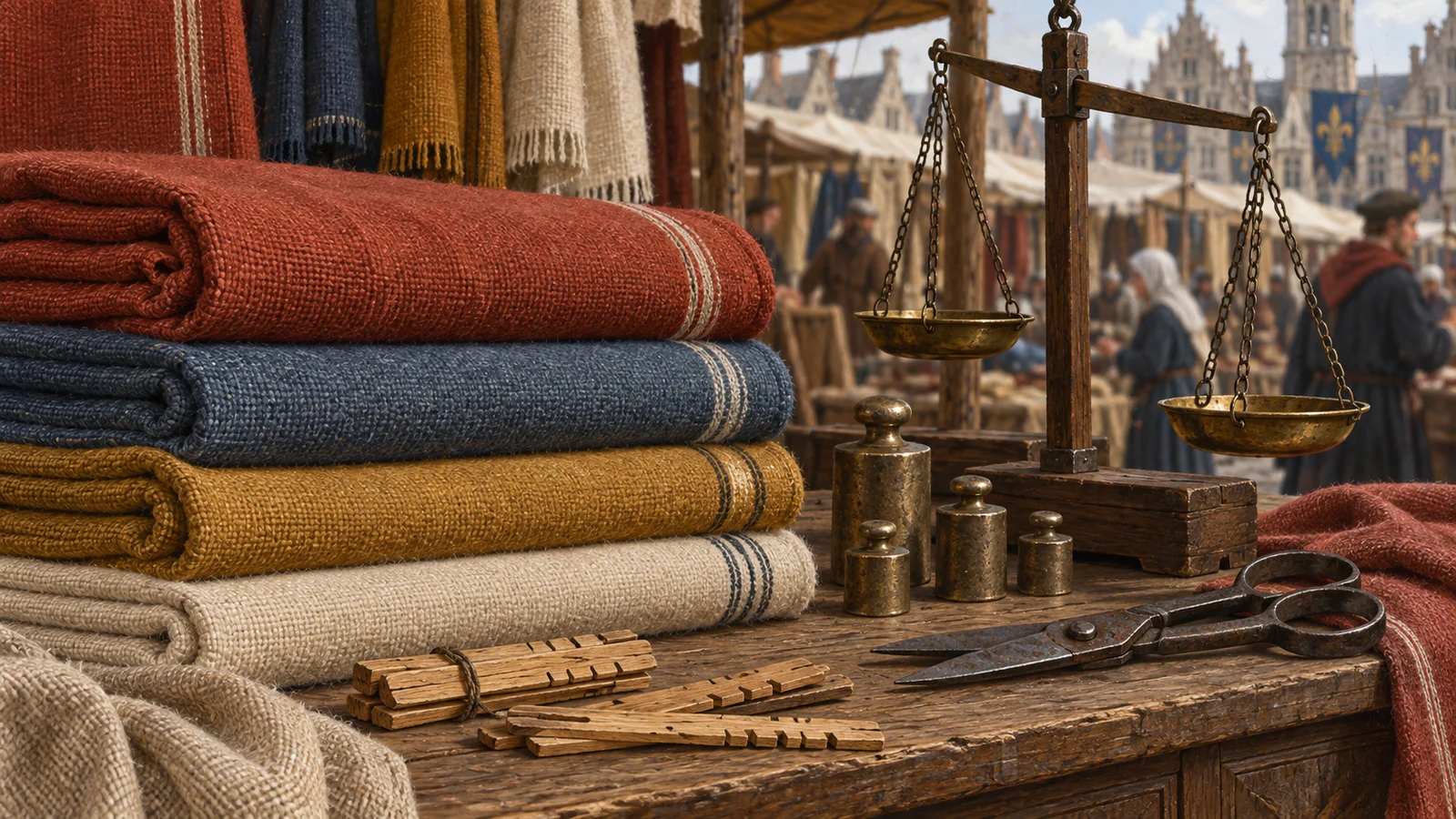
To produce quality cloth was in no way simple: it was the result of a meticulously organised chain of trades. The wool, once washed and sorted, was carded or combed, then spun, before being woven on great looms. The raw cloth then passed through the hands of the fullers, who beat and felted it to make it dense and solid, the shearers who evened its surface, and the dyers who gave it its colours, sometimes brilliant and costly. Each of these stages corresponded to a distinct trade, often organised in a guild, with its rules, its masters and its apprentices. This division of labour, remarkably advanced for the time, made the drapery town a laborious hive where thousands of people lived, directly or indirectly, from textiles. Historians of the medieval economy have stressed the sophistication of this organisation, a true industry before its time, with its quality controls, its marks and its social hierarchy. At the top sat the cloth merchants, who supplied the raw material, coordinated production and sold the cloth on distant markets; below stretched a whole people of craftsmen and workers. To understand this chain of know-how is to grasp the complexity of an urban economy where wealth was born of the coordination of multiple talents, and where the quality of the finished product engaged the reputation of the whole city.
| Stage | Trade and role |
|---|---|
| Preparation | Sorting, carding and combing of the wool |
| Spinning and weaving | Spinners and weavers at the looms |
| Finishing | Fullers, shearers, felting and finishing |
| Colour and sale | Dyers and cloth merchants |
Arras in the network of drapery towns
The drapery of Arras was never an isolated activity: it fitted into a vast network of textile towns that made the prosperity of northern Europe. Ghent, Ypres, Bruges, Douai, Lille, Saint-Omer, so many cities that, with Arras, formed a drapery ensemble of exceptional density, weaving between them competition and complementarity. The cloth produced in these towns was exported far, carried by merchants who frequented the great fairs of the age, foremost among them the famous fairs of Champagne, crossroads of European trade where buyers and sellers from all the West met. Through these circuits, the cloth of Arras reached Italy, the Iberian peninsula and many other regions. This insertion into the great commercial currents explains the considerable fortune amassed by the Arras merchants, who ranked among the richest of their time. It also explains the town's vulnerability to the hazards of international trade: a war, a crisis, a shift of the merchant routes could shake a whole economy. The place of Arras in this network, studied notably by historians of medieval Arras such as Jean Lestocquoy, was long eminent. The city of the Artois was an essential link of this drapery Europe, whose wealth and refinement prepared the cultural and artistic rise that would soon make the glory of the town.
Drapery wealth and the bourgeoisie
This prosperity had a decisive effect on urban society: it gave birth to a powerful bourgeoisie, whose wealth rested on the cloth trade. The great cloth merchants of Arras accumulated considerable fortunes, which made them the true masters of the town. This merchant elite knew how, thanks to its wealth, to conquer municipal power, supported by the communal charter of 1163 that recognised the liberties of the city. The aldermen, magistrates of the commune, came from these great families enriched by textiles. Drapery wealth did not content itself with feeding power: it also irrigated the arts, construction and luxury life. It was this wealth that financed the fine buildings, the pious foundations and, later, the refinement of the tapestries. The burghers of Arras even became famous lenders and bankers, to the point that the town was sometimes associated, in medieval literature, with money and credit. This accumulation of capital, the fruit of the textile industry, profoundly transformed the city, making a new class emerge there, neither noble nor peasant, which would durably mark the history of towns. To understand the drapery is thus to understand the birth of this Arras bourgeoisie, the engine of the town's power and culture throughout its golden age.
Social tensions and urban revolts
It would be naive to imagine the drapery town as a peaceful and united community. Behind the prosperity hid deep social tensions, opposing the rich merchant bourgeoisie to the mass of craftsmen and textile workers. The latter, weavers, fullers and small hands, depended closely on the merchants who supplied their raw material and fixed the prices, in a very unequal balance of power. Economic crises, rises in the price of bread or falls in wages could inflame a numerous and often wretched population. As in the other great drapery towns of Flanders, medieval northern Europe thus knew social movements, strikes and sometimes urban revolts, in which the common people of textiles contested the domination of the powerful. These conflicts, studied by historians of medieval towns, reveal a complex urban society worked by inequalities, far from the smooth image that prosperity alone might suggest. They recall that drapery wealth was also a source of tensions, between those who produced it and those who monopolised it. This social dimension is essential to understand the real life of Arras in the Middle Ages: a prosperous but divided town, dynamic but fragile, where economic greatness was accompanied by tense and sometimes violent power relations between the groups that composed it.
The decline of the great drapery
Like every economic activity, the drapery of Arras knew its peak then its decline. From the end of the Middle Ages, the traditional textile industry of the great Flemish and Artesian towns entered a long crisis, under the effect of several combined factors. The competition of new production centres, notably rural draperies or less regulated towns, able to produce at lower cost, undermined the position of the old cloth capitals. The evolutions of the wool trade, the wars and the political upheavals that struck the Artois also weighed heavily. The rigidities of the guilds, guarantors of quality but not very flexible, could slow adaptation to these challenges. Little by little, the great drapery that had made the fortune of Arras ran out of breath, without totally disappearing overnight, but losing its pre-eminence. This decline belongs to a broader transformation of the urban economies of the late Middle Ages, in which the old balances came undone. For Arras, it marked the end of a certain textile greatness, even if the town knew for a time how to reconvert toward other prestige productions, of which tapestry was the most dazzling. The history of the Arras drapery thus illustrates the cycle of economic activities, from rise to maturity then decline, according to the mutations of trade and techniques.
Scarlets and colours: the mark of a quality
Not all cloth was equal, and the reputation of Arras rested on the quality of its fabrics as much as on their quantity. The drapery towns produced a varied range of textiles, from everyday cloth to fabrics of great luxury, and it was in the top range that prestige was played out. Among the most sought-after productions were the richly dyed cloths, notably the scarlets, those fabrics of a brilliant red obtained thanks to costly dyes, reserved for the wealthiest. Dyeing was a delicate and expensive art, which required precise know-how and raw materials sometimes come from afar. Colour, the finesse of the weave and the regularity of the cloth determined its value and its market. To guarantee this quality, the urban authorities and the guilds issued strict regulations, controlled manufacture and affixed marks or seals attesting the origin and conformity of the pieces. This demand for quality, a true brand policy before its time, was vital: it protected the collective reputation of the town on distant markets, where the buyer had to be able to trust the name of Arras. One finds there a concern that, later, would also make the fame of the tapestries. The mastery of colour and the control of quality thus rank among the keys of the Arras drapery success, showing a medieval economy far more organised and mindful of its image than one sometimes imagines.
The rhythm of a drapery town
The drapery was not only a matter of merchants and profits: it gave its rhythm to the daily life of the whole city. A considerable part of the Arras population lived, closely or distantly, from textiles, and the cloth activities marked out the days and the seasons. The commercial heart of the town beat around the places of sale and exchange, where wool and cloth were negotiated. The noise of the looms, the bustle of the workshops, the comings and goings of the carriers and merchants composed the sonorous and human setting of a laborious town. This omnipresence of textiles also shaped the urban space, with its craftsmen's quarters, its halls and its warehouses. Drapery prosperity attracted a numerous population, making Arras one of the important towns of the North, densely peopled for the time. Social life, the feasts, the confraternities, all bore the mark of this cloth economy. Even the religious and cultural life, so rich in Arras, fed indirectly on this prosperity, which gave the burghers the means of their patronage and their largesse. To understand the drapery is thus to restore the atmosphere of a whole city turned toward the transformation of wool, a hive where textile work was not one activity among others, but the very pulse that animated the town and gave it its own physiognomy throughout the centuries of its golden age.
A legacy inscribed in the town
What remains, today, of this great epic of cloth? A largely invisible but fundamental legacy. The drapery left us no spectacular monument of its own, but it is at the origin of all that made the wealth and beauty of Arras. It was the drapery that built the fortune of the merchants, still testified to by fine dwellings such as the Hotel de Guines, and that indirectly financed the squares, the monuments and the arts of the city. Without the drapery, there would have been neither the powerful communal bourgeoisie, nor the means of the dazzling cultural life of the 13th century, nor doubtless the splendour of the tapestries. To understand this industry is thus to light up the economic foundations on which the golden age of Arras was built. The history of the drapery also invites a different look at the medieval town, not as a frozen setting of stones and legends, but as a living organism, crossed by flows of wool, money and men. Behind the beauty of the monuments and the prestige of the arts, there was the daily labour of thousands of weavers and fullers, and the boldness of merchants launched on the roads of Europe. It is to them, as much as to the princes and the artists, that Arras owes its greatness, and it is worth recalling.