
The relief of Arras of 1654: how did Turenne save the town?
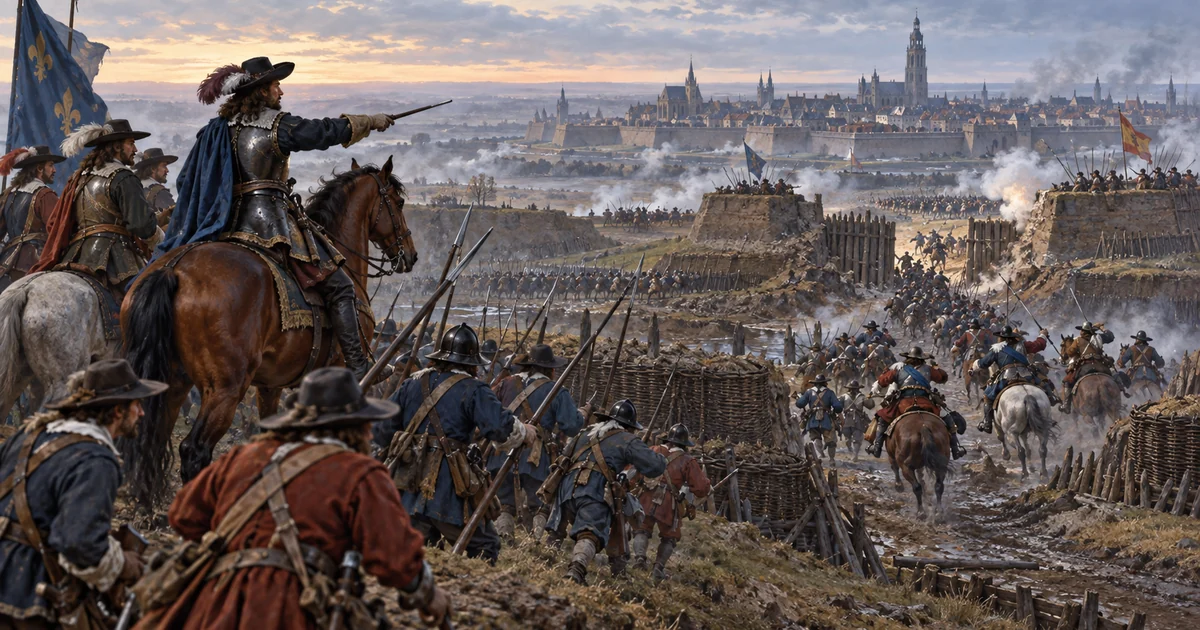
In 1654, Arras was at the heart of a memorable confrontation between two of the greatest captains of the century: the relief of Arras, when Turenne came to break the siege that the prince of Condé, having gone over to the service of Spain, had laid before the French town. This battle, one of the most famous of the Franco-Spanish war, saved Arras and consolidated its possession by France. It also saw, it is said, the beginnings of a young engineer destined for glory, Vauban. To understand the relief of Arras of 1654 is to grasp a decisive episode of the struggle for the town, where legendary figures of the military art clashed. A look back at this page of history where Arras, a threatened French place, was saved by one of the greatest generals of its time, in a confrontation worthy of the great hours of the Grand Siecle.
French Arras, threatened again
Since its conquest by France, Arras remained a disputed place, exposed to Spanish attempts at reconquest. The taking of the town, fourteen years earlier, during the siege of Arras of 1640, had not ended the war: Spain had not given up retaking this strategic place of the North. In 1654, the Spanish armies, taking advantage of the context, came to besiege Arras, hoping to wrest it from France. The town, now French but situated in a war zone, found itself again in peril. This situation illustrates the condition of Arras in the 17th century: a border town, bitterly disputed between France and Spain, whose possession was never definitively acquired as long as the war lasted. To lose Arras would have been a major setback for France, which held to this conquest. It was therefore necessary, at all costs, to defend the town and break the Spanish siege. To understand this threat is essential to grasping the stake of the relief of 1654: it was a matter of saving a threatened French possession, in a war where the town changed status according to the arms. Arras, a French but fragile place, was at the mercy of a successful siege. The relief that was to be brought to it was therefore a vital operation, destined to preserve a conquest and to repel the enemy. This precariousness of the possession of Arras, constantly put back at stake by the war, is the indispensable backdrop for understanding the importance of the battle of 1654 and the relief that the deliverance of the besieged town represented.
Condé besieges, Turenne relieves
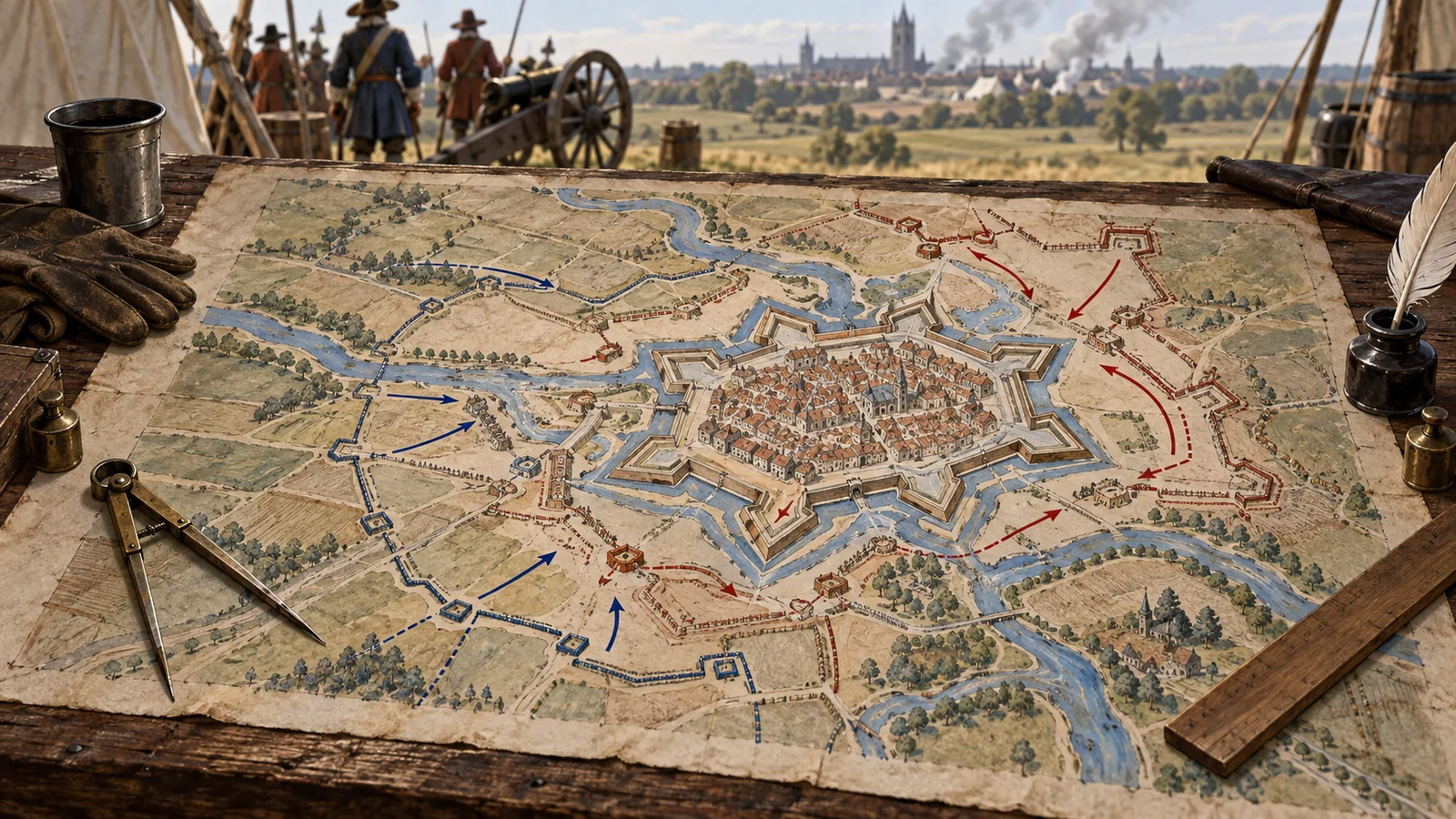
The relief of Arras opposed two legendary figures of the military art of the Grand Siecle. On one side, the prince of Condé, one of the most brilliant French generals, who, following the troubles of the Fronde, had gone over to the service of Spain and commanded the army besieging Arras. On the other, Marshal Turenne, the other great captain of the century, remaining faithful to the king of France and charged with relieving the town. Thus, two of the greatest war leaders of their time, formerly linked by the events of the Fronde, found themselves adversaries before Arras. This confrontation between Condé and Turenne adds to the battle an almost mythical dimension, opposing two military geniuses. Turenne, at the head of the royal army, undertook to force the Spanish lines to deliver the besieged town. The operation, bold and perilous, required piercing the defences of the besieger to bring relief to the besieged. This duel of strategists, this meeting at the summit of the military art, makes all the interest of the relief of Arras. To understand who clashed is essential: it is not an anonymous battle, but a clash between two legends, in a dramatic setting. The fate of Arras was played out in this confrontation of titans. That the town was the stake of a duel between Condé and Turenne, two of the most glorious names of French military history, gives this episode a particular relief and inscribes it in the great feats of arms of the Grand Siecle, of which Arras was, that year, the dazzling stage.
| Marker | Detail |
|---|---|
| 1654 | The relief of Arras, a besieged French town |
| Besieger | The prince of Condé, in the service of Spain |
| Liberator | Marshal Turenne, faithful to the king |
| A beginner | The young Vauban, future great engineer |
The battle and the deliverance of the town
The relief of Arras culminated in a decisive military action. To deliver the town, Turenne had to force the lines of circumvallation that the Spanish had established around Arras to protect themselves from a relief army. In a bold operation, carried out with determination, the royal army attacked these lines and managed to break through them, breaking the siege and forcing the besiegers to withdraw. The town, on the point of falling, was thus saved. This victory, won over an army commanded by a captain as formidable as Condé, was a great success for Turenne and for France. It confirmed the French possession of Arras and pushed back the Spanish threat. The precise course of the battle, with its nocturnal assaults and its dramatic turns, has been related by the memoirists and the military historians, who see in it a fine example of Turenne's art. To understand this action allows one to measure the feat: to force the lines of a besieger to deliver a town was no small matter, and Turenne's success testifies to his tactical genius. For Arras, the deliverance was an immense relief, ending the threat of a Spanish retaking. The battle of 1654 thus ranks among the great feats of arms of the Franco-Spanish war, and among the glorious episodes of the military history of Arras. It recalls that the possession of the town was played out, several times, on the battlefield, and that its preservation by France, in 1654, was the fruit of a hard-won victory over a formidable enemy.
The young Vauban at his beginnings
The relief of Arras is also associated, in tradition, with the beginnings of the young Vauban, the future great military engineer of Louis XIV. At that time, Vauban, still young, was making his first arms in the service of the king, in those campaigns of the North where military careers were forged. He who was to become the most famous builder of fortresses in the history of France thus took part in the operations of his time, learning on the ground the art of sieges and fortifications that would make his glory. One must, as a historian, remain cautious about the exact detail of his role in the relief of Arras, but it is established that Vauban served in the campaigns of this period and that he acquired precious experience there. These years of youth and apprenticeship were decisive for the one who was to revolutionise the art of fortification. That the name of Vauban is associated with Arras is no trifle: the town was, a few years later, to receive from him a powerful citadel, durably marking its landscape. The relief of 1654 thus appears as a moment when the young engineer crossed the destiny of a town he was later to fortify. To understand this dimension adds to the interest of the episode: it not only brings together Condé and Turenne, but also heralds the coming of Vauban into the history of Arras. This meeting between a town and the greatest military figures of the century, generals and engineers, illustrates the eminent place Arras held in the military history of the Grand Siecle, as a disputed stronghold and soon magnificently fortified.
Arras, lock of the northern frontier
The relief of 1654 confirmed the role of Arras as a strategic lock of the northern frontier of the kingdom. The town, bitterly defended and saved, was an essential base of support in the war against Spain, and its possession weighed on the balance of forces in the region. This strategic importance explains the determination put, on both sides, to conquer or defend it. For France, to hold Arras was to lock a door of the kingdom and to have a base for operations toward the Spanish Low Countries. The town, long a Spanish possession as in the time when it came under Charles V, had become a major stake of the Franco-Spanish struggle. Its preservation in 1654 consolidated the French positions in the North. To understand this strategic dimension is essential: Arras was not only a town to defend for itself, but a key point of a vaster military arrangement, on which the security of the frontier depended. This strategic value, the town was to keep for a long time, justifying the efforts deployed to fortify it. The relief of 1654 belongs to this logic: to save Arras was to preserve an essential lock of the kingdom. This battle thus illustrates the military importance of the town, a coveted stronghold whose possession decided, in part, the fate of the war in the North. Arras, a lock of the frontier, deserved to be fought over, and Turenne's relief was the dazzling demonstration of it.
The Fronde and Condé's turnaround
To understand why the prince of Condé was besieging a French town, one must evoke the Fronde, that period of troubles that shook France in the middle of the 17th century. During those years of revolt against royal authority, great lords, including Condé, rose against the power. At the end of these troubles, Condé, at odds with the court, went over to the service of Spain, enemy of France, and put his immense military talent at the service of the adversary. It is thus that this prince of the blood, one of the most glorious French generals, found himself commanding a Spanish army against his own homeland, before this Arras that Spain had held since the Union of Arras of 1579. This turnaround, spectacular, adds a tragic and romantic dimension to the episode. It illustrates the rifts of the Fronde, which pushed some of the greatest servants of the kingdom to rebellion, then to treason. To understand the path of Condé allows one to grasp the dramatic charge of the relief of Arras: it was not only a battle between France and Spain, but also a confrontation between two Frenchmen, Turenne the faithful and Condé the rebel, formerly companions and now enemies. This personal and political dimension considerably enriches the account. It recalls that the wars of the Grand Siecle were also human dramas, where loyalties were made and unmade according to circumstances. The turnaround of Condé, passing from the service of the king to that of Spain, is one of the keys of the relief of Arras, and one of the episodes that give this battle its singular relief, between great military history and individual destinies broken by the troubles of the Fronde.
Turenne and Condé, two military legends
The relief of Arras has this exceptional feature, that it brought face to face the two greatest captains of the century. Turenne and Condé are, in French military history, two of the most illustrious names, two geniuses of war whose campaigns are studied as models. That these two men clashed before Arras gives the battle a particular aura. Each embodied a way of making war, a style, a talent. Turenne, methodical and sure, Condé, fiery and bold: their rivalry, born in the wars of the kingdom and exacerbated by the Fronde, found at Arras one of its theatres. Turenne's victory in this relief added to his glory, while Condé's failure before the town marked a setback for the rebel prince. To understand the stature of these two adversaries allows one to measure the historical and symbolic importance of the battle. The relief of Arras is not one military episode among others: it is a meeting at the summit, between two legends, on Arras soil. This dimension gives the town, once again, a place in the great military history of France. That the destiny of Arras was played out in a confrontation between Turenne and Condé testifies to the importance of the place and adds to the prestige of its past. This duel of titans, of which Arras was the stake, will remain one of the great feats of arms of the Grand Siecle, and one of the most glorious episodes of the military history of the town, whose name finds itself associated with that of the greatest generals of its time.
Toward peace and the definitive attachment
The relief of Arras of 1654 was an important stage on the road to the definitive attachment of the town to France. By saving Arras and pushing back Spain, Turenne consolidated the French possession and brought closer the victorious outcome of the war. The latter continued a few more years, before peace finally came to seal the fate of the region. The treaty that ended the long Franco-Spanish war was to officially recognise the attachment of Arras and the Artois to France, confirming what arms had conquered and preserved. The relief of 1654 thus belongs to the sequence that, from the conquest of 1640 to the peace, made Arras a French town. Each episode, siege, defence, relief, contributed to this result. To understand the relief of 1654 in this perspective allows one to measure its significance: it was not only a fine military victory, but a decisive milestone toward the lasting integration of the town into the kingdom. Without the preservation of Arras in 1654, the attachment to France could have been called into question. Turenne's battle thus ensured the French future of the town, while awaiting diplomacy to consecrate it. This dimension inscribes the relief of Arras in the great history of the attachment of the Artois to France, a long and disputed process, made of wars and treaties, of which the town was both the stake and the witness. The relief of 1654 is one of its strong moments, the one when France, by the arms of Turenne, ensured the conservation of a conquest destined to become definitive.