
The siege of Arras of 1640: how did the town become French?
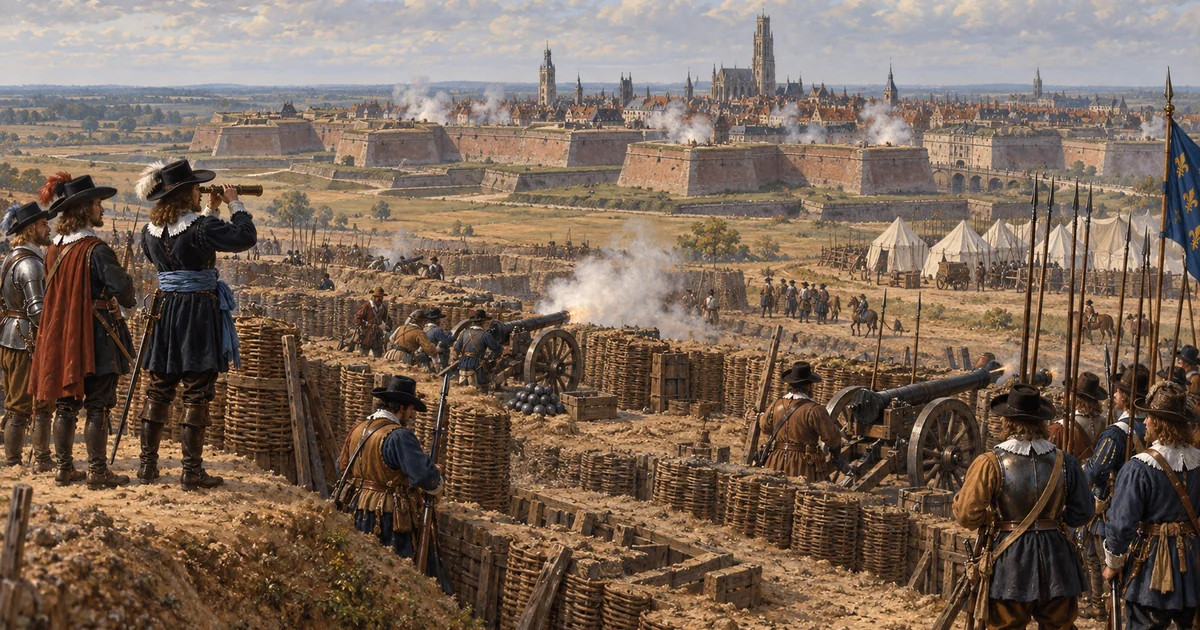
In 1640, a decisive siege changed the destiny of Arras: the taking of the town by the armies of the king of France, at the end of the famous siege of Arras of 1640. A Spanish town for more than a century, Arras was besieged and conquered by the troops of Louis XIII, marking the beginning of its attachment to France. To this episode is attached a famous saying, promising that the mice would eat the cats the day the French took the town, which the French victory mischievously transformed. To understand the siege of 1640 is to grasp a major turning point of the history of Arras, the one when the city tipped from the Spanish world toward the kingdom of France. A look back at this conquest, its stakes, its course and the legend that accompanies it, in the great confrontation that then opposed France to Spain.
Spanish Arras, target of the king of France
At the beginning of the 17th century, Arras was still a Spanish town, a stronghold of the Low Countries of the king of Spain, as it had become following the choices of the previous century, notably the Union of Arras of 1579. Now France and Spain were then engaged in a long war, within the framework of the great European conflict that bloodied the continent. The powerful minister of the king of France, Cardinal Richelieu, had made the weakening of Spanish power one of the major objectives of his policy. In this war, the Spanish Low Countries, and thus the Artois and Arras, constituted an important front. To seize Arras, a great strategic place on the confines of the kingdom, was a choice objective for France: the town commanded a rich region and locked the northern frontier. The conquest of Arras thus belonged to the French strategy of reconquest of the northern territories and weakening of Spain. To understand this context is essential: the siege of 1640 was not an isolated episode, but a moment of the great struggle between France and Spain for the domination of Europe. Arras, a border town and a Spanish stronghold, was a natural target in this war. Its taking would represent a considerable success for the king of France, both militarily and symbolically. It is in this spirit that was launched, in 1640, the expedition destined to wrest the town from Spain, in a large-scale operation that was to mobilise considerable means and hold the attention of all Europe.
The course of the siege
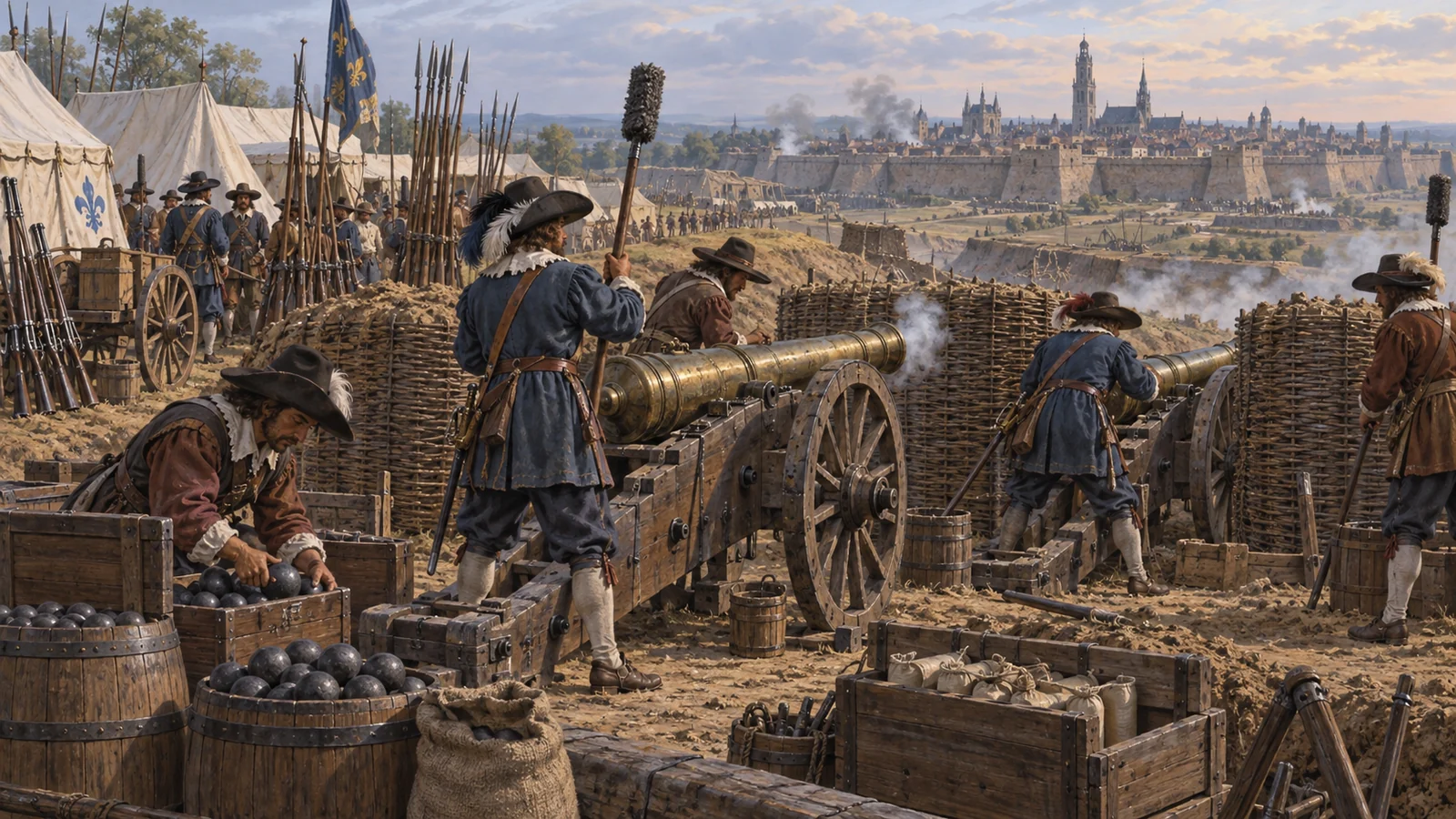
The siege of Arras of 1640 was a vast military operation, matching the importance of the stake. A powerful French army came to invest the town during the summer, undertaking a regular siege according to the methods of the era: encirclement of the place, construction of lines of circumvallation for protection, bombardments, approaches and assaults. The besiegers also had to guard against the Spanish attempts at relief, for Spain could not let such an important place fall without reacting. The siege was thus marked by this double dimension: to reduce the besieged town and to repel the armies come to its rescue. The operations, long and difficult, mobilised considerable means and a great number of men. The town, well fortified and defended by its Spanish garrison, resisted, but the French pressure finally prevailed. After weeks of siege, Arras capitulated and passed into the hands of the king of France. This victory, obtained at the cost of a major military effort, was a great success for France and for Richelieu. To understand the course of the siege allows one to measure the scale of the enterprise and the difficulty of the conquest. To take a great stronghold like Arras was a complex operation, which demanded organisation, means and perseverance. The siege of 1640 illustrates the military art of the era, made of methodical sieges and manoeuvres, in a war where the possession of strongholds was decisive. The fall of Arras marked an important stage of the Franco-Spanish war and opened a new page of the history of the town.
| Marker | Detail |
|---|---|
| 1640 | Siege and taking of Arras by France |
| Context | The Franco-Spanish war, under Richelieu |
| Stake | To wrest a great Spanish stronghold of the North |
| The saying | 'The mice will eat the cats' |
'When the French take Arras'
To the siege of 1640 is attached a saying that remained famous, one of the most delightful of the history of Arras. According to tradition, the Spanish, confident in the solidity of their place, are said to have displayed a mocking motto: when the French took Arras, the mice would eat the cats, in other words never. It was to proclaim the impregnability of the town with fine assurance. But history held a witty response: after the taking of the town by the French, they are said to have modified the saying by erasing a letter, transforming the verb to make it say, no longer when the French take Arras, but when the French give back Arras, the mice will eat the cats. In other words, never would France give back the town. This linguistic pirouette, full of humour and pride, entered the legend of Arras. It is fitting, as a historian, to treat this anecdote with the required distance: sayings of this kind often belong to tradition and embellishment, and it is difficult to establish their historical accuracy. But whether it be rigorously authentic or partly legendary, this saying says something true: the French will to keep Arras definitively, once the town was conquered. It also illustrates the era's taste for witticisms and plays on words. This famous saying today is part of the intangible heritage of the town, a witticism that accompanies the memory of the siege of 1640 and recalls, in a pleasant way, a serious turning point of its history.
A fortified and disputed town
The siege of 1640 recalls that Arras was a major stronghold, bitterly defended and disputed. The town, by its border position and its importance, had been fortified to resist attacks, and its possession was a strategic stake of the first order. This military vocation of Arras, a place of war as much as a merchant city, continued after the French conquest. To hold this newly conquered town, exposed to Spanish attempts at reconquest, France undertook to strengthen its defences. It is in this context that belongs, a little later, the construction of the famous citadel, still testified to by the Arras citadel, a military work destined to lock the place and ensure its control. Arras thus became a garrison and fortification town, a lock of the northern frontier of the kingdom. This military dimension is essential to understanding the history of the town at this era: conquered by arms, it had to be defended by arms, in a region that long remained a war zone between France and Spain. To understand that Arras was a disputed stronghold allows one to grasp why the town was the object of so many sieges and fortification efforts. The siege of 1640 was neither the first nor the last military episode of its history, but it was decisive, for it tipped the town into the French camp, opening the way to its definitive attachment and to its transformation into a powerful stronghold of the kingdom of France.
A turning point toward France
The taking of Arras in 1640 marks a decisive turning point in the history of the town: the beginning of its attachment to France. After more than a century of belonging to the Habsburg then Spanish world, inherited from the period when Arras was a city of Charles V, the town passed under the authority of the king of France. This shift, obtained by arms, was not yet definitive: the war continued, and Spain had not given up retaking the town. One would have to wait for the later treaties for the attachment of Arras to France to be officially and durably consecrated. But the conquest of 1640 was its founding act, the moment when the town changed camp. This turning point had immense consequences for Arras: it left the world of the Spanish Low Countries, to which it had belonged for generations, to enter the kingdom of France, of which it would become a fully-fledged town. To understand the importance of this shift is essential: the siege of 1640 is one of the great turning points of the history of Arras, comparable, by its significance, to the great moments that had shaped the destiny of the town. It opens the French period of Arras, the one that endures today. To remember the siege of 1640 is thus to recall the moment when Arras, a town long Flemish, Burgundian then Spanish, took the road of France, in a turning point obtained by force of arms but promised a lasting future, which the following decades would confirm.
Richelieu and the Franco-Spanish war
The taking of Arras belongs to the grand policy of Cardinal Richelieu, chief minister of Louis XIII. Convinced that the power of the Habsburgs, who reigned over both Spain and the Empire, threatened France by encircling it, Richelieu engaged the kingdom in a long war against Spain, belonging to the vast European conflict of the era. This war aimed to break the Habsburg vice and to extend the frontiers of the kingdom, notably northward. The conquest of the strongholds of the Spanish Low Countries, of which Arras was one of the most important, was a major strategic objective of this policy. By seizing Arras, France weakened Spain and advanced its positions toward a safer frontier. The siege of 1640 was thus one of the great successes of Richelieu's military policy, a dazzling victory that reinforced the prestige of the king and his minister. To understand this frame is essential: the conquest of Arras was not an isolated operation, but a link in a long-term strategy aiming to make France the leading European power. Richelieu, the architect of this policy, did not see the completion of his work, but the taking of Arras was a decisive stage of it. It illustrates France's determination to push back Spain and to assert itself, in a long and costly war whose stake was nothing less than the domination of Europe. Arras, a conquered place, became a symbol of this French rise, and a milestone on the road that was to lead, a few years later, to the victorious peace and the definitive attachment of the town to the kingdom.
A conquest to be confirmed
The taking of Arras in 1640, however dazzling, did not end the war for the possession of the town. Spain, far from giving up, sought to retake this lost place, and the region remained a theatre of confrontations. Arras, now French but exposed, had to be defended against the Spanish attempts at reconquest. A few years after the siege, the Spanish moreover tried to retake the town, in an episode that was to test French determination. The conquest of 1640 therefore had to be confirmed, both on the battlefield and by the treaties. One would have to wait for the end of the long Franco-Spanish war and the peace that concluded it for the attachment of Arras to France to be officially and definitively recognised. This period of uncertainty, between the conquest and the confirmation, lasted about twenty years, during which Arras remained a disputed place and a military stake. To understand that the conquest of 1640 was not immediately definitive is essential: it opened a phase of consolidation, marked by new confrontations, before the town was assuredly and durably French. The siege of 1640 was the founding act of this attachment, but its completion still demanded years of efforts and wars. This dimension recalls that the history of frontiers and conquered towns is rarely simple and immediate: it is played out over time, between arms and diplomacy, until the treaties finally come to seal a fate that the battles had prepared but not definitively fixed.
The siege of 1640 in the memory of Arras
The siege of 1640 occupies a particular place in the memory of Arras, at once as a historical turning point and as the source of the famous saying of the mice and the cats. This episode, mixing military history and delightful anecdote, is one of the best known of the past of the town. It recalls the time when Arras was a stronghold disputed between the great powers, and the moment when it tipped into the French camp. The saying, passed into local language and tradition, pleasantly maintains the memory of this conquest. To make known the siege of 1640 is to light up a decisive moment of the history of Arras, that of the passage from Spain to France, while transmitting an anecdote that makes one smile. This episode also illustrates the condition of Arras, a border town long tossed between the powers, whose destiny was often played out by arms. To understand the siege of 1640 is to grasp both the great history, that of the Franco-Spanish war and the attachment to France, and the small history, that of the saying that remained famous. The two mingle in the memory of the town, making this episode a striking and endearing moment of its past. For the people of Arras as for visitors, the memory of the siege of 1640 and its famous saying remains vivid, the testimony of an era when the town, a coveted stronghold, changed destiny at the end of a siege whose account, between history and legend, continues to charm and instruct those who take an interest in the rich past of Arras.