
The Union of Arras of 1579: why did it divide the Low Countries?
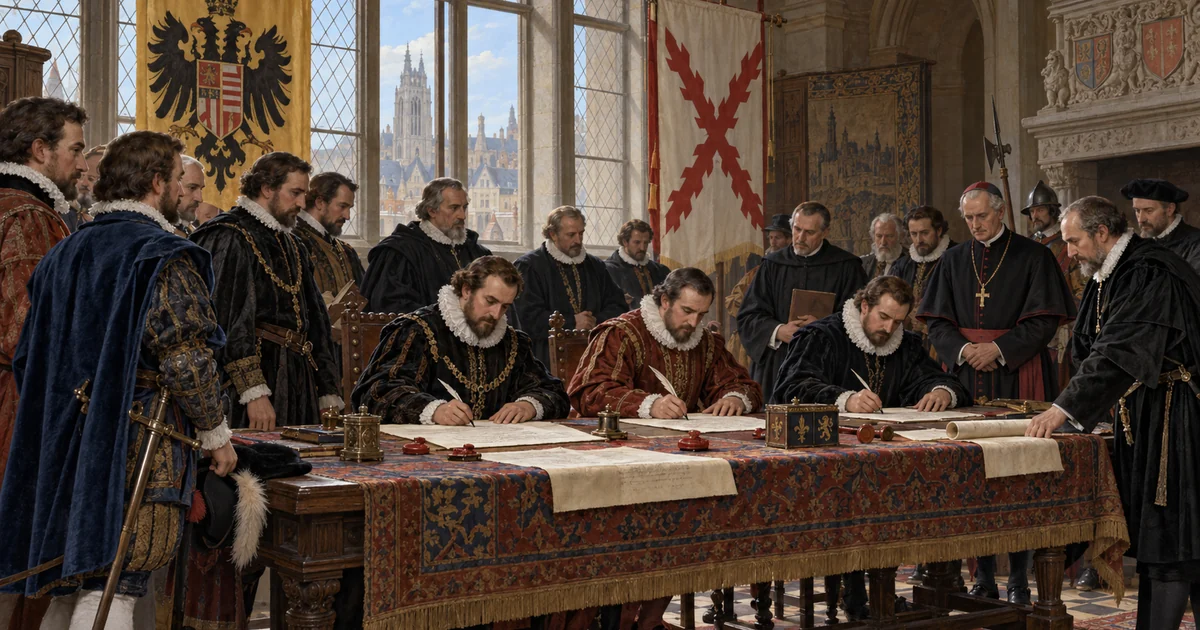
In 1579, Arras gave its name to a major political act that was to durably divide the Low Countries: the Union of Arras. While the northern provinces rose against Spanish authority, the Catholic provinces of the South, including the Artois, gathered at Arras to reaffirm their loyalty to the king of Spain and to the Catholic faith. This act, in opposition to the Union of Utrecht formed by the Protestant provinces of the North, sealed the partition of the Low Countries, foreshadowing the future separation between North and South. To understand the Union of Arras is to grasp a turning point of European history, when the town of Arras found itself at the heart of a decisive choice between revolt and loyalty, between the two camps that were tearing the Low Countries apart. A look back at this event that once again inscribed the name of Arras in the great history.
The Low Countries in revolt against Spain
To understand the Union of Arras, one must place it back in the context of the revolt of the Low Countries against Spain. In the second half of the 16th century, the provinces of the Low Countries, governed by the king of Spain, heir of Charles V, entered into rebellion. The causes of this uprising were multiple: the authoritarian and fiscal policy of Spain, the religious repression against the Protestants, and the aspiration of the provinces to preserve their liberties and privileges. This conflict, which was to last decades, opposed the insurgents to the powerful king of Spain, in a long and complex war. The Low Countries, a mosaic of provinces with diverse interests and confessions, did not form a united bloc against Spain. Deep divisions existed, notably between the northern provinces, largely won over to Protestantism and to the revolt, and the southern provinces, mostly Catholic and more attached to the established order. Arras and the Artois belonged to this Catholic South. To understand this revolt and its divisions is essential to grasping the Union of Arras: it was the response of part of the Low Countries, the Catholic South, to the radicalisation of the revolt and to the fear of seeing Protestantism triumph. In this context of civil and religious war, where the provinces had to choose their camp, Arras was to play a leading role, by hosting the act through which the Catholic South reaffirmed its loyalty, thus sealing the fracture of the Low Countries.
The Catholic South facing the Protestant North
The Union of Arras translates a confessional and political fracture within the Low Countries. On one side, the northern provinces, where Protestantism had largely taken root and where the revolt against Spain was the most radical; on the other, the southern provinces, including the Artois, remained mostly Catholic and more moderate before royal authority. This opposition between North and South, between Protestants and Catholics, between partisans of rupture and holders of loyalty, structured the conflict. The southern provinces, worried by the radical and Protestant turn the revolt was taking, feared for their Catholic faith and for the social order. They were more inclined to seek an accommodation with the king of Spain than to pursue a rebellion dominated by the Protestants of the North. It was this divergence that led to the formation of two rival unions, each expressing the choice of a camp. To understand this fracture is essential: the Union of Arras was not a mere local act, but the expression of a fundamental choice, that of the Catholic South, which preferred reconciliation with Spain to union with the revolted North. This division, of which Arras was the emblematic place, reflected the religious and political rifts of an era when faith and loyalty to the sovereign were capital stakes. It was to have lasting consequences, drawing a line of partition between the Low Countries that, under various forms, still marks the geography of north-western Europe.
| Marker | Detail |
|---|---|
| 1579 | Union of Arras of the Catholic southern provinces |
| Opposite | The Union of Utrecht of the northern provinces |
| Choice | Loyalty to the king of Spain and to Catholicism |
| Significance | The lasting partition of the Low Countries |
The act of the Union of Arras
It was at Arras that, at the beginning of the year 1579, the act of union was concluded through which the Catholic provinces of the South sealed their alliance and their loyalty. By this agreement, these provinces reaffirmed their attachment to the Catholic religion and their loyalty to the king of Spain, while seeking to preserve their privileges. The Union of Arras was at once a religious act, a political choice and a defensive alliance, in the context of the war tearing the Low Countries apart. Shortly after, the northern provinces responded with their own union, the Union of Utrecht, sealing on their side the alliance of the revolted provinces, mostly Protestant. These two acts, almost contemporary, consecrated the division of the Low Countries into two opposed camps. That the Catholic South chose Arras to conclude its union is no trifle: the town, a great city of the Artois, Catholic and faithful, was a symbolic place for such an act. The name of Arras thus found itself attached to this major event of the history of the Low Countries and of Europe. To understand the significance of this act is essential: the Union of Arras did not settle the conflict, which continued for a long time, but it acted a rupture, that between North and South, which was to prove lasting. By giving its name to this union, Arras inscribed itself, once again, in the great events of European history, as a place of decisions that far exceeded the frame of the city.
A town faithful to king and Church
The Union of Arras illustrates the attachment of Arras and the Artois to Catholicism and loyalty to the king. The town, deeply Catholic, was little inclined to follow the Protestant revolt of the North. Its population, its institutions and its clergy remained attached to the traditional faith and to the established order. This religious loyalty could be read in the daily life of the city, paced by Catholic practices and buildings, like the many churches of the town such as the Saint-Jean-Baptiste church of Arras, witnesses to the vitality of religious life in Arras. In the context of the wars of religion and the revolt of the Low Countries, this Catholic anchoring oriented the choice of the town and the region. To rally to the Union of Arras was to remain faithful to the faith of one's fathers and to the legitimate sovereign, against the revolted provinces won over to Protestantism. This choice was not only religious: it also engaged the political future of the region, which remained in the Spanish fold. To understand this loyalty allows one to grasp why Arras and the Artois sided with Spain and Catholicism. The town, by its history and its faith, was naturally drawn toward this camp. The Union of Arras was thus the expression of an identity, that of a Catholic and faithful city, which, in the turmoil of the wars of religion, reaffirmed its attachment to what constituted, for it, order and truth, even at the cost of durably separating from the northern provinces.
The birth of two Low Countries
The deepest consequence of the Union of Arras was the lasting partition of the Low Countries. By consecrating the separation between the Catholic South, faithful to Spain, and the Protestant North, in revolt, this act, with the Union of Utrecht that responded to it, drew a line of partition destined to last. The North was, at the end of a long war, to form the United Provinces, an independent Protestant state, ancestor of the present-day Netherlands. The South, including the Artois and Arras, remained under Spanish authority, Catholic, forming the Spanish Low Countries, part of which would later become Belgium. This division, one of the most important of European history, takes its source in part in the events of 1579. The Union of Arras thus marks a founding moment of the political and religious geography of north-western Europe. That this major partition bears, for one of its founding acts, the name of Arras, testifies to the role of the town in this history. To understand this significance is essential: beyond the local episode, it is the destiny of a whole region, and in time the birth of nations, that was played out. The Union of Arras recalls that the town was, at a crucial moment, an actor of the great history, a place where a division was sealed that was to durably shape Europe. This dimension gives the event an importance that far exceeds the frame of the history of Arras, inscribing it in the great narrative of the formation of European nations.
Pontus Payen, a witness of his time
Our knowledge of the troubles that agitated Arras and the Artois at this era owes much to the chroniclers who reported them. Among them, the memoirist Pontus Payen, a native of the region, left a precious testimony on the events of the 1570s, those years of troubles that preceded and accompanied the Union of Arras. His writings offer historians a contemporary's view of a troubled period, marked by religious tensions, revolts and power struggles. Like any source, these memoirs must be handled with a critical spirit: their author, engaged in his era, held a situated view, and one must make allowance for his opinions and his biases. But their documentary value is real: they allow one to reconstruct the facts, the atmosphere and the stakes of a crucial period. To resort to such testimonies is at the heart of the historian's work, who reconstructs the past from the traces it has left, weighing their reliability. To understand the Union of Arras and its context, these chronicles are irreplaceable. They recall that history is made not only of great acts, but also of the accounts of those who lived them. The testimony of Pontus Payen, by lighting up the troubles of Arras, contributes to making this period one of the best known of the history of the town, and invites one to distinguish, in these accounts, what belongs to fact and what belongs to the view of their author, in the rigour that befits the study of sources.
Toward the Spanish reconquest
The Union of Arras had a military and political sequel: the Spanish reconquest of the southern provinces. After the rallying of the Catholic provinces, Spain, served by skilful war leaders, undertook to retake control of the South of the Low Countries and to subdue the revolt. This reconquest consolidated the partition begun in 1579: the South, including the Artois and Arras, remained in the Spanish and Catholic fold, while the North pursued its march toward independence. For Arras, this meant remaining a town of the Spanish Low Countries, under the authority of the king of Spain, for long decades yet. This Spanish belonging was to last until the great sieges of the following century, which would finally tip the town into the kingdom of France. The Union of Arras thus marks the beginning of a long Spanish period for the city, a period made of loyalty to the Catholic king, but also of wars and tensions with neighbouring France. To understand this sequel allows one to place the Union of 1579 in the long term: it was not a culmination, but a stage, which fixed for a time the belonging of Arras to the Spanish world. The town, by choosing loyalty to Spain and Catholicism, engaged its destiny for several generations, until the arms of the king of France came, in the 17th century, to reopen the question and finally wrest Arras from the crown of Spain, to inscribe it durably in the French destiny.
The Union of Arras in European history
Placed back in the great history, the Union of Arras occupies a notable place. It is studied by historians of the revolt of the Low Countries and of the wars of religion as one of the major acts of this period, the one that consecrated the scission between North and South. Its importance far exceeds the local frame: it lights up the mechanisms of the confessional and political fracture that divided the Low Countries and, beyond, the Europe of the Reformation. For Arras, to have given its name to this act is a striking fact, which inscribes the town in the great events of the history of the continent, like the treaty that, a century earlier, had already mixed the city in European affairs, as the Treaty of Arras of 1482 recalls. The town appears decidedly as a recurrent place of great decisions, a name that returns in the history of treaties, unions and congresses. To understand the Union of Arras in this perspective allows one to measure the eminent place the city held in the great history, far beyond its apparent importance. To make this episode known is to do justice to the role of Arras and to recall that this town of the North was, several times, the stage of decisive acts for Europe. The Union of Arras of 1579, by sealing the partition of the Low Countries, is one of those moments when the name of the town was durably inscribed in the history of the continent, as the place of a choice with immense and lasting consequences.