
Joseph Le Bon: how did the Terror fall upon Arras in 1793-1794?
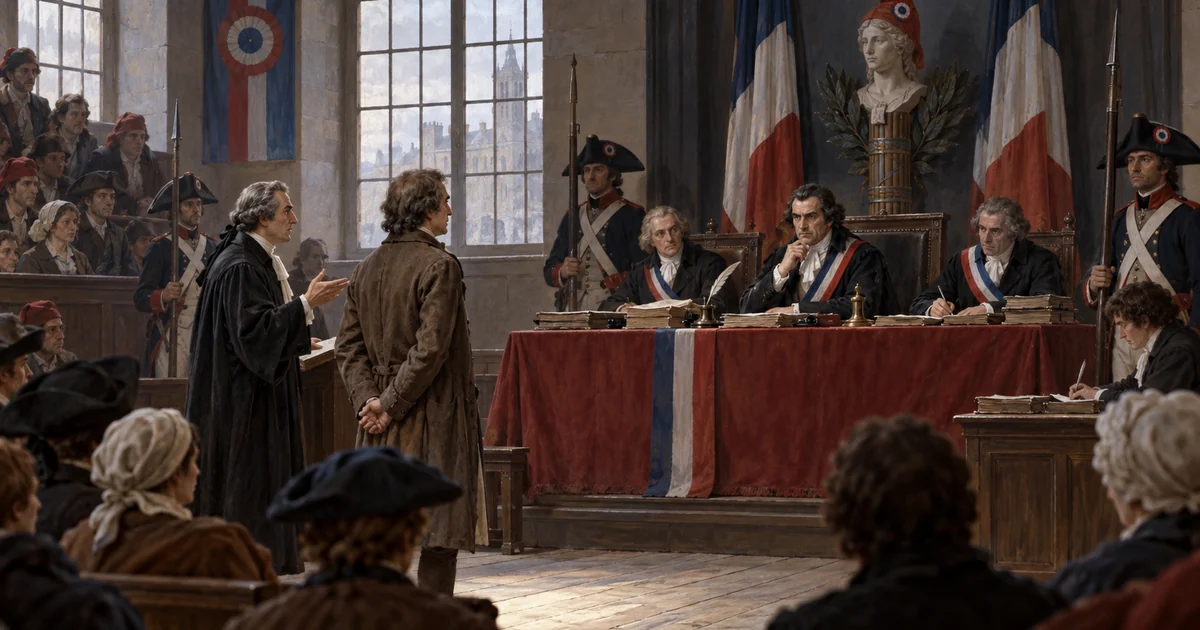
Among the figures that the French Revolution left in the memory of Arras, that of Joseph Le Bon is one of the darkest. A child of the region become a representative of revolutionary power, he was the man of the Terror in the Artois, associated with the executions that bloodied the town in 1793 and 1794. His memory remains heavy and controversial, between personal responsibility and the context of an era of civil war and radicalisation. A look back, with the necessary distance and rigour, at this painful episode of the history of Arras and at the character who embodied it.
A child of Arras in the Revolution
Joseph Le Bon was born in Arras in 1765, in the context of a provincial town of the ending Ancien Régime. Like other Arras figures of the Revolution, he was a child of the region, formed within the framework of his native city before events carried him to the forefront of the scene. Destined first for the ecclesiastical career, he received a religious education and entered orders, becoming a priest. Nothing, in these beginnings, foretold the role he was to hold. When the Revolution broke out, Le Bon, like part of the clergy, adhered to the new ideas and rallied to the movement. This rallying of a man of the Church to the Revolution was nothing exceptional: many priests, seduced by the ideals of regeneration and justice, embraced the revolutionary cause, sometimes to the point of abandoning their state. The path of Le Bon, from priesthood to political commitment, illustrates the upheavals that the Revolution imposed on individual destinies. Rooted in Arras, he found there the ground of his political rise, carried by the whirlwind of events. To understand the Arras origins of Joseph Le Bon allows one to grasp how an ordinary man, shaped by his town and his era, could find himself, in a few years, invested with considerable powers and associated with the most tragic hours of local history. His history is inseparable from that of Arras during the Revolution, of which he became, for the worse, one of the marking figures. It is within the framework of his native town that the essential of his destiny was played out, making him a character deeply linked to the history of Arras of this troubled period.
From priest to Montagnard
The path of Joseph Le Bon during the Revolution was that of a progressive radicalisation. A priest rallied to the new ideas, he embraced the revolutionary cause with conviction and engaged in local political life. He gradually abandoned his ecclesiastical state to devote himself entirely to public action, espousing the most advanced positions of the revolutionary movement. He ranged himself on the side of the Montagnards, the most radical faction of the Convention, partisans of energetic measures to defend the threatened Revolution. This evolution led him to occupy functions more and more important, both at Arras and at the national level. He was elected to the National Convention, the assembly that then directed France, and made himself known by his resolute commitment. The context of the era explains in part this radicalisation: revolutionary France, at war against the foreign powers and torn by interior conflicts, lived under the sign of threat and fear. Facing the peril, the most determined revolutionaries advocated exceptional measures to save the Revolution. Le Bon belonged fully to this logic, becoming one of the artisans of the policy of firmness in his region. His passage from priesthood to Montagnard militancy illustrates the trajectory of certain men whom the Revolution transformed radically, carrying them from religious vocation to the most intransigent political commitment. This metamorphosis, characteristic of the upheavals of the era, prepared the role he was to hold when he was invested with considerable powers in the Artois, at the height of the revolutionary period.

The mayor and the representative on mission
The rise of Joseph Le Bon led him to exercise leading functions in Arras and its region. He was notably mayor of the town, then, above all, invested by the Convention with the function of representative on mission. This role, proper to the revolutionary period, conferred on the one who held it considerable powers. The representatives on mission were deputies sent by the Convention into the departments and to the armies to have the policy of the revolutionary government applied there, with a quasi-unlimited authority. Charged with surveillance and repression in the Nord and the Pas-de-Calais, notably at Arras and Cambrai, Le Bon thus disposed of an immense power over his native region. This accumulation of responsibilities made him the strong man of revolutionary Artois, charged with tracking the supposed enemies of the Revolution and watching over the security of the territory in a context of war and generalised suspicion. The context, as the history of Robespierre in Arras and of his generation recalls, was that of a France in danger, where the central power demanded firmness and vigilance. Invested with the confidence of the Convention, Le Bon exercised his authority with a rigour that was to mark minds durably. To understand the extent of his powers is essential to grasp what followed: it is because he concentrated in his hands a considerable authority that Le Bon could play the role that was his during the Terror in Arras. His case illustrates the functioning of revolutionary power in the province, where men invested with extraordinary missions exercised, in the name of the Convention, an authority out of all proportion with ordinary functions.
The Terror in Arras
It is under the authority of Joseph Le Bon that the Terror fell upon Arras, in 1793 and 1794. During this period, the town was the theatre of a severe repression, marked by the installation of the guillotine and by numerous executions. A revolutionary tribunal judged the persons accused of being enemies of the Revolution, and the death sentences were numerous. The central square of the town, today a place of walking and conviviality, was then the theatre of these public executions, in an atmosphere of fear and tragedy. The Terror in Arras belonged to the national framework of this policy of exception put in place by the Convention to defend the Revolution, but it took on, under the authority of Le Bon, a particular intensity that durably struck the local memory. The victims belonged to various milieus: nobles, religious, bourgeois, but also common people, accused of plot, treason or hostility to the Revolution. This repression, exercised in the name of public safety, made Arras one of the provincial towns most marked by the Terror. It is fitting to evoke this episode with gravity and without complacency: it is a dark period, made of real sufferings and deaths, whose memory remains painful. Without yielding to the dark legend nor to trivialisation, the historian strives to understand the mechanisms of this violence, its context and its responsibilities. The Terror in Arras remains, whatever the case, one of the most tragic episodes of the history of the town, associated forever with the name of Joseph Le Bon, who was its principal local architect.
A power without sharing
During the months of the Terror, Joseph Le Bon exercised over Arras and its region a power without sharing. Invested by the Convention with extraordinary powers, he concentrated in his hands the political, administrative and judicial authority, in a context where the ordinary guarantees were suspended in the name of public safety. The revolutionary tribunal, charged with judging the supposed enemies of the Revolution, functioned under his influence, and its decisions were without appeal. This concentration of power, characteristic of the period, placed the fate of numerous persons in the hands of a single man and of the repressive apparatus he directed. Suspicion reigned, and the accusation could suffice to condemn. This climate of fear and arbitrariness, proper to the most intense moments of the Terror, transformed the life of the city and weighed on the whole population. The power of Le Bon rested on the confidence that the revolutionary government accorded him and on the logic of exception that then prevailed. He acted in the name of the Convention and of the defence of the Revolution, in a legal framework certainly, but marked by the suspension of the usual liberties and protections. To understand this power without sharing is indispensable to grasp the mechanics of the Terror in Arras: it is the concentration of a considerable authority in the hands of one man, in a context of fear and war, that made possible the scale of the repression. This reality poses the question, debated by historians, of the respective part of circumstances and of personal responsibility in the unfolding of these tragic events, an essential question to understand this period and the role that Joseph Le Bon played in it.
| Marker | Detail |
|---|---|
| Birth | Arras, 1765, former priest |
| Commitment | Montagnard, deputy to the Convention |
| Function | Representative on mission in the Artois |
| 1793-1794 | The Terror and the executions in Arras |
Zeal and responsibility: the debate of historians
The figure of Joseph Le Bon raises a question that has long divided historians: that of the respective part of personal zeal and of circumstances in the unfolding of the Terror in Arras. Should one see in Le Bon a man animated by a cruelty of his own, a fanatic responsible for the excesses of the repression? Or an agent of revolutionary power, applying with rigour a policy decided at the top, in a context of war and national peril? The answer is not simple, and historians guard against hasty judgments. On the one hand, it is undeniable that Le Bon exercised his power with an extreme firmness and that he bears a personal responsibility in the events. On the other, one must place his action in the general framework of the Terror, a national policy decided by the Convention in the face of the threats that weighed on the Revolution. The debate thus bears on the measure in which Le Bon showed an initiative of his own or contented himself with applying the orders received. This question, far from being a simple quarrel of scholars, touches on the very understanding of the Terror and of individual responsibilities in periods of collective violence. Historians strive to go beyond the dark legend, which makes of Le Bon an isolated monster, as well as the easy excuse that would dissolve all responsibility in the context. The truth, complex, lies doubtless in the taking into account both of the context and of the personal part of the man. To approach this question with rigour and nuance is essential to understand this episode without distorting it, neither in the sense of demonisation, nor in that of trivialisation. It is at this price that one can restore, with honesty, the reality of a tragic period and the role that Joseph Le Bon played in it.
The fall and the trial
The destiny of Joseph Le Bon tipped with the fall of Robespierre, during the day of Thermidor, in July 1794. The end of the Terror and the overthrow of the Montagnards marked the beginning of the reaction against the men who had embodied the policy of exception. Le Bon, associated with the excesses of the repression in the Artois, was quickly called into question. Arrested, he was brought to justice to answer for his action during the Terror. His trial, which was held after Thermidor, was the occasion for an examination of the events that had occurred in Arras and Cambrai under his authority. Accused of having abused his powers and of being responsible for the executions, Le Bon was condemned to death and executed in 1795. Thus, the one who had presided over the Terror in his region knew in turn the fate he had inflicted on so many others, victim of the political reversal that followed the fall of the Montagnards. His trial and his execution belonged to the wider movement of the Thermidorian reaction, which sought to settle the accounts of the Terror and to designate those responsible for it. The case of Le Bon was emblematic of this settling of accounts, making him one of the scapegoats of the revolutionary period. His tragic end closes a path marked by the violence of the era, from priesthood to the scaffold. The execution of Joseph Le Bon put an end to the career of one of the most feared men of revolutionary Artois, and closed one of the darkest chapters of the history of Arras during the Revolution.
Memory of a dark period
The memory of Joseph Le Bon and of the Terror in Arras remains, even today, heavy and sensitive. This episode counts among the most painful of the history of the town, associated with the suffering and death of numerous persons. It recalls that the Revolution, bearer of ideals of liberty and justice, also knew tragic hours, when violence and arbitrariness fell upon the populations. Arras, like other towns, bears the trace of this period, whose memory invites reflection. To evoke the Terror and the role of Le Bon belongs neither to complacency nor to forgetting: it is a matter of looking in the face a difficult past, with the lucidity and honesty that history requires. The very places of the town bear the memory of these events. The central square, heart of the city that one knows today as the Place des Héros, was the theatre of the executions, and its history keeps the trace of this tragic past. Likewise, the former seat of municipal power, around the belfry and the town hall, recalls the institutional framework in which revolutionary authority was exercised. To remember this dark period is to honour the memory of the victims and to understand the mechanisms that made such violence possible, so as not to forget them. The history of Joseph Le Bon and of the Terror in Arras, however painful it may be, is an integral part of the past of the town. To look at it with gravity, without disguising it, is a duty of memory and a requirement of truth, which allows one to measure all the complexity and all the tragedy of the revolutionary period in a provincial town like Arras.