
Robespierre lawyer in Arras: who was the man before the Revolution?

Before being the controversial figure of the French Revolution, Maximilien Robespierre was, for nearly ten years, a lawyer in Arras, a child of the region, trained and settled in his native town. Born in Arras in 1758, he spent his youth there, made his first steps at the bar there and led there a life of a man of letters and provincial notable, far from the national destiny that awaited him. These Arras years, often eclipsed by the rest of his career, are nonetheless essential to understand the man and his formation. A look back at the Robespierre from before the Revolution, the lawyer of the Enlightenment attached to his town of Arras.
A child of Arras
Maximilien de Robespierre was born in Arras on 6 May 1758, into a family of the petty bourgeoisie linked to the world of law. His childhood was marked by family misfortune: the early death of his mother, then the departure of his father, left the young Maximilien and his brother and sisters orphans, taken in and raised by their kin. This early ordeal deeply marked his personality, forging a grave, diligent and determined character. A gifted pupil, he distinguished himself very early by his seriousness and his aptitudes, which earned him brilliant studies. The Arras childhood of Robespierre took place in a peaceful and prosperous provincial town, that of the century of the Enlightenment, where a cultivated elite cultivated arts, letters and knowledge. It is in this setting that he grew up, imbued with the values and culture of his time and his milieu. The ordeals he crossed in his youth, the loss of his parents and the responsibility that weighed early on his shoulders doubtless contributed to shaping his sense of duty and his austerity. To understand the Arras origins of Robespierre is to grasp the roots of a man deeply marked by his town and by the circumstances of his childhood. Arras was not only his birthplace: it was the setting of his formation, the theatre of his first years and the starting point of a path that would lead him to the heart of the Revolution. This Arras rootedness, often neglected, is nonetheless one of the keys to understanding the character.
Studies at Louis-le-Grand
The talent of the young Robespierre opened for him the doors of an exceptional education. After his first studies at the college of Arras, he obtained a scholarship that allowed him to continue his schooling in Paris, at the prestigious college of Louis-le-Grand, one of the best establishments of the kingdom. There, he received a solid classical formation, nourished by the ancient authors, by law and by the philosophy of the Enlightenment. A brilliant and hardworking pupil, he made himself noticed by his capacities and his application. These Parisian years were decisive for his intellectual formation: he acquired there an extended culture, a taste for eloquence and a familiarity with the great ideas of the century, those of the philosophers who were to nourish his political thought. Rousseau, in particular, exercised on him a profound influence. After completing his studies and obtaining his law titles, Robespierre made the choice to return to his native town, rather than trying his luck in Paris. This return to Arras, around 1781, marked the beginning of his career as a lawyer and of his adult life in the city that had seen him born. The choice to return to the province was significant: it testified to an attachment to his origins and a will to establish himself in the familiar setting of his town. Arras offered this educated and ambitious young man a favourable ground for the practice of law and for insertion into local society. It is therefore rich with an elite formation but faithful to his roots that Robespierre began, in his native town, the career that would make him one of the most prominent lawyers of the Artois, before the Revolution upheaved his destiny.
The lawyer at the Council of Artois
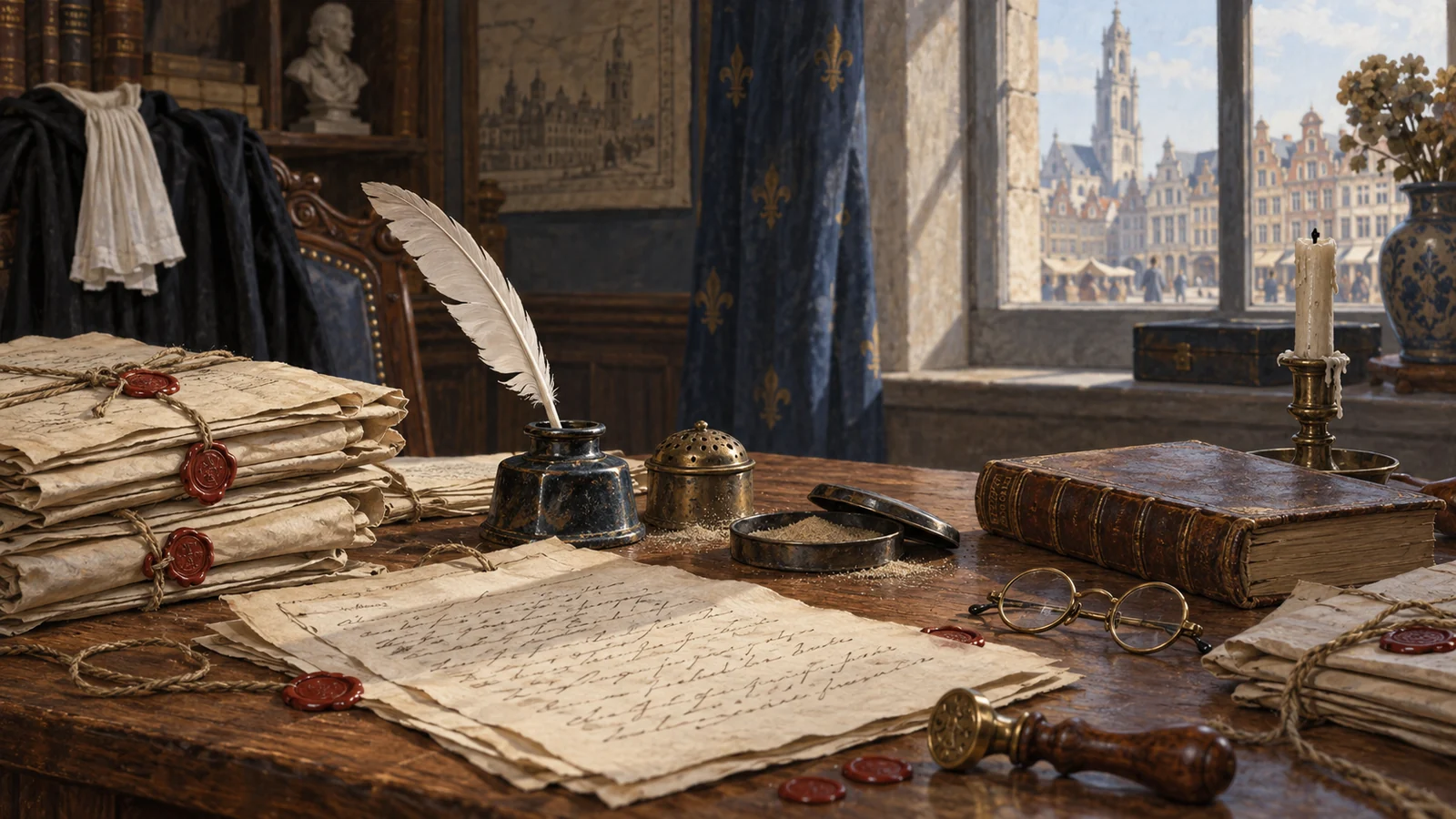
On his return to Arras, Robespierre enrolled at the bar and became a lawyer at the Council of Artois, the principal jurisdiction of the province. He practised his profession with seriousness and conviction, gradually forging a reputation in the local judicial world. His practice of law was not only a livelihood activity: it reflected deep convictions and a keen sense of justice. Robespierre showed himself sensitive to the defence of the weakest and attentive to the causes that touched on equity and the rights of persons. He pleaded in various cases, putting his eloquence and his knowledge of law at the service of his clients. His activity as a lawyer allowed him to insert himself into Arras society and to acquire a local notoriety. It was also the occasion to put into practice the ideas of justice and reform with which he was imbued, in the concrete framework of judicial affairs. The young lawyer distinguished himself by his application and by the sometimes moral or philosophical dimension he gave to his pleas, going beyond the simple technical framework of law. This way of practising the profession already announced the man preoccupied with justice and principles that he was to become. The years spent at the bar of Arras were thus a period of maturation, where Robespierre refined his convictions and his talents, while leading the life of a provincial notable. His activity as a lawyer, placed in the context of the ending Ancien Régime, testifies to a serious man, engaged in his profession and already inclined towards the great questions of justice that were to dominate his future action. This judicial experience constituted an essential apprenticeship, forming the orator and defender of causes that he would remain throughout his career.
The lightning-rod affair
Among the cases that Robespierre pleaded in Arras, one has remained famous: the lightning-rod affair, judged at the beginning of the 1780s. An inhabitant of the region had installed on his house a lightning rod, a recent invention that still aroused mistrust and hostility. His neighbours, worried or incredulous, demanded the removal of this device that they judged dangerous. Robespierre took up the defence of the owner of the lightning rod and pleaded in favour of science and reason against prejudice and obscurantism. He won the case, contributing to having the right to install this useful invention recognised. This affair, beyond its concrete stake, takes on a symbolic value: it shows the young lawyer defending the progress of science and the lights of reason in the face of irrational fears. It illustrates the spirit of the time, that of the Enlightenment, enamoured of science, progress and rationality. For Robespierre, this trial was an occasion to make himself known and to assert his convictions. The lightning-rod affair earned him a certain notoriety and testifies to his commitment in favour of new ideas. It is often cited by historians, notably Hervé Leuwers in his reference biography, as a revealing episode of the personality of the young lawyer and of his adherence to the values of the Enlightenment. This cause, which united the defence of a private individual and that of a principle, corresponded perfectly to the way in which Robespierre conceived his profession: to put law at the service of justice and progress. The lightning-rod affair thus remains one of the most striking episodes of his Arras career, symbol of a lawyer who wished to be a defender of reason and of the ideas of his century.
| Marker | Detail |
|---|---|
| Birth | Arras, 6 May 1758 |
| Studies | College of Arras, then Louis-le-Grand in Paris |
| Profession | Lawyer at the Council of Artois (around 1781) |
| Famous case | The lightning rod, reason against prejudice |
A lawyer of the Enlightenment
Robespierre was not only a practitioner of law: he was a true lawyer of the Enlightenment, committed in favour of the ideas of justice, reform and progress that animated his century. Nourished by the philosophy of his time, imbued with the thought of Rousseau, he conceived law and justice as instruments in the service of equity and the common good. This intellectual and moral dimension imbued his practice of the profession and distinguished him from a simple man of law. He took interest in the great questions of his era, took part in the intellectual life of the town, notably within the Academy of Arras, and wrote, reflecting on the means of reforming society and improving the lot of men. His pleas and his writings testify to a constant preoccupation with justice and with the defence of principles. Robespierre thus embodied the figure of the enlightened lawyer, anxious not only to win his cases, but to serve just causes and to contribute, in his measure, to the progress of society. This intellectual and moral commitment, anchored in the values of the Enlightenment, prefigured the politician he was to become. The Arras years were, in this respect, a period of formation and ripening of his thought, where the convictions that were to guide his revolutionary action were forged. It would however be anachronistic to read these years in the sole light of what followed: at Arras, Robespierre was a cultivated and ambitious lawyer, engaged in the life of his town, of whom nothing yet foretold the national role. This lawyer of the Enlightenment, attached to his province and his ideals, belonged fully to the world of the ending Ancien Régime, that of an enlightened provincial elite of which he was one of the most gifted representatives.
Robespierre in Arras society
Like every cultivated notable of his time, Robespierre took part in the social and intellectual life of Arras. He frequented the circles and societies that animated the cultural life of the city, testifying to his insertion into the local elite. He was thus a member of the Academy of Arras, of which he even became the director in 1786, a sign of the recognition he enjoyed among the scholars and men of letters of the town. He took part in the works of this learned company, reading discourses and memoirs before his colleagues. He was also received, in 1787, among the Rosati, the amiable poetic society that celebrated the rose, wine and friendship, and the memory is kept of the light verse he composed there. This membership in the cultivated circles of Arras reveals an unknown aspect of the character: that of a man of letters, enamoured of poetry and sociability, quite different from the austere image that posterity has retained. The young lawyer thus led the life of a cultivated provincial notable, sharing his time between his profession, his intellectual activities and worldly sociability. This insertion into Arras society testifies to his success and his local recognition before the Revolution. It also shows a Robespierre inserted into his milieu, taking part in the pleasures and activities of the elite of his town. This contrast between the young Arras man of letters and the future revolutionary tribune never ceases to strike historians, who see there one of the most interesting aspects of his biography. The Arras years thus deliver to us a different Robespierre, anchored in the cultural and social life of his province, before the Revolution propelled him onto the national scene.
The deputy of 1789
The year 1789 marked a decisive turning point in the life of Robespierre and put an end to his Arras years. Convened by the king, the Estates-General were to gather the representatives of the three orders of the kingdom to try to resolve the crisis. Robespierre stood as a candidate and was elected deputy of the Third Estate of the Artois. This election made him pass from the provincial scene to the national scene, leaving Arras for Versailles then Paris, where the Revolution was to be played out. This departure marked the end of his Arras life and the beginning of his national political career, the one that was to make him one of the major and most controversial figures of the French Revolution. The provincial lawyer, the Arras man of letters, gave way to the politician, engaged in the great struggles of his time. His election of 1789 testifies to the confidence that his fellow citizens accorded him and to the reputation he had forged in his province. It is strong with his experience as a lawyer, his culture and his convictions that Robespierre approached the great theatre of the Revolution. The Arras years thus constituted the base of his formation, the period during which the man, his ideas and his talents were forged. In leaving Arras, Robespierre turned a page of his life, but carried with him all that his town and his province had given him: a formation, convictions and an experience that were to nourish his action. The deputy of 1789 was the fruit of the Arras years, even if the national destiny that awaited him was to lead him far from the peaceful life of a provincial lawyer that he had led until then in his native town.
Arras and the memory of Robespierre
The memory of Robespierre in Arras is, as everywhere, complex and divided, in the image of the controversial figure he remains in the history of France. A child of the region become one of the principal actors of the Revolution, associated with the period of the Terror, Robespierre arouses contrasting judgments, between those who see in him an intransigent defender of revolutionary principles and those who reproach him for the excesses of his action. This ambivalence is found in the way in which his native town keeps his memory. Arras does not erase this famous son, but composes with a delicate memory, where attachment to a child of the region mingles with awareness of the controversies that surround his name. The house where he lived, which one can discover by visiting Robespierre's birthplace, constitutes one of the material testimonies of his Arras presence and a place of memory for visitors interested in this historical character. Through this heritage, the town preserves the trace of its Arras years, those from before the glory and the controversy. To rediscover the Robespierre of Arras, the lawyer of the Enlightenment and the provincial man of letters, allows one to enrich and nuance the image often reduced to the sole revolutionary period. It invites one to consider the man in all his complexity, from his Arras roots to his national destiny. The memory of Robespierre in Arras thus recalls that history is made of men whose path always begins somewhere, in a town, a family and an era, and that to understand these origins is essential to grasp the figures who marked their time, whatever the way in which posterity judges them.