
The Rosati of Arras: who were these poets of the rose and friendship in the century of the Enlightenment?
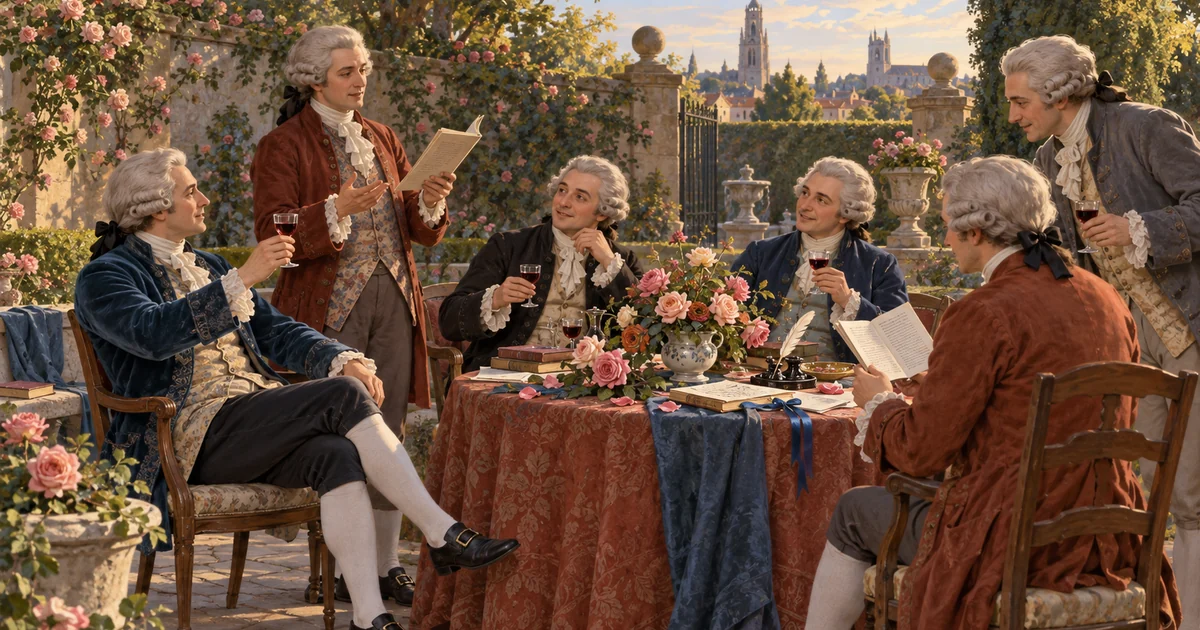
In the last years of the Ancien Régime, Arras saw the flourishing of a pleasant society of poets and friends gathered under a charming name: the Rosati. Celebrating the rose, wine and friendship in the light and refined spirit of the century of the Enlightenment, this literary circle founded in 1778 in a suburb of the town was to know an unexpected posterity, for it counted among its members two men whom the Revolution would make famous: Maximilien Robespierre and Lazare Carnot. A look back at this Arras society where poetry and conviviality served as the rule, and whose memory remains alive in the town.
A society of poetry and friendship
The Rosati were founded in 1778, at Blangy, a suburb of Arras, by a small circle of cultivated young people, enamoured of poetry and good company. This society pursued no scholarly or political goal: it wished above all to be a place of conviviality, where one gathered to read verse, sing, drink in moderation and cultivate friendship in an atmosphere of refined gaiety. It belonged to a fashion very widespread in the eighteenth century, that of societies of pleasure and literary circles where the sociability of the Enlightenment found expression, far from the gravity of official academies. The Rosati cultivated a particular poetic genre, light and graceful, inherited from the Anacreontic tradition: one sang there of the simple pleasures of existence, the rose, wine, love and friendship, in a playful and smiling tone. Far from the great philosophical debates of the time, the society placed itself under the sign of the amiable and the pleasant. Its members gathered regularly to share the fruit of their muses, compose epistles, songs and madrigals, and taste together the sweetnesses of the table and conversation. This lettered conviviality, typical of the enlightened provincial spirit, made of the Rosati a little republic of letters on the scale of Arras, where young talents practised poetry in an atmosphere of joyous brotherhood. This heritage prolonged, in its way, a long tradition of literary sociability of which Arras had given the example from the Middle Ages with the Puy of Arras.
Rosati, the anagram of Artois
The very name of the society conceals a play on words characteristic of the taste of the era: « Rosati » is an anagram of Artois, the province of which Arras was the capital. By rearranging the letters of the name of their country, the founders affirmed both their local rootedness and their inclination for the rose, whose name can be guessed in that of the society. This choice was nothing trivial: it condensed the spirit of the group, mingling love of the land, cult of the flower and taste for the literary game. The Rosati were therefore, literally, the poetic children of the Artois, transfiguring the name of their province into a floral and convivial emblem. This onomastic find illustrates marvellously the spirit of the time, when ingenious mottoes, rebuses and letter games were prized. The name quickly became a recognisable symbol, associated with a way of being and living: that of a cultivated youth which, in a provincial town, sought to combine the pleasure of verse with the joys of friendship. Far from being a simple label, the anagram founded the very identity of the society and gave it that particular charm that still distinguishes it today in the memory of Arras. It also testifies to the attachment of the Rosati to their region, of which they made the poetic heart of their name, as if to signify that the sweetness of living and literary talent could flourish as well at Arras as in the salons of the capital.
The cult of the rose and wine
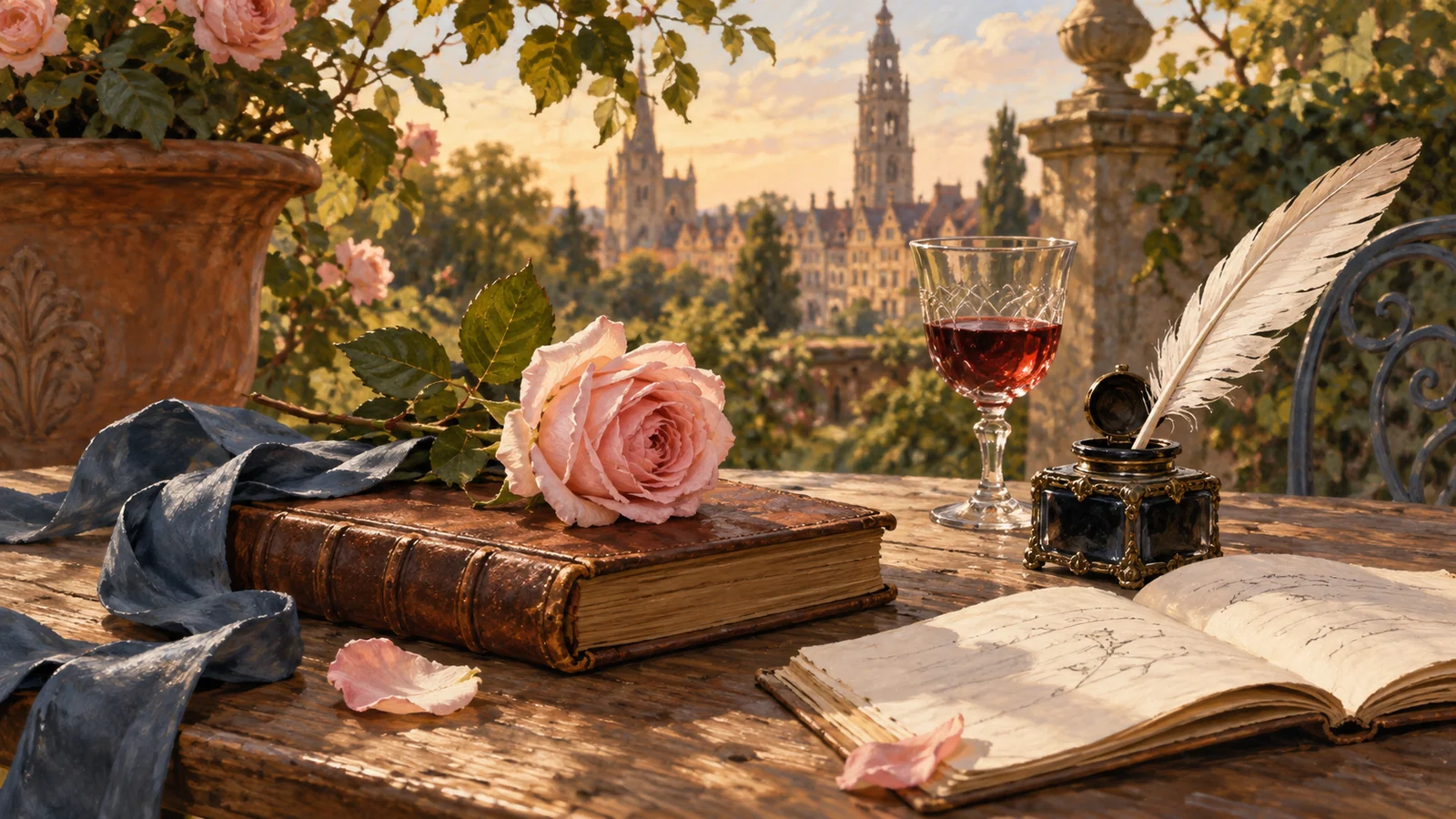
The Rosati owed their charm to a set of rites and symbols marked by grace and lightness. At the heart of their imagination sat the rose, flower of love and fleeting beauty, associated with wine and friendship as the three cardinal pleasures of the society. Tradition relates that the reception of a new member was accompanied by a delicate ceremonial: the recipient smelled a rose, drank a glass of rosé wine and received the embrace of his new brethren, thus sealing his entry into the joyous company. This ritual, at once simple and poetic, summed up all the spirit of the Rosati: to celebrate the innocent pleasures of existence, the flower, wine and brotherhood, in an amiable communion. The poetry of the Rosati tirelessly sang these themes, in a playful and graceful vein that echoed the fêtes galantes and the art of living of the eighteenth century. One composed there verse on the ephemeral rose, on the pleasures of the table, on the charms of friendship and the sweetnesses of provincial life. This cult of the rose and wine had nothing debauched about it: it was a matter of a polished conviviality, of a measured and lettered epicureanism, where wit and good taste tempered pleasures. The Rosati thus embodied an art of living where poetry was not separated from existence, but on the contrary celebrated its sweetest moments, in the chosen circle of friends gathered around the flower and wine.
Robespierre and Carnot among the Rosati
The posterity of the Rosati owes much to two names that the Revolution was to make illustrious and who, as young men, frequented the Arras society. Maximilien Robespierre, a lawyer at Arras, was received Rosati in 1787, and the memory is kept of the light verse he then composed, far from the austere tribune he would become a few years later. The future Incorruptible too sacrificed, for a time, to gallant poetry and to the conviviality of the Rosati, which historians, notably Hervé Leuwers in his reference biography, note as a revealing trait of his Arras youth. Lazare Carnot, the future « Organiser of Victory » of the revolutionary armies, also counted among the members of the society and gave poems there. This neighbouring, in the same poetic circle, of two men called to play a major role in the Revolution, confers on the Rosati a particular aura. It recalls that these figures, before becoming actors of History, were young cultivated provincials, enamoured of belles-lettres and sociability. It would however be anachronistic to see there a revolutionary hearth: the Rosati were a society of pleasure, not a political club, and nothing in their statutes or their activities prefigured the upheavals to come. It is the chance of destinies that gathered these names there, and it is the Revolution that, retrospectively, gave to this membership a singular relief. It remains no less true that the image of the young Robespierre inhaling a rose and drinking a glass of rosé wine among the Rosati offers a striking contrast with the dark legend of the man of the Terror.
The spirit of the Enlightenment at Arras
The Rosati are only fully understood when placed back in the context of the Arras of the Enlightenment, a provincial town animated by an intellectual and social life richer than one imagines. In the eighteenth century, Arras was not a sleepy city: it possessed its circles, its learned societies, its lovers of arts and letters, and an enlightened bourgeoisie eager for culture and sociability. The Rosati took part in this movement, alongside more serious institutions such as the Academy of Arras, founded a few years earlier and devoted to the study and progress of knowledge. Where the Academy cultivated learning, the Rosati cultivated pleasure; but both answered the same desire for a life of the mind, characteristic of enlightened French province, prolonging the role of Arras literary capital asserted from the Middle Ages. This effervescence testifies to the diffusion of the ideas and tastes of the Enlightenment well beyond Paris, into the medium-sized towns of the kingdom. Arras, capital of a rich province, offered its cultivated youth a favourable ground for the flourishing of these new sociabilities. The Rosati, with their light poetry and their chosen conviviality, were one of its most endearing expressions. They embody this provincial sweetness of living from before the Revolution, this moment when, in a town like Arras, young talents could gather to celebrate, in verse and music, the pleasures of friendship and beauty. It is a whole world, that of the ending Ancien Régime, that the memory of this amiable society resurrects.
| Marker | Detail |
|---|---|
| Foundation | 1778, at Blangy near Arras |
| The name | « Rosati », anagram of Artois |
| Symbols | The rose, rosé wine, friendship |
| Famous members | Robespierre (1787), Lazare Carnot |
The Revolution and the end of the Rosati
The sweet insouciance of the Rosati did not resist the revolutionary turmoil. With the upheavals of 1789 and the following years, poetic games and convivial gatherings were no longer in season. The society scattered, carried away by the whirlwind of events that mobilised all energies and radically transformed public and private life. Several of its members threw themselves into political action, beginning with Robespierre and Carnot, whose destinies tipped into the national arena. The time was no longer for gallant verse on the rose and wine, but for fiery speeches, grave decisions and combats. The Revolution thus put a brutal end to the existence of this society of pleasure, as it upheaved so many institutions and ways of living inherited from the Ancien Régime. The Rosati, symbols of an insouciant and refined sociability, now belonged to a vanished world. Their disappearance marks the end of an era, that of provincial sweetness of living from before the storm. There is something poignant in this contrast between the amiable society of 1778, where young people celebrated friendship by inhaling roses, and the tragic destiny that the Revolution reserved for some of them. The memory of the Rosati, long eclipsed by the din of events, was to resurface only much later, when time had appeased the passions and allowed one to look with nostalgia at this moment of grace of the Arras of the Enlightenment.
The rebirth of the Rosati
The history of the Rosati did not end with the Revolution. Over the course of the nineteenth century, the memory of the amiable Arras society aroused a renewed interest, and several attempts saw the light of day to revive the spirit of the Rosati. The end of the century saw reborn, in Paris and in the Artois, societies claiming the heritage of the founders of 1778, perpetuating the cult of the rose, wine and friendship, as well as the taste for light poetry and conviviality. This rebirth testifies to the lasting charm exerted by the model of the Rosati, become a sort of ideal of lettered and joyous sociability. The modern Rosati, while drawing inspiration from their predecessors, adapted the tradition to their era, but preserved the essential: the celebration of the pleasures of the mind and friendship, under the sign of the emblematic flower. This continuity, beyond the revolutionary rupture, shows to what extent the spirit of the Rosati had known how to mark memories. The name, the anagram, the symbols and the ritual thus crossed the generations, making of the Rosati much more than a historical curiosity: a true tradition, renewed from age to age. Even today, the heritage of the Rosati endures under various forms, keeping alive the memory of this society born at Arras in the century of the Enlightenment and become, over time, an emblem of poetic conviviality attached to the town and its province.
The Rosati in the memory of Arras
At Arras, the memory of the Rosati has remained alive and is inscribed today in the very landscape of the town. A park bears their name, keeping the memory of this society that made the rose its emblem, and offering to walkers a green setting where still floats, symbolically, the perfume of the flower dear to the poets of 1778. This place, like other green spaces of Arras that one can discover among the parks and gardens of Arras, recalls that the town has not forgotten its Rosati. Their history belongs to the long literary and cultural tradition of Arras, which, from the Middle Ages to the century of the Enlightenment, always knew how to make a place for poetry and the sociability of letters. The Rosati also offer a precious counterpoint to the image one sometimes forms of Arras, a town of grave history and tragic destinies: they recall that before the Revolution, the city also knew the lightness, gaiety and refinement of a cultivated youth. To rediscover the Rosati is to find again this amiable and smiling face of the Arras of former times, where one celebrated the rose, wine and friendship in an atmosphere of poetic brotherhood. It is also to measure the richness of an intangible heritage that is read not only in monuments, but in these societies, these traditions and these memories that make the soul of a town and transmit, from generation to generation, its living memory.