
Arras, literary capital: why did the town reign over poetry in the 13th century?
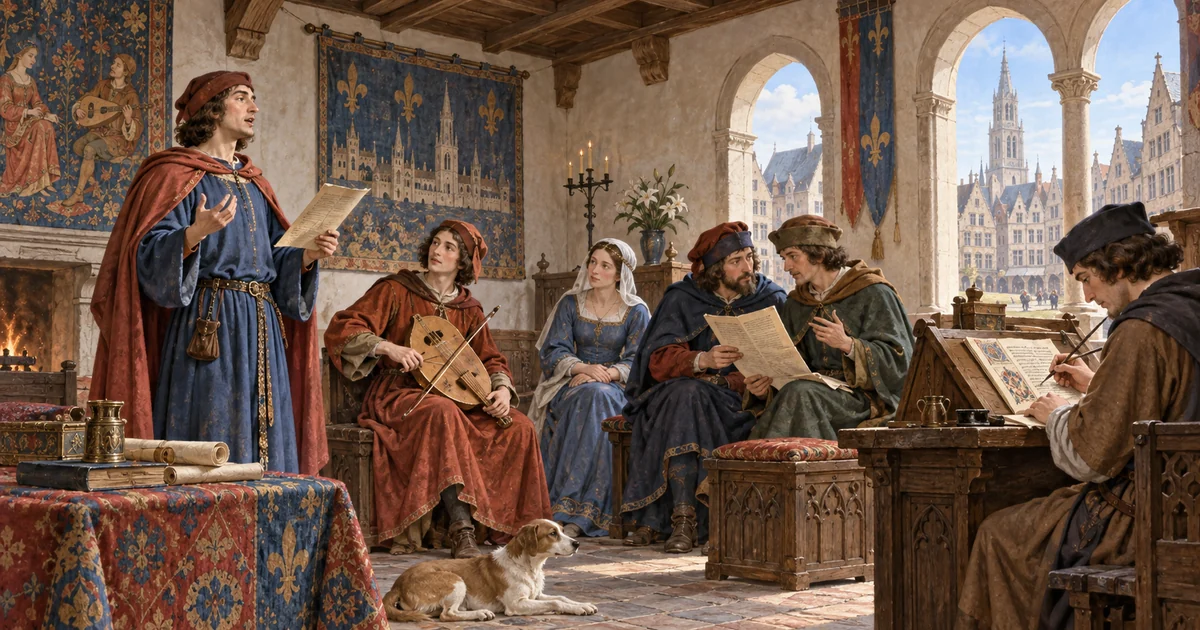
It is too often forgotten, but in the 13th century, Arras was the literary capital of the French-speaking world, the greatest poetic centre of its time. No other town then concentrated so many poets, musicians and playwrights, nor produced a body of work so abundant and varied. This phenomenon, exceptional in the history of letters, owes nothing to chance: it is the fruit of a rich, open town endowed with institutions favourable to creation. From Jean Bodel to Adam de la Halle, by way of a host of lesser-known authors, a whole school flourished there, inventing genres and carrying poetry in French to a summit. To understand this ferment is to do justice to a forgotten glory of Arras, as dazzling as that of its tapestries, and to measure the unexpected place of a town of the Artois in the birth of French literature.
A unique phenomenon in the history of letters
What played out in Arras in the 13th century is properly unique. While literature in the French language was taking off almost everywhere, no town rivalled the Artesian city by the number and quality of its authors. Specialists agree in recognising Arras as the principal centre of poetic production in the langue d'oil, a concentration of talent without equal in the kingdom. This ferment found its frame in the Puy of Arras and its confraternity, which structured and stimulated creation. There one composed, recited, sang and debated, in permanent emulation. The result was a considerable mass of works, a large part of which has come down to us, which is rare for the period. This very abundance makes Arras precious for literary history: it offers not a few isolated texts, but a whole corpus, allowing the study of a milieu in its density. Where, elsewhere, one often knows only an author or a work, Arras yields a true medieval republic of letters, with its schools, its rivalries, its masters and its disciples. This collective and massive character of the Arras phenomenon makes it a privileged object of study and an authentic title of glory for the town, provided it is made known, for it remains, outside the circle of scholars, astonishingly little known to the general public.
Why Arras? The conditions of a literary miracle
Such a centre does not arise without reasons: to explain it, several favourable conditions must come together. The first is wealth. Arras, a great drapery and merchant town, ranked among the most prosperous of the North, and this affluence gave the burghers the means to protect and reward artists. The second is the existence of a cultivated urban elite, open to creation, which found in the patronage of letters a means to distinguish and assert itself. The third lies in the institutions, the confraternity and the puy, which offered a stable frame for literary life, encouraging emulation and ensuring transmission. To this were added a numerous audience, eager for spectacle and poetry, and a geographical and cultural position at the crossroads of several influences. The conjunction of these factors made Arras an ideal seedbed. One measures thus that the literary flowering was not a whim of genius, but the product of a whole society, at a particular moment of its history. Historians of culture stress this point: great creations are born of milieus that make them possible. Arras gathered, in the 13th century, all that was needed for poetry to flourish. To understand these conditions is to avoid two pitfalls, that of explanation by individual talent alone and that of the unexplained mystery, in order to grasp a historical phenomenon in its deep logic and its concrete workings.
| Ingredient | Role in the literary rise |
|---|---|
| Wealth | Burghers able to protect the arts |
| Institutions | The confraternity and the puy, frames of creation |
| The audience | A population eager for poetry and spectacle |
| Emulation | Contests, jeux-partis and fertile rivalries |
A generation of authors
The greatness of Arras rests not on a single name, but on a whole generation of authors. Its two most famous figures are Jean Bodel, pioneer of secular theatre at the turn of the 13th century, and, later, Adam de la Halle, master of theatre and music. But around and between them gravitate many other poets, whose names are well attested by the sources and the manuscripts. One may cite, among the Arras trouveres, figures such as Jean Bretel, renowned for his eminent role in the poetic jousts, or Baude Fastoul, himself the author of famous congés. Many others, more discreet, completed this teeming landscape. This plurality is essential: it shows that Arras did not produce two or three isolated geniuses, but a true breeding ground, a community of authors knowing one another, answering one another, imitating and vying with one another. It is this density that makes the Arras exception. To study these authors, known or obscure, allows one to reconstruct a living milieu, with its hierarchies and its solidarities. The historian of literature refrains, however, from projecting onto them too rigid an organisation or too assured links, when the sources remain patchy. But the essential remains: in Arras, poetry was a collective affair, carried by a whole generation, and it is this choral dimension, more even than the individual summits, that gives the phenomenon all its scope and significance for the history of French letters.
The jeux-partis, intellectual sport of a town
Among the genres cultivated in Arras, one was carried to a rare degree of perfection: the jeu-parti. This poetic debate opposed two authors who, in turn, defended contrary positions on a question, most often of love or morality, each striving to prevail by the finesse of his arguments and the elegance of his verses. A veritable intellectual joust set to music, the jeu-parti presupposed wit, culture and virtuosity. Arras made it something of a specialty, and some of its trouveres shone in it particularly, within the puy where such debates were prized. This taste for regulated controversy says much about the mentality of a town of merchants and burghers, accustomed to negotiating, to arguing, to weighing the pros and cons. Poetry there became a social and intellectual game, a refined entertainment as much as a competition. The many jeux-partis preserved offer historians a precious glimpse of the concerns, values and humour of a medieval urban society. They reveal a culture of dialogue and debate, where wit prevailed, and where one knew how to handle with elegance the subtleties of amorous casuistry. This genre, so representative of the Arras centre, illustrates wonderfully how a town could imprint its own mark on literature, by favouring a form that resembled it, made of liveliness, intelligence and a taste for the jousting of ideas.
Theatre and laughter
Arras shone not only through sung poetry: it also played a leading role in the birth of theatre in French. After Bodel's Jeu de saint Nicolas, the Arras and northern stage continued to innovate, exploring both the religious register and the profane and comic one. It was in this cultural area that some of the oldest comic plays in the French language saw the light, where laughter, satire and the realistic depiction of manners made their entrance on the boards. Adam de la Halle, with his dramatic works mixing music, fairy-tale and satire of local life, carried this theatre to a summit and made it a complete art. This comic and realistic vein, so present in Arras, contrasts with the sometimes austere image one has of the Middle Ages: it reveals a society capable of self-mockery, gaiety and critical spirit. The Arras theatre showed the town itself, its figures, its failings, in an often mischievous mirror. For historians of theatre, this production ranks among the major milestones of the history of the Western stage, which then gradually emancipated itself from the Church to invest the profane world. That Arras held such an important place in this evolution adds still further to its literary prestige. The town was not only a capital of poetry, but also one of the cradles of French theatre, from religious drama to comedy, which is a rare and precious title of glory.
The songbooks, the manuscripts that saved it all
If we know this flowering today, it is thanks to an essential link: the manuscripts that preserved the works. The poems and songs of the trouveres have come down to us through collections, the songbooks, those precious books in which the productions of the authors were copied, sometimes with the music noted. Without these manuscripts, patiently assembled then preserved over the centuries, a whole part of medieval literature would have sunk into oblivion. The work of the copyists first, then that of the librarians, the collectors and finally the scholars who studied and edited them, made it possible to save and transmit this treasure. It is a crucial point of the historical approach: our knowledge of the past depends closely on what was written, copied and preserved, with all the share of chance and loss that this implies. Many works no doubt disappeared without leaving a trace, and what we read is only a fraction of what was created. Historians of literature therefore work in full awareness of these gaps, striving to reconstruct a whole from fragments. The songbooks that carry the memory of Arras are, on this account, doubly precious objects: for the beauty of the works they contain, and because they are the very condition of our knowledge. To study them is to go back to the source of all we can say about the great literary century of Arras.
The decline and memory of a golden age
Like every flowering, that of Arras had an end. From the end of the 13th and into the 14th century, the extraordinary literary concentration of the town ran out of breath, without a single factor explaining it. The economic decline begun of the great drapery, the political and military troubles that struck the Artois, the evolution of tastes and the shift of the centres of creation toward others, all contributed to the end of this golden age. This ebb was not a brutal collapse but a slow weakening, as the conditions that had allowed the rise came undone. The memory of this literary greatness then faded, eclipsed by other glories and by the ordeals the town went through. It took the patient work of scholars, in the modern and contemporary era, to rediscover and revalue this forgotten heritage. This history of decline and rediscovery is instructive: it shows the fragility of cultural centres, hung on a balance of conditions, and the way a glory can sink into oblivion before being reborn through study. It also recalls the essential role of transmission and research in the conservation of a town's memory. To give Arras back the awareness of its literary past is to repair a form of injustice of history, and to restore to the city one of its finest titles of nobility, too long remained in the shadow of the manuals and the libraries.
Arras, a town of culture, from yesterday to today
There is a fine continuity to underline, to conclude, between the Arras of the trouveres and the Arras of today, still attached to culture. The town that was, in the 13th century, the capital of French poetry remains a living city, rich in festivals, stages and an intense cultural life. To recognise this legacy is to inscribe the present in a long tradition, and to recall that the cultural vocation of Arras does not date from yesterday. This literary glory adds to the town's other titles, including the tapestries of Arras that also carried its name across Europe: in both cases, a town of the North knew how to attain excellence and shine far beyond its walls. To make this past known is not to yield to a vain nostalgia, but to nourish the identity and pride of a town, and to invite everyone to discover a little-known heritage. The trouveres of Arras, their poems, their debates and their plays, belong to the great heritage of French culture, and the town that saw them born may rightly take pride in it. At a time when one seeks to better know and value local heritages, the history of Arras as a literary capital offers a magnificent subject of rediscovery, able to link the distant Middle Ages to the most current cultural life, and to remind everyone that a town is also made greater by the memory of its poets.