
Jean Bodel: how did an Arras trouvere invent secular theatre?
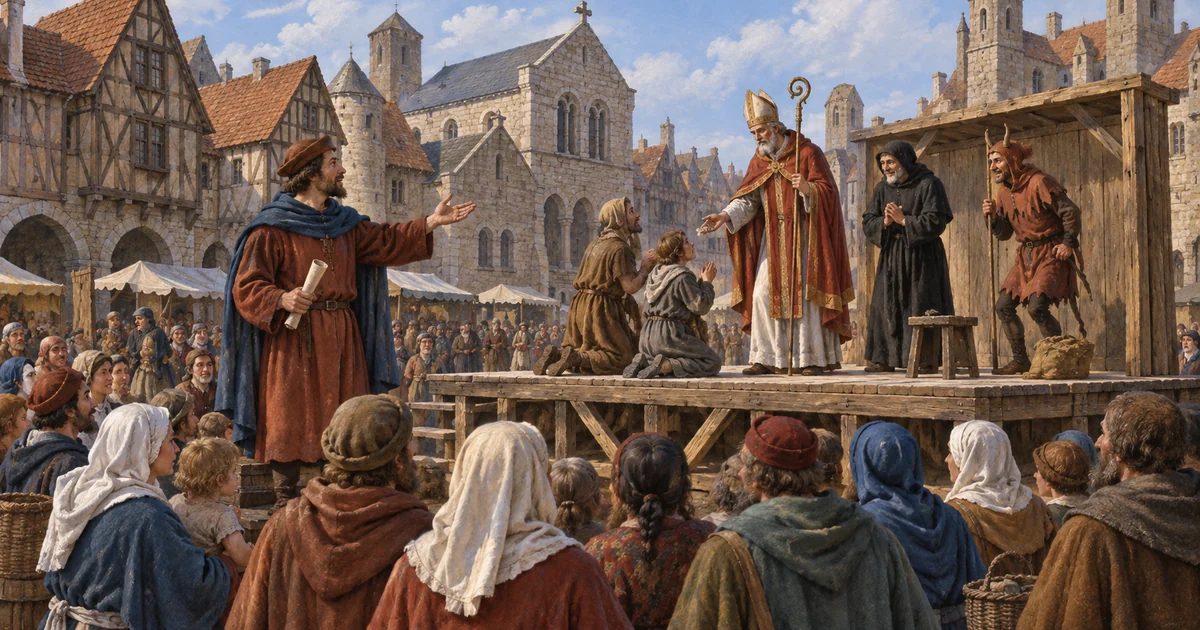
Among the great names that made Arras a capital of letters, one stands out by his genius and his destiny: Jean Bodel and his Jeu de saint Nicolas. An Arras trouvere of the turn of the 12th and 13th centuries, Bodel is the author of a body of work of astonishing boldness and variety, in which theatre, epic and personal poetry rub shoulders. His Jeu de saint Nicolas is regarded as one of the very first plays in the French language on a non-liturgical subject, a founding text of the Western stage. His very life, marked by illness and a moving farewell to his town, adds a human and poignant dimension to his work. To discover Jean Bodel is to meet a major creator of the Middle Ages, too little known, and to measure the place of Arras in the birth of French literature and theatre. It is also to learn to distinguish, as a historian, what is really known of him from what legend may have added.
A trouvere at the heart of medieval Arras
Jean Bodel lived in Arras around 1200, at the peak of the town's literary life, and he was one of the leading figures of that centre which was the Puy of Arras and its confraternity of jongleurs and burghers. Like many Arras trouveres, he moved in that rich and lettered urban milieu, where poets and notables rubbed shoulders. It is known that he held functions in the town and that he was integrated into the society of his time, far from the image of the marginal poet. The details of his biography nonetheless remain patchy, as for most medieval authors: his life is reconstructed from rare mentions and above all from his work, with the caution that is required. What can be affirmed is that he was a recognised and prolific creator, mastering several genres, which was rare. His Arras rootedness is essential to understanding him: Bodel is not an isolated genius but the product of an exceptional milieu, that Arras of the trouveres where creation was encouraged, discussed and celebrated. He embodies wonderfully the alliance of the merchant town and culture, that moment when a city of the North, strong in its wealth and its institutions, could give French literature some of its founding works. To situate Bodel in his Arras is already to begin to understand his work.
The Jeu de saint Nicolas, at the origins of theatre
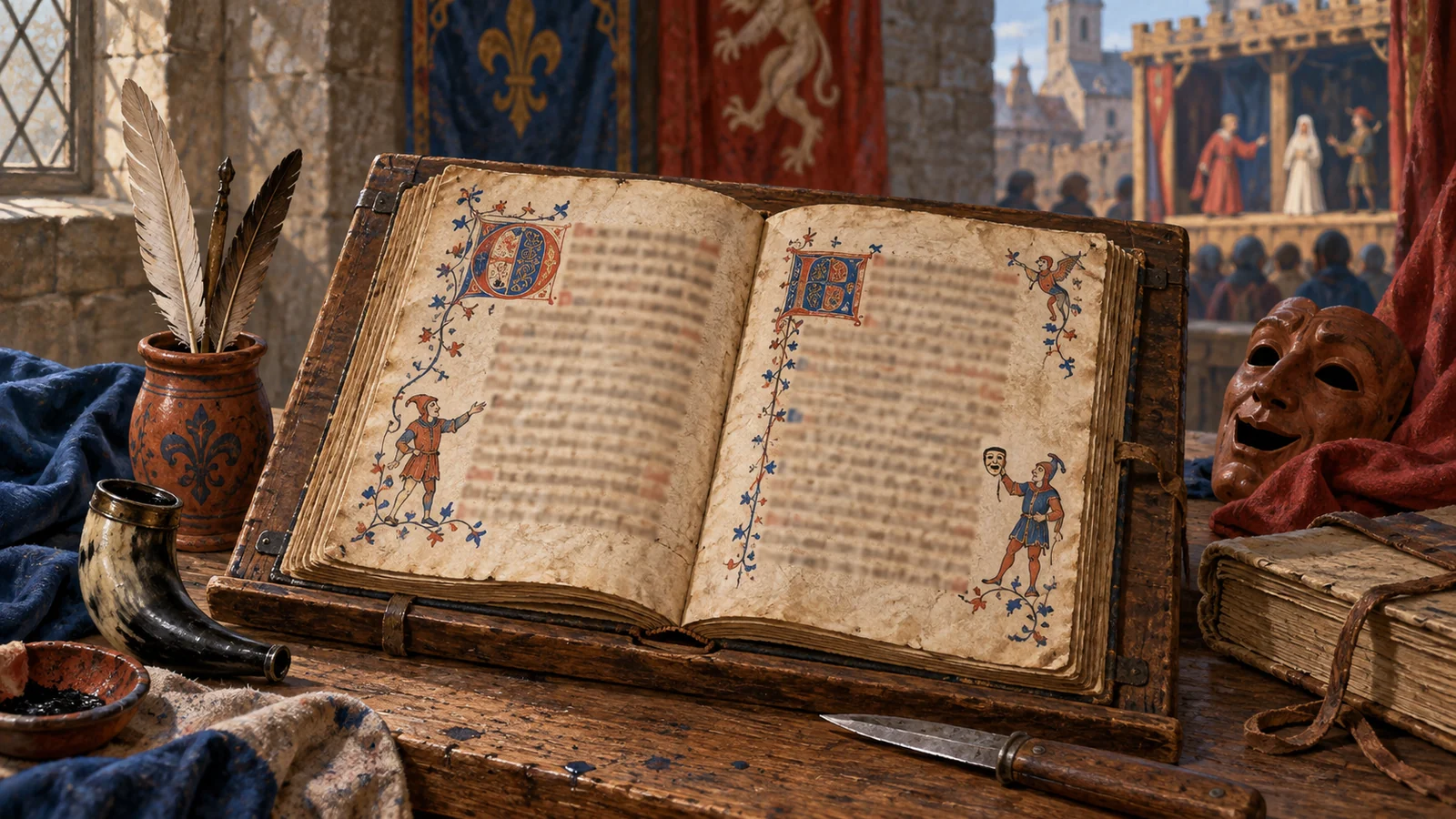
The work that made Bodel famous is undoubtedly his Jeu de saint Nicolas, a play composed at the turn of the 13th century and considered one of the oldest dramatic texts in French dealing with a subject that is not strictly liturgical. Medieval theatre had been born within the Church, from religious ceremonies; with Bodel, it partly emancipates itself, bringing onto the stage the profane world, its taverns, its dice players, its thieves, alongside Christian wonder. The play stages a miracle attributed to Saint Nicholas, in a setting where crusade, Saracens and daily life mingle, with remarkable liveliness and realism. This meeting of the sacred and the profane, of the serious and the comic, makes all the originality of the work and heralds the great rise of medieval theatre. Historians of literature stress the importance of this text in the birth of the Western stage, as a milestone of a gradual emancipation of theatre. One must, however, beware of anachronism: Bodel did not invent theatre single-handedly, he belongs to a long and collective evolution. But his Jeu, by its boldness and its quality, marks a decisive stage. That such a founding text was born in Arras, in the milieu of the Puy, confirms the leading role of the town in the history of French letters and earns it a lasting place in the manuals of literature.
| Work | Nature and interest |
|---|---|
| The Jeu de saint Nicolas | Nascent secular theatre, a staged miracle |
| The Chanson des Saisnes | Chanson de geste on Charlemagne's wars |
| The Congés | Farewell poems, a personal and poignant work |
| Fabliaux | Short tales, a realistic and comic vein |
The Chanson des Saisnes and the three matters
Bodel's talent was not limited to theatre. He is also the author of an important chanson de geste, the Chanson des Saisnes, which tells of Charlemagne's wars against the Saxons. This vast epic poem belongs to the great tradition of the chansons de geste, those tales of warlike deeds that celebrated the heroes of the past. But Bodel left, in the prologue of this work, a passage that has remained famous above all among specialists: the distinction of the three great matters of the literature of his time. He opposes there the matter of France, devoted to Charlemagne and his warriors, the matter of Britain, turned toward King Arthur and his knights, and the matter of Rome, drawn from Antiquity. This classification, formulated by a trouvere of Arras, has become a fundamental reference for understanding the organisation of medieval literature, cited in all the manuals. That it comes to us from Bodel testifies to his culture, his critical distance and his awareness of belonging to a structured literary tradition. Far from being a mere maker of verses, Bodel appears here as a thoughtful mind, able to think literature as much as to practise it. This lucidity, joined to the variety of his work, makes him an author of exceptional richness, whose contribution far exceeds the local frame and touches the very history of French letters.
The Congés: the farewell of a man struck by illness
The destiny of Jean Bodel changed when he was struck by leprosy, that dreaded disease which, in the Middle Ages, entailed the exclusion of the sick person from the society of the living. Forced to withdraw to a leper house, separated from his own and from his town, Bodel then composed the Congés, a series of farewell poems of rare emotion. He takes leave, one by one, of his friends, his protectors and his town of Arras, in verses where pain, lucidity and faith mingle with an overwhelming intensity. These Congés are considered one of the summits of the personal poetry of the Middle Ages, a moment when the voice of a real man, facing his misfortune, pierces through the literary conventions. They moreover inaugurated at Arras a small tradition, since another trouvere struck by the same ill later composed his own congés. This text gives Bodel's work a unique human depth: after theatre and epic, here is the confidence, the farewell, the meditation on fate. For the historian as for the reader, the Congés offer a rare testimony on the condition of lepers and on the sensibility of a man of the Middle Ages facing illness and death. They also recall the fragility of destinies, even the most brilliant, and confer on the figure of Bodel a tragic dimension that adds still further to his greatness.
An author of multiple talents
What is striking, in embracing the whole of his work, is the diversity of Jean Bodel's talents. Few medieval authors excelled in so many registers: theatre with the Jeu de saint Nicolas, epic with the Chanson des Saisnes, personal poetry with the Congés, and probably the comic tale, several fabliaux being attributed to him. This versatility is the sign of a complete literary genius, able to pass from wonder to realism, from the sublime to the comic, from the collective to the intimate. It also testifies to the richness of the Arras milieu, which offered its authors the possibility of exploring every genre. Each facet of his work lights up the others: the sense of dialogue and stage he deploys in theatre is found in the liveliness of his fabliaux; the mastery of epic narrative dialogues with the depth of his intimate poetry. This variety makes Bodel particularly precious for understanding the range of possibilities of the literature of his time. He was not enclosed in a genre, but freely explored forms, with an ease that compels admiration. This creative freedom, this curiosity for all modes of expression, make him astonishingly modern in some respects, and one of the most complete authors the Middle Ages bequeathed us. It amply justifies the eminent place he holds in the history of French literature.
Bodel, Adam and the literary school of Arras
Jean Bodel was not an isolated phenomenon, but the first great name of a lineage. After him, the town continued to produce leading poets, foremost among them Adam de la Halle, who carried Arras theatre and music to a new summit a few decades later. From Bodel to Adam, a whole literary school takes shape, a continuity of creation that makes Arras a unique case in the history of medieval letters. The two men, separated by two or three generations, illustrate the permanence of a centre, where the torch of creation was passed on. To compare Bodel and Adam allows one to measure the evolution of forms and tastes, while underlining what unites them: belonging to the same town, the same milieu, the same tradition of excellence. This continuity is no accident: it rests on the durable structures of the literary life of Arras, the confraternity, the puy, bourgeois patronage, which ensured transmission and renewal. To speak of Bodel without speaking of those who followed him would therefore be incomplete. He opens a history, that of the great literary century of Arras, of which he is like the founding father. To situate his figure in this lineage is to understand that a town can, through its institutions and its culture, durably become a place of creation, and not the theatre of a single brilliance without a morrow.
Secular theatre and its Arras audience
Why could a work as innovative as the Jeu de saint Nicolas be born in Arras rather than elsewhere? The answer lies largely in the audience that welcomed it. The nascent theatre needed spectators numerous, informed and available, able to enjoy both religious wonder and tavern scenes and witticisms. Now Arras, a populous and prosperous town, offered precisely such an urban audience, mixing lettered burghers and common people. This prosperity, born of the drapery wealth of Arras, had made the city a place dense in men, money and exchange, where collective life was intense. The realism of the play, with its dice players and its innkeepers, presupposes an audience able to recognise itself in these figures, and to laugh at them. The presence of the confraternity and the puy moreover provided a frame for creation and performance. Thus the Jeu de saint Nicolas is not a text without ground: it is the product of a precise urban society, that of a great merchant town of the North, with its codes, its tastes and its concerns. To understand this is to grasp a general principle of the history of the arts: works are born of milieus that make them possible. The genius of Bodel needed the Arras of his time to express itself, and this meeting of a talent and a town explains the birth, here, of one of the first masterpieces of French theatre.
A work that crosses the centuries
What remains today of Jean Bodel, eight centuries after his death? A living body of work, still studied, edited and sometimes performed. The Jeu de saint Nicolas figures in the histories of theatre as an essential milestone, and specialists of medieval literature continue to explore its riches. The Chanson des Saisnes and its famous distinction of the three matters remain references cited in all teaching of medieval letters. As for the Congés, they still touch the reader by their bare emotion and their modernity of tone. This durability is the surest sign of an author's value: to cross the centuries, to keep speaking to readers whom everything separates from his world. For Arras, to keep alive the memory of Bodel is to maintain a link with one of the most brilliant pages of its past and to recall that the town was a cradle of French literature. It is also to offer the people of Arras today a tutelary figure, that of a creator who, from the depths of his leper house, knew how to transform misfortune into beauty. The legacy of Bodel thus belongs not only to scholars: it is part of the cultural heritage of the town and, beyond, of the nation. To rediscover it, to read it, to make it known, is to prolong the life of a work that has already proved, by its very survival, that it belongs to the great classics of our language.
What do we really know of Jean Bodel?
It is fitting, to conclude, to measure what we really know of this author, and to distinguish it from suppositions. As for many medieval writers, the documentation on Bodel's life is thin: a few rare mentions in archives, and above all his works, which yield precious but indirect clues. The Congés, in particular, inform us about his illness and his withdrawal, but they are literary texts, to be interpreted as such, not simple confidences. The attribution of certain works, notably fabliaux, is not always certain and is the object of scholarly discussion. The dates of his birth and death remain approximate. Faced with these uncertainties, the historian of literature works with method: he analyses the language, the style, the manuscripts, crosses the clues, and refrains from asserting more than the sources allow. This caution takes nothing from the importance of Bodel, quite the contrary: it founds it on something solid, the work itself, whose authenticity and value are not in doubt. To distinguish the certain from the probable, the documented from the legendary, such is the approach that suits the study of such an author. It reminds us that our knowledge of the past, even for its greatest figures, is always partial, reconstructed from traces, and that there is as much rigour as beauty in honestly recognising the limits of what one can know.