
The Arras School: who were the landscape painters of the nineteenth century?
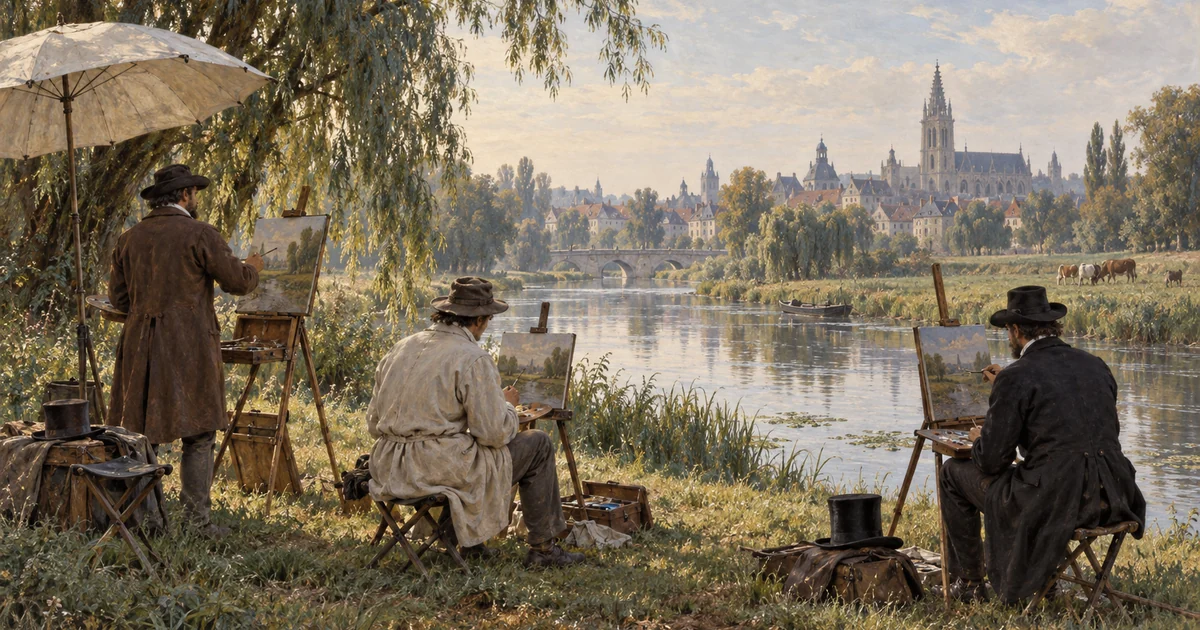
In the nineteenth century, Arras was the hearth of a group of landscape painters known as the Arras School. Around Constant Dutilleux, the central figure, gravitated artists like Charles Desavary and Alfred Robaut, while the great Camille Corot, a friend of Dutilleux, came to paint in the region. These painters made the Artois and its landscapes the subject of their canvases, in the spirit of the renewal of landscape that marked the nineteenth century. A look back at the Arras School, its figures and its artistic legacy.
A school of landscape painters
The Arras School designates a group of landscape painters active in Arras and its region in the nineteenth century. These artists, gathered around common figures and sharing the same taste for landscape, made Arras a notable artistic hearth. The term school does not designate a formal institution, but a set of painters linked by relations, influences and a common inspiration. These artists devoted themselves to landscape, a genre that knew an important renewal in the nineteenth century. They painted nature, the countrysides of the Artois, the riverbanks and rural scenes, in a style attached to the faithful and sensitive representation of nature. The Arras School belonged to the great movement of renewal of landscape that marked the painting of the nineteenth century, with the rise of painting from the motif and the new attention paid to nature. This Arras artistic hearth, often unknown, testifies to the cultural vitality of the town and its region. Far from being only an administrative and commercial city, Arras was also, in the nineteenth century, a place of artistic creation, where talented painters devoted themselves to landscape. This artistic dimension enriches the image of the town, adding to its history a cultural page. To understand the Arras School as a school of landscape painters allows one to grasp its nature and its inspiration. A group of painters linked by the taste for landscape, active in Arras in the nineteenth century, these artists made the town and its region a hearth of creation. Their attachment to landscape, in the spirit of the renewal of this genre in the nineteenth century, characterises the Arras School, whose artistic legacy testifies to the cultural richness of the town, a hearth of talented landscape painters.
Constant Dutilleux, the soul of the school
The central figure of the Arras School was Constant Dutilleux, an Arras painter around whom this artistic hearth was constituted. Born at the beginning of the nineteenth century, Dutilleux was a talented landscape painter, but also an animator and a gatherer, whose role went beyond that of a simple artist. Around him gravitated other painters, whom he influenced, trained or with whom he maintained relations. Dutilleux was also a man of relations, in contact with artists of his time, which contributed to the influence of the Arras School. His friendship with the great painter Camille Corot, notably, was decisive, attracting the latter towards Arras and its region. Dutilleux thus played an essential role in the constitution and animation of this artistic hearth. His talent as a landscape painter, his commitment and his relations made him the soul of the Arras School. He embodied this hearth of creation, of which he was the figurehead. Without him, the Arras School would doubtless not have known the influence that was its own. Constant Dutilleux illustrates the role of central figures in the constitution of artistic movements, those artists who, by their talent and their commitment, federate and inspire. To understand the role of Dutilleux allows one to grasp the constitution of the Arras School. A central figure and soul of the group, he gathered around him other painters and attracted artists like Corot. His talent, his commitment and his relations made him the pivot of this artistic hearth. Constant Dutilleux, by his gathering role and his influence, was thus the soul of the Arras School, of which he remains the most emblematic figure, the one around whom this hearth of landscape creation was constituted in the nineteenth century.
Corot and Arras
One of the most prestigious links of the Arras School was the one that united it to Camille Corot, one of the greatest French landscape painters of the nineteenth century. Corot was a friend of Constant Dutilleux, and this friendship led him to stay in Arras and to paint in the region. The presence of Corot, a major figure of the painting of his time, conferred on the Arras School a considerable prestige and an opening onto the great artistic currents. Corot, known for his landscapes marked by poetry and light, exercised an influence on the Arras painters, who could benefit from the contact with this master. His stays in the region, where he painted landscapes, inscribed Arras in the path of this great artist. The link between Corot and Arras, through his friendship with Dutilleux, is one of the most remarkable aspects of the artistic history of the town. It testifies to the influence of the Arras School and its insertion into the artistic networks of the nineteenth century. The presence of a painter as famous as Corot heightened the prestige of the Arras hearth and enriched its inspiration. This relationship illustrates the opening of the Arras School onto the great currents of the painting of its time. To understand the link between Corot and Arras allows one to grasp the prestige and influence of the Arras School. A friend of Dutilleux, Corot stayed in the region and painted there, conferring on this artistic hearth a considerable prestige. This relationship, between one of the greatest French landscape painters and the Arras painters, testifies to the opening and influence of the Arras School, inscribed, thanks to Corot, in the great artistic currents of the nineteenth century. The presence of this master durably enriched the Arras artistic hearth.
Desavary and Robaut
Alongside Dutilleux and in the wake of Corot, other painters animated the Arras School, among whom Charles Desavary and Alfred Robaut. These artists, linked to Dutilleux, contributed to the life and influence of the Arras artistic hearth. Charles Desavary was a landscape painter, pursuing the tradition of the Arras School. Alfred Robaut, for his part, is notably known for his work of cataloguing the work of great artists, including Corot, a precious work for the knowledge of these painters. These figures, alongside Dutilleux, formed the core of the Arras School, each bringing its contribution. Linked by family and artistic relations, they shared the same inspiration and the same attachment to landscape. Their activity contributed to making Arras a hearth of landscape creation in the nineteenth century. These painters, less known than Corot but important for the Arras School, illustrate the vitality of this artistic hearth. Their work, attached to the landscape of the Artois, testifies to the common inspiration that animated the group. Desavary and Robaut, alongside Dutilleux, embody the Arras School in its diversity and richness. To understand the role of these figures allows one to grasp the constitution of the Arras School. Alongside Dutilleux and in the wake of Corot, painters like Desavary and Robaut animated this artistic hearth, each bringing its contribution. Linked by common relations and inspiration, they formed the core of the Arras School, of which they illustrate the vitality and richness. These artists, attached to the landscape of the Artois, contributed to the influence of this hearth of creation, making the Arras School a group of talented and united painters.
Painting the Artois
The painters of the Arras School made the Artois and its landscapes the privileged subject of their canvases. The countrysides of the region, the riverbanks, the rural scenes, the light and skies of the North: so many motifs that inspired these artists. The painters did not neglect the views of the town itself either, around the Grand-Place of Arras. Attached to their region, they painted its landscapes with sensibility, in a style attentive to nature and light. This painting of the local landscape testifies to an attachment to the territory and a will to represent the beauty of the surrounding nature. The Artois, a region of plains and countrysides, offered the painters motifs favourable to landscape painting. The artists of the Arras School knew how to capture its beauty, in canvases marked by sensibility. To paint the Artois was also to take part in the renewal of landscape that marked the painting of the nineteenth century, with the new attention paid to nature and painting from the motif. The Arras painters belonged to this movement, while giving their art a local anchoring, that of their region. This painting of the landscape of the Artois constitutes one of the characteristics of the Arras School. It testifies to the attachment of the painters to their territory and to their talent in representing its beauty. To understand what the artists of the Arras School painted allows one to grasp their inspiration. Attached to the Artois and its landscapes, they made their region the subject of their canvases, in a style sensitive to nature and light. This painting of the local landscape, inscribed in the renewal of landscape in the nineteenth century, characterises the Arras School, whose painters knew how to capture the beauty of the Artois, making their region a subject of artistic creation.
| Figure | Role in the Arras School |
|---|---|
| Constant Dutilleux | Central figure and soul of the artistic hearth |
| Camille Corot | Great landscape painter, friend of Dutilleux |
| Charles Desavary | Landscape painter of the school |
| Alfred Robaut | Painter and cataloguer of Corot's work |
The art of landscape in the nineteenth century
The Arras School belongs to the great movement of renewal of the art of landscape that marked the painting of the nineteenth century. This century saw landscape, long considered a minor genre, assert itself and know a considerable rise. The painters turned towards nature, which they represented with a new attention and sensibility. Painting from the motif, in the open air, developed, allowing the artists to capture the light and atmosphere of landscapes on the spot. This renewal of landscape, illustrated notably by movements like that of Barbizon, transformed painting and gave the genre a new place. The Arras School took part in this movement, with its painters attached to landscape and to the representation of nature. The Arras artists, in the wake of Corot and under the impulse of Dutilleux, belonged to this dynamic of the renewal of landscape. Their painting, attentive to nature and light, testified to this evolution of art. The Arras School thus illustrates, on the scale of a regional hearth, the great movement of the renewal of landscape in the nineteenth century. To understand this artistic context allows one to situate the Arras School in the history of painting. Inscribed in the renewal of landscape that marked the nineteenth century, it took part in the rise of this genre and in the new attention paid to nature. The Arras painters, in the wake of Corot, belonged to this dynamic, making the Arras School a regional hearth of the renewal of landscape. This insertion into the great currents of the painting of its time testifies to the richness and artistic topicality of this Arras hearth.
The Museum of Fine Arts and the collection
Today, the work of the painters of the Arras School can be admired notably at the Museum of Fine Arts of the town. Installed in the former Saint-Vaast abbey, the museum preserves collections that testify to the artistic richness of the town and its region, including works linked to the Arras School. The conservation and exhibition of these works allow this artistic hearth to be made known and its memory to be perpetuated. The museum thus offers the possibility of discovering the canvases of these painters, of measuring their talent and of appreciating their art. This presence of the works at the museum is essential for the knowledge and transmission of the legacy of the Arras School. It allows the public to discover this artistic hearth and its inspiration. The visitors who go through the Museum of Fine Arts of Arras can thus approach the work of these painters and discover this page of the artistic history of the town. The museum plays an essential role in the conservation and transmission of this artistic heritage. It allows the memory of the Arras School and its inspiration to be kept alive. To understand the role of the museum allows one to grasp how the legacy of the Arras School is preserved and transmitted. Installed in the former Saint-Vaast abbey, the Museum of Fine Arts preserves works linked to this artistic hearth, allowing the public to discover them. This conservation and exhibition are essential for the knowledge and transmission of the legacy of the Arras School, whose works, presented at the museum, testify to the artistic richness of the town and perpetuate the memory of its landscape painters.
The legacy of the Arras School
The Arras School left an artistic legacy that enriches the cultural heritage of the town. This hearth of landscape painters, active in the nineteenth century, testifies to the artistic vitality of Arras and its region. Its legacy is read in the preserved works, in the memory of its figures and in the place it occupies in the history of landscape painting. The Arras School recalls that Arras was not only a town of history and architectural heritage, but also a hearth of artistic creation. This dimension enriches the image of the town, adding to its history a cultural and artistic page. The legacy of the Arras School belongs to the long cultural tradition of the town, which, from the Middle Ages to the nineteenth century, always knew how to make a place for creation, as the role of Arras literary capital from the Middle Ages recalls. From medieval literature to the painting of the nineteenth century, Arras was a hearth of creation, of which the Arras School constitutes one of the expressions. This artistic legacy deserves to be known and valued, as a testimony of the cultural richness of the town. To rediscover the Arras School is to enrich the knowledge of the history of Arras with an artistic page. To understand the legacy of the Arras School allows one to grasp its place in the cultural heritage of the town. A hearth of landscape painters of the nineteenth century, it enriches the history of Arras with an artistic dimension, belonging to the long cultural tradition of the town. Its legacy, preserved notably at the museum and perpetuated in the memory of its figures, testifies to the artistic vitality of Arras. The Arras School thus remains an important page of the cultural history of the town, that of a hearth of landscape creation that made Arras, in the nineteenth century, a place of art and painting.