
What was the battle of the Sabis, where the Atrebates fought?
In 57 BC, the people who occupied the land of Arras fought one of the fiercest battles of the Roman conquest. The battle of the Sabis, in which the Atrebates stood alongside the Nervii and the Viromandui against Caesar's legions, nearly turned into disaster for Rome before ending in a crushing victory for the proconsul. This clash, told by Caesar himself in the Gallic War and discussed since by historians of Gaul such as Jean-Louis Brunaux, marks the brutal entry of the Artois into written history. It also explains why, in the aftermath, Caesar was able to reorganise the region and entrust the Atrebates to a king of his own choosing. To understand the Sabis is to understand the warlike origins of a territory that would become Arras. Here we glimpse a people often reduced, in the popular imagination, to a few clichés about the Gauls, yet whose military and political organisation earned the respect of the greatest Roman commander of his time. It is this part of history, at once local and national, that the battle of the Sabis brings back.
The Belgae, « the bravest » according to Caesar
As Caesar launched the conquest of Gaul, the peoples of the North were reckoned the most formidable. The proconsul himself writes that the Belgae are the bravest of all, because the farthest from Roman civilisation and luxury, and the closest to the Germans with whom they constantly wage war. Among them the Nervii, fierce and wary of any outside influence, form the hard core of resistance. Alongside them stand other peoples, including the Atrebates of the future land of Arras and the neighbouring Viromandui. These Belgic peoples, briefly united against the invader, had first formed a vast coalition that Caesar, through manoeuvre and division, had managed to break apart. There remained the hardest core, that of the Nervii and their allies, determined to fight. The role of the Atrebates in this confederation is directly linked to the destiny of Commius, the future king of the Atrebates, whom Caesar would place at their head after the battle. The stage is thus set for a major clash, in which the people of Arras will play their part. Caesar stresses this reputation for bravery less out of admiration than to magnify his own victory, something the historian must bear in mind when reading his testimony. Even so, the peoples of the North, the Atrebates among them, entered the struggle with a determination that the ancient sources, biased as they are, cannot conceal.
An ambush on the riverbank
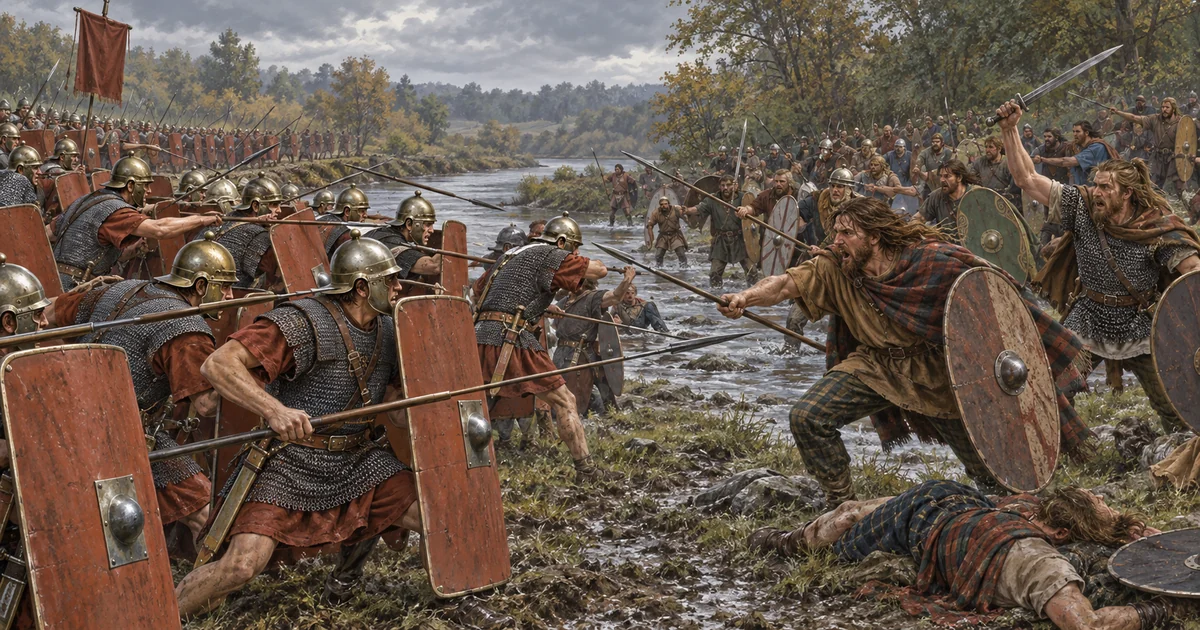
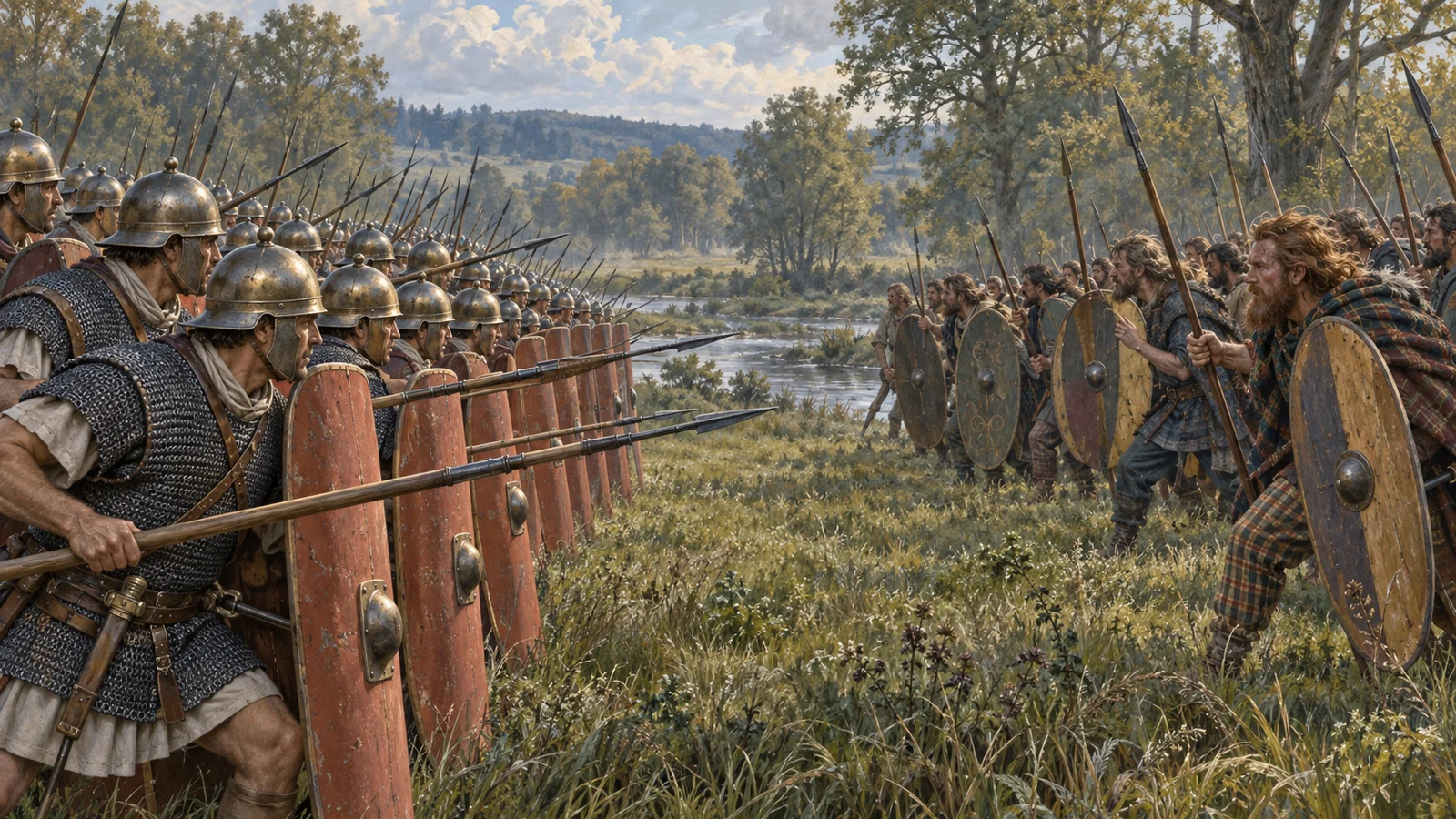
The tactical genius of the Belgae shows in their choice of ground and timing. Rather than attack head-on, the Nervii and their allies hide in the woods bordering a river, the Sabis, and wait until the Romans, busy setting up camp, are at their most vulnerable. The surprise attack is of lightning suddenness: the legions have barely begun to entrench their position when the Gaulish warriors surge out, cross the river and charge. Caesar, in his account, does not hide the confusion that gripped his army: the soldiers must grab their weapons in haste, some have no time to don their helmet or reach their standard. It is one of the rare moments of the Gallic War where the proconsul admits he came close to defeat. The speed of the assault nearly carried the day, so well had the Belgae exploited surprise and the vigour of their first charge. This initial onslaught shows how bitter the clash was, far from the image of an easy, methodical Roman conquest. The choice of the river as a trap was no accident: the ford disrupted the Roman formation and exposed the legionaries when they were least ready to fight. This tactical intelligence belies the image of disorderly Gaulish bravery and reveals chiefs able to prepare a large-scale ambush against the most seasoned army of the age.
The Atrebates against the legions
In the melee, each people of the coalition faces part of the Roman army. The Atrebates, placed on one wing, clash with the legions opposite them and engage in furious combat. Caesar reports that, despite their drive, they are gradually pushed back toward the river, forced to cross it again under Roman pressure, and cut down on its banks. The people of the future land of Arras thus paid a heavy price that day, throwing all their strength into a battle lost in advance against legionary discipline. For that is where the battle is decided: to Gaulish ardour, Rome opposes order, training and the ability of its officers to restore a line briefly broken. The arrival of the last legions and the cavalry, then the return to combat of units momentarily overwhelmed, gradually reverse the balance. The courage of the Atrebates, real and stressed by the sources, is not enough against a superior military machine. Their defeat on the banks of the Sabis seals, for them, the end of open resistance and opens the way to submission. The fighting was of extreme violence, each side aware of what was at stake. For the Atrebates it was not a skirmish but a decisive battle, involving the very existence of their community, which explains the fierceness they showed before yielding to numbers and discipline.
How the Atrebate warriors fought
To grasp what was at stake at the Sabis, one must picture the way the Belgic peoples waged war. Their armies rested first on a numerous infantry of free men fighting with a long iron sword, javelins and a large oval shield, more than on cavalry or chariots, less common among the Belgae than among other Gauls. Gaulish combat relied on the impetus of the first charge, on individual courage and on the din of arms meant to overawe the enemy. This ardour could sweep away an ill-prepared line, as the Sabis attack nearly proved. But it met its limits against the Roman legion, a collective machine trained to hold ranks, relieve one another and obey amid chaos. Where the Atrebate warrior sought the feat of arms, the legionary applied cold discipline. Historians of Gaul stress this contrast, which does not pit barbarians against the civilised but two military cultures: one founded on valour and honour, the other on organisation and logistics. The Sabis offers an almost perfect demonstration, since Belgic bravery, victorious for a moment, ultimately broke on Rome's ability to recover. Understanding this avoids the clichés and does justice to a people who, far from a disorderly horde, offered Rome a methodical and formidable resistance.
| Marker | Detail |
|---|---|
| Date | 57 BC, Caesar's campaign against the Belgae |
| Coalition | Nervii, Atrebates and Viromandui |
| Tactics | Ambush and surprise attack at a river crossing |
| Outcome | Roman victory; submission of the northern Belgae |
The Roman recovery and Caesar's victory
What could have been a rout becomes a victory thanks to the Roman recovery. Caesar, present at the height of the melee, seizes a shield, moves to the front line and restores his men's morale, a famous episode historians cite as an example of command in battle. The arrival of the rear-guard legions and the decisive intervention of the cavalry finally turn the situation. The Nervii, who had risked everything, are almost annihilated: Caesar writes that their nation was reduced to almost nothing, so much so that he later received with clemency the survivors who came to beg forgiveness. For the Belgic peoples, the defeat of the Sabis is a turning point: it breaks the main northern coalition and opens the region to Roman domination. The hard-won victory impressed Rome itself, where exceptional public thanksgivings were decreed. For the land of Arras, the event means entry into a new order, that of the Roman peace imposed by arms, which would last several centuries and deeply transform the country of the Atrebates. This episode also fed Caesar's personal legend, which he staged in his writings to secure his authority in Rome. Behind the heroic account, historians read above all the superiority of a military organisation able to turn a near-rout into triumph, where the Belgic coalition, lacking lasting coordination, could not exploit its initial advantage.
Where did the battle take place? A debate still open
On one point the historian's caution remains necessary: the exact location of the battlefield is still disputed. Tradition, relying on the name Sabis, long identified it with the Sambre, placing the clash in that valley. Some researchers, however, have proposed other sites, notably on the edges of the Cambrésis, comparing Caesar's text with the realities of the terrain and archaeological finds. The proconsul's account, precious but written to his own glory, does not always suffice to settle the matter, and the material clues of an ancient battle are hard to establish with certainty. This debate is no minor thing: it recalls that ancient history is built from partial and sometimes biased sources, to be read with a critical mind. Rather than impose a certainty, it is better to set out the state of the question, as specialists of Gaul do. What matters for Arras is not so much the precise site of the clash as the proven participation of the Atrebates in this battle, and the fate it dealt them, decisive for the rest of their history. This uncertainty in no way lessens the interest of the event: on the contrary it invites us to distinguish what is known from what is supposed, an exercise at the heart of the historian's craft. For the land of Arras, what matters is the proven participation of the Atrebates and the turning point this defeat represented for them.
From the battlefield to the birth of Nemetacum
The defeat of the Sabis had direct consequences for the land of Arras. Defeated, the Atrebates had to submit, and Caesar reorganised the region by relying on devoted local chiefs. It is in this framework that the Gallo-Roman town gradually arose, as told by the history of Nemetacum, the capital of the Atrebates, which flourished under the Roman peace. The warrior people of the Sabis then became a city integrated into the empire, devoted to trade and craft rather than arms. This transformation, from Belgic tribe to Roman town, sums up on its own the shift of a world. It recalls that conquest, brutal as it was, was also the starting point of a long urban development of which Arras is the distant heir. The battle of the Sabis is therefore not only a military episode: it is the moment when the land of Arras, after resisting arms in hand, tips into Rome's orbit and begins the metamorphosis that, century after century, would lead it to the city we know.