
The theatre of Arras in the eighteenth century: how did the town acquire an Italian-style stage?
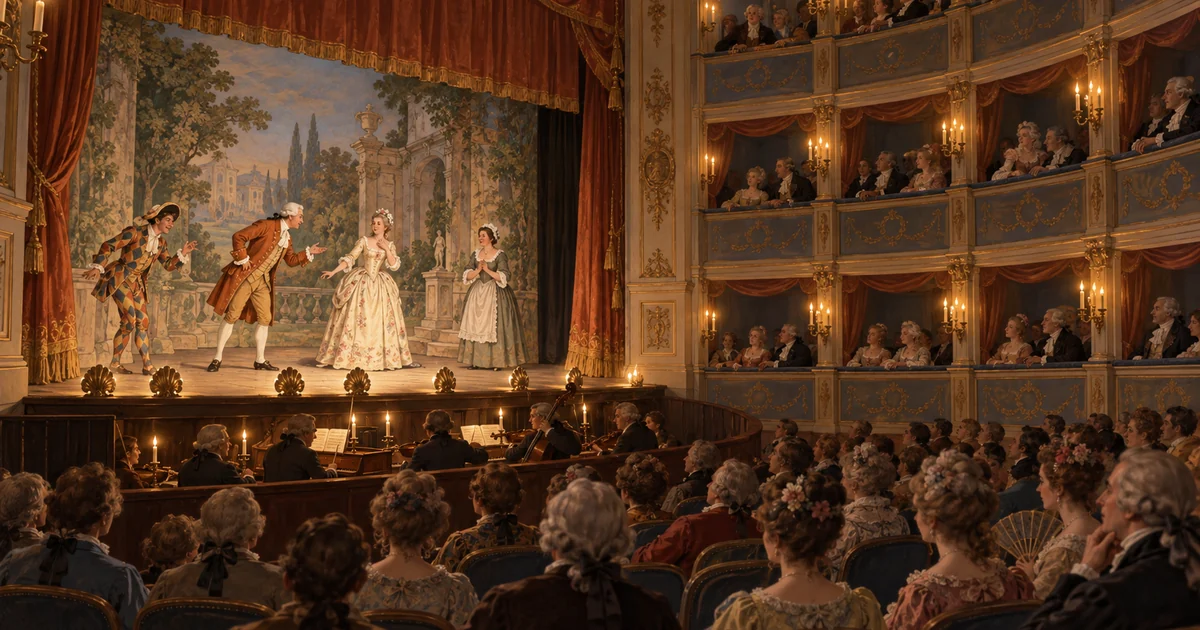
In the century of the Enlightenment, theatre was much more than a simple entertainment: it was a social institution, a place of sociability and representation where a whole town gathered. Arras did not escape this enthusiasm, and endowed itself in the eighteenth century with a true playhouse, an elegant Italian-style theatre where one came to applaud comedies, tragedies and operas. This stage, which has crossed the centuries, testifies to the refined cultural life of a provincial city enamoured of spectacle. A look back at the theatre of Arras in the eighteenth century, its birth, its role and its place in the life of the town.
The Arras stage in the eighteenth century
The eighteenth century marked, for Arras as for so many towns of the kingdom, the rise of theatre as a permanent institution. Where performances were previously given occasionally, in makeshift halls or during the passage of travelling troupes, the town gradually endowed itself with a place dedicated to spectacle. This evolution accompanied the recovered prosperity and the assertion of a cultivated urban society, eager for entertainment and refinement. Theatre became an essential element of social and worldly life, on the same footing as salons, circles and learned societies. To frequent the playhouse was for the elite a way of showing oneself, of keeping one's rank and of sharing the pleasures of cultural life. To understand this rise, one must place it in the context of a town at peace, enriched and desirous of imitating the customs of the capital and the great cities. Arras, a prosperous capital, seat of institutions and place of residence of a numerous elite, offered a public sufficient to justify the existence of a regular theatre. Theatrical life in Arras thus took part in the great cultural movement of the Enlightenment, which saw spectacle take a growing place in the provincial towns. This new stage also prolonged, in its way, an ancient theatrical tradition, whose roots can be traced back to the Middle Ages, to the era when Arras already distinguished itself by its plays and spectacles. The eighteenth-century hall, however, marked a decisive stage: that of the institutionalisation of theatre, henceforth endowed with its own building, symbol of its importance in the life of the city.
The taste for spectacle in the century of the Enlightenment
The eighteenth century was, par excellence, the century of the taste for spectacle. Throughout France, and well beyond, theatre knew an immense popularity, touching all strata of society, from the aristocracy to the bourgeoisie and even the common people. One thronged to see the great classical tragedies, the comedies, the fashionable plays, but also opera and musical spectacles, which aroused a considerable enthusiasm. This passion for spectacle belonged to a civilisation of entertainment and sociability, where the pleasure of the arts held a place of choice. Provincial towns competed to endow themselves with halls worthy of the name, in imitation of Paris and the princely courts. Theatre was a marker of civilisation and refinement, an external sign of the importance and modernity of a city. For Arras, to possess a fine playhouse was to assert its rank among the towns of the kingdom and to offer its cultivated population the pleasures of the stage. The repertoire played reflected the tastes of the time, mingling the great classics of French theatre with novelties and fashionable genres. To go to the theatre had become a social habit, a regular rendezvous that set the rhythm of the life of good society. This cultural effervescence testifies to the vitality of provincial life in the century of the Enlightenment, often underestimated. Far from being a cultural desert, the French province took full part in the civilisation of spectacle, and Arras, with its theatre, offers a fine example of it. The taste for spectacle, shared by a whole society, made theatre one of the most living and characteristic places of the town of the Enlightenment.
An Italian-style theatre
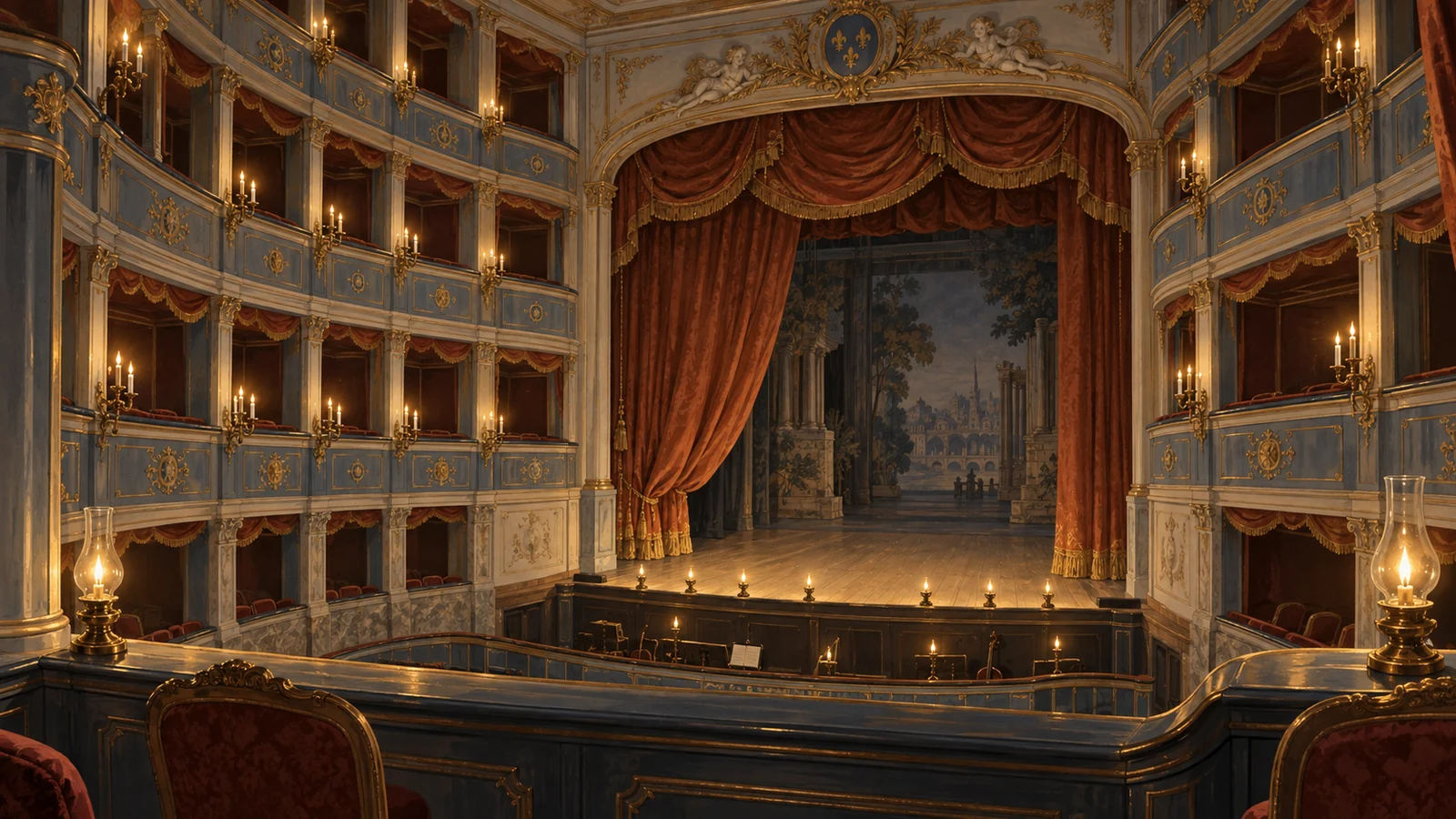
The playhouse with which Arras endowed itself in the eighteenth century belonged to a very precise architectural type: the Italian-style theatre. This model, come from Italy and spread throughout Europe, was characterised by a horseshoe-shaped hall, surrounded by several tiers of superposed boxes, facing a stage equipped with machinery. This arrangement, at once functional and prestigious, allowed a numerous public to be accommodated while contriving a hierarchy of places, from the pit to the most sought-after boxes. The horseshoe offered excellent visibility and a careful acoustic, while the boxes, arranged in tiers, allowed each to see and be seen, which answered perfectly the social function of theatre. The interior decoration, often sumptuous, contributed to the prestige of the building: gildings, paintings, velvet and chandeliers created a setting to the measure of the importance accorded to spectacle. Built in the 1780s, the theatre of Arras belonged fully to this tradition, offering the town an elegant and modern hall, conforming to the canons of the time. This type of theatre was the fruit of a long evolution of the art of the stage, which had gradually defined the forms best adapted to dramatic and lyric performance. To possess an Italian-style theatre was for a town a motive of pride, the sign of its belonging to the civilisation of spectacle that then united all cultivated Europe. The theatre of Arras, by its very architecture, thus testified to the cultural ambition of the city and to its desire to align itself with the most prestigious models. It constitutes today one of the rare witnesses of this theatrical architecture of the eighteenth century, precious as such for the history of the town and of spectacle.
A social institution
Beyond the pleasure of spectacle, the theatre of the eighteenth century was above all a social institution, a place where the hierarchy of the town was displayed. The very arrangement of the hall, with its pit and its tiered boxes, translated the social order: each occupied there the place corresponding to his rank and his means. The most prestigious boxes were reserved for the elite, while the pit welcomed a more popular public. To go to the theatre was therefore to take part in a social ritual as much as in an artistic entertainment. One came there to see the play, but also to show oneself, meet one's relations, exchange news and assert one's position. The theatre was a place of representation in the double sense of the term: on the stage was played the spectacle, but in the hall was also played the social comedy, where each held his role. This worldly dimension made theatre one of the principal places of sociability of the town, on the same footing as salons and promenades. The same elite that had the private mansions of Arras built met there regularly, making the playhouse an essential meeting point of urban life. Theatre thus faithfully reflected the society that frequented it, with its distinctions, its codes and its customs. This social function, inseparable from the artistic function, explains the importance accorded to the playhouse and the care brought to its construction and decoration. To understand the theatre of the eighteenth century is therefore to grasp it in this double dimension, artistic and social, that made it a central place of the life of a city like Arras.
| Element | Feature |
|---|---|
| Type | Italian-style theatre, horseshoe-shaped hall |
| Period | Built in the 1780s |
| Seating | Pit and tiered boxes, reflecting ranks |
| Function | Spectacle and sociability of the elite |
The repertoire and the troupes
What was played on the Arras stage in the eighteenth century? The repertoire reflected the tastes of the era, mingling the great genres of French theatre with the most prized entertainments. One gave there the classical tragedies and comedies, inherited from the great preceding century, as well as new plays and fashionable genres. Opera and musical spectacles also occupied an important place, answering the public's enthusiasm for song and music. Performances were provided by troupes, often itinerant, which travelled the provincial towns to give series of spectacles there. These travelling actors, professionals of theatre, brought to the cities the fashionable plays and the talents of the moment. Their passage was awaited and constituted an event in the local cultural life. Some towns also had more stable troupes, attached to their hall, but the system of itinerant troupes remained very widespread. The quality and frequency of spectacles thus depended largely on the dynamism of theatrical life and the attractiveness of the town for actors. Arras, a prosperous town endowed with a cultivated public, offered a favourable ground for this theatrical life. The repertoire proposed there was varied, allowing each to find his pleasure, from the noblest drama to the lightest comedy. This diversity testifies to the richness of the cultural offer and the vitality of the Arras stage. Through its theatre, the town took full part in the circulation of works, artists and tastes that animated the cultural life of the kingdom, making the playhouse a place open to the novelties and trends of its time.
From medieval origins to the modern stage
The theatre of the eighteenth century did not arise from nothing: it prolonged a theatrical tradition which, at Arras, plunged its roots very far into the past. From the Middle Ages, the town had indeed distinguished itself by its literary and dramatic life, to the point of holding an eminent place in the history of French theatre. It is at Arras that was composed, in the thirteenth century, one of the first masterpieces of secular theatre, and the town had given birth to authors whose work marked the beginnings of the stage in the French language. This medieval tradition, borne notably by the figure of Adam de la Halle, made Arras a cradle of secular theatre, well before the rise of permanent halls. There is thus a continuity, across the centuries, between the dramatic plays of the Arras Middle Ages and the stage of the century of the Enlightenment. Certainly, the forms had radically changed: medieval theatre, often linked to festivals and confraternities, was given in the street or on trestles, while the theatre of the eighteenth century was played in a dedicated hall, according to quite different codes. But the spirit of a town enamoured of spectacle and literature endured, linking the eras in the same cultural vocation. This historical depth confers on Arras theatre a particular dimension: it is not only the expression of an eighteenth-century fashion, but the heir of a long tradition that makes Arras one of the towns historically linked to the history of theatre in France. To rediscover this continuity allows one to better appreciate the place of spectacle in the cultural identity of the city, from the Middle Ages to our day.
The theatre of Arras through the centuries
Built in the eighteenth century, the theatre of Arras has crossed the centuries, not without ordeals, to reach us. Like the whole town, it knew the vicissitudes of history, the changes of regime, the evolutions of tastes and, in the twentieth century, the terrible destructions of the wars that ravaged Arras. The safeguarding and restoration of this theatrical heritage testify to the attachment of the town to its history and its cultural life. The theatre has been the object of care and measures of protection, recognised as a precious witness of the architecture and theatrical life of the eighteenth century. Its conservation allows one today to admire an Italian-style hall of the period, a rarity that makes it a remarkable element of the Arras heritage. Through the centuries, the theatre continued to fulfil its function, welcoming successive spectacles and publics, adapting its programming to the evolution of the performing arts. It thus kept its primary vocation, that of a place of spectacle and gathering, while becoming a monument charged with history. This permanence is remarkable: few buildings have known, like it, how to combine the continuity of their use and the preservation of their historical character. The theatre of Arras thus embodies the fidelity of the town to its heritage and its cultural life, transmitting from generation to generation the taste for spectacle that had seen it born. Its longevity makes it an exceptional witness of the cultural history of the city, linking the century of the Enlightenment to the contemporary era in the same passion for the stage.
A still-living stage
Even today, the theatre of Arras remains a living stage, faithful to its primary vocation. Far from being a simple frozen monument, it continues to welcome spectacles and cultural events, perpetuating the theatrical tradition of the town. This continuity is precious: it makes theatre not a relic of the past, but a living place, where heritage and creation meet. The people of Arras and visitors can thus discover a historic hall while attending contemporary performances, in an experience that unites the charm of the ancient setting and the vitality of the current stage. The theatre belongs to a wider cultural offer, alongside the other spectacle venues that one can explore among the theatres and concert halls of Arras, which make the town a culturally animated city. This vitality prolongs, in its way, the spirit of the eighteenth century, when theatre was at the heart of social and cultural life. It also recalls the depth of the Arras theatrical tradition, which, from the Middle Ages to our day, has never ceased to keep alive the taste for spectacle. The theatre of Arras, by its beauty, its history and its present activity, illustrates marvellously this cultural continuity. It testifies to the richness of a living heritage, where past and present dialogue, and where the pleasure of spectacle, celebrated for centuries, continues to gather the public in a hall charged with memory. To discover the theatre of Arras is thus to enter a place where history and life combine, in the service of a shared passion for the performing arts.