
The union of the Ville and the Cité: how did Arras become a single town in 1749?
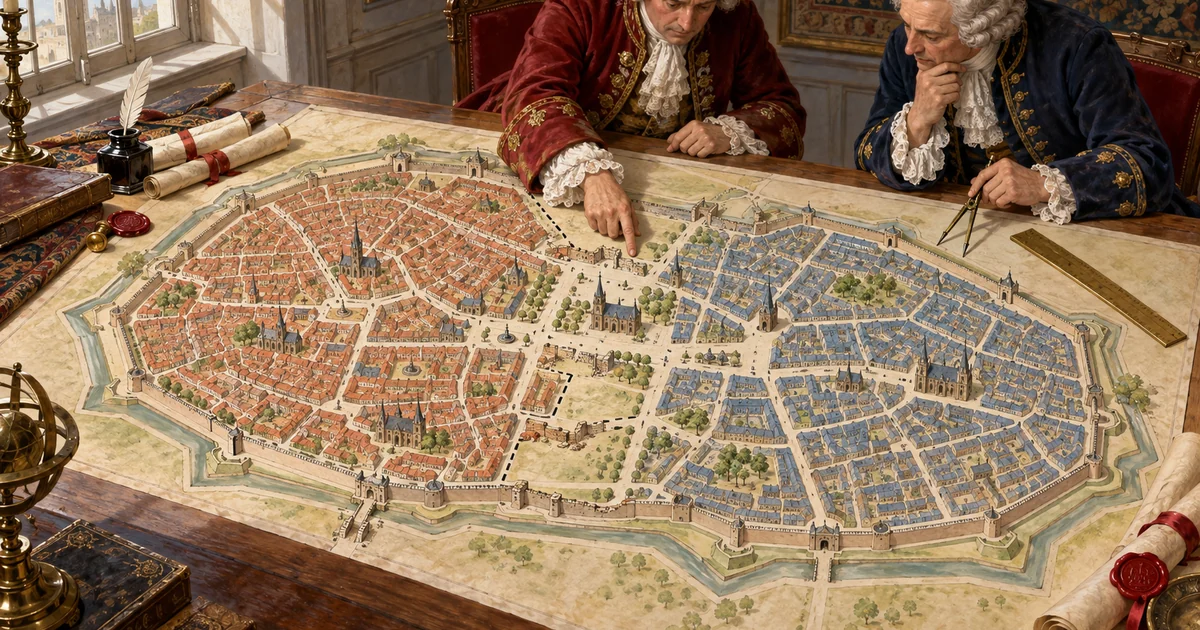
For more than a thousand years, Arras was not one, but two distinct towns, neighbouring and rival: the Cité, the ancient episcopal core gathered around the cathedral, and the Ville, the merchant town born around the powerful abbey of Saint-Vaast. Two enclosures, two administrations, two spirits that a single gate sometimes separated. It took a royal edict of 1749 for these two entities to be at last united into a single municipality, giving birth to the Arras we know today. A look back at this long duality and at the act that, in the century of the Enlightenment, made Arras a single, unified town.
Two towns in one
To understand the Arras of the Ancien Régime, one must first accept a reality baffling for the modern visitor: the town was in fact an urban double, formed of two juxtaposed but legally separate settlements. On one side, the Cité, the oldest, heir to the Gallo-Roman core and become the seat of the bishop, nestled around its cathedral and came under episcopal authority. On the other, the Ville, larger and more populous, had developed around the abbey of Saint-Vaast and its markets, animated by commerce and drapery, strong in its communal institutions won since the Middle Ages. Between the two, a very real border: their own ramparts, gates, and above all distinct powers. The Cité obeyed the bishop and his chapter; the Ville had its aldermen, its privileges, its autonomous economic life. This separation was nothing like a folkloric curiosity: it commanded taxation, justice, policing and even the way inhabitants were counted. An inhabitant of the Ville did not come under the same authorities as an inhabitant of the Cité, a few hundred metres away. This duality, inherited from the most ancient history of Arras, structured local life for centuries and explains many particularities of the topography and memory of Arras. It was also a constant source of friction, before the monarchy put an end to it.
The Cité, episcopal cradle
The Cité represents the oldest cradle of Arras, the one whose roots plunge into Antiquity. It was there, on the plateau of Baudimont, that the Gallo-Roman capital of the Atrebates had established itself, then that the bishopric was implanted in the first Christian times. Around the cathedral and the episcopal palace was gradually constituted a quarter apart, the Cité proper, placed under the authority of the bishop and his chapter. This ecclesiastical quarter had its canons, its schools, its religious institutions, and lived to the rhythm of the liturgy and diocesan administration. The Cité was less populous and less commercial than its neighbour, but it enjoyed an immense prestige, for it housed the spiritual power and one of the finest Gothic cathedrals of the North, today vanished. Its particular status went back to the era when, as in many episcopal towns, the bishop exercised a temporal power over his quarter, distinct from that which governed the merchant town. The Cité long preserved this autonomy, with its own jurisdictions, its policing and its inhabitants coming directly under episcopal authority. It embodied the permanence of ancient and religious Arras, facing the Ville, new, dynamic and commercial. This coexistence of two worlds, the sacred and the trade, the old Cité and the prosperous Ville, makes all the originality of the urban history of Arras before 1749.
The Ville, merchant heart
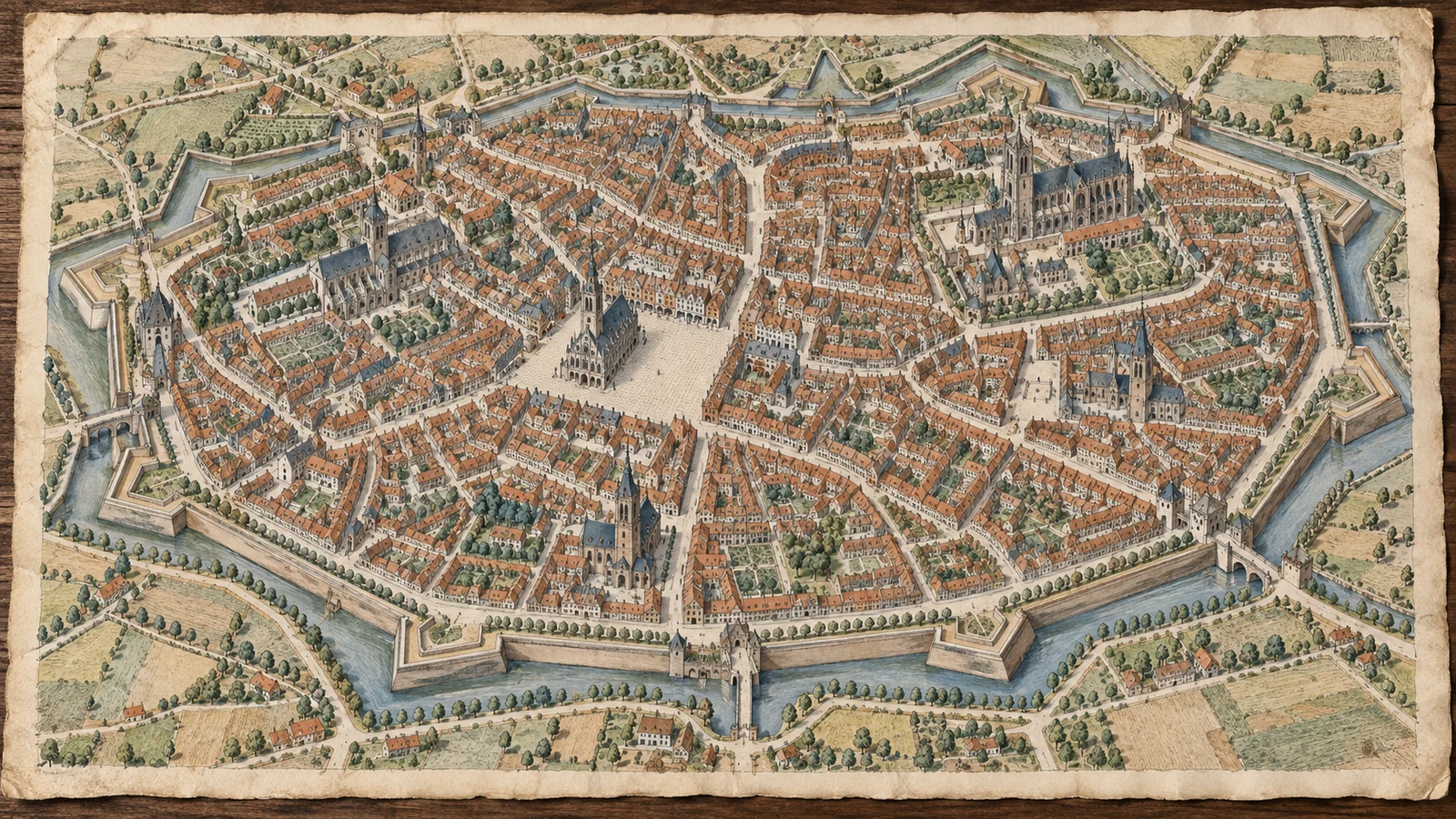
Beside the episcopal Cité stretched the Ville, born and grown around the abbey of Saint-Vaast, one of the richest monasteries of the kingdom. It is here that the economic heart of Arras beat, with its famous arcaded squares, its halls, its markets and its weavers' workshops. From the Middle Ages, the Ville had obtained, thanks to the communal charter of 1163, a broad municipal autonomy, with its aldermen, its privileges and the right to manage its own affairs. This merchant bourgeoisie, enriched by drapery and the trade of the famous tapestries, had made Arras one of the most prosperous cities of the medieval West. The Ville possessed its belfry, symbol of communal liberties, its institutions, its taxation and its justice, quite distinct from those of the neighbouring Cité. Its population, more numerous, lived from trade, craft and fairs. The Ville saw itself as the true Arras, that of work, wealth and municipal power, facing a Cité perceived as the reserved domain of the clergy. This Ville, with its monumental squares and its belfry, is the one whose architectural heritage survives today and makes the renown of Arras. It was a city proud of its franchises, jealous of its autonomy, and little disposed to let itself be confused with its ecclesiastical neighbour. The coexistence of the two entities therefore rested on a fragile balance, where each held to its prerogatives.
Centuries of rivalry
The coexistence of the Ville and the Cité was not always peaceful. Two neighbouring powers, with sometimes divergent interests, disputed the limits, the competences and the precedences. Conflicts of jurisdiction were frequent: to whom did such a tax, such a justice, such a right of policing belong in the border zones? The inhabitants themselves could play one authority against the other, seeking refuge in the Cité to escape the justice of the Ville, or the reverse. This separation complicated the administration, hindered common projects and sometimes harmed the defence of an urban whole that the ramparts themselves divided. Over the centuries, the situation became more and more anachronistic, as the French monarchy, after the attachment of Arras in 1659, sought to rationalise the administration of its towns. The maintenance of two distinct municipalities in the same agglomeration, with their doubles of offices, accounts and functionaries, appeared as a costly survival and a source of disorder. The royal authorities, anxious for efficiency and unity, looked with a bad eye on this duality inherited from the past. The pressure for unification therefore grew in the eighteenth century, driven by the centralising logic of the State and by the concern for simpler and more coherent management. The union of the Ville and the Cité was now only a question of time, and it fell to the reign of Louis XV to settle definitively this old division.
The edict of 1749: the union
It was in 1749, under the reign of Louis XV, that a royal act at last united the Ville and the Cité of Arras into a single municipality. This decision put an end to a separation more than a thousand years old and created the unified Arras that we know. Henceforth, there would be only a single administration, a single body of the town, a single municipal justice for the whole agglomeration. The union suppressed the doubles of institutions and merged into a single entity what had been, for centuries, two distinct towns. This act belonged to the general policy of the monarchy, which sought to simplify and unify the administration of the kingdom. For Arras, it represented a considerable change: the end of the autonomy of the episcopal Cité, absorbed into the urban whole, and the constitution of a single municipality covering the entire territory of the town. The union was not achieved without reluctance, for each entity held to its traditions and its prerogatives, but the royal will prevailed. From 1749, one no longer spoke of the Ville and the Cité as two separate bodies, but of a single Arras, endowed with a common administration. This event, today little known to the general public, nonetheless constitutes one of the major milestones of the urban history of Arras, the one that gave the town its modern administrative form, prefiguring the single commune born of the Revolution.
| Entity | Features before 1749 |
|---|---|
| The Cité | Ancient core, cathedral, authority of the bishop |
| The Ville | Saint-Vaast abbey, markets, aldermen, belfry |
| Separation | Two enclosures, two justices, two taxations |
| 1749 | Royal edict uniting the two into a single Arras |
A single administration
The union of 1749 had concrete and lasting consequences on the life of Arras. With the disappearance of the duality, the town endowed itself with a single administration, simpler and more efficient, capable of managing in one piece the whole urban territory. The inhabitants, whether they were of the former Cité or the former Ville, now came under the same authorities, paid the same taxes and depended on the same municipal justice. This unification facilitated the management of common affairs: roads, defence, policing, upkeep of buildings and organisation of fairs. It put an end to the countless conflicts of competence that had poisoned the relations between the two bodies of the town. The former Cité, once proud of its episcopal autonomy, lost its particular status, but the whole gained in coherence. The town could henceforth think and administer itself as a whole, an indispensable condition for its later development. On the symbolic level, the union erased an interior border that had no more reason to be, while leaving to subsist, in the names of streets and quarters, the memory of the old division. This administrative rationalisation, typical of the spirit of the eighteenth century and of the enlightened monarchy, prepared the ground for the transformations that the Revolution was soon to bring. Arras, henceforth unified, was better armed to face the great upheavals of the end of the century.
Towards modern Arras
The union of the Ville and the Cité constitutes an essential stage on the road to modern Arras. In unifying the administration, it gave the town the coherence it needed to face the following decades. Forty years after the edict, the French Revolution was to complete this movement by making Arras a single commune, capital of the new department of the Pas-de-Calais. Without the merger of 1749, the town would have entered the revolutionary era still divided into two distinct bodies, which would have complicated the setting up of the new institutions. The prior union, on the contrary, facilitated the transition towards the modern communal regime, founded on the unity of the territory and the equality of the inhabitants. The disappearance of the former episcopal Cité also belonged to the long decline of the temporal power of the bishops, which the Revolution would definitively abolish. In absorbing the Cité, the merchant Ville had, in a sense, completed a secular movement by which municipal power had asserted itself against ecclesiastical power. The union of 1749 thus appears as a turning point, at the hinge of the Ancien Régime and the contemporary era. It sealed the unity of a town long divided and gave it the administrative physiognomy which, for the essential, is still its own today. It is from this merger that was truly born the one and indivisible Arras.
Ville and Cité in the memory of Arras
Today, the distinction between the Ville and the Cité has totally disappeared from daily life, but it remains inscribed in the memory and topography of Arras. The names of certain quarters, streets and places still recall the ancient partition, for those who know how to read them. The sector of the former Cité, around the site of the vanished cathedral and the plateau of Baudimont, preserves an atmosphere different from that of the great merchant squares, heirs of the Ville. These last, with their arcaded facades and their belfry, remain the most famous face of Arras and today attract visitors to the Grand-Place of Arras, historic heart of the former Ville. To understand the duality of former times considerably enriches the walk through the city: one then grasps why such a quarter has such a physiognomy, why certain limits seem arbitrary, why the religious history and the merchant history of Arras developed for so long side by side without merging. The union of 1749 made Arras a single town, but it did not erase the traces of its double past. For the lover of history, to rediscover the Ville and the Cité is to find again one of the deepest keys of the identity of Arras, that of a city born of the meeting of two worlds, the sacred and the trade, long separated then at last united into one and the same Arras.