
The Nord-Pas-de-Calais mining basin: a UNESCO landscape to discover near Arras
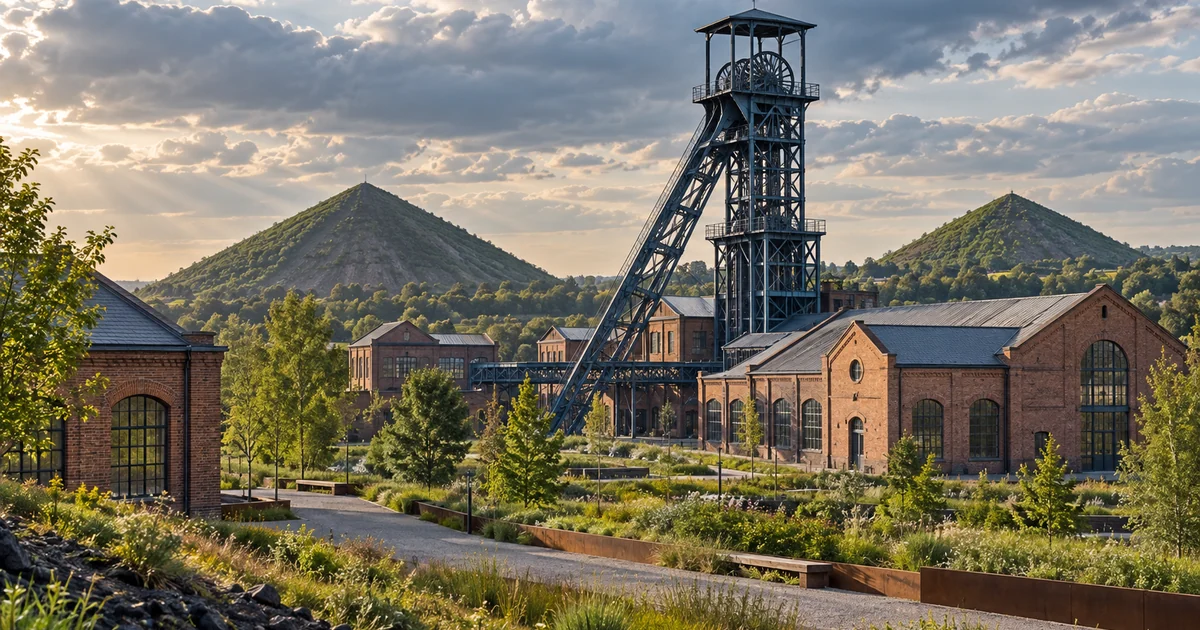
Near Arras stretches a landscape shaped by three centuries of coal extraction: the mining basin of the Nord-Pas-de-Calais. Slag heaps, headframes, mining towns and miners' rows testify to this industrial and human epic, today recognised by an inscription on the World Heritage List of UNESCO. Far from the image of a mere industrial past, this territory is a living cultural landscape, carrier of a strong identity and a collective memory. Let us set off to discover the mining basin, from its history to its listing, by way of its emblematic landscapes and its reconversion, a few kilometres from Arras.
The mining basin, a world cultural landscape
The mining basin of the Nord-Pas-de-Calais constitutes a vast territory marked by the exploitation of coal, recognised as an exceptional cultural landscape. Stretching over about one hundred and twenty kilometres in length, from the Belgian border in the east to the hills of the Artois in the west, it forms a strip of territory profoundly transformed by mining activity. This landscape, shaped by the hand of man, associates extraction sites, slag heaps, workers' towns and collective facilities, forming a coherent and singular whole. In 2012, part of this territory, representing several thousand hectares and hundreds of remarkable elements, was inscribed on the World Heritage List of UNESCO. This inscription recognises the exceptional value of this evolving and living cultural landscape, witness of a major industrial and human adventure. The mining basin is not a frozen site, but an inhabited territory, in constant evolution, where the mining heritage rubs shoulders with contemporary life. To understand this landscape supposes grasping the extent of the exploitation and its imprint on the territory and the people. The mining basin, a few kilometres from Arras, thus offers a unique heritage, recognised at the highest level. To discover this cultural landscape is to understand an essential page of the history of the North of France. The mining basin, by its extent and its recognition, constitutes a major heritage destination of the region.
Three centuries of coal exploitation
The history of the mining basin is that of three centuries of coal exploitation, which shaped the territory and the life of its inhabitants. Discovered and exploited from the eighteenth century, coal became the major resource of the region, feeding industry and economic development. For generations, thousands of miners descended into the pits to extract the precious mineral, in often difficult and dangerous conditions. Mining exploitation structured a whole society, with its companies, its workers' towns and its particular organisation. It profoundly marked the landscape, the economy and the culture of the region, creating a strong mining identity. Over the course of the twentieth century, the activity declined, until the halt of extraction, around 1990 in the region. The end of the mine left a transformed territory, bearing the traces of its industrial past, and a population marked by this history. This long chapter of coal exploitation, made of labour, solidarity and ordeals, constitutes the foundation of the identity of the mining basin. To understand this history allows one to grasp the scope of the mining heritage and memory. Three centuries of exploitation thus shaped a territory and a culture, of which the mining basin today bears the imprint. This industrial and human epic is at the heart of the identity of the region.
Slag heaps, headframes and pits
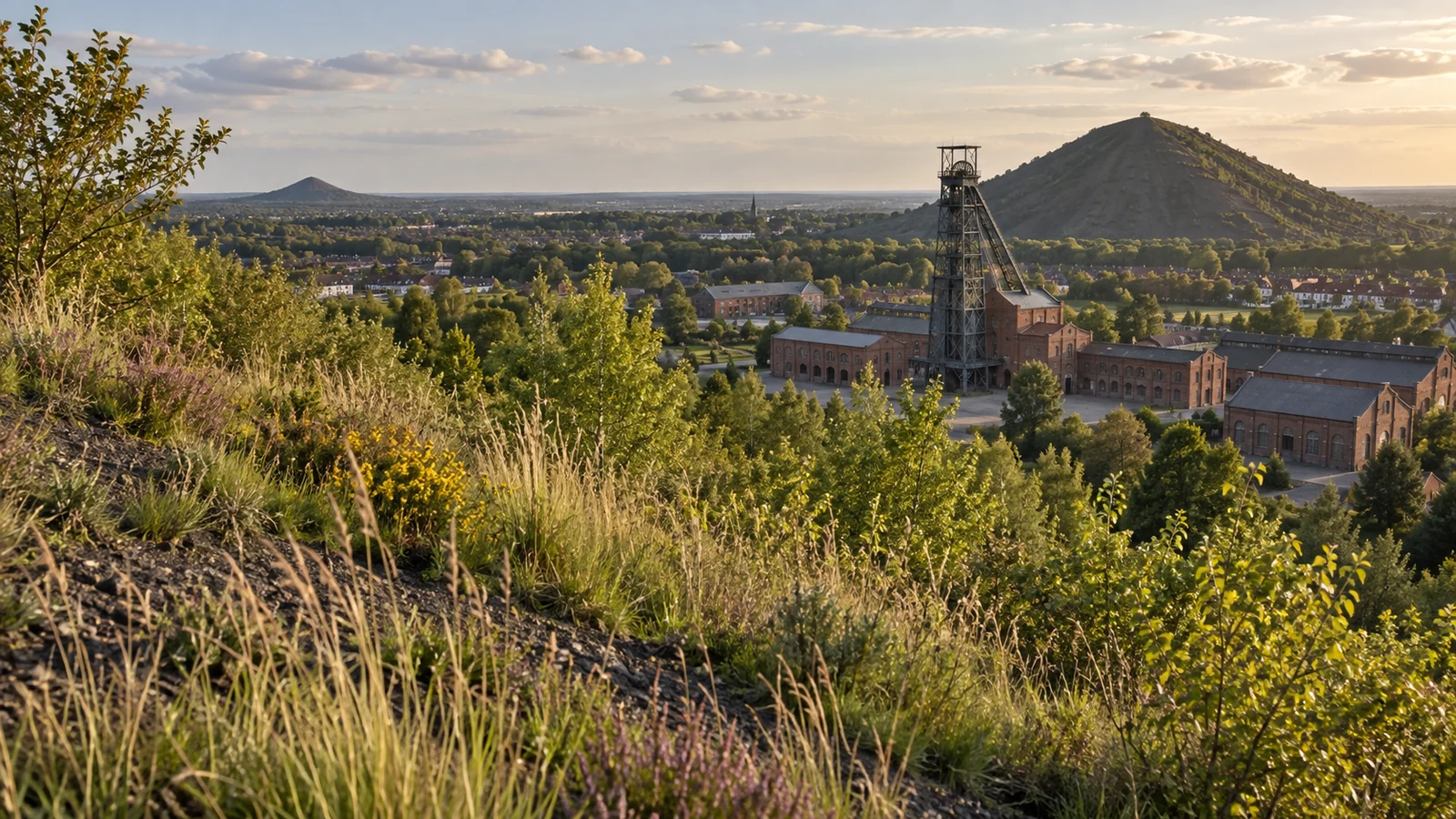
The landscape of the mining basin is marked by emblematic elements, foremost among which the slag heaps, the headframes and the pits. The slag heaps, these artificial hills formed by the accumulation of the spoil from extraction, have become the symbols of the mining basin, dominating the landscape with their characteristic silhouette. Some, among the highest in Europe, have covered themselves with vegetation and now shelter a surprising biodiversity, transforming into spaces of nature and walking. The headframes, these metal or concrete structures that surmounted the shafts, testify to the extraction activity and still rhythm the landscape where they subsist. The pits, coal-extraction sites, constituted the heart of mining activity, with their shafts, their installations and their buildings. To understand the working of the mine and the life of the miners, the memory sites offer a plunge into this universe: the Lewarde mine, a historical mining centre, allows one to discover the work at the bottom and the history of the exploitation. These elements, slag heaps, headframes and pits, form the characteristic landscape of the mining basin. They testify to the extent of the exploitation and its imprint on the territory. To discover these vestiges allows one to understand the reality of mining activity. This industrial heritage, preserved and valued, is an integral part of the cultural landscape of the mining basin.
| Element | What it represents |
|---|---|
| The slag heaps | Artificial hills of spoil |
| The headframes | Structures surmounting the shafts |
| The mining towns | Housing of miners and their families |
| The UNESCO listing | Cultural landscape inscribed in 2012 |
The mining towns and the miners' rows
Beyond the extraction sites, the mining basin is characterised by its mining towns and its miners' rows, which housed the miners and their families. These sets of dwellings, built by the mining companies, formed veritable districts, organised around the mine and workers' life. The corons, these rows of aligned and similar houses, have become one of the symbols of mining habitat, evoking the collective life of the miners' families. Over time, the companies developed varied forms of habitat, from the corons to the garden cities, offering dwellings accompanied by facilities. For mining life was not limited to work at the bottom: around the mine was organised a whole society, with its schools, its churches, its dispensaries, its community halls and its collective facilities. This organisation, framed by the companies, structured the daily life of the miners and their families, creating a close-knit community. The mining towns testify to this social and human dimension of the exploitation, beyond extraction alone. They are an integral part of the inscribed heritage, in the same way as the slag heaps and the pits. To discover the mining towns and the corons is to understand the daily life of the world of the mine. This built heritage, still inhabited, testifies to the mining identity and culture. The mining towns and the corons thus give a human face to the landscape of the mining basin.
A heritage recognised by UNESCO
The inscription of the mining basin on the World Heritage List of UNESCO, in 2012, consecrated the exceptional value of this territory. The mining basin was recognised as an evolving and living cultural landscape, testifying to the history of coal exploitation and its imprint on the territory and the people. This inscription, which concerns thousands of hectares and hundreds of remarkable elements, honours the richness and coherence of this heritage. It marks an important recognition for a region long associated with a difficult industrial past, by valuing its heritage and its memory. The listing underlines the value not only of the extraction sites, but also of the habitat, the facilities and the landscapes shaped by the mine. It recognises the mining basin as a coherent whole, witness of a major human and industrial adventure. This inscription also has a strong symbolic scope, by giving back pride and recognition to a territory and its inhabitants. It contributes to the preservation and valorisation of this heritage, as well as to its influence. The UNESCO listing made the mining basin a recognised heritage destination, attracting visitors and the curious. To understand the scope of this inscription allows one to measure the value of this cultural landscape. The mining basin, recognised by UNESCO, thus asserts itself as an exceptional heritage, to be preserved and passed on.
The Louvre-Lens, a symbol of reconversion
The mining basin, after the end of the exploitation, engaged in a profound reconversion, of which the Louvre-Lens is one of the most striking symbols. Established on the site of a former pit, in Lens, this museum of international scope illustrates the metamorphosis of a mining territory into a place of culture and influence. The choice to establish a branch of the Louvre in the heart of the mining basin marked a major step in the valorisation and reconversion of the region: the Louvre-Lens today offers art lovers an exceptional place, on the traces of the mining past. This museum illustrates the way in which the territory knew how to reinvent itself, by transforming the vestiges of the mine into cultural and tourist assets. The reconversion of the mining basin is not limited to culture: it also concerns planning, the environment and economic development, in a dynamic of renewal. The slag heaps become spaces of nature, the reconverted sites and the local initiatives testify to this transformation. The Louvre-Lens, by its extent and its scope, embodies this rebirth and this change of outlook on the territory. It shows how an industrial past can become a foundation for the future. The reconversion of the mining basin, of which the Louvre-Lens is the emblem, illustrates the resilience and dynamism of the region. To discover this transformation allows one to understand the mining basin of today, turned towards the future.
Visiting the mining basin
To visit the mining basin offers a plunge into the industrial and human history of the North of France, through its sites and its landscapes. Many places allow one to discover this heritage: the historical mining centres, which bring back to life the work at the bottom, the slag heaps that one can climb for a panorama over the territory, or the mining towns that testify to workers' life. The visit can take different forms, from the discovery of the museums and memory sites to walks on the slag heaps and in the towns. Each site brings light to a facet of mining history, from extraction to daily life. The territory, vast, offers multiple possibilities of exploration, according to the interests of each. Some slag heaps, developed, have become spaces of hiking and nature, offering remarkable viewpoints. The memory sites, for their part, allow one to understand the work of the miners and the organisation of the exploitation. To visit the mining basin is also to go to meet a strong culture and identity, still alive in the region. This discovery, rich and moving, offers a journey into the history and memory of the territory. To prepare one's visit, by choosing the sites to discover, allows one to organise an exploration to the measure of one's desires. The mining basin thus lends itself to varied visits, between heritage, memory and nature.
Discovering the mining basin from Arras
The mining basin is easily discovered from Arras, which makes it a destination of choice for an excursion. Located near the Arras town, it is easily accessible and offers a complete change of scene, in a territory charged with history. Arras, by its central position, constitutes an ideal starting point to radiate out and explore the riches of the region: Arras between metropolises and European borders illustrates this privileged situation, which puts many destinations within reach of a visit. An excursion in the mining basin allows one to complete the discovery of Arras with that of a unique industrial and human heritage. The proximity invites one to combine the visit of the Arras town and that of the mining territory, for a rich and varied stay. The mining basin, with its slag heaps, its memory sites and its history, offers a different discovery, complementary to the heritage of Arras. From the town, the excursion is easy and allows one to approach an essential page of regional history. To explore the mining basin is to understand the identity of the North of France and the memory of its inhabitants. This territory, recognised by UNESCO, is worth the detour during a stay in the region. To discover the mining basin from Arras is thus to enrich one's visit with a journey into the industrial and human history of the North.