
Where to eat in Arras depending on the occasion? Restaurants
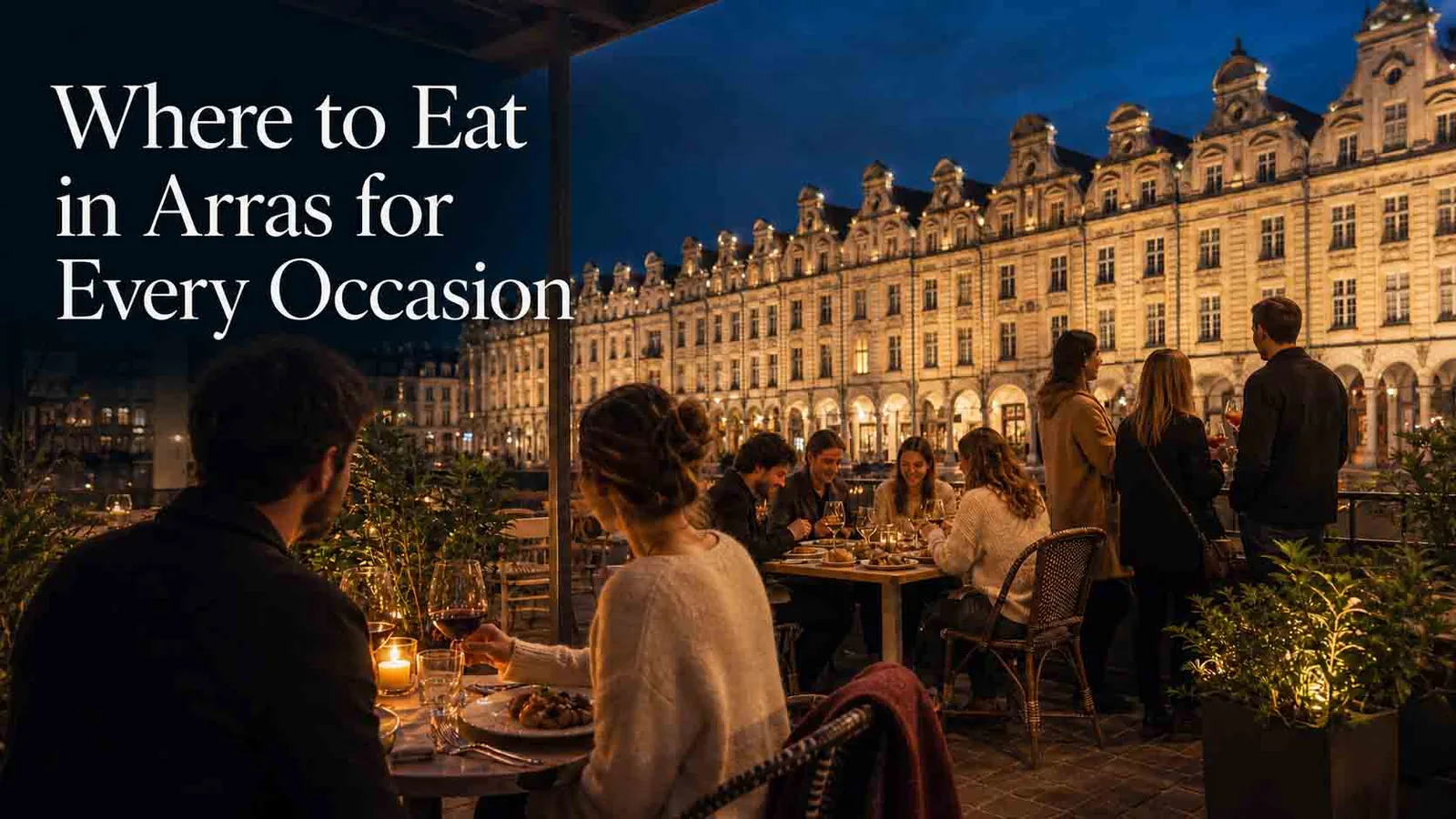
Deciding where to eat in Arras is far less a matter of rankings than of context: a lunch squeezed between two meetings, a Sunday family meal, a dinner meant to impress and a table of fifteen for a birthday call for neither the same district, nor the same budget, nor the same booking reflexes. Within a remarkably small perimeter, the capital of the Pas-de-Calais packs in square-side brasseries, estaminets faithful to northern cooking, quick options, neighbourhood cafés and caterers able to host an entire party. That density is a gift; it turns into a trap as soon as you approach it without method, opening a review app only to keep an average score. This guide therefore starts from the occasion itself and works back towards the address, rather than the other way round.
Why the occasion should drive your choice of restaurant in Arras
Starting from the occasion rather than a ready-made list avoids the most common disappointment: booking a charming table for a meal that never called for that setting, or landing in a lively brasserie when you came precisely to talk. The useful reflex is to qualify the meal before qualifying the restaurant; four questions almost always suffice (how many guests, how much time, what budget per person, what access or parking constraint). Once those answers are settled, the search becomes almost mechanical and the field narrows on its own. This is where a local directory earns its keep: the guide where to eat in Arras sorts venues by category (traditional dining, quick bites, bars and cafés, caterers) and by district, letting you filter on those criteria instead of drifting through contradictory reviews that are rarely put in context. An enthusiastic comment written by a couple on a weekend break tells you strictly nothing about a room's ability to seat twelve people on a Tuesday lunchtime, nor about its noise level at nine in the evening.
The district already sets the tempo
Arras reads as a handful of very different areas, and choosing a district already means choosing a pace. The historic core, around the Grand'Place and the Place des Héros, lines up its Flemish-Baroque façades and arcades: this is the land of terraces, of the meal that stretches out, of a setting that does much of the work for you. The shopping streets linking the two squares concentrate quick formats and cafés, invaluable when lunch has to fit into forty minutes. The station area moves to the rhythm of the trains; you will find brasseries used to tight departures, handy when the clock matters more than the atmosphere. Finally, the outer districts and neighbouring towns of the urban community offer what the centre struggles to provide: parking, larger rooms and often gentler prices, at the cost of a ten-minute drive. A visitor staying in the centre and a resident arriving by car should therefore not be consulting the same list, even though they are looking for the same thing.
Budget, duration and party size: three filters are enough
Budget should be worked out per person and drinks included, otherwise comparison is meaningless: between a lunch formula and the evening menu, the gap often exceeds double within the very same establishment. Duration is the most neglected criterion, yet the most structuring: table service rarely takes less than an hour and a quarter, whereas a quick address frees you in thirty minutes; scheduling a two o'clock meeting after a lunch started at 12.45 is therefore a gamble. Party size changes everything beyond six to eight people, since many small Arras rooms, perfect for two, become unworkable for a large table. These three filters intersect, and it is their intersection that decides: a table of ten on a Saturday evening in the centre, on a tight budget and with two hours to spare, mechanically reduces the list to a handful of addresses. Setting these constraints first saves considerable time and spares you from ringing ten restaurants only to be told no.
Opening hours, the blind spot behind most disappointments
Most bad surprises have nothing to do with the cooking and everything to do with the calendar. Outside Paris, evening service starts earlier and stops decisively: turning up at 9.45 pm on a Thursday exposes you to a kitchen that has already closed, even if the room is still busy. Sunday evening and Monday are the two most common closing days, precisely when passing visitors are looking for a table. All-day service remains a minority practice, which leaves a genuine gap between 2.30 pm and 6.30 pm, when only cafés and a few quick formats answer the call; a traveller arriving at three in the afternoon often learns this the hard way. Add to that the local high points (market days, braderies, festivals, the Christmas village) that saturate the centre and sometimes shift the usual hours. Checking the actual opening time the day before, by telephone rather than on a listing that may have been out of date for months, remains the single most profitable step of the whole preparation.
Table 1: choosing your table by occasion
| Occasion | Type of venue | Check first | Budget |
|---|---|---|---|
| Quick weekday lunch | Quick bites, café, caterer | All-day service, takeaway | € |
| Sunday family meal | Brasserie, traditional restaurant | Sunday opening, high chair | €€ |
| Dinner with friends | Square-side brasserie, wine bar | Terrace, noise level, last orders | €€ |
| Northern French cooking | Estaminet, regional brasserie | Mussel season, daily specials | €€ |
| Business lunch | Traditional restaurant, brasserie | Lunch formula, quiet room, invoice | €€ |
| Group of 10 or more | Restaurant with a function room, caterer | Group menu, deposit, private hire | €€ to €€€ |
| Birthday, wedding, reception | Event caterer | Written quote, equipment, staff | On quotation |
Where to eat in Arras with family or friends?
The sociable table is the most frequent occasion and, paradoxically, the worst prepared: the decision comes at the last minute, for six or eight people, on a Saturday, which is to say at the worst possible moment. Two reflexes change everything. The first is to book as soon as the group exceeds four, even for a plain brasserie; the second is to accept moving away from the two central squares, where weekend demand vastly outstrips supply. To spot the addresses locals actually frequent rather than those that capture passing trade, the selection where to eat like a local in Arras makes a solid starting point, with its neighbourhood tables, creative kitchens and family bistros. The rule of thumb fits in one sentence: a room full of regulars on a Tuesday evening tells you more than an average score computed from three hundred reviews, half of which rate the service rather than the plate.
Saturday lunch, in the wake of the market
The Arras market is held on Wednesday and Saturday mornings, from 8 am to 1 pm, on the Place des Héros and the Place de la Vacquerie, spilling over on Saturdays onto the Grand'Place and the pedestrian streets (city of Arras). That fixture shapes the whole morning in the centre, and therefore the lunch that follows. Two effects combine in practice: terraces fill up as soon as the market winds down, around midday, and parking becomes difficult well before that. Saturday lunch is therefore planned against the usual instinct: either you sit down early, ahead of the wave, or you push back past 1.30 pm, once the stalls are folded away and the parking spaces returned. It is also the liveliest moment of the week in the centre, which makes it an excellent way in for a visitor, provided you have booked or are willing to wait your turn. Shopping at the market then eating a few steps away remains, for many locals, a ritual more eagerly awaited than a restaurant dinner.
Dinner with friends beneath the arcades
Dinner with friends usually comes down to one trade-off: the setting or the quiet. The terraces of the Flemish squares offer one of the finest backdrops in northern France, with baroque gables and the belfry inscribed on the World Heritage list behind you (UNESCO, belfries of Belgium and France); in return, on a summer evening, noise levels and waiting times rise sharply, and conversation suffers for it. The adjoining streets, two minutes away on foot, offer smaller rooms where you can actually hear one another. The choice therefore depends on the shape of the evening: if the meal is its centrepiece, favour a dining room; if it is merely the prelude to a drink, the terrace does the job perfectly. One practical detail matters more than people think: ask what time last orders are when booking, so you do not discover at nine o'clock that the kitchen closes in ten minutes while half the group has yet to arrive.
With children, what actually counts
A family meal is not judged on the children's menu, often reduced to the same trio from one end of town to the other, but on three very concrete parameters. Space first: a narrow room and a pushchair make poor companions, whereas terraces set on the edge of traffic-free squares grant a freedom few cities allow. Time next: beyond an hour and a half, younger attention spans run out, which argues for a short formula rather than a multi-course menu. Noise finally, which cuts both ways: a lively brasserie forgives a great deal, whereas a hushed dining room turns the slightest outburst into a diplomatic incident. Estaminets often tick these three boxes, with their wooden games left out on the tables to keep children busy while the food arrives. Checking that a high chair is available, and that one plate can be shared between two children, settles most of the rest.
Where to eat in Arras to taste northern French cooking?
Northern French cooking is not folkloric set dressing; it is brasserie and estaminet food, built on beer, cheese, the potato and long, slow cooking. In Arras you meet it everywhere, from the neighbourhood bistro to the table on the Grand'Place, but not all versions are equal: a carbonade is judged on the depth of its sauce, a welsh on the quality of its cheese, and the chips on whether they were fried twice. Moules frites deserve separate treatment, so completely do they crystallise regional attachment; to widen the search across the Hauts-de-France, the overview where to eat mussels and fries lists addresses from Lille to the Opal Coast, by way of Arras and the Place des Héros. Worth remembering in passing: the dish is Belgian in origin, and its season does not span the year, something any serious establishment will tell you unprompted.
Welsh, carbonade and potjevleesch, the trio to know
Three dishes sum up the essentials of the repertoire. The welsh is a gratin of sliced bread, ham and cheddar drowned in beer, often crowned with an egg and served with chips; it is filling to the point of making a starter, and usually a dessert, redundant. Carbonade flamande is a beef stew simmered in brown beer, softened with mustard-spread gingerbread and brown sugar, whose sweet-savoury balance signals success or failure. Potjevleesch, literally “little pot of meat” in Flemish, brings together four white meats set in jelly and served cold with hot chips: the most disconcerting of the three for a visitor, and arguably the most revealing of the terroir. To that trio add the andouillette, for which Arras claims a long tradition and which divides as much as it unites. None of these dishes is light, which carries a rarely anticipated practical consequence: they sit poorly with a business lunch followed by an afternoon of work.
Mussels and fries, a question of season
The mussel season traditionally runs from late summer to early winter, when the shellfish is at its plumpest; it is also when regional menus push it hardest. The rest of the year you will still find it, but the promise is not the same. The most widespread preparation remains marinière (white wine, onions, parsley), then varied with cream, maroilles cheese or beer depending on the house, each defending its own version. Two clues rarely deceive: mussels served with their cooking juices, and chips fried on the premises rather than reheated. The pairing itself results from the convergence of two Belgian traditions: eating mussels in the coastal regions, a staple of the working classes because it was plentiful and cheap, and potato frying, popularised in brasseries during the twentieth century with the arrival of paid holidays. In Arras, seafood specialists and several brasseries in the centre serve them regularly.
The estaminet, as much a setting as a menu
The estaminet is not a restaurant like any other: it is a form of northern brasserie, at once a drinking house, a room of old games and a table of the terroir. You will find wooden tables, a menu that is short and unapologetic, a selection of regional beers and, frequently, traditional games left out for customers. That format explains its lasting popularity: you come as much for the atmosphere as for the plate, and the meal can stretch without anyone noticing. For a visitor, it is the most direct way to understand the regional food culture, that of a region marked by conviviality and simplicity; for a local, it is a landmark, sometimes handed down across generations. The trade-off is well known: these rooms are full in winter, when comfort food does its work, and they lend themselves poorly to a quiet meal or to a business meeting where you need to hear each other.
Table 2: northern specialities, season and context
| Speciality | What it is | Best season | Suits |
|---|---|---|---|
| Welsh | Gratin of bread, ham, cheddar and beer | Autumn and winter | Sociable meal, big appetite |
| Carbonade flamande | Beef simmered in brown beer with gingerbread | Autumn and winter | Family meal, estaminet |
| Potjevleesch | Four white meats in jelly, served cold | All year round | Discovering the terroir |
| Moules frites | Mussels marinière and home-cut chips | Late summer to early winter | Table of friends |
| Andouillette | A speciality of Arras tradition | All year round | Seasoned enthusiasts |
Where to eat in Arras for a group or business meal?
As soon as a meal involves a group or a professional stake, it changes nature: it is no longer an outing, it is a logistics exercise. The threshold sits around ten to twelve guests, beyond which most rooms will ask for a single or restricted menu, a deposit, and sometimes the private hire of a space. Three mistakes recur without fail. Booking too late, first: Saturday evenings and holiday periods go weeks in advance, and a group ringing on Thursday for Saturday is effectively accepting whatever is left. Announcing an approximate head count, next, when billing will often be based on the figure you gave. Neglecting the bill, finally; it is better to settle beforehand between a single payment, equal shares or separate bills, raising the question when booking rather than when paying. Arras holds a real advantage here: between the brasseries of the centre, the function rooms of the outer districts and event caterers, the offer covers a lunch for ten as readily as a reception for several dozen.
The business lunch: quiet, quick, predictable
A successful business lunch rests on three qualities no menu ever advertises: noise level, consistency of service and predictability of the bill. The lunch formula answers the last two, since it states a firm price and a service calibrated to turn the table in an hour. The first is settled on site, by asking for a table away from the thoroughfare or a banquette against a wall rather than a pedestal table in the middle of the room. Geography counts too: the centre is the obvious choice if the offices are there, but becomes a handicap the moment parking enters the equation, whereas the station area suits a meeting caught between two trains. Two details are worth confirming when booking: whether an invoice in the company's name can be issued, and whether the time slot is genuinely long enough, since a 1.30 pm appointment sometimes runs into a kitchen closing at two.
Birthday, wedding or graduation: think caterer
For an event, a restaurant is not always the right answer. An event caterer opens up three possibilities a conventional dining room rarely offers: hosting at home or in a venue of your choosing, tailoring the formula to the exact number of guests, and spreading the meal across a full running order (welcome, buffet, main, dessert) with no service constraint and no slot to vacate. In Arras and across the urban community, this offer exists for a twenty-person birthday as much as for a wedding reception. The quote must be written and itemised: exactly what it includes (equipment, tableware, staff, drinks, delivery, collection), the deadline for confirming numbers, and the cancellation terms. A graduation, a christening or a retirement send-off follow the same logic. The point to watch never changes: a price per head means strictly nothing until the scope of the service is set down in black and white.
The group meal: what to settle before you book
Booking for a group means fixing five things before you even pick up the phone. Head count first, with an honest range rather than an optimistic figure. The group menu next: beyond about ten guests, the full carte almost always gives way to two or three choices per course, which is not pettiness but a condition of service, since no kitchen can fire fifteen different preparations at once. Dietary requirements and allergies are flagged at that precise moment, not on the day as you sit down. Budget, then, is framed as drinks included or excluded, and that single clarification prevents half of all end-of-meal misunderstandings. Finally the real start time, allowing for latecomers: a table of fifteen announced for 8 pm and complete at 8.45 pm throws an entire service out of order. A single point of contact on the group's side, centralising changes, beats five people ringing the same restaurant.