
Arras capital: how was the department of the Pas-de-Calais born in 1790?

In 1790, the French Revolution overturned the administrative map of the country by replacing the old provinces with departments. It is in this great movement that the Pas-de-Calais was born, of which Arras became the capital. Former capital of the Artois, the town thus confirmed its role as an administrative centre, this time at the head of a new territory with unprecedented contours. This choice, heavy with consequences, durably anchored Arras in its status as a departmental capital, which it still occupies today. A look back at the birth of the Pas-de-Calais and at the accession of Arras to the rank of capital, a decisive turning point in its administrative history.
The Revolution redraws France
One of the great works of the French Revolution was the administrative reorganisation of the kingdom. Under the Ancien Régime, France was a complex assemblage of provinces, generalities, governments and districts with entangled limits, inherited from centuries of history. This organisation, judged irrational and unequal, was swept away by the revolutionaries, anxious to rationalise and standardise the administration of the country. In 1790, the National Constituent Assembly created the departments, new territorial districts conceived according to principles of rationality and equality. France was thus divided into a set of departments of relatively homogeneous dimensions, each endowed with a capital and its own administration. This reform, one of the most lasting of the Revolution, aimed to bring the administration closer to the citizens and to erase the old provincial divisions, symbols of inequality and particularism. The new departments received names most often drawn from geography, watercourses, mountains or situation, rather than from the old provinces, in order to break with the past. This new administrative map, put in place in 1790, constitutes the base of the territorial organisation of France, which endures for the essential to our day. It is within the framework of this vast reform that the Pas-de-Calais was created and that the question of its capital was posed. To understand this general context is indispensable to grasp the birth of the department and the role that fell to Arras. The creation of the departments marks indeed the passage from an Ancien Régime France, fragmented and complex, to a new France, organised according to rational principles, in which Arras was to find a leading place.
From the Artois to the Pas-de-Calais
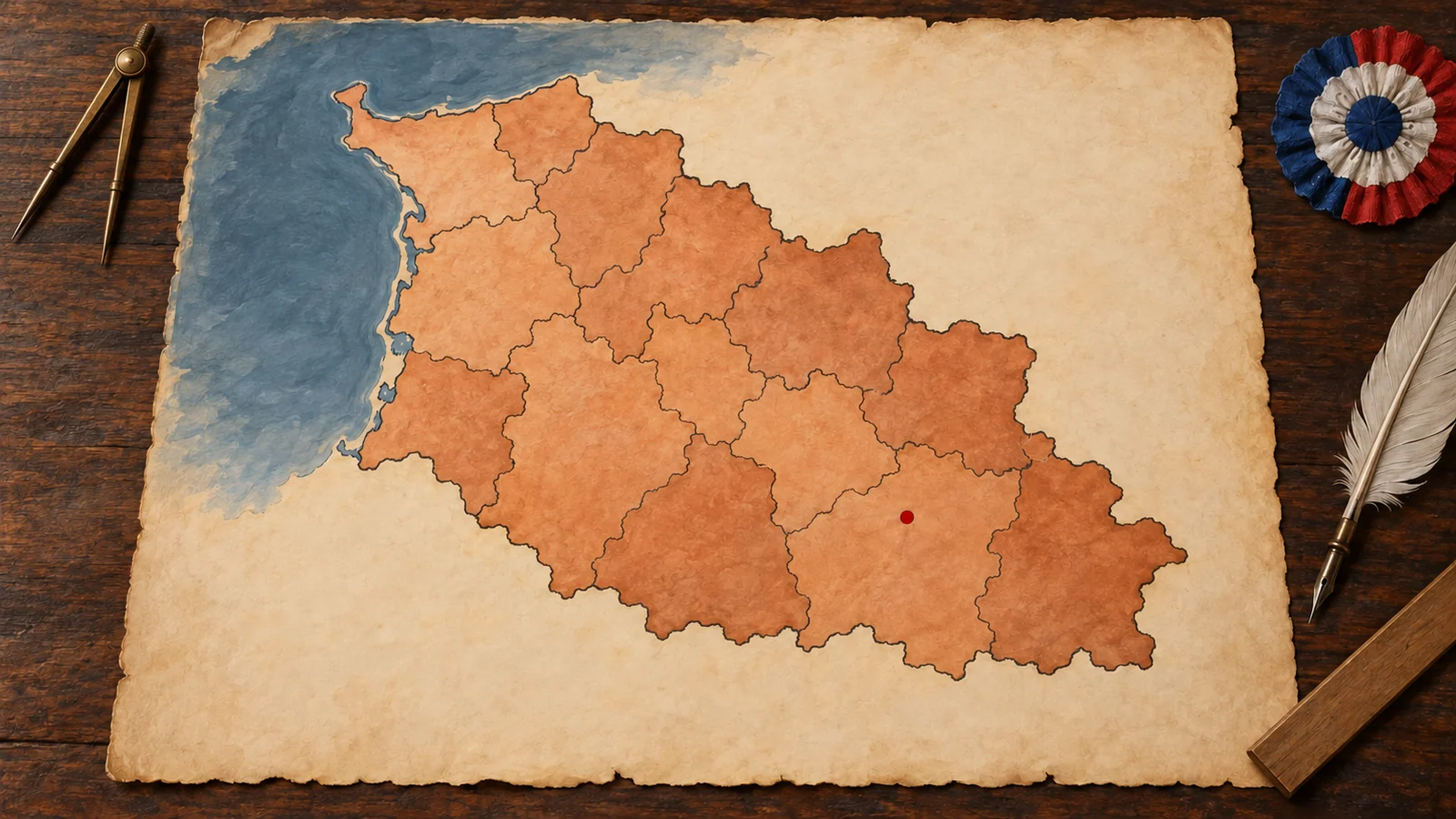
The creation of the department of the Pas-de-Calais, in 1790, proceeded from the grouping of several old territories. The new department was principally constituted from the Artois, of which Arras had been the capital, to which were added other neighbouring lands such as the Boulonnais, the Calaisis and part of northern Picardy. This assemblage gave birth to a new territory, with contours defined by revolutionary logic rather than by historical heritage. The very name of the department, drawn from the Strait of Dover, the Pas de Calais, that borders its coasts, illustrates the will to break with the old provincial appellations in favour of a neutral geographic reference. The disappearance of the Artois as an administrative entity marked the end of a long history, that of a province that had known many vicissitudes, having belonged in turn to the Flemish, Burgundian, Spanish world, before its definitive attachment to France. This eventful history, marked by sieges and treaties, gave way to a new organisation, that of the department. For Arras, which had never ceased to affirm its unity since the union of the Ville and the Cité in 1749, the creation of the Pas-de-Calais represented both a rupture and a continuity: rupture with the provincial framework of the Artois, continuity in its role as a regional administrative centre. The town, former provincial capital, was naturally to become the heart of the new department. To understand the formation of the Pas-de-Calais from the Artois and the neighbouring lands allows one to grasp the nature of this new territory and the place that Arras occupied in it, called to become its capital.
Arras, natural capital
The choice of Arras as capital of the Pas-de-Calais imposed itself almost naturally. Former capital of the Artois, the town had considerable assets to assume this role: a central position, a long administrative tradition, institutions and the status of an important city. For centuries, Arras had been the political and administrative heart of its province, seat of the principal institutions and place of residence of the authorities. It is from this town, capital of the Artois, that Robespierre, lawyer at the Council of Artois, was elected deputy of the province in 1789, on the eve of its transformation into a department. This anteriority conferred on it an obvious legitimacy to become the centre of the new department. The designation of a capital was not trivial: it determined the town that would house the administrations, concentrate the functions of direction and benefit from the prestige and the benefits linked to this status. The choice generally fell on an important town, well situated and having the necessary infrastructure. Arras met these conditions and imposed itself as the logical capital of the Pas-de-Calais. This choice confirmed and prolonged its historical role as regional capital, while inscribing it in the new framework of the department. For the town, to become capital represented a recognition of its importance and a guarantee of its maintenance at the rank of leading administrative centre. This accession to the status of departmental capital constitutes an important moment of the history of Arras, ensuring its continuity as a territorial capital despite the revolutionary upheavals. Where many towns saw their status modified by the administrative reorganisation, Arras preserved and confirmed its rank, passing from the status of capital of the Artois to that of capital of the Pas-de-Calais. This continuity, in change, testifies to the solidity of the administrative vocation of the town, anchored in a long history and confirmed by the Revolution.
What is a chef-lieu?
The term chef-lieu, or capital, designates the town which, within an administrative district, constitutes its centre and the seat of the institutions. The capital of a department is the town where the principal departmental authorities sit and where the administrative functions are concentrated. This status confers on the town a central role in the organisation of the territory and a particular prestige. In the system born of the Revolution, each department was endowed with a capital, chosen for its position, its importance and its capacities to house the administration. The capital housed notably the governing bodies of the department, then, from the Napoleonic period, the prefecture, seat of the representative of the State. To be the capital therefore implied becoming the point of convergence of departmental administrative life, with all that this supposes in terms of functions, jobs and activities. This centrality had concrete consequences on the life and development of the town, which benefited from the presence of the administrations and the movement they generated. The status of capital was not only honorary: it structured the organisation of the territory and made the designated town the heart of its department. For Arras, to become capital of the Pas-de-Calais thus meant to assume this role of administrative centre, with the responsibilities and advantages that accompanied it. To understand the notion of capital allows one to measure the importance of this status for a town and the stakes that attached to its designation. In the case of Arras, this accession confirmed and perpetuated its role as territorial capital, durably inscribing it at the centre of the administrative organisation of its region, a role it has never ceased to assume since.
A new administration
The creation of the department was accompanied by the setting up of a new administration, conforming to revolutionary principles. The territory was organised according to a hierarchy of districts: the department was subdivided into districts, themselves composed of cantons grouping the communes. This organisation on several levels aimed to structure the territory in a rational manner and to bring the administration closer to the citizens. Arras, as capital, housed the governing bodies of the department and became the centre of this new administration. The departmental authorities sat there, took their decisions there and coordinated public action there over the whole territory. This concentration of administrative functions in the town confirmed and reinforced its role as regional centre. The setting up of this administration marked a rupture with the organisation of the Ancien Régime, more complex and less uniform. It instituted a new framework, founded on principles of rationality, uniformity and representation. The departmental administrations, installed in Arras, were henceforth to set the rhythm of the life of the town and the department, making the capital the nerve centre of the territorial organisation. This new administration, born of the Revolution, knew subsequent evolutions, notably under the Consulate and the Empire, with the creation of the prefectures. But the departmental framework, put in place in 1790, remained, and Arras kept its role as capital through the changes of regime. To understand the setting up of this administration allows one to grasp how the new department was organised concretely and what central role Arras played in it, become the seat and administrative heart of the Pas-de-Calais.
| Marker | Detail |
|---|---|
| 1790 | Creation of the department of the Pas-de-Calais |
| Origin | Artois, Boulonnais, Calaisis, northern Picardy |
| Name | Drawn from the Strait of Dover (Pas de Calais) |
| Capital | Arras, former capital of the Artois |
Arras and its region
In becoming capital, Arras found itself placed at the head of a vast territory with varied realities. The Pas-de-Calais, formed of lands once distinct, presented a notable geographic and human diversity: the agricultural plains of the Artois, the coastline of the Boulonnais and the Calaisis, the lands of northern Picardy. This diversity made the new department a composite whole, which Arras now had the vocation to administer and represent. The town, situated in the heart of the rich Artesian plains, occupied a central position within this territory. Its role as capital implied coordinating the administration of an extended and varied region, with diverse needs and characteristics. This function of regional centre prolonged the historical vocation of Arras, capital of the Artois, while widening it to the framework of the new department. The town thus became the administrative point of reference of a territory that exceeded the limits of the old province. This role reinforced the links between Arras and its region, the town concentrating the functions of direction and serving as a relay between the central power and the territory. The position of Arras within the Pas-de-Calais, at once central and emblematic, confirmed its status as regional capital. It inscribed the town in a close relationship with the whole department, of which it became the administrative and symbolic heart. To understand the relationship between Arras and its region allows one to grasp the significance of its status as capital, which exceeded the sole framework of the town to extend to a whole territory. This regional dimension, anchored in geography and history, makes Arras much more than a simple town: a departmental capital, in the service of the whole Pas-de-Calais.
The prefecture and the administrative anchoring
The status of capital of Arras was reinforced and perpetuated under the Consulate and the Empire, with the creation of the prefectures. In 1800, the Napoleonic administrative reform instituted the prefects, representatives of the State at the head of each department, and made the capitals the seat of these new authorities. Arras thus became the seat of the prefecture of the Pas-de-Calais, confirming and consolidating its role as administrative centre. This institution of the prefecture durably anchored the town in its status as departmental capital. The prefect, representative of the central power, exercised his functions there, and all the services of the State were concentrated there. This administrative anchoring had important consequences on the life and development of the town, which benefited from the presence of the administrations and the prestige linked to its status. The prefecture became one of the symbols of the administrative function of Arras, materialising its role as capital. This organisation, put in place at the beginning of the nineteenth century, was maintained through the successive regimes, making Arras a stable and lasting departmental capital. The administrative anchoring of the town, inherited from the Revolution and consolidated by the Empire, constitutes one of the lasting traits of its identity. To understand the institution of the prefecture and its role allows one to measure the importance of the administrative anchoring of Arras and the continuity of its status as capital. Since 1790, and even more since 1800, the town has never ceased to assume this role of administrative centre, confirming its historical vocation as territorial capital, in the service of the department of the Pas-de-Calais.
Arras capital today
More than two centuries after the creation of the Pas-de-Calais, Arras remains the capital of the department, faithful to the role that was attributed to it in 1790. The town still houses the prefecture and the principal departmental administrations, confirming its vocation as territorial capital. This remarkable continuity testifies to the solidity of the administrative anchoring of Arras and to the relevance of the choice made at the Revolution. Through the changes of regime and the evolutions of the territorial organisation, the town has kept its status as capital, remaining the administrative heart of the Pas-de-Calais. This role contributes to the identity and dynamism of the city, which benefits from the presence of the institutions and the functions linked to its status. The administrative role of Arras is exercised notably from the public buildings of the centre, around the belfry and the town hall, symbols of municipal power, and from the prefecture, seat of the State in the department. This permanence of the status of capital inscribes Arras in a long tradition of regional capital, going back to the medieval Artois and confirmed by the Revolution. The town has never ceased, through the centuries, to assume this role of administrative centre, a pledge of its importance and its stability. To understand the continuity of the status of capital of Arras allows one to grasp the depth of its administrative vocation and the lasting link that unites the town to its territory. From capital of the Artois to capital of the Pas-de-Calais, Arras has remained, through the centuries, a capital in the service of its region, a role that constitutes one of the foundations of its identity and its history.