
D'Artagnan and the musketeers at the siege of Arras: history or legend?
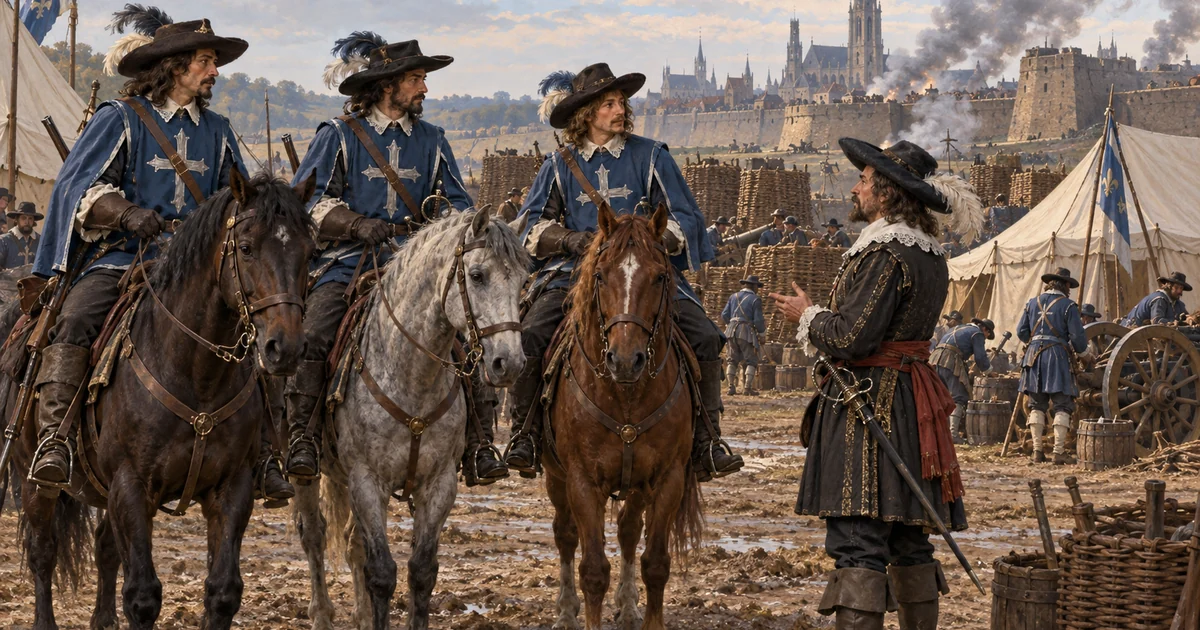
Few figures evoke as much adventure and panache as d'Artagnan and the musketeers. Now their legend crosses, in the collective imagination, the siege of Arras of 1640, that great feat of arms of the reign of Louis XIII. But what do we really know of the link between the famous king's musketeers and the conquest of Arras? Between the real history of the corps of musketeers, the biography of the true d'Artagnan and the powerful legend forged by the novel, it is fitting to untangle the true from the romantic. To understand this question is to explore the border between history and fiction, a fascinating exercise about an episode where military reality mingles with literary myth. A look back, with the historian's caution, at the musketeers, the siege of Arras and the legend that unites them in popular memory.
The siege of Arras of 1640, a very real fact
Let us begin with what is solidly established: the siege of Arras of 1640 was a major and very real military event. That year, the armies of the king of France took the town from the Spanish, at the end of a regular siege, as the history of the siege of Arras of 1640 recounts. This conquest, one of the great successes of the Franco-Spanish war, marked the beginning of the attachment of Arras to France. There is thus no doubt about the reality of the siege itself, abundantly documented. The question that concerns us is different: that of the presence and the role of the musketeers, and in particular of the famous d'Artagnan, in this episode. For it is there that history and legend begin to mingle. The siege of 1640 mobilised many troops of the king of France, and it is entirely plausible that elite units, such as the musketeers, could have taken part in it, these corps being engaged in the campaigns of the era. But to go from there to affirming the presence of a precise character is a step the historian takes only with caution. To distinguish the established fact, the reality of the siege, from what belongs to hypothesis or legend, the presence of this or that person, is essential to approaching this subject with rigour. The siege of Arras of 1640 is a solid historical base; it is on this base that a legend was then built, which it is fitting to examine for itself, without confusing it with the attested facts.
The king's musketeers, an elite corps
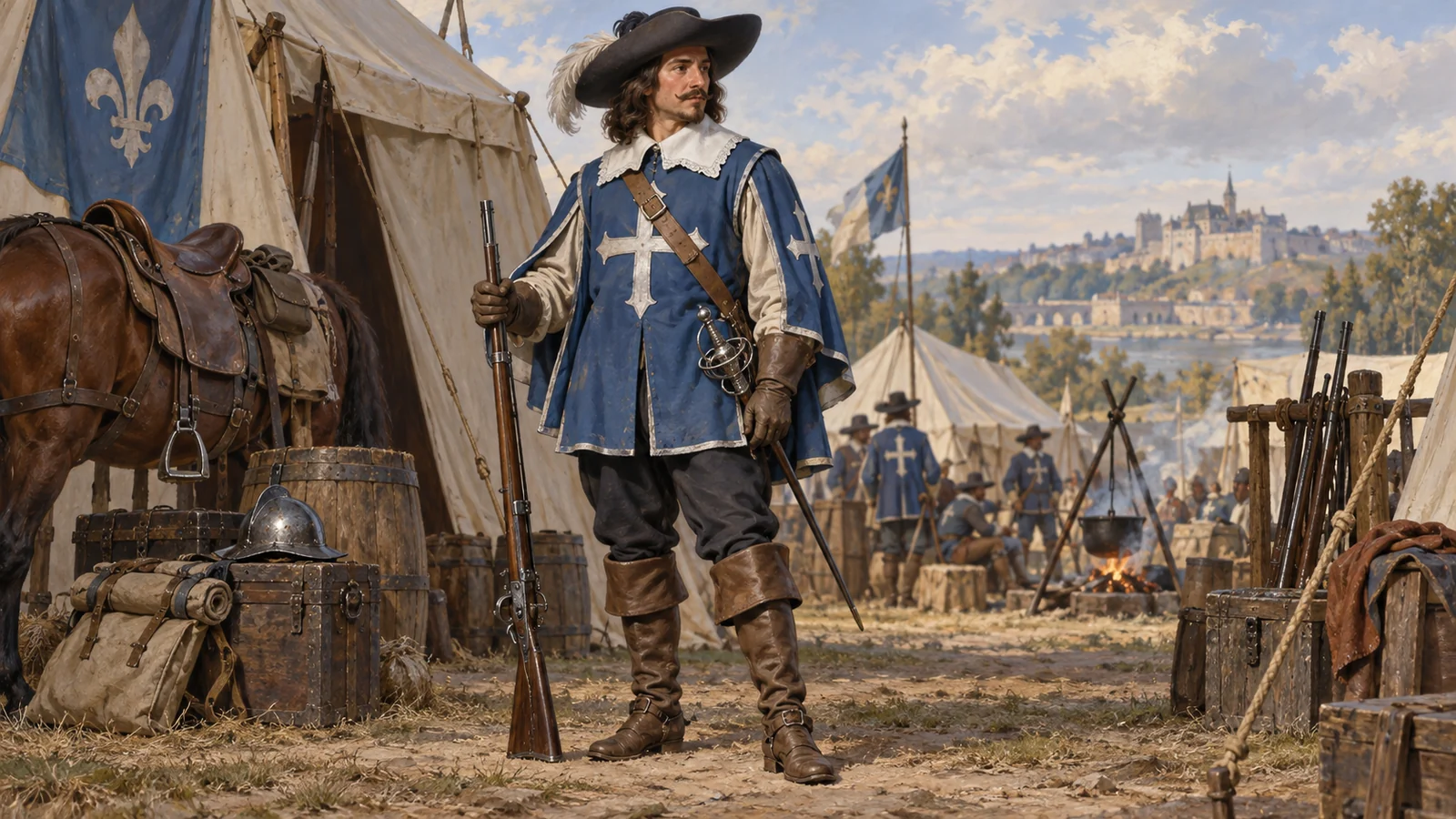
The king's musketeers were a very real military corps, an elite unit of the military household of the kings of France. Created under Louis XIII, these elite horsemen, armed with the musket that gave them their name, formed a prestigious troop, charged notably with the king's guard and engaged in the military campaigns. Far from the purely romantic image, the musketeers were soldiers in the service of the crown, taking part in the wars of their time, including the long struggle against Spain. It is therefore historically founded to say that the corps of musketeers existed at the time of the siege of Arras and that it took part in the military operations of the reign. These men, often from the nobility, sought in the service of arms glory, advancement and honour. The prestige attached to the musketeers, real in their time, was then considerably amplified by literature. To understand what the musketeers really were allows one to sort things out: behind the legend, there is a historical reality, that of an elite corps in the service of the king. This reality makes plausible their participation in the great campaigns of the era, including the sieges of the Spanish strongholds of the North. But it does not suffice to establish the presence of a precise individual at Arras in 1640. The musketeers as a corps are a reality; their association with the siege of Arras, through a character become mythical, belongs to another history, that of the literary legend, which must now be addressed.
| Marker | Detail |
|---|---|
| Established fact | The siege and taking of Arras in 1640 |
| The musketeers | A real elite corps under Louis XIII |
| D'Artagnan | A historical figure, much fictionalised |
| The legend | Forged above all by the 19th-century novel |
The real d'Artagnan and the novel's character
One must here carefully distinguish the historical d'Artagnan from the novel's character. The true d'Artagnan was a Gascon gentleman who indeed served as a musketeer and officer in the service of the kings of France in the 17th century, knowing a fine military career. He is an attested historical figure, whose existence is not in doubt. But his immense posthumous glory he owes to literature, which seized his figure to make him a hero of a novel, largely reinvented. The d'Artagnan everyone knows, that of the adventures of the musketeers, is largely a novelistic creation, inspired by the real character but considerably transformed and embellished. Between the historical man and the fictional hero, the gap is great. Now it is the novel's character, far more than the real man, who is associated in the imagination with the panache of the musketeers and their exploits. The question of d'Artagnan's presence at the siege of Arras of 1640 must therefore be posed with caution: the historical character, young at that time, could have been engaged in the king's campaigns, but to affirm it precisely belongs to hypothesis more than to demonstrated fact. As for the novel's d'Artagnan, he belongs to fiction, and his adventures, even if they draw on a real historical context, are not reliable sources on the events. To understand this distinction between the man and the myth is at the heart of the subject: it invites one not to confuse the fine legend with the historical reality, more modest and more uncertain.
The role of the novel in the legend
The legend associating the musketeers and d'Artagnan with the great sieges of the reign of Louis XIII owes much to the 19th-century novel. It is popular literature, through works become universally famous, that fixed in the imagination the image of the heroic, faithful and intrepid musketeers, mixed in the great events of their time. These novels, drawing on real historical characters and facts, transformed them into a flamboyant epic, where adventure and panache prevailed over accuracy. The considerable success of these works durably anchored in minds a certain image of the musketeers and of d'Artagnan, to the point that the border between history and fiction blurred in the collective memory. It is thus that real places and events, such as the siege of Arras, found themselves associated, in the imagination, with the exploits of the novel's heroes. One must therefore clearly distinguish the contribution of literature, which created and popularised a legend, from the historical reality, more complex and less spectacular. This distinction takes nothing from the pleasure of the legend, but it is necessary to whoever wants to understand history. The role of the novel in the making of the myth of the musketeers is a fine example of the way fiction can shape our perception of the past. To recognise this contribution allows one to appreciate the legend for what it is, a magnificent literary creation, while keeping in mind that it is not history. The real siege of Arras and the dreamed siege of Arras of the musketeers are two different things, which it is fitting not to confuse.
Why the legend still charms
If the legend of the musketeers at the siege of Arras persists, it is because it answers a need for the imaginary and the romantic. The history of the musketeers, with its panache, its sense of honour and friendship, its adventures and its prestigious historical setting, continues to fascinate. To associate these heroes with the great sieges of the reign, such as that of Arras, adds to the charm of the legend by anchoring it in real events. This meeting between history and fiction is fertile: it gives historical facts a romantic aura, and fiction an anchoring in the real. For a town like Arras, to be associated, even by legend, with figures as popular as the musketeers is not without interest: it contributes to its prestige and its imaginary. But it matters to keep a critical spirit and not to take the legend for history. The historian's approach consists precisely in distinguishing the two, in recognising what belongs to established fact and what belongs to the fine story. This does not forbid loving the legend or playing with it, but invites doing so knowingly. To understand why the legend of the musketeers still charms is to understand the power of narratives and their capacity to seize history to transfigure it. The siege of Arras of 1640, a major historical fact, found in this legend an imaginary extension, which contributes to its fame while calling, on the part of whoever wants to understand the past, for a useful work of untangling between reality and myth.
Arras, a place of war at the heart of the campaigns
The siege of Arras of 1640 recalls that at this era, the town was a leading place of war, at the heart of the military campaigns that opposed France to Spain. Conquered then defended, Arras became a stake and a base of support in this long war. Its border position made it a target and a lock, whose possession weighed on the balance of forces. To hold and protect the town, its defences were strengthened, making Arras a powerful fortress, as the Arras citadel, built a little later to lock the place, still testifies today. In this context of permanent war, the king's troops, including elite corps like the musketeers, were engaged in the operations of the region. It is therefore historically founded to say that Arras was a theatre of the campaigns of Louis XIII, where the king's soldiers fought. This military dimension, very real, is the base on which the legend was then grafted. To understand that Arras was a major place of war allows one to measure why its siege and its defence mobilised the best troops, and why the town belongs to the military history of the Grand Siecle. Far from being a fiction set, Arras was the place of real combats, bitterly disputed, in a war that decided its belonging. It is this reality, that of a place of war at the heart of the Franco-Spanish confrontations, that gives its historical consistency to the account, beyond the embellishments of the legend, and recalls that behind the panache of the novel's musketeers, there was the hard reality of the sieges and battles of the era.
From the Spanish siege to the French town
Beyond the legend, the siege of 1640 belongs to the great movement that made Arras pass from Spain to France. The town, long a Spanish possession inherited from the period when it came under Charles V, was wrested from Spain by the arms of the king of France. This episode, beyond the figures associated with it, real or legendary, marks a decisive turning point: the beginning of the French period of Arras. The musketeers, real or of the novel, are finally only one aspect of a vaster history, that of the conquest of a great town and its attachment to the kingdom. It matters not to let the legend eclipse this fundamental reality: what was played out at Arras in 1640 was the change of destiny of a city, its passage from one world to another. This historical significance far exceeds the, after all secondary, question of the presence of this or that character. To understand the siege of 1640 is first to understand this shift, which engaged the future of the town for the following centuries. The legend of the musketeers, however seductive, must not make one forget the essential: Arras became French following this siege, in a major turning point of its history. To restore this perspective allows one to put the legend back in its just place, that of a romantic ornament on a solid historical base. The real subject, behind d'Artagnan and the musketeers, is the destiny of a town, that of Arras passing from Spain to France, an event far more important than the adventures, real or dreamed, of the heroes with legendary panache.
History and fiction: a lesson in method
The case of the musketeers and the siege of Arras offers a fine lesson in historical method. It illustrates the necessity of distinguishing the sources and the levels of reality: the attested historical fact, the plausible hypothesis, the legendary construction. This distinction, at the heart of the historian's work, is particularly useful before subjects where history and fiction mingle closely, as is the case here. To take a novel for a historical source would be an error, just as to deny the real existence of the musketeers or of the siege of Arras. The truth lies in nuance: a real event, a real military corps, a real historical figure, but a legend largely forged by literature. To recognise each of these elements in its just place is the mark of a rigorous approach. This lesson goes beyond the case of Arras: it holds for all subjects where myth seizes history, which is frequent. It invites caution, critical spirit and respect for sources. For the town of Arras, this episode, at the crossroads of history and legend, is the occasion to recall the richness of its military past, while cultivating the critical sense. To sort out history and fiction does not impoverish the account: on the contrary, it enriches it, by allowing one to appreciate both the reality of a great siege and the beauty of a legend. The siege of Arras of 1640 and the myth of the musketeers thus coexist, each in its place, in the memory of the town, provided one knows how to distinguish them.