
The plague epidemics in Arras: how did the town face the scourge?
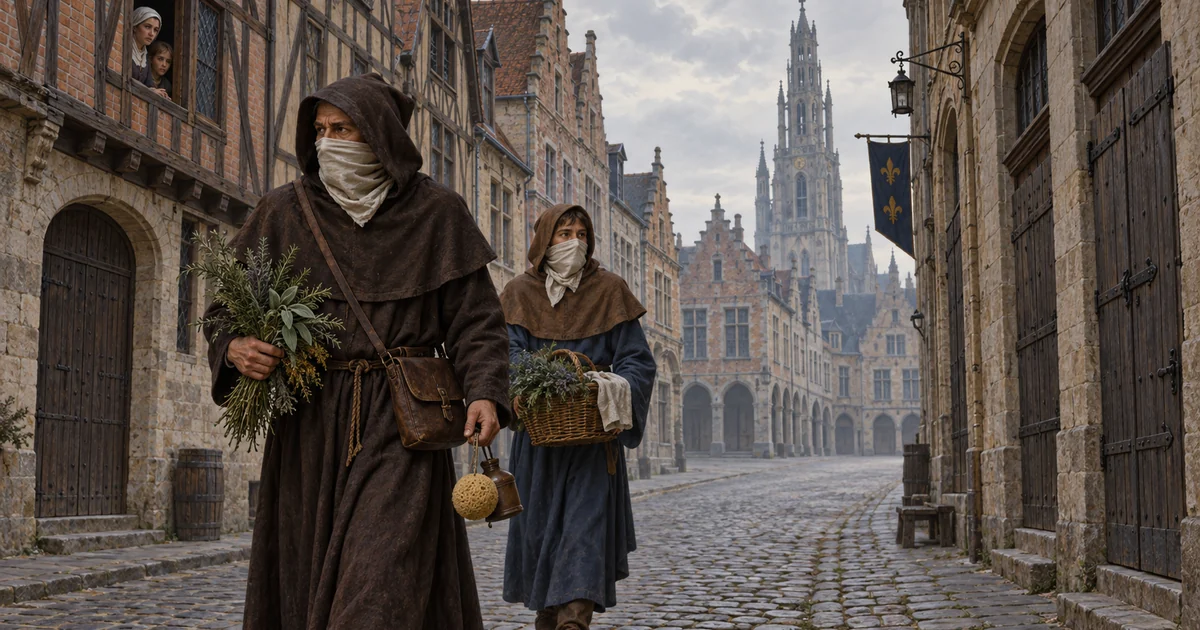
Like all the towns of Europe, Arras was, over the centuries, struck by a formidable scourge: the plague epidemics. From the Great Plague of the 14th century to the deadly returns of the following centuries, the disease periodically decimated the population, sowing terror and upsetting the life of the city. These episodes, common to all the West, light up the vulnerability of old societies before disease, as well as the fears, beliefs and responses it aroused. To understand the plague epidemics in Arras is to plunge into the history of health, mentalities and demography of a town confronted, at regular intervals, with mass death. A look back, with the historian's caution, at this scourge that durably marked Arras and the whole region, from the Middle Ages to the modern era.
The plague, a recurrent scourge of old societies
The plague was not a single event, but a recurrent scourge that haunted Europe for centuries. After the great wave of the mid-14th century, the disease returned regularly, in more or less deadly waves, until the modern era. Each return bereaved the towns, including Arras, and recalled the fragility of life before an ill that one knew neither how to prevent nor to cure. This recurrence is essential to understanding the impact of the plague: it was not a one-off catastrophe, but a permanent threat, inscribed in the horizon of the populations. The inhabitants of Arras, like those of the other cities, lived with the awareness that the plague could return at any moment, decimating families and neighbourhoods. This disease struck without distinction, touching rich and poor, even if modest living conditions aggravated the vulnerability. It upset the economy, notably an activity such as the drapery of Arras, by disorganising work and trade. To understand the plague as a recurrent phenomenon allows one to grasp its weight in the history of mentalities and societies: it shaped fears, behaviours and even the organisation of towns. Far from being a mere episode, it was a sinister and lasting companion of urban life, of which Arras, like all the great cities, made the tragic experience many times over the course of its history.
The Great Plague of the 14th century
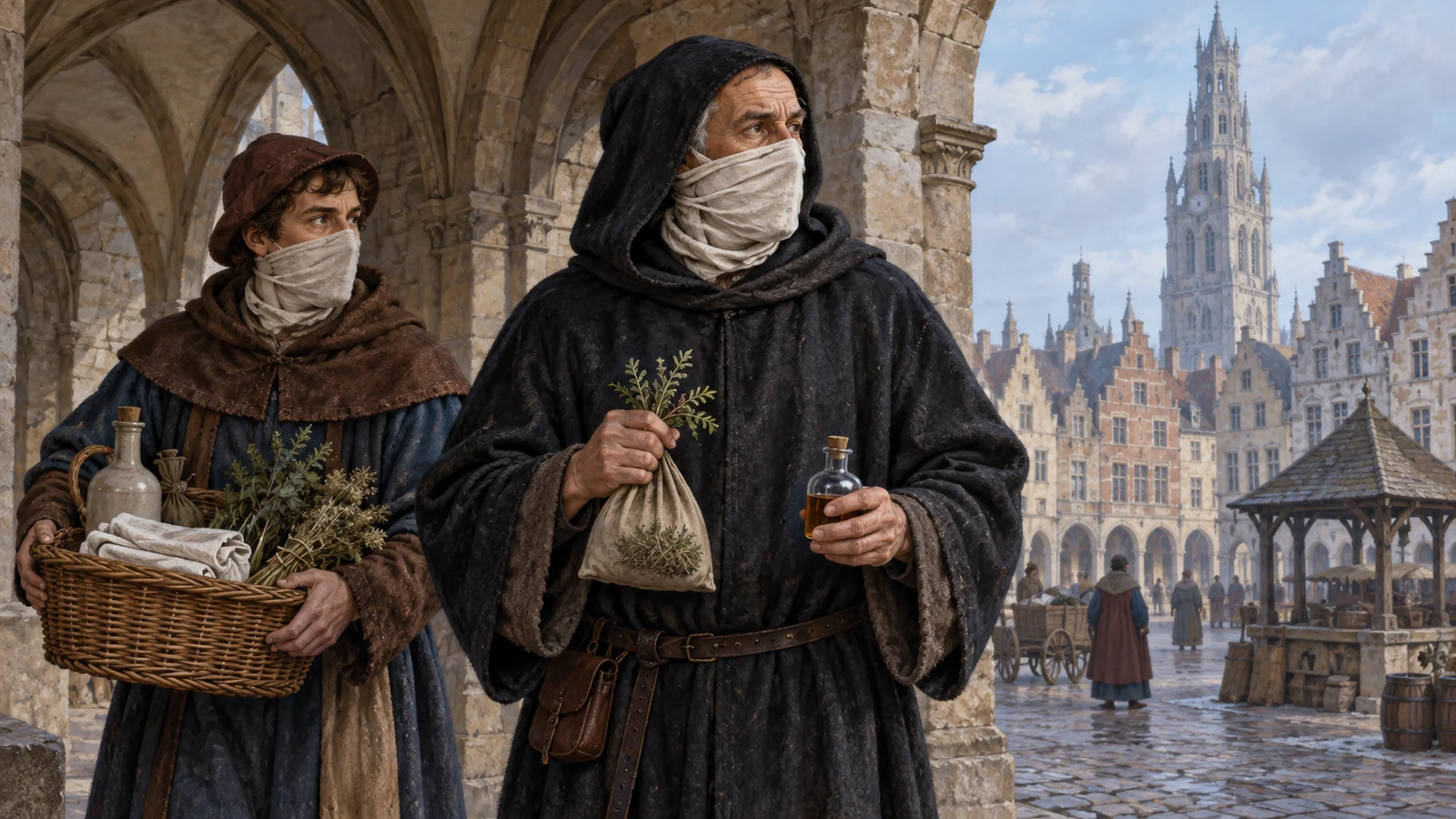
The most famous and most devastating episode was the Great Plague of the mid-14th century, often called the Black Death. Come from the East, it swept over Europe and wrought, in a few years, considerable havoc, carrying off an immense part of the population of the continent. No region was spared, and northern France, densely populated, was hard hit. Arras, a great town of the time, knew like the other cities this slaughter, even if the precise detail of its local toll demands caution, medieval sources being patchy. What is certain is the scale of the shock: the Black Death was one of the greatest demographic catastrophes of history, durably upsetting the societies it struck. It disorganised the economy, emptied villages, decimated towns, and left the survivors traumatised. Before a sudden and incomprehensible ill, the populations reacted by flight, prayer, sometimes the search for scapegoats. The Great Plague marked a turning point in the history of Europe, bringing about profound social, economic and religious transformations. For Arras, as for all towns, it was a terrible ordeal, whose memory long haunted minds. To understand this founding episode is essential: it inaugurated a long era of cohabitation with the plague, which was to return regularly to strike the city during the following centuries, making this scourge one of the great recurrent traumas of urban history.
| Marker | Detail |
|---|---|
| Nature | Plague epidemics, a recurrent scourge |
| 14th century | The Great Plague, a demographic catastrophe |
| Returns | Repeated waves until the modern era |
| Responses | Flight, prayer, care, sanitary measures |
The return of the epidemics
After the Great Plague, the disease did not disappear: it returned regularly, in successive waves, for several centuries. Arras, like the other towns, knew these periodic returns, which, without always reaching the scale of the Black Death, were no less deadly and dreaded. Each epidemic followed a sadly familiar pattern: appearance of the first cases, rapid spread, panic, emergency measures, then ebb, leaving behind it mourning and desolation. These returns maintained a permanent fear and shaped the organisation of towns, which gradually learned to react. Over time, the urban authorities developed measures to try to stem the epidemics: isolation of the sick, control of access, hygiene measures, so many empirical responses before an ill whose real cause was unknown. These arrangements, distant ancestors of our sanitary policies, testify to the efforts of old societies to protect themselves. The frieze below recalls the recurrent character of this scourge across the centuries. To understand these returns allows one to grasp that the plague was not only an event of the distant past, but a lasting threat, which accompanied the life of Arras until the modern era. This recurrence explains the place the disease occupied in mentalities, institutions and even the urbanism of towns, shaped by the necessity of facing, again and again, the return of the ill.
Caring for and helping the sick
Before the plague, the question of care and help for the sick arose acutely. In a society that ignored the real cause of the disease, the means to combat it were limited and often ineffective. Care rested on empirical remedies, charity and religious assistance, as much as on measures of isolation. The charitable and hospital institutions, inherited from a long tradition of aid to the poor and the sick, played an essential role, welcoming the victims and trying to relieve them. This tradition of welcoming the sick has been perpetuated over the centuries, up to the current health establishments that are the hospitals of Arras, distant heirs of these medieval institutions of care. In time of plague, these places were overwhelmed, and the devotion of those who cared, often at the peril of their lives, deserves to be underlined. The religious, the doctors and the carers sometimes paid a heavy tribute to the disease. To understand the dimension of care is important so as not to reduce the history of the plague to that of death: it was also that of the efforts, often heroic, to help the sick and maintain a semblance of order and solidarity before the scourge. These responses, however limited by the state of knowledge, testify to the capacity of old societies to organise themselves in the ordeal, and lay the milestones of a long history of public health, of which Arras, like the other towns, was the stage over the course of its ordeals.
Fear, religion and scapegoats
The plague did not only cause deaths: it also unleashed intense fears and collective reactions. Before an incomprehensible and sudden ill, the populations sought explanations and remedies in religion, multiplying prayers, processions and acts of devotion to implore divine protection or appease a supposed heavenly anger. The plague was often interpreted as a punishment from God, which fed a climate of penance and spiritual anguish. This religious dimension joins other episodes of the history of Arras, such as the devotion born of the burning sickness, another great scourge that had struck the town. But fear could also engender the worst: the search for scapegoats, the accusation of groups held responsible for the epidemic, with the persecutions that could ensue. This dark mechanism, alas recurrent in the history of epidemics, shows how fear can lead societies to turn against innocents. To understand these reactions is essential to grasping the impact of the plague on mentalities: it upset not only bodies, but also minds, exacerbating religious fervour as much as the most destructive impulses. This psychological and social dimension of the scourge is inseparable from its history, and recalls that great epidemics are as much events of mentalities as medical facts, revealing the deep springs of the societies they strike.
The consequences of a scourge
The consequences of the plague epidemics were considerable and lasting, far beyond the immediate deaths. On the demographic level, the successive waves slowed the growth of the population, sometimes for long periods. On the economic level, the plague disorganised work, trade and craft, dealing severe blows to prosperous towns like Arras. The loss of hands and know-how, the disorganisation of exchange, the crises that followed the epidemics weighed heavily. On the social level, the disease could upset the balances, redistribute fortunes, transform the relations between groups. Historians have shown how much the great epidemics were factors of change, accelerating or provoking profound transformations of societies. For Arras, a merchant town dependent on its economic activity, the epidemics represented a threat not only to lives, but to the very prosperity of the city. To understand these consequences allows one to measure the overall impact of the scourge, which far exceeded the mere count of victims. The plague was a major factor of history, shaping demography, economy and society over the long term. To restore this dimension is essential to grasping the place of the disease in the history of Arras: not a mere accident, but a force which, at regular intervals, came to shake the foundations of urban life and inflect the course of the history of the city.
What the historian can say about the plague
To write the history of the plague in Arras imposes a great methodological caution. The old sources, chronicles, registers, archives, are often patchy, scattered or difficult to interpret, especially for the most distant periods. The figures put forward by the accounts of the time must be handled with caution, for they sometimes belong to estimation or exaggeration. The historian of the plague therefore crosses the available documents, compares them, and refrains from asserting more than the sources allow. The progress of research, notably thanks to the contributions of historical demography and archaeology, has refined our knowledge of these epidemics, while recalling the share of uncertainty that remains. One must also distinguish the medical reality of the disease, today well identified, from the representations the contemporaries had of it, who attributed it to supernatural or erroneous causes. This double reading, medical and historical, allows one to understand both what the plague was and how it was experienced. For Arras, this means reconstructing, from scattered traces, the impact of a scourge that struck the town without one always knowing the precise detail. This rigour takes nothing from the interest of the subject, on the contrary: it invites an honest history, aware of its limits, which restores the scale of the scourge without yielding to approximations. To understand what the historian can, or cannot, say about the plague in Arras is essential to approaching this subject with the right measure, between the recognition of a real tragedy and caution before fragmentary sources, in respect of historical truth.
The plague in the memory of Arras
What remains, today, of this long history of the plague in Arras? A memory and lessons. If the great plague epidemics belong to the past, they have left an imprint in the history of the town, in its demography, its institutions and its mentalities. To remember these episodes is to measure the vulnerability of old societies before disease, and the scale of the ordeals crossed by the generations that preceded us. It is also to reflect on the way societies face health crises, a subject whose recent relevance has been recalled. The history of the plague in Arras, as elsewhere, offers an instructive mirror: it shows how fear, solidarity, stammering science and religion combined before the scourge. It also recalls the progress accomplished since, in the knowledge and the fight against diseases. To make this history known is not to yield to the morbid, but to do justice to the victims and to draw the lessons of the past. The plague, long a sinister companion of urban life, is part of the history of Arras just like its greatnesses and its glories. To look it in the face, with the historian's rigour, allows one to better understand the past of the town and the condition of the people who inhabited it, confronted with ordeals whose full scale and gravity we measure today, with hindsight.