
The arras of Wawel: why do the tapestries of Krakow bear the name of Arras?
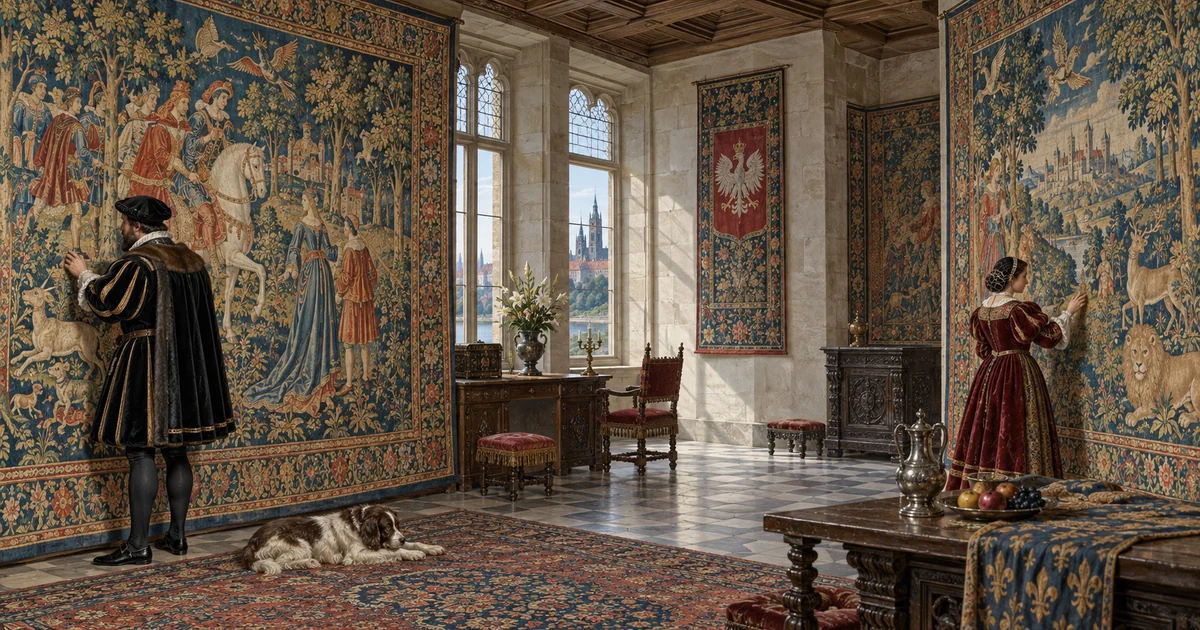
Hundreds of kilometres from Arras, in the royal castle of Wawel that overlooks Krakow, a prestigious collection of Renaissance tapestries bears a name that comes straight from northern France: the arras of Wawel. In Polish, the word arrasy still designates tapestries today, in memory of the town that, in the Middle Ages, was their European capital. This treasure of Krakow thus tells, in its own way, the glory of Arras, while posing a question the historian must treat with rigour: were these hangings really woven in Arras? The answer, nuanced, is fascinating, for it separates the reality of the workshops from the radiance of a name become synonymous with excellence. Here is the story of these distant arras, from the Polish queen to the Flemish workshop, and of what they tell us about the lasting imprint left by the Arras city on the language and art of all Europe.
Arrasy: when Polish borrows the name of Arras
The most striking fact lies in a single word. In Polish, a tapestry is called arras, in the plural arrasy, and this term derives directly from the name of the town. Like the tapestries of Arras that gave their name to the hanging in several Western languages, the fame of the city reached as far as Central Europe and inscribed itself in the Polish vocabulary. This linguistic phenomenon is no anecdote: it measures the extraordinary reach of the Arras reputation, able to mark a distant language for centuries. When Poles speak of the arrasy of Wawel, they use, without always knowing it, a word forged on the name of a town in the Artois. This lexical imprint is comparable to that which English kept with its own word arras. It testifies to a time when the textile luxury of Arras held authority from one end of the continent to the other, and when owning such works was, for the most prestigious courts, a sign of supreme refinement. The name of the town, detached from its actual production, had become a kind of universal label of quality, a password of artistic excellence. To understand why Polish says arras is already to measure the unique place the city held in the European imagination of the beautiful and the precious.
The treasure of Sigismund Augustus
The Wawel collection owes its existence to a great patron, the king of Poland Sigismund II Augustus, who reigned in the 16th century. This sovereign of the Jagiellon dynasty, enamoured of splendour and Renaissance art, gathered an exceptional set of tapestries meant to adorn the halls of the royal castle of Krakow, then the capital of the kingdom. One speaks of a considerable ensemble, several dozen pieces, forming one of the most important royal collections of hangings of its time. These works illustrated scenes from Genesis, landscapes peopled with animals, grotesques and ornamental motifs of great richness, in the refined taste of the northern Renaissance. Bequeathed by the king to the nation, they became a treasure of state, a symbol of the Polish monarchy. Through this princely commission, one finds the very function of the great tapestry, as it had asserted itself in the golden age of Arras: to display the power and refinement of a sovereign, to dress the places of power with magnificence. Sigismund Augustus, in gathering his arras, took his place in a long European tradition of textile patronage, of which Arras had been one of the cradles. The treasure of Wawel is thus, beyond borders and centuries, a distant heir of the prestige that the Arras city had first attached to the art of the storied hanging.
| Marker | Detail |
|---|---|
| Place | Royal castle of Wawel, Krakow (Poland) |
| Patron | Sigismund II Augustus, king of Poland (16th c.) |
| Polish name | Arrasy, from the name of the town of Arras |
| Origin of the weaving | Flemish workshops, above all Brussels |
Woven in Arras? The historian's nuance
Here, historical rigour is required and corrects a received idea. Despite their name, the tapestries of Wawel were not, for the most part, woven in Arras. Most came out of Flemish workshops of the 16th century, mainly in Brussels, by then become the great centre of luxury tapestry, after the decline of Arras as a producing city. The Polish word arras here designates the hanging in general, by linguistic inheritance, and not the precise place of manufacture of these works. To confuse the two would be an error the historian must avoid. This distinction between the name and the actual origin is at the heart of a scientific approach to history: one does not take a word for a proof, one goes back to the workshops, the marks, the archives. The case of Wawel illustrates wonderfully how the glory of Arras survived its production: the town had long ceased to be the leading weaving centre that its name continued to designate the object itself, as far as Poland. Far from weakening the interest of these tapestries for the history of Arras, this nuance enriches it: it shows the power of a cultural radiance that far overflowed the economic reality. To recognise that the arras of Wawel are above all Brussels works is to do justice both to the Flemish art that created them and to the town of Arras whose name, become universal, baptised them.
A masterpiece of the Flemish Renaissance
To reduce these hangings to a question of label would be to wrong them: they are masterpieces in their own right. Produced at the peak of the art of Renaissance tapestry, they testify to a dazzling technical and artistic mastery. The cartoons, those painted models, were the work of talented artists trained in the aesthetic of the Renaissance, and the weaving, entrusted to the best workshops, reached a remarkable finesse in the rendering of figures, landscapes and ornaments. The animated verdures, where beasts move in a lush nature, the monumental biblical scenes and the borders teeming with grotesques deploy a visual universe of great sophistication. These works illustrate the passage from medieval tapestry, flatter and more narrative, to Renaissance tapestry, playing on effects of perspective, volume and colour in the manner of painting. They constitute today an ensemble of inestimable heritage value, studied and admired by art historians the world over. That these treasures bear, in Polish, the name of Arras adds a further dimension to their interest: they link the Flemish Renaissance, the Polish monarchy and the memory of a town in the Artois. To admire the arras of Wawel is thus to contemplate at once a summit of European art and a living testimony to the way the name of Arras engraved itself in the culture of the continent.
A treasure that has weathered ordeals
The history of this collection is also that of a survival against all odds. The arras of Wawel have crossed centuries of turbulent history, marked by the partitions of Poland, the wars and occupations that struck the country. Several times, these hangings were dispersed, carried off, hidden or threatened, before being gathered and protected. In the 20th century, during the conflicts that ravaged Europe, they knew exile to escape destruction and plunder, travelling far from Krakow before returning to their castle. This heritage odyssey recalls the fragility of works of art before the storms of history, a theme that strangely echoes the fate of the tapestries of Arras themselves, almost all vanished from their town of origin. On one side as on the other, one measures how far the preservation of such a legacy depends both on the care of men and on chance. That the arras of Wawel survived where so many works perished makes them precious witnesses, not only of Renaissance art, but also of the efforts deployed over generations to safeguard a threatened heritage. Their preservation is in itself a lesson, that of the value peoples attach to the objects that embody their history and identity, beyond borders and regimes.
Genesis, animals and grotesques: the programme of the hangings
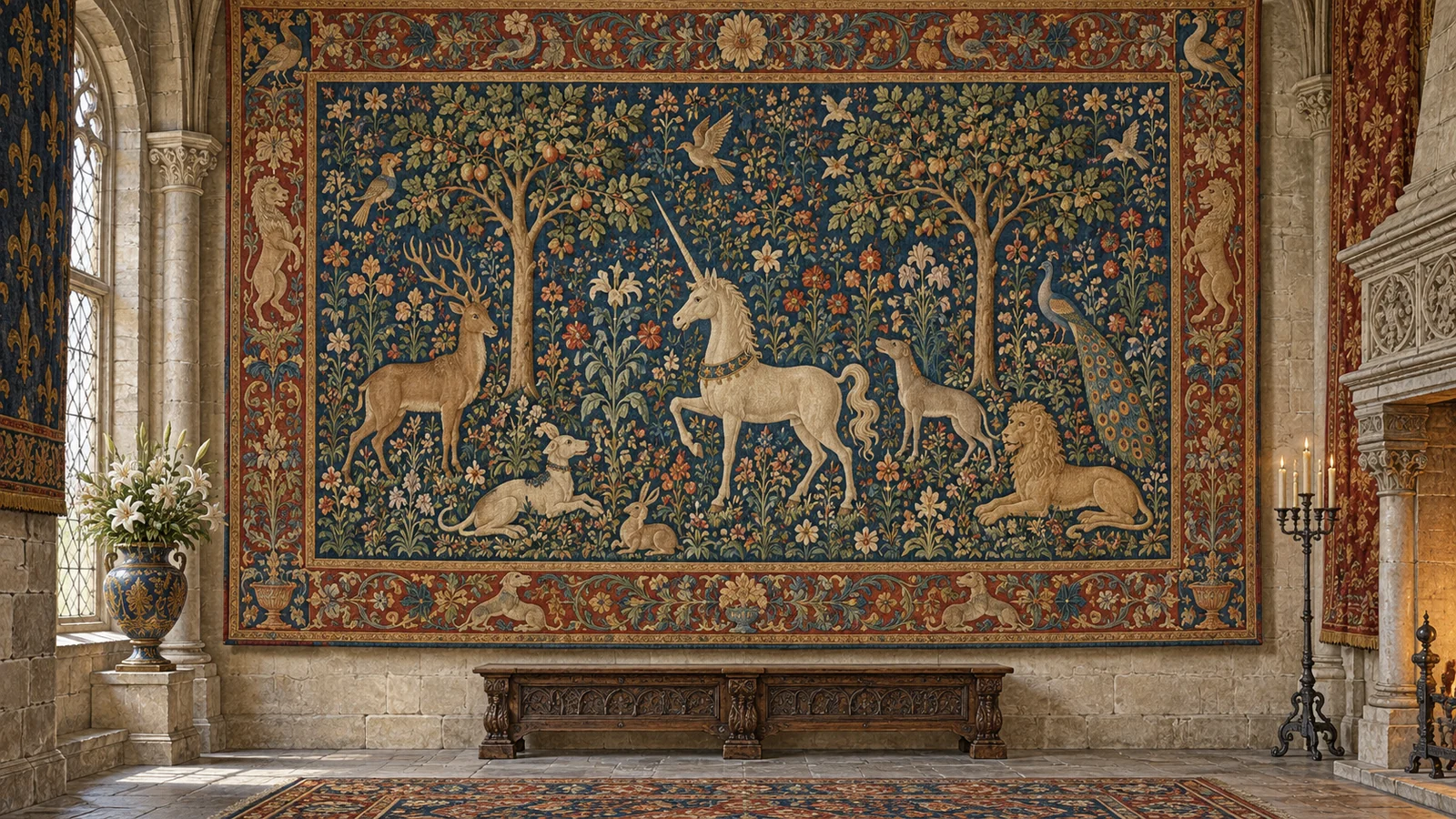
To grasp the richness of the treasure, one must dwell on what these hangings show. The royal collection was divided into large thematic ensembles of remarkable coherence. One series deployed the narratives of Genesis, from the creation of the world to the flood, offering a true woven Bible in which the great episodes of the origins could be read. Another group, famous above all, staged verdures peopled with animals, real or fabulous, moving in landscapes teeming with foliage, flowers and bluish distances. A third ensemble multiplied grotesques, those fanciful ornaments inherited from the Antiquity rediscovered in the Renaissance, mixing scrolls, figures and architectural motifs. To this were added borders adorned with emblems, monograms and royal arms, which signed the works' belonging to the sovereign. This programme was no mere decorative assemblage: it expressed a vision of the world, a learned taste and a will to dynastic assertion. The Genesis hangings recalled the divine order, the verdures celebrated nature in its profusion, the grotesques displayed the humanist culture of the patron. To study this iconographic repertoire, as art historians do, allows one to understand the total function of these works, at once objects of devotion, delight and representation of power, worthy heirs of the great tradition of which Arras had, two centuries earlier, laid the first milestones in Europe.
The Flemish Renaissance behind the arras
These works are only fully understood by linking them to the artistic centre that saw them born: the Flemish Renaissance. In the 16th century, the former Low Countries, and Brussels in particular, dominated the art of luxury tapestry, supplying the courts of all Europe. The painted models, or cartoons, were designed by artists versed in the vocabulary of the Renaissance, attentive to perspective, the modelling of bodies and the expression of figures, while the weavers translated these images into woven surfaces of extreme finesse. It was this milieu of painters, cartoon-makers and highly specialised workshops that produced the hangings of Wawel, in the distant but real wake of the tradition inaugurated by Arras. For it must not be forgotten: if Brussels shone then, it was in part because Arras had, first, carried this art to a summit and spread its prestige. The know-how, the commercial circuits, the princely clientele, all this had formed around the great centres of the North, of which the Arras city was the pioneer. The arras of Wawel thus appear as the late fruit of a tree whose roots Arras had planted. To recognise the part of the Flemish Renaissance in these masterpieces, far from diminishing the Arras contribution, on the contrary lights up its historical depth and its long continental posterity.
Seeing the arras today, from Krakow to Arras
Where can one admire, nowadays, this scattered legacy? The Wawel collection can be visited in Krakow, where it constitutes one of the jewels of the Polish national heritage, presented in the halls of the royal castle for which it was designed. For the visitor, it is the rare chance to contemplate a princely ensemble of hangings that has remained largely coherent, which is exceptional given how often such collections were dismembered. In Arras itself, on the other hand, almost nothing survives of the local medieval production, and it is toward institutions such as the Museum of Fine Arts or other great collections that one must turn to approach this art of the hanging and its history. This contrast between the Krakow that keeps its treasure and the Arras that has lost its own is rich in lessons on the hazards of heritage preservation. It also recalls that the radiance of a town is measured not only by the objects it keeps, but also by the trace it has left elsewhere, in museums, languages and memories. To bring the arras of Wawel and the memory of Arras into dialogue is to weave a thread between two towns that the history of art links across borders, and to make perceptible, to whoever takes an interest, the astonishing reach of the name of a town in the Artois.
Arras in Krakow: the imprint of a name
What remains, at the end of this journey, of the link between Arras and Krakow? A link made of words more than objects, but a powerful and lasting link. The Arras city did not weave the hangings of Wawel, but it gave them their name, and through it, a part of its soul. This linguistic legacy is the sign of a radiance few towns have known: to have imposed its name, in several languages of Europe, as the synonym of an art. It prolongs, as far as Poland, the memory of the medieval golden age of Arras, that of cloth-making, the fairs and the bourgeois wealth born of the communal charter of 1163. The treasure of Wawel thus offers the people of Arras a further reason for pride, by showing how far the reputation of their town carried. It also invites a broader reflection on the way names travel, detach themselves from their origin and take on a life of their own in cultures. Arras, a small town of the North, saw its name become, in Krakow as elsewhere, the very word for woven beauty. Few legacies are more elegant or more revealing of the place a city can hold, by its genius, in the long memory of Europe.