
The Battle of Arras of 1917: how did the British offensive unfold?
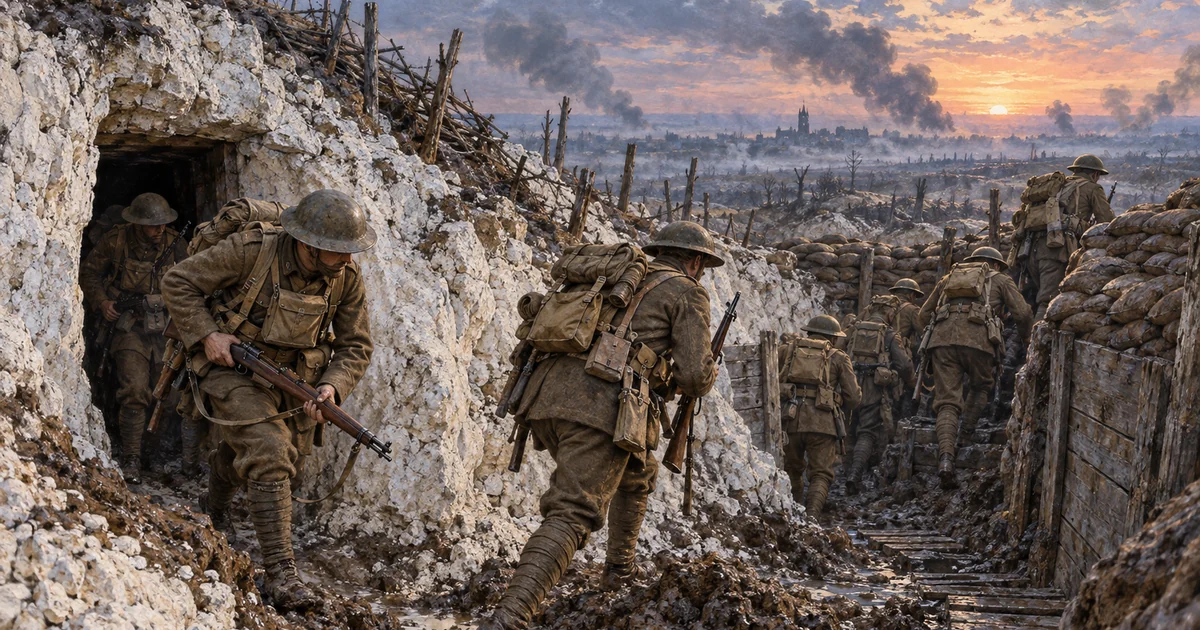
In the spring of 1917, Arras was the starting point of a great British offensive, one of the major battles of the First World War on the Western Front. From the town and its underground passages, where thousands of soldiers had massed in shelter, the assault was launched on 9 April 1917, with notably the famous attack on the Vimy Ridge by the Canadian troops. This battle, marked by fierce combats and very heavy losses, remains attached to the town and its region. A look back at the Battle of Arras of 1917, its unfolding and its memory.
Arras, base of the offensive
In the spring of 1917, Arras served as a starting base for a great Allied offensive. The town, situated in the front line and already largely ravaged by the bombardments, as the history of Arras under the shells recalls, became the point of support from which the attack was launched. Its position, at the closest to the front, made it a strategic place to prepare and unleash an offensive towards the enemy lines. From Arras and its surroundings, the British and Commonwealth troops prepared for the assault. The town and its subsoil played an essential role in this preparation, offering shelters and gathering points for the soldiers. This function of base of the offensive belonged to the situation of Arras as a front town, at the heart of the military operations. The city, a martyr of the bombardments, became the springboard of a great attack, illustrating its central role in the combats of the region. The choice of Arras as base of the offensive held to its position, at the closest to the enemy lines, and to its infrastructures, notably its underground network. The town, despite the destructions, offered the necessary conditions for the gathering and preparation of the troops. To understand the role of Arras as base of the offensive allows one to grasp the place of the town in the battle of 1917. A starting point of the attack, it was at the heart of this great military operation. From its ruins and its underground passages, the offensive was launched, making the martyr town the springboard of one of the great battles of the war. This strategic function, in a context of trench warfare, underlines the importance of Arras in the military operations of the front, beyond its martyrdom under the bombardments.
The context of 1917
The Battle of Arras belongs to the context of 1917, a pivotal year of the First World War. After more than two years of a bogged-down trench warfare, marked by costly offensives and limited gains, the general staffs sought to break through the front and to get out of the impasse. The year 1917 was that of several great Allied offensives, aiming to break the enemy lines. The offensive launched from Arras belonged to this strategy, in coordination with other operations on the front. The objective was to break through the enemy defences and to progress, in the hope of winning a decisive victory. Trench warfare, with its trenches and fortified lines, however made offensives extremely difficult and murderous. The assaults ran up against powerful defences, and the gains were often dearly paid. The context of 1917 was therefore that of repeated attempts to break through the front, in a war that seemed unable to be resolved. The offensive of Arras took part in these efforts, with the hopes and difficulties that characterised them. To understand the context of 1917 allows one to grasp the stakes and objectives of the Battle of Arras. This offensive was not isolated, but belonged to the Allied strategy of the year, aiming to break through the front and to win victory. The conditions of trench warfare, however, made this objective extremely difficult to attain. The Battle of Arras, like the other offensives of 1917, was to illustrate both the hopes of breakthrough and the terrible realities of trench warfare, made of fierce combats and considerable losses for often limited gains.
The quarries and tunnels
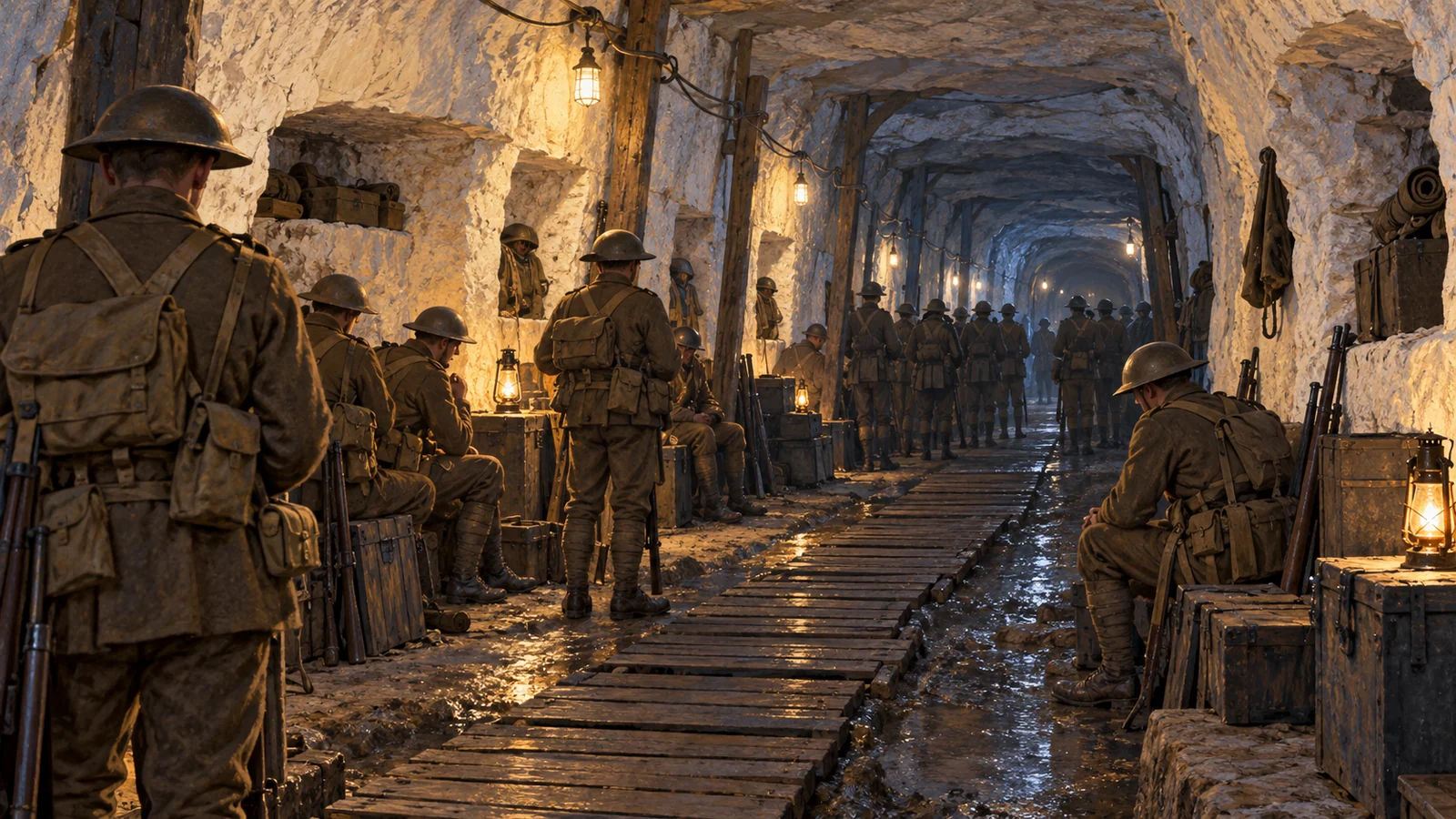
One of the most remarkable aspects of the preparation of the offensive of Arras was the use of the underground quarries and tunnels. Beneath the town and its surroundings extended a network of quarries and underground passages, inherited from the ancient history of Arras. During the war, this network was arranged and extended, notably by units of tunnellers, to shelter the troops before the assault. Thousands of soldiers could thus be massed underground, sheltered from the bombardments and enemy eyes, in the immediate vicinity of the front. This underground device allowed the offensive to be prepared in secret and the men to be protected until the moment of the assault. The Wellington Quarry, arranged by tunnellers, is one of the most famous testimonies of this underground effort, as the visit of the Wellington Quarry and the underground of Arras shows today. This network of tunnels and quarries played an essential role in the preparation of the battle, allowing the troops to be gathered and sheltered. The use of the subsoil, in a war marked by bombardments and the power of artillery, illustrates the ingenuity deployed to prepare the offensives. The soldiers lived underground the days preceding the assault, awaiting the signal of the attack. This underground world, on the eve of the battle, constitutes one of the most striking aspects of the history of the offensive of Arras. To understand the role of the quarries and tunnels allows one to grasp how the battle was prepared. The subsoil of Arras, arranged to shelter the troops, was a key element of the offensive, allowing the men to be massed in shelter before launching them into the assault. This underground effort, of which the Wellington Quarry is the symbol, testifies to the particular dimension of the Battle of Arras, prepared from the depths of the martyr town.
9 April 1917, the assault
It is on 9 April 1917 that the assault was launched, marking the beginning of the offensive of Arras. After an artillery preparation, the British and Commonwealth troops came out of their positions and the underground passages to attack the enemy lines. This date remains associated with the Battle of Arras and with one of its most famous episodes: the attack on the Vimy Ridge by the Canadian troops. The unleashing of the assault, after months of preparation, marked the passage to action, with all the hopes and dangers that this involved. The first days of the offensive knew successes, the troops progressing and seizing enemy positions. This initial assault, conducted with vigour, allowed significant gains, in a context where offensives often ran up against impassable defences. 9 April 1917 was thus a decisive day, that of the launch of the offensive and the first advances. The troops, come out of the shelter of the underground passages and the trenches, launched themselves into the assault, in the din of the battle. This day illustrates the critical moment of any offensive, that of the passage to attack, after the preparation. To understand the unleashing of the assault on 9 April 1917 allows one to grasp the beginning of the Battle of Arras. This date, associated notably with the attack on Vimy, marks the launch of the offensive and its first successes. 9 April was the day when, from Arras and its surroundings, the troops launched themselves into the assault of the enemy lines, opening the battle that was to bear the name of the town, in one of the great confrontations of the year 1917.
Vimy, the ridge conquered
One of the most famous episodes of the Battle of Arras was the conquest of the Vimy Ridge by the Canadian troops, on 9 April 1917. This height, which dominated the plain and constituted a strongly defended strategic position, was taken by assault by the Canadian corps, in a carefully prepared operation. The conquest of the Vimy Ridge was a notable military success, in a context where such advances were rare and dearly paid. This victory had a considerable resonance and became a symbol, notably for Canada, whose troops distinguished themselves there. The capture of Vimy has thus remained in memory as a marking moment of the Battle of Arras and of the Canadian participation in the war. It testifies to the meticulous preparation and the commitment of the troops, which allowed the conquest of a position reputed impregnable. The Vimy Ridge, today, is a high place of memory, where a memorial recalls the sacrifice and courage of the soldiers. The conquest of this height, during the Battle of Arras, constitutes one of the most famous feats of arms of the offensive. It illustrates both the successes that could be won and the price paid for these advances. The capture of Vimy, a symbol of courage and sacrifice, has become emblematic of the Battle of Arras and of the memory of the war in the region. To understand the episode of Vimy allows one to grasp one of the strong moments of the battle. The conquest of the ridge, by the Canadian troops, was a notable success, become a symbol. It recalls the scale of the combats fought around Arras in 1917 and the sacrifice consented to conquer the enemy positions, in one of the major battles of the First World War.
| Marker | Detail |
|---|---|
| Spring 1917 | British offensive launched from Arras |
| Preparation | Thousands of soldiers sheltered underground |
| 9 April 1917 | The assault and the conquest of the Vimy Ridge |
| The price | Fierce combats and heavy losses |
A murderous battle
Like the other great offensives of the First World War, the Battle of Arras was extremely murderous. If the first days knew successes, the offensive then ran up against powerful defences, and the combats bogged down. The initial gains could not be transformed into a decisive breakthrough, and the battle prolonged itself in fierce confrontations. The losses were considerable, on both sides, in combats of extreme violence. This reality, that of a battle costly in human lives, was characteristic of trench warfare, where offensives often ended in enormous losses for limited gains. The Battle of Arras did not escape this tragic logic. After the successes of the first days, the offensive ran out of breath, and the combats continued without allowing the hoped-for breakthrough. The human toll was heavy, illustrating the murderous character of the war on the Western Front. This tragic dimension of the battle recalls the terrible price paid by the soldiers in the offensives of the Great War. The combats around Arras, in 1917, cost the lives of very many men, in confrontations of extreme violence. To understand the murderous character of the battle allows one to grasp the reality of trench warfare. Behind the successes and the feats of arms, there was the reality of considerable losses and the suffering of the soldiers. The Battle of Arras, despite its initial successes, was a costly battle, whose human toll recalls the tragedy of the First World War and the sacrifice of the combatants engaged in these terrible confrontations.
The toll of the battle
The toll of the Battle of Arras illustrates the difficulties of the offensives of the First World War. Despite the successes of the first days, notably the conquest of the Vimy Ridge, the offensive did not allow a decisive breakthrough. After the initial advances, the combats bogged down, and the front, if it was modified, was not broken. The territorial gains, obtained at the price of very heavy losses, remained limited with regard to the initial objectives. This mixed toll was characteristic of the offensives of trench warfare, which most often failed to obtain the hoped-for breakthrough. The Battle of Arras, like other offensives of 1917, thus ended in a mixed result: notable successes, but no decisive victory, and considerable losses. This reality illustrates the strategic impasse of trench warfare, where the offensives, despite the means engaged, did not manage to durably break the front. The toll of the Battle of Arras belongs to this logic, with its successes and its limits. It recalls that, in this war, the advances were dearly paid and rarely decisive. To understand the toll of the battle allows one to grasp its real significance. Neither a brilliant victory, nor a total failure, the Battle of Arras was an offensive with limited results, obtained at the price of heavy losses. This toll, characteristic of trench warfare, illustrates the difficulties and tragedies of the offensives of the First World War. The Battle of Arras, despite the feats of arms that marked it, like the capture of Vimy, did not change the course of the war, but left a heavy human tribute, recalling the murderous and often indecisive character of the great offensives of the conflict.
The memory of the Battle of Arras
The Battle of Arras of 1917 left a deep memory in the town and its region. The places of memory, the cemeteries and the monuments recall the sacrifice of the soldiers who fought and fell during this offensive. The Wellington Quarry, arranged to shelter the troops before the assault, is today a major place of memory, allowing one to discover the underground passages where thousands of soldiers awaited the hour of the attack. Likewise, the Vimy Ridge, conquered on 9 April 1917, has become a high place of memory, where the Vimy memorial honours the courage and sacrifice of the Canadian troops. These places of memory perpetuate the memory of the battle and of those who took part in it. They recall the scale of the combats fought around Arras in 1917 and the price paid by the soldiers. The memory of the Battle of Arras belongs to the wider memory of the First World War, which so deeply marked the town and its region. To honour this memory is to remember the fallen soldiers and the combats fought, but also to recall the tragedy of the war. The places of memory of the Battle of Arras, like the Wellington Quarry and the Vimy memorial, are so many testimonies of this history. To understand the memory of the battle allows one to grasp the place it occupies in the memory of the region. A major battle of the First World War, it is today commemorated through its places of memory, which honour the sacrifice of the soldiers. The memory of the Battle of Arras, maintained through these sites, perpetuates the memory of one of the great confrontations of the war, inseparable from the history of Arras and its region during the conflict.