
Le Lion d'Arras: what was this siege newspaper born under the shells in 1916?
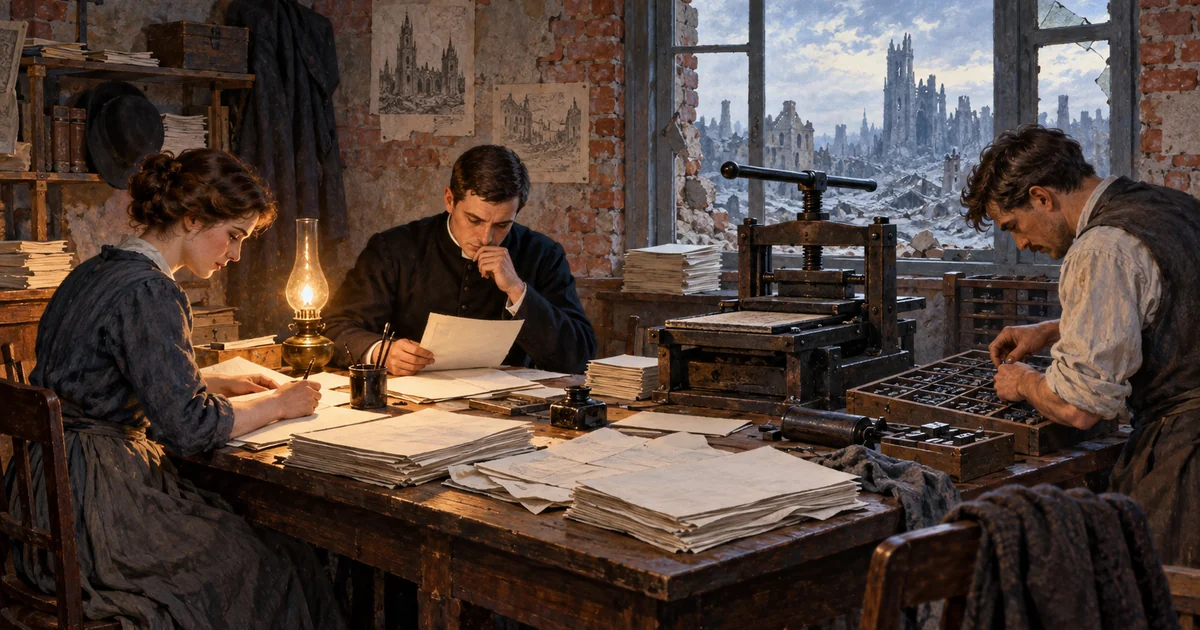
In the heart of the First World War, while Arras lived under the shells, a singular newspaper came into being: Le Lion d'Arras (The Lion of Arras). Founded on 1 January 1916 by Aymé Guerrin, with Jules Millecamps and Louis Ducrocq, this siege newspaper wished to be the organ of union of the people of Arras tried by the war. Bearing the name of the emblematic lion of the town, it testifies to the resistance and morale of a martyr city. A look back at this siege newspaper, its founder and the place it occupies in the memory of Arras during the Great War.
Besieged Arras and its newspaper
During the First World War, Arras, a front-line town, lived under the incessant bombardments, as the history of Arras under the shells recalls. In this dramatic context, where the town was largely destroyed and its population tried or dispersed, a singular newspaper was born, Le Lion d'Arras. That a newspaper could come into being in a besieged and bombarded town may surprise, but it answered a real need: to maintain the link between the people of Arras, tried and often dispersed by the war, and to testify to the life of the city under the shells. This siege newspaper belonged to a tradition of publications born in exceptional circumstances, to inform, unite and support the morale of tried populations. Le Lion d'Arras was one of these, a publication born of the war and the ordeal, in the service of the people of Arras. Its birth, in a martyr city, testifies to the will to resist, to maintain a link and to keep hope despite the ordeals. The newspaper thus became a form of moral resistance, a means of holding on in the face of adversity. This dimension confers on Le Lion d'Arras a particular place in the history of the town during the war. To understand the context of its birth allows one to grasp its meaning and significance. Born in a besieged and bombarded town, this siege newspaper testified to the resistance of the people of Arras and their will to maintain a link despite the dispersion and the ordeals. Le Lion d'Arras thus belongs to the history of the town during the Great War, as a testimony of the life and morale of a city under the shells, and as a form of resistance through word and information.
Aymé Guerrin, journalist and stretcher-bearer
The principal architect of Le Lion d'Arras was Aymé Guerrin, a journalist whose name remains attached to this publication. During the war, Guerrin did not content himself with founding and animating the newspaper: he also served as a stretcher-bearer at the Saint-Jean hospital of Arras, devoting himself to the care of the wounded in a town subjected to the bombardments. This double commitment, both by the pen and by care, testifies to his devotion to the town and its inhabitants during the ordeal. His action earned him, moreover, an official recognition after the war. Guerrin thus embodied the figure of the committed man, putting his skills and his energy in the service of the tried city. A journalist, he founded and animated the newspaper that was to maintain the link between the people of Arras; a stretcher-bearer, he cared for the wounded in a town under the shells. This path illustrates the commitment of a man during the war, in the service of the town and its inhabitants. Aymé Guerrin was not only the founder of a newspaper, but an actor of the support to the tried population. His name remains attached to Le Lion d'Arras, of which he was the inspirer and the animator. After the war, Guerrin pursued a career as a journalist, travelling and writing, before engaging, during the Second World War, in the Resistance. This later path, marked by a new commitment, testifies to the constancy of his devotion. To understand who Aymé Guerrin was allows one to grasp the spirit of Le Lion d'Arras. A journalist and stretcher-bearer, a man committed in the service of the tried town, he embodied, through his newspaper and his action, the resistance and devotion of a man of Arras during the Great War. It is this figure who gave birth and life to Le Lion d'Arras, a siege newspaper in the service of the martyr city.
The birth of Le Lion d'Arras
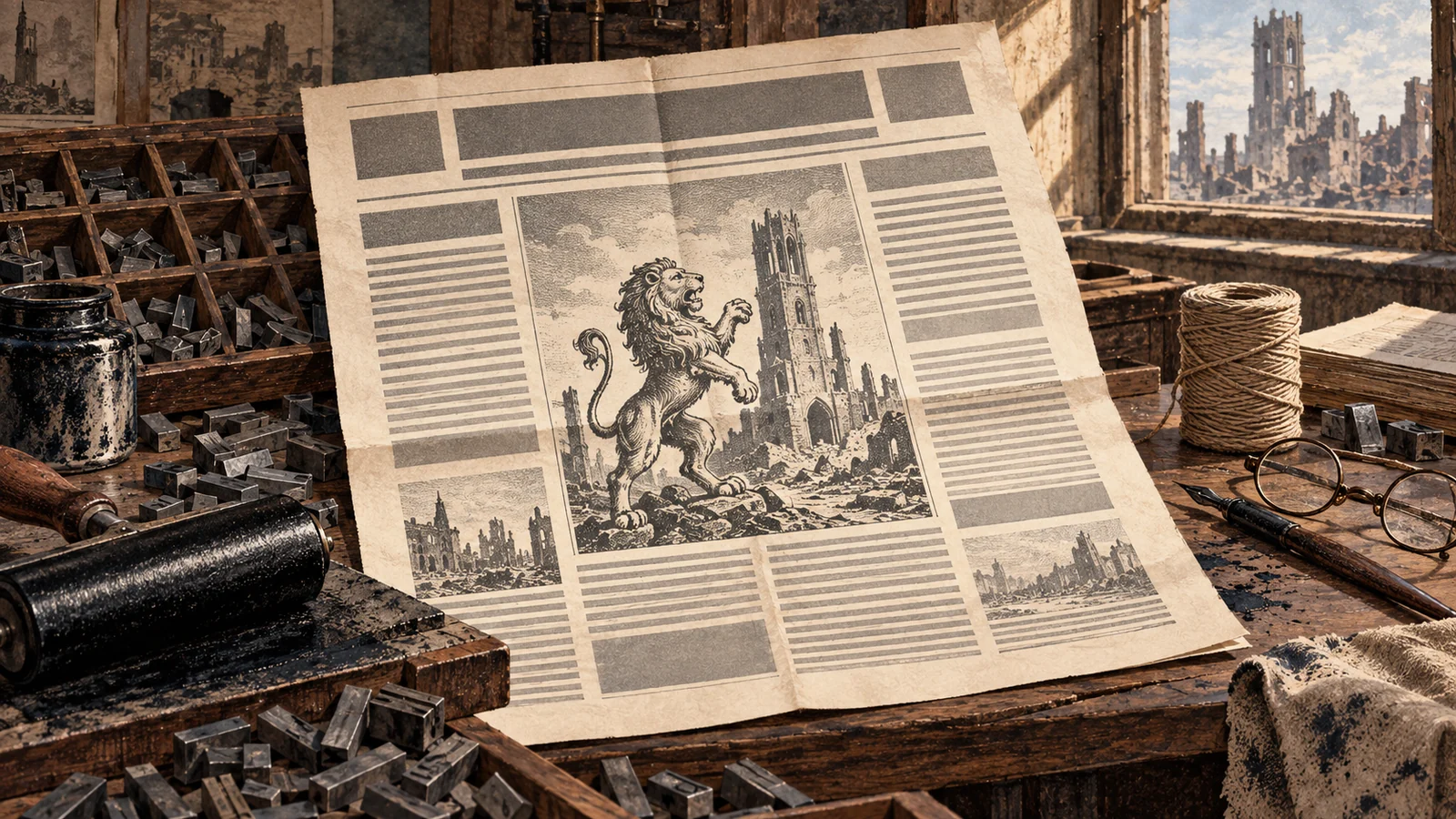
Le Lion d'Arras came into being on 1 January 1916, founded by Aymé Guerrin, with Jules Millecamps and Louis Ducrocq. This date marks the birth of a singular newspaper, born in the midst of the war, in a bombarded town. The creation of a newspaper in such circumstances was in itself a remarkable act, testifying to the will to maintain a life and a link despite the ordeal. The newspaper presented itself as a siege newspaper, a publication born of the exceptional circumstances of the war. Initially monthly, it became weekly in September 1917, a sign of its success and its anchoring in the life of the people of Arras. Its foundation, by a group of committed men, answered the need to testify, to inform and to unite the people of Arras, tried and often dispersed. Le Lion d'Arras thus became a link between the inhabitants of the town, wherever they were, and a testimony of the life of the city under the shells. Its birth, in 1916, belonged to the context of a war that dragged on and a town durably tried. The newspaper was to accompany the people of Arras during the years of war, maintaining a link and a morale. To understand the birth of Le Lion d'Arras allows one to grasp its origin and its vocation. Founded in 1916 in a bombarded town, this siege newspaper answered the need to testify and to unite the people of Arras during the ordeal. Its creation, by Aymé Guerrin and his companions, marks the beginning of a singular editorial adventure, born of the war and in the service of the town. Le Lion d'Arras, from its birth, asserted itself as the newspaper of the tried people of Arras, a link and a testimony in the dark years of the Great War.
A siege newspaper
Le Lion d'Arras defined itself as a siege newspaper, presenting itself as the weekly organ of a union of the people of Arras, in the Atrebatian spirit that recalled the ancient origins of the city. This appellation of siege newspaper tells all the singularity of the publication, born of the exceptional circumstances of the war and the front-line situation of the town. Such a newspaper had a particular vocation: to testify to the life of the besieged city, to maintain the link between the dispersed inhabitants, to support the morale and to assert the resistance in the face of the ordeal. The siege newspaper was not an ordinary publication, but a response to the circumstances of the war, a means of holding on and of maintaining a community despite the dispersion and the destructions. Le Lion d'Arras played this role, uniting the people of Arras around a publication that testified to their town and their ordeal. This dimension of union and resistance was at the heart of the vocation of the newspaper. In a largely destroyed town and a dispersed population, the newspaper maintained a common link and identity. It asserted, by its very existence, the permanence of the community of Arras despite the war. To understand the nature of siege newspaper of Le Lion d'Arras allows one to grasp its particular vocation. An organ of union of the people of Arras, born of the circumstances of the war, it testified to the life of the besieged city and maintained a link between its inhabitants. This function, proper to siege newspapers, made Le Lion d'Arras much more than a simple publication: an instrument of moral resistance and union, in the service of a community tried by the war. Its nature of siege newspaper explains its particular place in the history of Arras during the Great War.
The lion, symbol of the town
The very title of the newspaper, Le Lion d'Arras, referred to the lion, an emblematic figure of the town. The lion is indeed a symbol of Arras, found notably at the summit of the belfry, an emblematic monument of the city. In choosing this name, the founders of the newspaper placed their publication under the sign of this strong symbol, associated with the identity and pride of Arras. The lion evoked strength, courage and resistance, values that took on a particular meaning in the context of the war and the siege. The choice of this title was therefore not trivial: it inscribed the newspaper in the identity of the town and conferred on it a symbolic dimension. Le Lion d'Arras wished to be the mouthpiece of a resistant city, in the image of the lion that symbolised it. This reference to the symbol of the town reinforced the meaning of the newspaper as an organ of union and resistance. The belfry, surmounted by its lion, had been struck by the bombardments, as the visit of the belfry and the town hall, rebuilt after the war, recalls today. The lion, symbol of the struck but resistant town, gave its name to the newspaper, in a gesture charged with meaning. To understand the symbolic significance of the title allows one to grasp the spirit of the newspaper. In placing itself under the sign of the lion, emblem of the town, Le Lion d'Arras asserted its anchoring in the identity of Arras and its vocation of newspaper of resistance. The title, evoking strength and courage in the face of the ordeal, summed up the spirit of this publication born in a martyr city. The lion of Arras, symbol of the town, thus became that of a newspaper in the service of a tried but resistant community, during the dark years of the Great War.
| Marker | Detail |
|---|---|
| Foundation | 1 January 1916, in the midst of the war |
| Founders | Aymé Guerrin, Jules Millecamps, Louis Ducrocq |
| Nature | Siege newspaper, organ of Atrebatian union |
| The title | The lion, emblematic symbol of Arras |
To testify and maintain morale
The primary vocation of Le Lion d'Arras was to testify and maintain the morale of the people of Arras during the war. In a bombarded town and a dispersed population, the newspaper played an essential role of link and support. It informed the people of Arras of the life of their town, maintained a contact between the distant inhabitants and asserted the permanence of the community despite the ordeal. This role of link was crucial in a context where the war had dispersed the population and upheaved the life of the city. The newspaper allowed one to keep a contact, to share news and to maintain a feeling of belonging. The newspaper also accompanied the great events the town knew, such as the Battle of Arras of 1917. It also contributed to supporting the morale, by asserting the resistance and hope in the face of adversity. In the darkest moments, such a publication brought a comfort and an encouragement, recalling that the community was resisting and keeping hope. Le Lion d'Arras thus fulfilled a moral function as much as an informative one, in the service of the tried people of Arras. This double vocation, of testimony and support, made the newspaper a precious instrument during the war. It did not content itself with informing: it united, supported and encouraged. To understand this vocation allows one to grasp the importance of Le Lion d'Arras for the people of Arras during the war. A siege newspaper in the service of the tried town, it testified to the life of the city, maintained the link between the inhabitants and supported their morale. This essential function, in a context of war and dispersion, explains the place the newspaper occupied in the life of the people of Arras. Le Lion d'Arras was thus much more than a publication: a link, a support and a testimony, in the service of a resistant community during the dark years of the Great War.
Le Lion d'Arras after the war
Le Lion d'Arras did not disappear with the end of the combats: it continued after the war, until January 1920. This continuation, beyond the armistice, testifies to the anchoring of the newspaper in the life of the people of Arras and to its role during the period of the coming-out of war and reconstruction. After the years of siege and bombardments, the town indeed entered a new ordeal, that of the reconstruction of a largely destroyed city. The newspaper accompanied this transition, continuing to testify and to inform while the town bound its wounds and rose again. Its continuation until 1920 illustrates its usefulness and its anchoring in local life, beyond the strict context of the war. The newspaper moreover evolved, adapting to the new situation of the post-war and the reconstruction. This continuity testifies to the vitality of the publication and to its role in the life of the people of Arras. Born during the war, the newspaper accompanied the town in the first years of peace and reconstruction, before giving way to other publications. To understand the continuation of Le Lion d'Arras after the war allows one to grasp its anchoring and its evolution. Continued until 1920, the newspaper accompanied the town during the coming-out of war and the beginning of the reconstruction, prolonging its vocation of link and testimony. This continuity, beyond the armistice, illustrates the importance the newspaper had acquired in the life of the people of Arras. Le Lion d'Arras, born of the siege, thus accompanied the town in its ordeal then in its rebirth, before fading away, leaving the memory of a singular newspaper, born of the war and in the service of the city.
A source for memory
Today, Le Lion d'Arras constitutes a precious source for the memory of the town during the Great War. The collections of the newspaper, preserved notably in the archives, testify to the life of Arras under the shells and during the coming-out of war. They offer a view from the inside of the ordeal lived by the town and its inhabitants, a testimony written at the very moment of the events. This value of historical source makes Le Lion d'Arras an important document to know Arras during the war. Through its pages, one can approach the reality of life in a besieged town, the morale of the inhabitants, the preoccupations and hopes of a tried population. The newspaper, as a direct testimony, completes the other sources on the town during the war, bringing a local and immediate point of view. This memorial dimension prolongs the initial vocation of the newspaper, which was already to testify. What was, during the war, a siege newspaper in the service of the people of Arras, has become, with time, a source for the history and memory of the town. The archives that preserve the newspaper allow one today to study and to make known this page of the history of Arras. To understand the value of source of Le Lion d'Arras allows one to grasp its importance for memory. A direct testimony of the life of Arras during the war, the newspaper is today a precious source, preserved in the archives and studied by historians. Its memorial value prolongs its vocation of testimony, making Le Lion d'Arras an essential document to know and to remember Arras during the Great War. This siege newspaper, born of the ordeal, thus remains, a century later, an irreplaceable witness of the martyr city and of the resistance of its inhabitants.