
The troubles of Arras (1577-1578): how did the town cross the revolt?
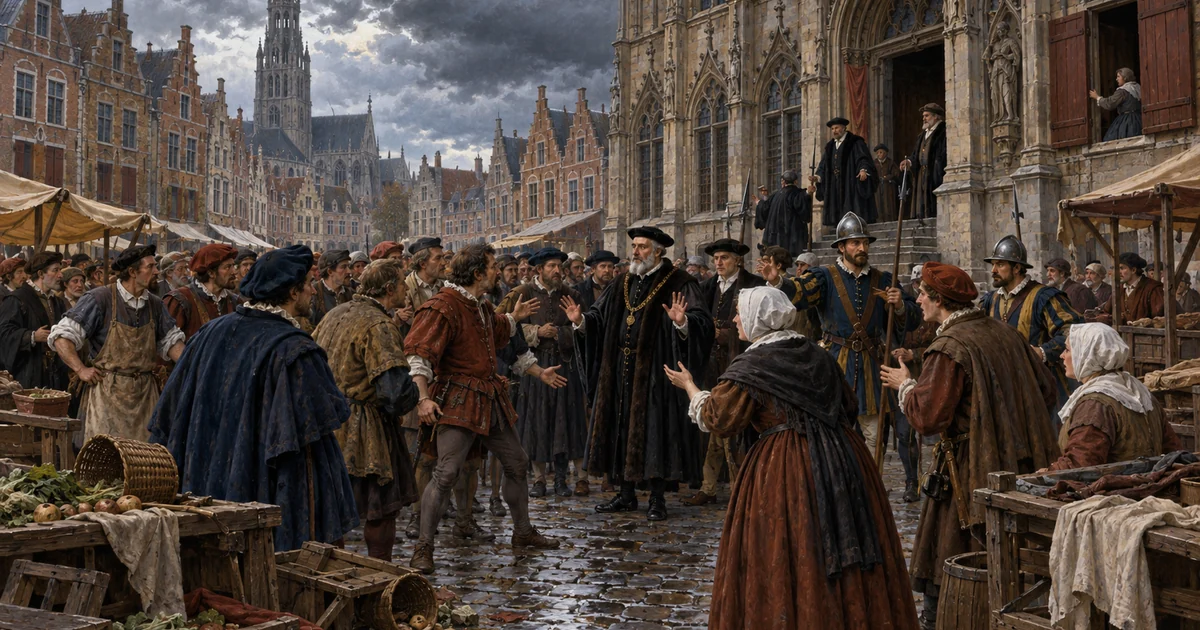
Before choosing loyalty to Spain through the Union of 1579, Arras knew two years of intense agitation: the troubles of Arras of 1577 and 1578. While the revolt of the Low Countries shook the region, the town was the stage of factional struggles, religious tensions and popular agitation, in a climate of uncertainty and fear. These events, reported notably by the chronicler Pontus Payen, light up the life of a city torn between rival camps, at a decisive moment of its history. To understand the troubles of 1577-1578 is to grasp how a great town lived, from within, the turmoil of the revolt of the Low Countries, before making the choice that would keep it in the Spanish fold. A look back at these agitated years, when the destiny of Arras was played out in its streets as much as in the great political decisions.
A town in the turmoil of the revolt
The troubles of 1577-1578 belong to the broader context of the revolt of the Low Countries against Spain. As the conflict set the provinces ablaze, Arras, a great city of the Artois, did not remain apart from the agitation. The town, like many others, was crossed by the currents that divided the Low Countries: partisans of the revolt against Spanish authority, holders of loyalty to the king, sympathisers of the new ideas or defenders of traditional Catholicism. These divisions, which were to lead to the partition consecrated by the Union of Arras of 1579, manifested themselves first through internal troubles, clashes and an agitation that made the situation confused and unstable. The town lived in uncertainty, tossed between the camps, exposed to external pressures and internal tensions. This period of troubles is revealing of what, concretely, the revolt of the Low Countries was in a town like Arras: not a distant confrontation, but a crisis lived in the streets, the assemblies and the minds. To understand this context is essential to grasping the troubles of 1577-1578: they were the local expression of a great upheaval, the one that then tore apart the whole of the Low Countries. Arras, caught in this turmoil, had to find its way amid the chaos, at a moment when its very future seemed uncertain, suspended on the outcome of the struggles that agitated it and on that of the great conflict setting the region ablaze.
Factions, tensions and agitation
The troubles translated into factional struggles and a lively agitation. The town was divided between rival parties, with opposed political and religious orientations, which fought for influence and power. Leaders and orators inflamed minds, in a climate of passion and mistrust. This agitation could take diverse forms: clashes, pressures on the authorities, mobilisation of the population, rumours and fears. Municipal life, ordinarily regulated, was upset by these struggles, which threatened the order and cohesion of the city. In this climate, religious tensions played a major role, the question of faith mixing with the political stakes. The Catholic town dreaded the progress of the new ideas, while the partisans of the revolt contested the established authority. These divisions, exacerbated by the context of war, made Arras a powder keg. To understand this agitation allows one to grasp the concrete reality of the troubles: they were not an abstraction, but a crisis lived daily, with its clashes, its fears and its disorder. This eventful period tested the cohesion of the city and raised the question of its orientation. The factions that clashed embodied the possible choices for Arras, between revolt and loyalty, at a moment when nothing was settled and when the future of the town depended on the outcome of these internal struggles, local reflections of the great rift of the Low Countries.
| Marker | Detail |
|---|---|
| 1577-1578 | Two years of troubles at Arras |
| Context | The revolt of the Low Countries against Spain |
| Nature | Factional struggles, religious tensions |
| Outcome | The rallying to the Union of Arras (1579) |
The testimony of Pontus Payen
Our knowledge of these troubles owes much to the chronicler Pontus Payen, whose memoirs offer a first-hand testimony on this period. A native of the region and an actor of his time, Pontus Payen recorded the account of the events that agitated Arras and the Artois during these troubled years. His testimony is a precious source for historians, who find in it the detailed account of a crisis lived from within. Like any source, these memoirs must be read with a critical spirit: their author, engaged in the affairs of his time, held a situated view, marked by his convictions and his biases. The historian must therefore make allowance for what belongs to fact and what belongs to interpretation, crossing this testimony with other sources. But the value of this account is undeniable: it gives flesh and life to the events, allowing one to understand not only what happened, but also how the contemporaries lived and perceived it. To resort to such chronicles is at the heart of the historian's work, who reconstructs the past from the traces it has left. The testimony of Pontus Payen makes the troubles of Arras one of the best-documented episodes of this period, and recalls the importance of memoirists in the knowledge of history. Thanks to him, we can approach the reality of these agitated years, with the caution required before an engaged account, but also with the recognition due to a witness who took care to fix, for posterity, the memory of the events of his time.
Municipal power in crisis
The troubles severely tested the municipal power of Arras. The town, endowed with a long tradition of autonomy and communal institutions, saw its authorities confronted with an agitation they struggled to master. The factional struggles were played out in part around the control of the government of the city, each camp seeking to impose its views and its men. The heart of municipal power, embodied by age-old institutions whose symbol remains the belfry and the town hall, was the stake of these rivalries. In a town used to managing its affairs, this crisis of power was all the more destabilising. The magistrates had to deal with the pressures of the factions, the demands of the higher authorities and the popular agitation, in a situation where public order was threatened. This institutional crisis is an essential aspect of the troubles: beyond the street clashes, it was the very government of the town that was faltering. To understand this dimension allows one to grasp the gravity of the situation: Arras was not only agitated, it risked sinking into disorder and ungovernability. The restoration of order and the choice of a clear orientation became imperatives. It was in part to emerge from this crisis that the town was, finally, to rally to the Union of Arras, choosing loyalty to Spain and the re-establishment of order. The troubles of 1577-1578 were thus the agitated prelude of this decisive choice, the moment of confusion that preceded the clarification.
From disorder to the choice of loyalty
The troubles of 1577-1578 found their outcome in the choice of loyalty to Spain and Catholicism. After these years of agitation, the moderate and Catholic party finally prevailed at Arras, setting aside the holders of the radical revolt. This rallying led to the Union of Arras of 1579, by which the town and the Catholic provinces of the South reaffirmed their loyalty to the king of Spain. The troubles thus appear, in retrospect, as the crisis that preceded and prepared this choice. The town, after having hesitated and torn itself apart, opted for order, the Catholic faith and loyalty to the sovereign, against uncertainty and revolt. This outcome sealed the destiny of Arras for the following decades, keeping it in the Spanish fold. To understand this passage from disorder to the choice of loyalty is essential: it shows how a town, after a period of crisis and confusion, recovered an orientation, at the cost of setting aside one camp in favour of the other. This choice was not neutral: it engaged the future of the city, which would remain Spanish and Catholic until the great sieges of the following century. The troubles of 1577-1578 were thus a pivotal moment, the one when Arras, emerging from the agitation, determined its way. Far from being a mere episode of disorder, they constitute the necessary prelude to the understanding of the major choice that was the Union of Arras, and of the long Spanish period that was to follow for the town.
Arras in the Spanish Low Countries
The troubles of 1577-1578 are understood within the framework of the belonging of Arras to the Spanish Low Countries. Since the attachment of the Artois to the Habsburgs, then the passage to the kings of Spain, heirs of Charles V, the town was part of this set of provinces governed from Brussels in the name of the king of Spain. Now it is precisely these Low Countries that rose, in the second half of the 16th century, against Spanish authority, in a revolt mixing political, religious and fiscal demands. Arras, a city of these Low Countries, was therefore directly concerned by the conflict, not as a spectator, but as an actor, summoned to choose its camp. The troubles that agitated it were the local expression of this general crisis that shook all the provinces. To understand this belonging is essential: Arras was not an isolated town, but a component of a vast ensemble in revolt, whose rifts it shared. Its position, at once Catholic and attached to its liberties, placed it in a delicate situation, between loyalty to the king and the defence of its privileges. The troubles of 1577-1578 reflect this tension, proper to a town of the Spanish Low Countries caught in the turmoil of the revolt. They recall that Arras then belonged to a world, that of the Low Countries and the Spanish monarchy, whose destiny conditioned its own. This insertion into a vaster ensemble is the key to understanding why the town knew these years of agitation, and why its choice, in 1579, had a significance that exceeded its walls.
When religion divides the city
At the heart of the troubles was the religious question, one of the great engines of the conflicts of the era. The 16th century was that of the Reformation and the wars of religion, which opposed Catholics and Protestants throughout Europe. In the Low Countries, this religious fracture mixed closely with the revolt against Spain, the northern provinces leaning toward Protestantism and rupture, those of the South remaining mostly Catholic. Arras, a deeply Catholic town, dreaded the progress of the new ideas and saw in the revolt a threat to its faith as much as to order. This religious dimension exacerbated the tensions and hardened the positions, each camp claiming non-negotiable convictions. Fear played a major role: fear of heresy, fear of disorder, fear of the other. This climate of religious passion made the troubles all the more violent and difficult to appease. To understand this dimension is essential: the troubles of 1577-1578 were not only a struggle for power, but also a confrontation of convictions, where faith engaged political choices. This interweaving of the religious and the political is characteristic of the era of the wars of religion. For Arras, it largely explains the final choice of loyalty to Catholicism and to Spain. The town, in the turmoil, reaffirmed its Catholic identity, and it was largely in the name of faith that it rejected the Protestant revolt of the North to choose, with the Union of Arras, the camp of tradition and loyalty to the most Catholic king of Spain.
What the troubles of Arras reveal
Beyond the facts, the troubles of 1577-1578 reveal the reality of a great town confronted with a major crisis. They show how the revolt of the Low Countries was lived concretely in a city like Arras, not as a distant event, but as an intimate turmoil, made of divisions, fears and difficult choices. They light up the mechanisms of the urban crises of the era: factional struggles, the role of leaders, the weight of religious questions, the fragility of public order. They also recall that history is not reduced to the great decisions, but is also played out in the agitation of the streets and the rifts of a population. For Arras, these troubles are part of an eventful history, that of a town often caught in the great conflicts of its time, from the Middle Ages to the modern era. They prepare the understanding of the Union of Arras and of the long Spanish period. To make this episode known is to enrich the knowledge of the past of the town and to recall that, behind the great political acts, there is the lived reality of the inhabitants. The troubles of 1577-1578, thanks notably to the testimony of Pontus Payen, offer a precious dive into the life of a city in crisis. They illustrate the capacity of a town to cross the ordeal and to recover, after the disorder, an orientation and an order. On this account, they deserve their place in the account of the history of Arras, as a moment of tension and choice, revealing the forces that then ran through the city and the whole of the Low Countries.