
Mahaut of Artois: who was the building countess of Arras?

On the death of Robert II in 1302, the county of Artois fell to an exceptional woman: Mahaut of Artois, a building countess, an enlightened patron and a formidable woman of power. For more than a quarter of a century she governed the principality and Arras its capital, marking her time by her buildings, her taste for the arts and her role at the court of France, where two of her daughters became queens. But her memory remains stained by dark rumours, the poison affair, which accused her of royal poisonings without ever proving anything. Between attested history and dark legend, the figure of Mahaut fascinates and calls for the historian's caution. A look back at an extraordinary countess, one of the most powerful women of her century, whose destiny played out between Arras, Burgundy and the throne of France.
A countess at the head of the Artois
Mahaut of Artois came to power in difficult circumstances, at the end of the succession quarrel opened by her father's death. Daughter of Robert II, she prevailed over her nephew Robert, who claimed the county, and became countess of Artois in 1302. Her authority, contested, had to assert itself against a tenacious adversary. Heir of the counts of Artois, she was also, through her marriage, countess of Burgundy, thus combining two principalities and a considerable weight in the kingdom. To govern the Artois was no small matter: one had to administer a rich region, stand up to ambitions, manage relations with the towns and the crown. Mahaut applied herself to it with remarkable energy, showing a keen political sense in a world of men. That a woman wielded such power was not a given at the time, and it earned her respect as much as hostility. She nonetheless knew how to assert herself durably, governing her county for more than twenty-five years. Her reign was that of an active sovereign, present on her lands as at court, involved in the great affairs of her time. To understand Mahaut is first to recognise in her a true ruler, one of the few women to have held, in her own name, a principality as important as the Artois, and to have done so with an authority that compelled admiration as it aroused jealousies.
The building countess and patron
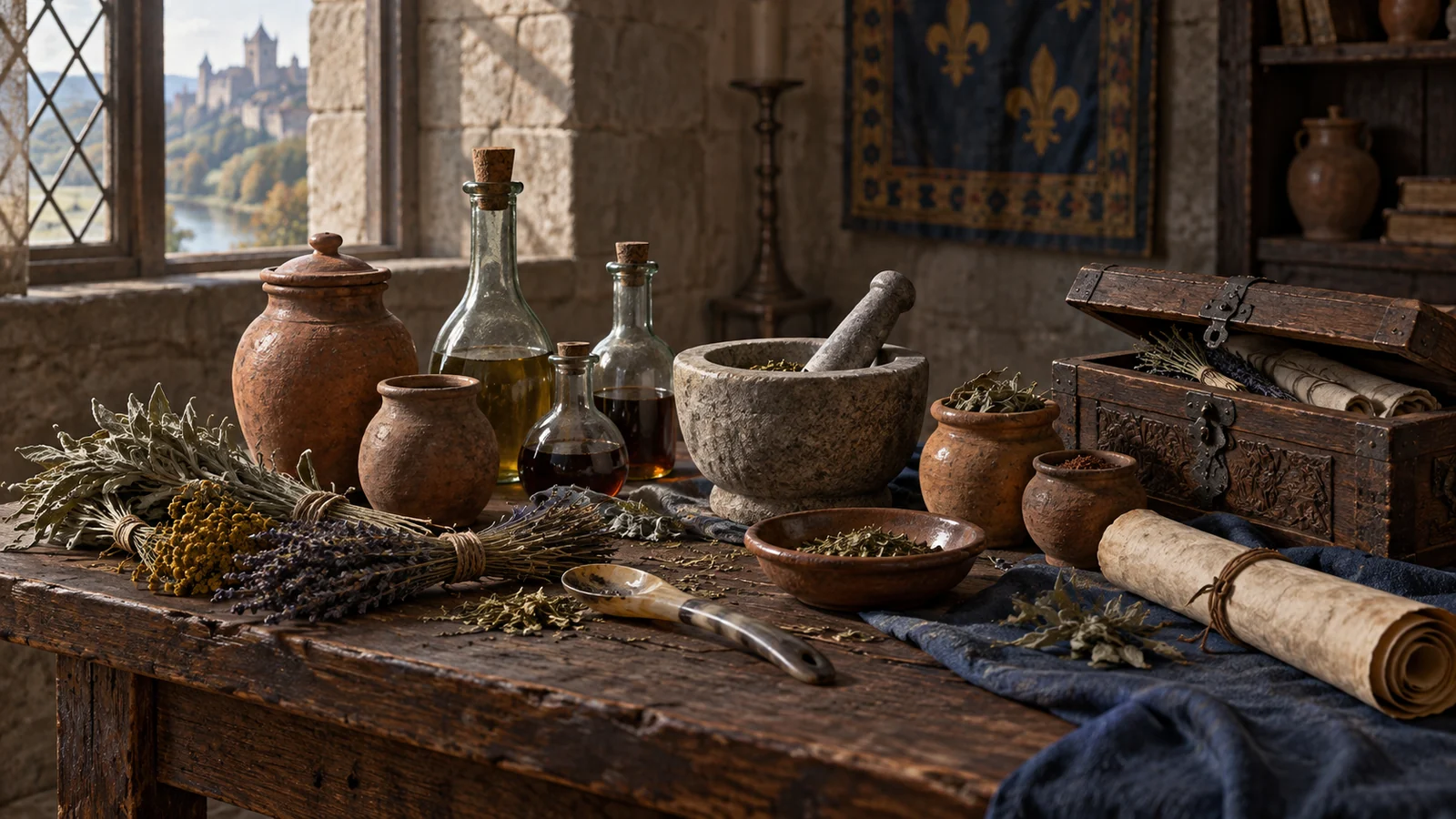
What most distinguishes Mahaut, in the memory of historians, is her role as builder and patron. Passionate about art and beautiful things, she had many residences built, embellished and maintained, including the famous castle of Hesdin, renowned for its gardens and its ingenious installations that amazed contemporaries. She commissioned illuminated manuscripts, works of art, precious objects, keeping around her a refined court. Her patronage, abundantly documented by the accounts of her household, offers historians a mine of information on court life, the arts and the taste of her time. Mahaut spent without counting for prestige and pleasure, making her court a centre of culture and refinement. This dimension is essential: it reveals a woman of taste, curious and cultivated, anxious to leave a lasting imprint. In a region already rich in its drapery and its arts, the countess's patronage added a further brilliance. Her commissions contributed to the artistic radiance of the Artois, of which Arras was the centre. Far from the image of the sulphurous countess that legend would retain, the archives first draw the portrait of a great patron, a tireless builder and protector of the arts, whose cultural activity was one of the most striking and best established traits of her long government.
| Marker | Detail |
|---|---|
| 1302 | Mahaut becomes countess of Artois |
| Double title | Countess of Artois and of Burgundy |
| Patronage | Castles, manuscripts, a refined court |
| Rumours | The poison affair, never proven |
Two daughters queens of France
Mahaut's power did not rest only on her lands: it also rested on her family alliances at the highest level. She married her two daughters to sons of the king of France, and both became queens. These unions placed the countess at the heart of the royal family, giving her considerable influence at court. But this closeness to the throne was also a source of dramas. Mahaut's two daughters were implicated in a resounding court scandal, the so-called Tour de Nesle affair, which saw the king's daughters-in-law accused of adultery, with dramatic consequences. This episode, mixing love, betrayal and reason of state, shook the court of France and directly touched Mahaut's family. The countess, skilful, nonetheless knew how to preserve the essential of her position and the future of her descendants. These events show how far Mahaut's destiny was linked to that of the French monarchy, in an interweaving of ambitions, alliances and rivalries. To be the mother of two queens placed the countess of Artois among the greatest ladies of the kingdom, but also exposed her to the storms of politics. To understand these alliances is to grasp the extent of the network of power woven by Mahaut, which made her far more than a provincial countess: a leading actor of the history of the kingdom, involved in its most secret intrigues as in its gravest affairs.
The poison affair: rumour and dark legend
Mahaut's reputation remains marked by a dark legend, that of the poison affair. The rumour, born in her time and amplified since, accused her of having poisoned members of the royal family to favour her own descendants, notably King Louis X and his infant son. These grave accusations were the subject of an investigation, but Mahaut was cleared, no proof having been established against her. The historian must here show the greatest caution: nothing allows one to affirm that the countess was guilty of these crimes, and everything indicates that these were above all rumours, fed by the hostility of her enemies and by the climate of suspicion surrounding the royal deaths. These rumours were moreover spread by those who had an interest in her downfall, foremost among them her nephew, her lifelong adversary. Posterity, fond of dark tales, has retained the image of the poisoner countess, popularised much later by literature, notably by successful novels that have durably shaped her image in the collective imagination. One must know how to distinguish this legend, born of rumour and embellished by fiction, from the established facts. Mahaut was accused, but never convicted of these crimes. To restore this nuance is a duty of the historian, who cannot confuse suspicion and proof, nor take at face value the accusatory tales of an age quick to see poison behind every premature death of a powerful figure.
An endless succession quarrel
Throughout her reign, Mahaut had to face the relentless claim of her nephew, Robert, who never accepted having been set aside from the county. This conflict, waged through lawsuits, intrigues and sometimes unrest, poisoned the life of the principality for decades. Robert multiplied appeals, going so far as to produce documents to support his claims, some of which turned out to be forgeries, which cost him dearly. Dismissed and compromised, he finally left the kingdom and took refuge with the king of England, where his resentment would play a role in the outbreak of the long conflict between France and England. This family quarrel thus goes far beyond the local frame: it had repercussions at the scale of the kingdom and beyond. For Mahaut, standing up to her nephew was the fight of a lifetime, waged with tenacity and skill. She kept the county until her death, passing the Artois to her descendants, but at the cost of an incessant struggle. This conflictual dimension is inseparable from her history: Mahaut did not reign in quiet, but in permanent adversity, facing a rival who contested her legitimacy to the end. To understand this quarrel is to measure the fragility of power, even the best established, and the strength of character it took the countess to keep, for a lifetime, a heritage that others never ceased to want to wrest from her.
The death of Mahaut and the fate of the county
Mahaut died in 1329, after a reign of remarkable length. True to the dark legend that surrounded her, rumour would have it, here again, that she had been poisoned, but nothing establishes it, and it is fitting to receive this rumour with the same scepticism as the previous ones. Her disappearance did not put an end to the succession troubles: the county passed to her descendants, but the tensions inherited from the quarrel with her nephew continued to weigh. Through her daughters and grandchildren, Mahaut's heritage was passed on and mingled with the great lineages of the kingdom and of Burgundy, preparing the coming recompositions of the Artois. The countess left behind a prosperous county, marked by her imprint as builder and patron, but also a sulphurous reputation that would cross the centuries. The destiny of the Artois, after her, remained linked to the great dynasties, until the later upheavals that would see the region pass under other authorities. The death of Mahaut thus closes a long chapter of the county's history, that of a countess who dominated it for more than a quarter of a century. She leaves the memory of a powerful and complex woman, whose shadow still hangs over the history of Arras and the Artois, between the admiration due to the great patron and the unease maintained by a legend that historical truth, however, has never confirmed.
A woman of power in a world of men
Mahaut's trajectory is all the more remarkable as it was accomplished in a society deeply dominated by men. That a woman governed two principalities in her own name, sat among the peers and weighed on the affairs of the kingdom was exceptional. Mahaut had constantly to assert her legitimacy, not only against her nephew, but against the prejudices of an age little used to seeing a woman wield such power. She succeeded by her political intelligence, her tenacity and her mastery of the workings of power, surrounding herself with faithful advisers and managing her affairs with rigour. The accounts of her administration, meticulously kept, testify to an attentive manager, far from the caricatural image of the schemer. Her case lights up the place, real but constrained, that great ladies could occupy in medieval society: heiresses, regents or countesses, some women acceded to power, but always in a framework that exposed them to contestation and slander. The dark legend that pursued Mahaut is perhaps not unconnected to this hostility toward a woman too powerful. In this, her destiny goes beyond her person: it raises the question of female power in the Middle Ages, of its possibilities and its limits. To study Mahaut is thus also to reflect on the condition of women of power in a society globally unfavourable to them, and to measure what must have been the energy deployed by those who, like the countess of Artois, nonetheless knew how to assert themselves and govern durably.
Arras in the time of Mahaut
While the countess conducted her great affairs, her capital pursued its life as a rich merchant city. Arras, in the time of Mahaut, remained one of the most prosperous towns of the North, strong in its drapery and its powerful business bourgeoisie, whose role as lenders and financiers is well known. The relationship between the countess and her town was part of the usual interplay between princely power and urban autonomy, made of cooperation and tensions. Mahaut needed the wealth of Arras to finance her lifestyle, her constructions and her ambitions, while the town held to its liberties. This dialogue between the princess and the bourgeoisie, like that maintained by the whole line of counts with their capital, is an essential thread of the history of Arras. The prosperity of the town, carried notably by the bourgeoisie of Arras, made the capital of the county a major asset for its sovereign. Under Mahaut, Arras thus continued to shine, between intense economic activity and refined court life. The countess and her town shared one destiny, that of a principality at the height of its wealth. To understand Mahaut's reign therefore supposes not forgetting the town that was its heart, this prosperous medieval Arras whose fortune made, for a large part, the power of the countess and the value of the stake that the county represented in the eyes of all those who coveted it.
Mahaut between history and fiction
Few medieval figures illustrate as well the distance between history and fiction as Mahaut of Artois. The documented reality shows us a governing countess, builder and patron, involved in the highest affairs of the kingdom, accused but never convicted of crimes. Fiction, for its part, has retained and amplified the figure of the poisoner, making her a leading novelistic character, notably through a famous series of 20th-century historical novels that durably marked the collective imagination. This literary posterity, if it made Mahaut known to the general public, also helped to blur the boundary between what is known and what has been imagined. The historian's role is precisely to restore this distinction, relying on the sources and resisting the temptation of the sensational tale. This does not make Mahaut less fascinating, quite the contrary: the real countess, a woman of power in a world of men, an enlightened patron and a tireless fighter, is an even richer character than her legend. To make this historical Mahaut known, distinct from the Mahaut of fiction, is to do justice to one of the great figures of the history of Arras and the Artois. This link between the town and a sovereign of such stature, whose court rivalled in refinement the artistic centres of which Arras was rich, like the workshops that made the glory of the tapestries of Arras, deserves to be known and pondered.