
Who were the Atrebates, the Celtic people of the Artois?
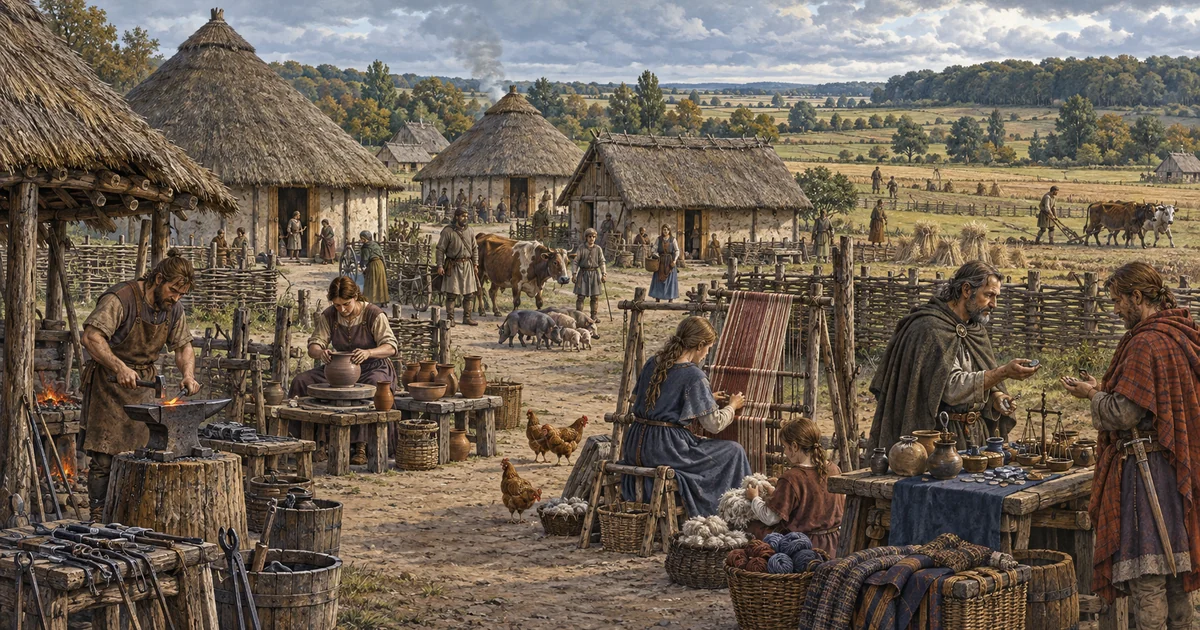
Long before the town of Arras, long before even Roman Nemetacum, a Celtic people lived here: the Atrebates. It was they who gave their name to the Artois, and on their land the city gradually rose. We know them mainly through the eyes of their conquerors, in Caesar's Gallic War, but archaeology, numismatics and the work of specialists of Gaul, such as Jean-Louis Brunaux, now allow us to go beyond the clichés and restore a society far more organised than long believed. To discover the Atrebates is to go back to the Celtic roots of Arras and to understand the world that preceded the Roman conquest, a world of warriors and farmers, artisans and druids, open to the sea and to trade.
Who were the Atrebates
The Atrebates were one of the peoples of Belgic Gaul, that northern part of Gaul Caesar set apart from the others. Their territory roughly matched today's Artois, to which they bequeathed their name, among the valleys and fertile plains of the future Pas-de-Calais. Like other Gaulish peoples, they did not form a state in the modern sense, but a community united by language, religion and common institutions, led by an aristocracy. At their head could stand powerful chiefs, such as Commius, whom Caesar made king of the Atrebates after the conquest. The people's very name has been the subject of scholarly interpretation, often linked to the idea of inhabitants or landholders, without any absolute certainty. This caution about etymology is fitting, for Gaulish words reach us distorted by Latin authors. What is certain is this people's territorial anchoring, whose memory settled in the name of the Artois and, more discreetly, in that of the town that would rise on their land.
A Belgic people among the Celts
To place the Atrebates among the Celts is to understand their place in a vast cultural whole. The Belgic peoples, of whom they were part, occupied northern Gaul and were marked by a reputedly rougher temperament, in contact with the Germans beyond the Rhine. Caesar himself judged them the bravest of the Gauls, a judgement to be read with distance, for it also served to magnify his own victories. The Atrebates shared with their neighbours, the Nervii, Viromandui and Menapii, the same Iron Age civilisation of villages, farms and fortified places. With these peoples they kept relations now of alliance, now of rivalry, according to interests and threats. This belonging to the Belgic world explains their part in the great coalitions raised against Rome. Far from isolated, the Atrebates belonged to a network of Celtic peoples who, despite their divisions, shared a common culture, neighbouring gods and similar practices. It is this world, coherent in its own way, that the Roman conquest would deeply upset.

A hierarchical society
Atrebate society was no egalitarian horde. Like the whole Celtic world, it was strongly hierarchical, dominated by a warrior and landed aristocracy that held wealth and power. Around these nobles gravitated clients, free men bound to a great man by reciprocal obligations, and a mass of farmers and artisans. The druids, of whom more below, formed a respected religious and intellectual elite. This organisation, described for all of Gaul by Caesar and illuminated by archaeology, shows a complex community, able to mobilise significant forces and conduct diplomacy. Power was not always stable there: rivalries between great families, personal ambitions and shifting alliances paced political life. Understanding this hierarchy helps move past the image of a primitive people: the Atrebates had institutions, justice, chiefs and assemblies. This structuring also explains why Rome, to hold the country, preferred to rely on local aristocrats rather than directly administer a population it knew to be organised and proud.
| Marker | Detail |
|---|---|
| Territory | The Artois, which owes them its name |
| Group | A people of Belgic Gaul |
| Economy | Cereals, metal, wool and textiles |
| Links | Atrebates also present in Britain |
A feared warrior people
The Atrebates also had a solid warrior reputation. Members of the Belgic world, they took part in the great resistances raised against Caesar, notably in the coalition crushed at the battle of the Sabis, one of the fiercest clashes of the conquest. The Celtic warrior fought with a long sword, a shield and javelins, relying on individual courage and the impetus of the charge. Among the Atrebates as among their neighbours, war was at once a necessity, a way to assert rank and a cultural value. Yet this people should not be reduced to its martial side: the same men were farmers, herders or artisans, and war remained one activity among others. Atrebate bravery, real and stressed by the sources, met the superior discipline of the legions, but it left the memory of a people who did not submit without fighting. This warrior pride partly explains the reversals that followed the conquest, when former allies of Rome, starting with their own king, rose against it.
Coinage and trade
A sign of an advanced civilisation, the Atrebates struck coins. Like other Gaulish peoples, they issued gold, silver and bronze pieces, often inspired by Greek models passed on from hand to hand, then stylised in a very recognisable Celtic taste. These coins, found by archaeologists and studied by numismatists, served not only for trade: they asserted the prestige of the chiefs who issued them and eased long-distance commerce. Their circulation attests to the Atrebates' insertion into networks far beyond their territory, toward other Gaulish peoples, the Mediterranean and nearby Britain. The existence of this coinage alone contradicts the image of a backward people: issuing coins presupposes recognised authority, a developed economy and a need for structured exchange. For the historian, these coins are a precious source, sometimes the only one to bear the names of otherwise unknown chiefs. They recall that Celtic Gaul, far from ignoring writing and calculation, had sophisticated economic tools, which the Atrebates used at the crossroads of the continent and the island.
Druids, sanctuaries and beliefs
Spiritual life held a central place among the Atrebates, as among all Celts. The druids, at once priests, judges, scholars and keepers of memory, formed an influential elite whose authority reached beyond a single people. Celtic religion was polytheistic, peopled with deities linked to nature, war or fertility, often honoured in open-air sacred places, the nemeton, consecrated groves or clearings. This word is found, as we saw, even in the name of Nemetacum, a possible clue to a sanctuary at the town's origin. Celtic religious practices remain partly mysterious, for the druids passed on their knowledge orally and left few written traces, which imposes caution on the historian. Archaeology nonetheless reveals sanctuaries, offerings and rites that shed light on this world of beliefs. Under the empire, this Celtic religion did not vanish at once: it mingled with Roman cults in a lasting syncretism. To understand Atrebate spirituality is to grasp an essential dimension of a people for whom the sacred pervaded daily life.
From both shores of the Channel to the Roman city
One last trait makes the Atrebates fascinating: their presence on both shores of the Channel. A people of the same name is indeed attested in southern Britain, around a town the sources call Calleva, and tradition links this island branch to king Commius, exiled after the Gaulish defeat. Real or partly legendary, these cross-Channel links speak of the antiquity of exchange between continent and island, of which the Atrebates were actors. This maritime openness, like their agricultural and textile wealth, explains this people's vitality. Yet the Roman conquest would change everything: after submission, the Atrebates entered the empire, and their country acquired a town, the Gallo-Roman city of Nemetacum, which prolonged and transformed their heritage. From Celtic tribe to Roman city, then to medieval Arras, a continuous thread runs. To make the Atrebates known is to recall that the history of Arras does not begin with its stones, but with a people, its language, its gods and its name, bequeathed to a whole region.