
The siege of Arras of 1414: how did the town resist?
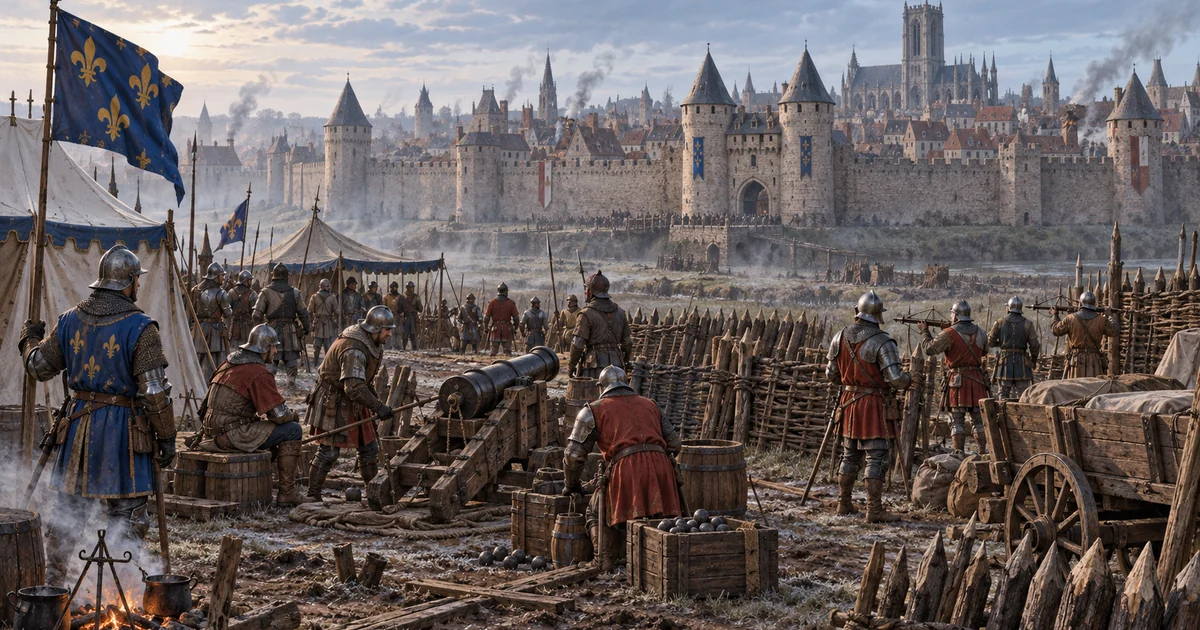
In the summer of 1414, Arras lived through one of the striking episodes of the civil war then tearing France apart: the siege of Arras, when the royal army came to besiege the town held by the Burgundians. In the bloody conflict opposing Armagnacs and Burgundians, the great city of the Artois, faithful to the duke of Burgundy, found itself on the front line. For weeks it resisted behind its ramparts, before a negotiated peace closed the confrontation. This episode, less known than the battle of Agincourt of the following year, lights up the strategic place of Arras and its Burgundian anchoring in the 15th century. To understand the siege of 1414 is to grasp how the town was a major stake of the French civil war, and how its fortifications and its people faced the ordeal of a regular siege. A look back at these decisive weeks.
Arras in the war of the Armagnacs and Burgundians
To understand the siege, one must place it back in the civil war that ravaged France at the beginning of the 15th century. The kingdom was torn between two rival factions, the Armagnacs, partisans of the house of Orleans, and the Burgundians, faithful to the powerful duke of Burgundy, who fought for power around a weakened king. This fratricidal struggle bloodied the country and paralysed its defence. Now Arras, a great town of the Artois, belonged to the domain of the duke of Burgundy, a distant heir of the counts of Flanders who had once held the region. The city was thus a leading Burgundian stronghold, a bastion of the duke's party in the North. When the opposing camp, that of the Armagnacs who then controlled the king and the royal army, decided to strike Burgundy on its lands, Arras became a natural target. To besiege and take a town of such importance would have dealt a severe blow to the duke of Burgundy. Thus the great city of the Artois found itself at the heart of the civil war, not by choice, but by its loyalty and its position. To understand this Burgundian anchoring is essential: Arras was not a neutral stage, but a place committed to one camp, which explains why it was besieged by the royal army. The siege of 1414 is therefore, above all, an episode of the French rupture, whose price the Artois and its capital paid.
The royal army before Arras
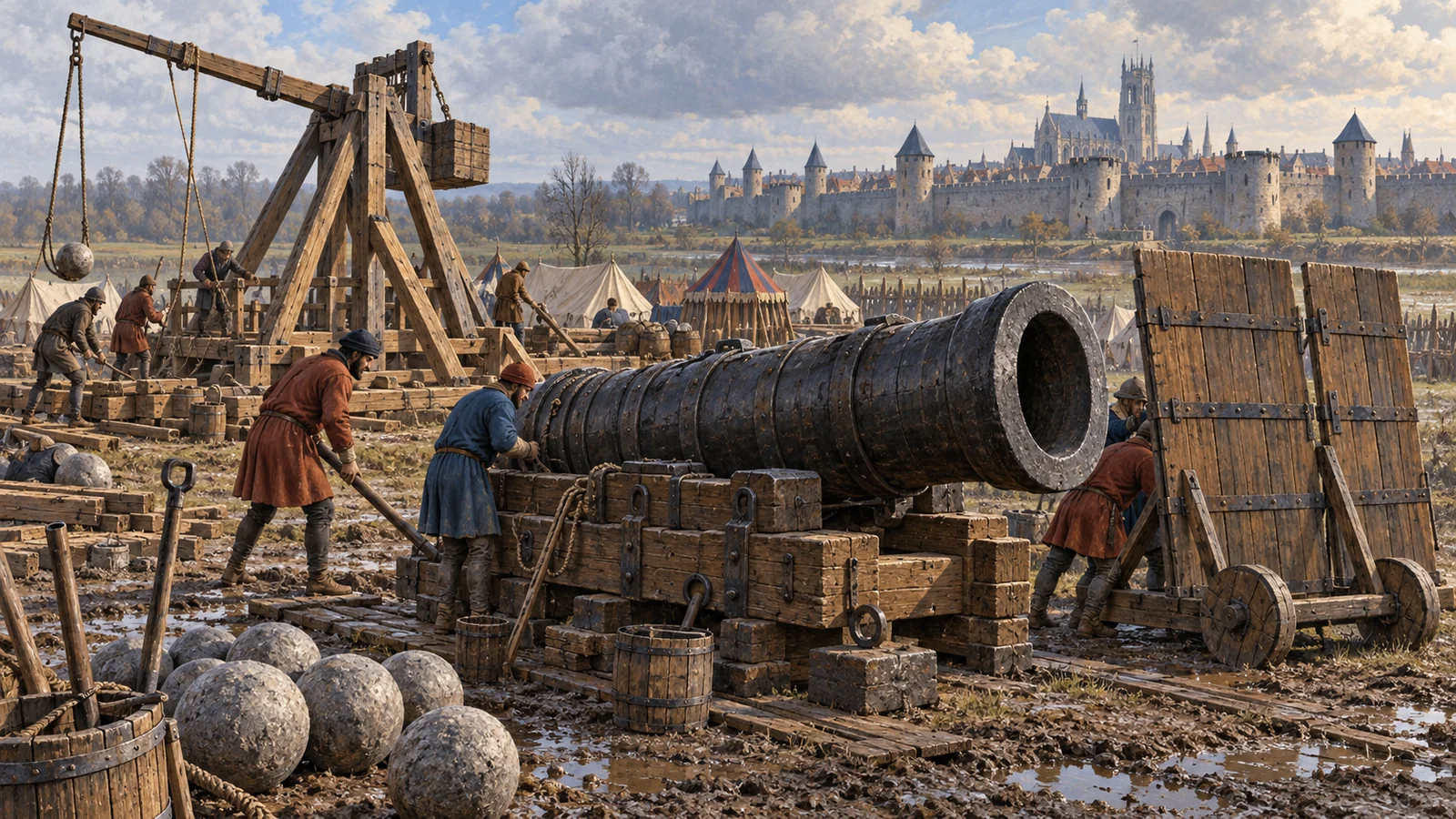
In the summer of 1414, a powerful royal army set out northward and came to lay siege to Arras. Led in the king of France's name by the then-dominant Armagnac party, this expedition aimed to reduce the Burgundian strongholds of the Artois and to humiliate the duke of Burgundy on his own lands. Arras, with its ramparts and its numerous population, constituted the major objective of the campaign. The arrival of the royal army before the town was a considerable event, mobilising important forces and the summoned nobility. To besiege a great city was a heavy undertaking, requiring investing the place, cutting its communications, bombarding its defences and trying to reduce the besieged by force or by famine. The inhabitants of Arras, behind their ramparts, prepared to resist, supported by the Burgundian garrison. The siege promised to be long and difficult, so well defended and determined was the town. This confrontation, between the king's army and a great city of his own kingdom held by a rival party, illustrates the tragic absurdity of civil war, where French fought French under different banners. For Arras, to see the royal army camp before its gates was a formidable ordeal, but also the occasion to affirm its loyalty and its resistance. The siege of 1414 thus tested the solidity of the Arras fortifications and the determination of its inhabitants, in a confrontation whose outcome remained uncertain.
| Marker | Detail |
|---|---|
| Date | Summer 1414, French civil war |
| Besieged | Arras, a Burgundian stronghold of the Artois |
| Besiegers | The royal army, led by the Armagnacs |
| Outcome | The Peace of Arras, a temporary reconciliation |
A town that resists behind its ramparts
Facing the royal army, Arras put up a determined resistance. The town was protected by solid fortifications, ramparts, towers and ditches, the fruit of centuries of defensive works, and defended by a garrison and a mobilised population. A medieval siege was a test of endurance as much as of strength: one had to hold on, resist assaults and bombardments, preserve supplies and morale. The people of Arras, faithful to the duke of Burgundy, applied themselves to it with courage, repelling the attempts of the besiegers. The liberties and organisation of the commune, inherited from the communal charter of 1163, had forged a population used to defending and administering itself, able to stand firm in adversity. The resistance of Arras seriously complicated the task of the royal army, which failed to take the place by force. A siege that drags on also exhausts the besiegers: diseases, supply difficulties, weariness and financial cost weighed on the royal army, far from its bases. This effective resistance shows the solidity of Arras as a stronghold and the determination of its inhabitants. It also recalls that, in medieval war, taking a great well-defended town was often out of reach, even for a powerful army. The tenacity of the besieged was one of the factors that finally pushed the two camps toward negotiation, rather than toward a clear-cut military outcome. Arras, by holding firm, preserved its integrity and weighed on the resolution of the conflict.
The Peace of Arras of 1414
The siege did not end with the taking of the town, but with a negotiated peace, the Peace of Arras of 1414. After weeks of confrontation without decisive result, and faced with the difficulties of a siege that dragged on, the two camps resolved to negotiate. An agreement was concluded, ending the hostilities and sealing a reconciliation, at least on the surface, between the Armagnacs and the Burgundians. This peace, like so many others during this civil war, proved fragile and temporary: the rancours were too deep and the ambitions too keen for an agreement to last. But it ended, for a time, the fighting and spared Arras the dire fate of a town taken by storm. For the city, the lifting of the siege was a relief and a form of victory: it had resisted and preserved its integrity. The Peace of Arras of 1414 illustrates the mode of resolution of the conflicts of the time, where sieges often ended in negotiations rather than in clear military outcomes. It also shows the difficulty of durably restoring peace in a torn kingdom. Alas, the truce was short-lived, and the civil war soon resumed, with dramatic consequences, notably the following year with the national disaster we know. To understand the Peace of Arras is to grasp both the relief of a spared town and the precariousness of a reconciliation that settled nothing deeply.
The siege of 1414 and the battle of Agincourt
The siege of Arras of 1414 takes on its full meaning when linked to what followed: the resumption of the war and the disaster of the next year. The peace concluded before Arras did not last, and the division of the kingdom between Armagnacs and Burgundians remained entire. This French disunity was to weigh heavily when, the following year, the king of England landed and inflicted on French chivalry the terrible defeat of Agincourt, whose battle of Agincourt we have told, very close to Arras. There is a tragic continuity between these events: the civil war that had led to the siege of 1414 was the same that, by weakening and dividing France, made possible the disaster of 1415. Arras and the Artois thus found themselves at the heart of a dramatic sequence, mixing civil war and foreign war. The siege of 1414 is therefore not an isolated episode, but a link in a chain of events that ravaged the kingdom and deeply marked the region. To understand this sequence allows one to grasp the gravity of the period and the central place Arras held in it. The town, besieged in 1414 then a neighbour of the Agincourt battlefield in 1415, lived these years in the front rank of the kingdom's torments. This proximity to the great dramas of the history of France gives the history of Arras a particular density, that of a city constantly mixed up in the upheavals of its time.
Arras, a coveted stronghold
The siege of 1414 reveals a constant of the history of Arras: its status as a coveted stronghold. By its wealth, its strategic position on the confines of the kingdom and Flanders, and its political importance, the town was, over the centuries, the object of much covetousness and multiple sieges. To besiege Arras was to aim at an objective of great value, whose possession changed the balance of forces in the North. This military dimension is inseparable from the history of the city, which had constantly to defend and fortify itself. The ramparts that protected it in 1414 were but one stage of a long history of fortifications, which would culminate later with the famous citadel built in the modern era, still testified to today by the Arras citadel. The siege of 1414 belongs to this long military history, that of a town of war as much as of trade and culture. To understand Arras supposes keeping in mind this dimension: a prosperous and brilliant city, it was also a stronghold, exposed to conflicts and regularly besieged. This vulnerability was the flip side of its wealth and its position. The siege of 1414, by testing the town's defences, perfectly illustrates this destiny of a coveted city, constantly forced to defend its soil and its freedom before the appetites of the powerful who fought for control of the Artois.
What the siege of 1414 teaches us
What should we retain, today, of the siege of Arras of 1414? First that it lights up an often little-known period, that of the French civil war of the early 15th century, of which the Artois was one of the stages. Then that it reveals the central place of Arras in the great conflicts of its time, a Burgundian town besieged by the army of its own king. It also shows the solidity of the city, able to resist a powerful army, and the importance of its fortifications and its mobilised population. Finally, it recalls the fragility of the peaces of that era, this Peace of Arras as soon concluded as threatened. For the historian, this episode is a rich case study, provided it is treated with rigour, relying on the sources and avoiding fictionalised reconstructions. The siege of 1414, less spectacular than a great battle, is no less revealing of the logics of medieval war and politics. It deserves to be known, for it is one of those episodes that, without having marked national memories, weighed on the destiny of a town and a region. To give back its place to this siege is to enrich the history of Arras with an important chapter, that of a city at war, caught in the torments of a divided kingdom. It is also to recall that, behind the great names and the great dates, there is the concrete history of besieged towns, of their inhabitants and their courage, without which history would remain abstract and incomplete.